Semiconductor O-Rings and Seals Market Insights
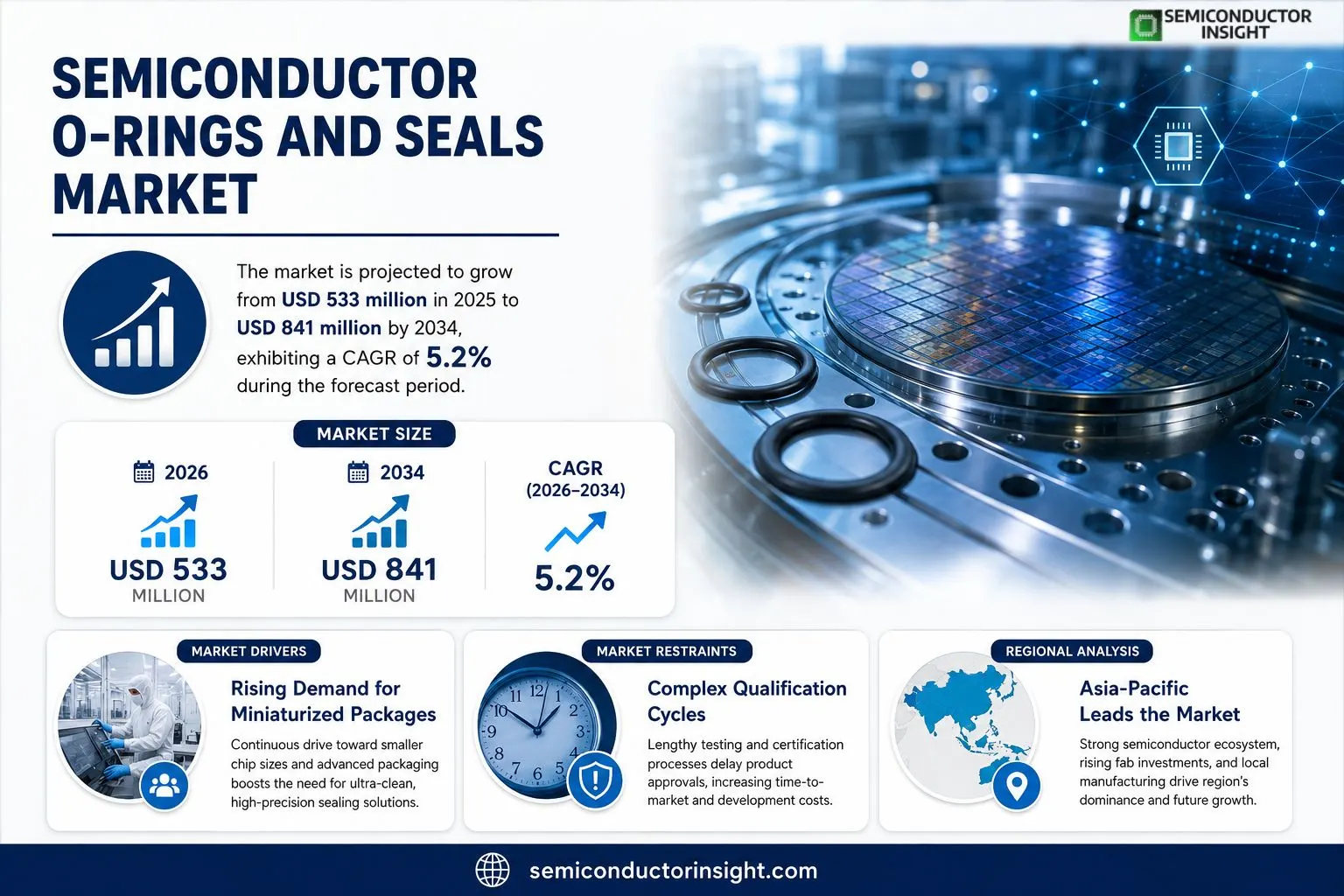
Semiconductor O-Rings and Seals market size was valued at USD 533 million in 2025. The market is projected to grow from USD 533 million in 2025 to approximately USD 841 million by 2034, exhibiting a CAGR of about 5.2% during the forecast period.
Semiconductor O‑rings & seals are sealing components used across wafer‑fab tools and supporting chemical, vacuum, and handling systemsincluding O‑rings, gaskets, lip seals, spring‑energized PTFE seals, valve seat seals, chamber door seals, and metal C/E seals. The “semiconductor‑grade” specification emphasizes ultra‑clean performance, low outgassing, minimal particle generation, resistance to aggressive process chemistries and plasma/high temperature environments, vacuum compatibility, and stable compression settypically delivered through qualified materials, precision manufacturing, and clean packaging with traceability.The market’s expansion is driven by continuous upgrades in semiconductor manufacturing technology that demand higher purity and tighter dimensional tolerances for sealing components; meanwhile the increase in chip production capacityspanning traditional integrated circuits as well as power semiconductors and third‑generation devicescreates sustained demand for these products. Localization of equipment manufacturing offers opportunities for regional suppliers to replace imports, yet challenges persist because high‑end seal materials remain sourced from a limited pool of overseas providers and certification cycles are lengthy.
MARKET DRIVERS
Rising Demand for Miniaturized Semiconductor Packages
The push toward ever‑smaller chip footprints forces equipment manufacturers to adopt sealing solutions that can tolerate tight tolerances while maintaining chemical resistance. Semiconductor O-Rings and Seals Market participants that can deliver low‑profile, high‑purity elastomers are therefore seeing their order books fill faster than a year ago.
Stringent Clean‑Room Standards
Foundries operating under Class 1 or better clean‑room classifications require sealing components that emit virtually no particulate or outgassing. Vendors that have validated their products against ISO 14644‑1 are commanding premium pricing because their offerings directly reduce yield loss during wafer processing.
➤ Customers increasingly view seal reliability as a cost‑avoidance lever rather than a line‑item expense.
Beyond pure technical merit, the broader push for automotive electrification adds a secondary layer of demand. Electric‑vehicle power modules rely on compact, high‑temperature seals, and the Semiconductor O-Rings and Seals Market is adjusting its material portfolio to capture this crossover.
MARKET CHALLENGES
Complex Qualification Cycles
Semiconductor manufacturers typically subject each new sealing material to multi‑stage testing that can last six months or longer. The time‑intensive nature of these programs stalls rapid market entry and forces suppliers to hold inventory without certainty of order conversion.
Other Challenges
Material Compatibility with Emerging Substrates
New substrates such as silicon‑on‑insulator (SOI) and gallium‑nitride introduce surface chemistries that traditional fluoro‑elastomers struggle to seal. Without proactive R&D, suppliers risk being sidelined as OEMs gravitate toward partners with proven compatibility data.
MARKET RESTRAINTS
High Cost of Premium Elastomers
Advanced fluoro‑carbon compounds that meet outgassing limits often carry price points 30‑40 % above conventional nitrile alternatives. For cost‑sensitive fabs, the expense can deter adoption, especially when budget cycles are constrained by broader capital‑equipment investments.
MARKET OPPORTUNITIES
Expansion into Advanced Packaging Formats
Three‑dimensional (3D) stacking, system‑in‑package (SiP) and wafer‑level packaging each demand sealing solutions that survive repeated thermal cycling while occupying minimal volume. Companies that can engineer thin‑profile, high‑temperature O‑rings for these formats are positioned to capture a sizable slice of future growth within the Semiconductor O-Rings and Seals Market.
Semiconductor O-Rings and Seals Market Trends
Rising Cleanliness Standards Elevate Seal Material Performance
The Semiconductor O-Rings and Seals Market is feeling the impact of ever‑tighter particle‑generation limits imposed by advanced lithography and atomic‑layer deposition tools. As process nodes descend into the sub‑10 nm regime, manufacturers demand O‑rings that exhibit ultra‑low outgassing, chemically inert surfaces, and compression‑set stability at temperatures exceeding 250 °C. This pressure has accelerated the adoption of high‑purity fluoropolymers and specially compounded elastomers, which, while costlier, deliver yield gains by protecting critical chambers from contamination spikes. Suppliers that can guarantee traceable clean‑room packaging and consistent dimensional tolerance are increasingly becoming preferred partners, reshaping the competitive hierarchy of the market.
Other Trends
Shift Toward Regional Manufacturing Reduces Dependency on Imports
Geopolitical volatility and the strategic imperative to localize semiconductor equipment have opened a corridor for domestic seal producers. Asian fabs expanding capacity in China, Taiwan, and South Korea are incentivizing local sourcing to shorten lead times and mitigate tariff exposure. This trend translates into collaborative R&D programs between OEMs and regional material specialists, fostering technology transfer that narrows the historic gap with legacy Western suppliers. Companies that can align product qualification cycles with local fabs’ certification timelines are poised to capture a growing share of the market volume.
Growth of Power and Wide‑Bandgap Devices Expands Seal Application Base
The emergence of SiC and GaN power devices has introduced new thermal‑stress envelopes and aggressive plasma chemistries in manufacturing lines. Consequently, the Semiconductor O-Rings and Seals Market observes heightened demand for seals capable of withstanding high‑temperature, high‑pressure environments without degradation. Vendors offering metal‑cased C/E seals or hybrid polymer‑metal solutions are gaining traction in power‑module assembly and high‑voltage testing rigs. This shift not only broadens the addressable application set but also presses manufacturers to diversify their material portfolios, driving incremental R&D spend across the sector.
COMPETITIVE LANDSCAPE
Key Industry Players
Semiconductor O‑Rings and Seals Market Competitive Overview
The semiconductor manufacturing ecosystem treats sealing components as mission‑critical, because any outgassing or dimensional drift can cascade into yield loss or equipment downtime. The market’s valuation of US$533 million in 2025, edging toward US$757 million by 2032, reflects not only broader fab capacity expansion but also tightening specifications around low‑particle generation, high‑temperature stability, and resistance to aggressive process chemistries. Leading firms have leveraged deep material science expertise to qualify fluoropolymer‑based and metal‑cased seals that meet these ultra‑clean standards. Their dominance is reinforced by long‑standing relationships with fab equipment OEMs, a rigorous certification regime, and the ability to guarantee traceable, clean‑room‑ready packaging. Consequently, the competitive hierarchy is anchored by a blend of legacy multinational seal manufacturers and emerging specialists that have secured niche contracts in advanced lithography and plasma‑etch modules.Beyond the top tier, a cluster of regional players is capitalising on localisation drives and supply‑chain resilience concerns. Companies that have established in‑house extrusion and precision moulding lines are positioning themselves as viable alternatives to imported solutions, especially in Asia‑Pacific where fab construction is accelerating. Their strategic focus on co‑development projects with equipment makers, coupled with targeted R&D investments in high‑purity elastomers, is reshaping market entry dynamics. While the barrier to entry remains highowing to stringent qualification cycles and limited high‑grade raw‑material sourcesthese challengers are gradually eroding the monopoly held by a handful of overseas firms, creating a more contested landscape that could stimulate pricing flexibility and innovation speed.
List of Key Semiconductor O‑Rings and Seals Companies Profiled
- Trelleborg Sealing Solutions
- Parker Hannifin
- Freudenberg Sealing Technologies
- DuPont
- Greene Tweed
- Daikin Finetech
- Datwyler Sealing Solutions
- Omniseal Solutions
- VALQUA
- Technetics Group
- Precision Polymer Engineering Ltd (PPE)
- GMORS
- Marco Rubber
- Advanced EMC Technologies
- Enduraz
- Boilpeak
- Honseal
- Wintop
Segment Analysis:
| Segment Category | Sub-Segments | Key Insights |
| By Type |
|
Premium Sealing Solutions
|
| By Application |
|
Critical Process Enablers
|
| By End User |
|
Strategic Partnerships
|
| By Material |
|
Material‑Driven Differentiation
|
| By Process Module |
|
Process‑Specific Seal Priorities
|
Regional Analysis: Semiconductor O-Rings and Seals Market
Foundries are expanding clean‑room footprints, prompting seal suppliers to augment batch sizes and diversify material portfolios. The shift toward 3‑nm and smaller geometries raises the bar for dimensional tolerance, prompting manufacturers to invest in tighter process controls for O‑Rings.
Recent disruptions have highlighted the need for regional stockpiles. Companies are now establishing dual‑sourcing agreements within the Asia‑Pacific corridor to mitigate logistics bottlenecks and protect fab uptime.
Tightening environmental standards in Japan and South Korea are encouraging the adoption of low‑emission elastomers. Suppliers that can certify compliance gain preferential access to high‑value fab contracts.
Emerging packaging formats such as fan‑out wafer‑level packaging drive demand for miniature seals with enhanced chemical resistance, prompting R&D teams to experiment with hybrid material blends.
North America
North America’s market trajectory is shaped by the continued modernization of legacy fabs and a surge in specialty‑process facilities across the United States and Canada. Industry players are leveraging the region’s strong IP ecosystem to introduce advanced polymer formulations that address the stringent outgassing requirements of high‑frequency chips. While the overall volume is modest compared with Asia‑Pacific, the willingness to pay a premium for reliability makes North America a lucrative niche, especially for OEMs serving aerospace and defense semiconductor applications.
Europe
European manufacturers remain focused on precision engineering, with Germany and the Netherlands leading the pack. The region’s emphasis on sustainability has spurred interest in bio‑based O‑Ring compounds that meet REACH regulations without compromising performance. Moreover, the rise of “fab‑as‑a‑service” models in the EU encourages modular seal solutions that can be rapidly swapped as production lines retool for new node introductions.
South America
In South America, the market is still nascent, anchored mainly by assembly and test facilities rather than front‑end wafer production. Nevertheless, Brazil’s recent incentives for microelectronics clusters are attracting niche seal manufacturers. The primary challenge lies in aligning local material standards with specifications, a hurdle that firms are addressing through cross‑border certification programs.
Middle East & Africa
The Middle East & Africa region is witnessing incremental growth driven by government‑backed semiconductor incubators in the United Arab Emirates and South Africa’s push toward a diversified tech economy. While the overall footprint is limited, these initiatives create pockets of demand for high‑purity seals that support pilot‑scale fab projects, laying the groundwork for future expansion as domestic capabilities mature.
Report Scope
This market research report provides a comprehensive analysis of the Semiconductor O-Rings and Seals Market , covering the forecast period 2026–2034. It offers detailed insights into market dynamics, technological advancements, competitive landscape, and key trends shaping the industry.
Key focus areas of the report include:
- Market Overview: The report begins with an overview outlining its current market scenario, key growth indicators, and industry transformation drivers. It discusses macroeconomic factors, demand–supply balance, regulatory landscape, and the strategic role of semiconductors in powering advancements across industries such as automotive, telecommunications, consumer electronics, and industrial automation.
- Market Size & Forecast: Historical data and future projections for revenue, unit shipments, and market value across major regions and segments.
- Segmentation Analysis: Detailed breakdown by product type, technology, application, and end-user industry to identify high-growth segments and investment opportunities.
- Regional Insights: Insights into market performance across North America, Europe, Asia-Pacific, Latin America, and the Middle East & Africa, including country-level analysis where relevant.
- Competitive Landscape: Profiles of leading market participants, including their product offerings, R&D focus, manufacturing capacity, pricing strategies, and recent developments such as mergers, acquisitions, and partnerships.
- Technology Trends & Innovation: Assessment of emerging technologies, integration of AI/IoT, semiconductor design trends, fabrication techniques, and evolving industry standards.
- Market Drivers & Restraints: Evaluation of factors driving market growth along with challenges, supply chain constraints, regulatory issues, and market-entry barriers.
- Stakeholder Insights: Insights for component suppliers, OEMs, system integrators, investors, and policymakers regarding the evolving ecosystem and strategic opportunities.
Primary and secondary research methods are employed, including interviews with industry experts, data from verified sources, and real-time market intelligence to ensure the accuracy and reliability of the insights presented.
FREQUENTLY ASKED QUESTIONS:
What is the current market size of Semiconductor O-Rings and Seals Market?
-> Semiconductor O-Rings and Seals Market was valued at USD 533 million in 2025 and is expected to reach USD 757 million by 2032 at a CAGR of 5.2% during the forecast period.
Which key companies operate in Semiconductor O-Rings and Seals Market?
-> Key players include Trelleborg Sealing Solutions, Parker, Freudenberg Sealing Technologies, DuPont, Greene Tweed, Daikin Finetech, Datwyler Sealing Solutions, Omniseal Solutions, VALQUA, Technetics Group, Precision Polymer Engineering Ltd (PPE), GMORS, Marco Rubber, Advanced EMC Technologies, Enduraz, Boilpeak, Honseal, Wintop, among others.
What are the key growth drivers?
-> Key growth drivers include upgrading of semiconductor manufacturing processes, expansion of semiconductor production capacity, increasing demand for ultra‑clean low‑outgassing seals, and localization of equipment manufacturing.
Which region dominates the market?
-> Asia-Pacific is the fastest-growing region, while Europe remains a dominant market.
What are the emerging trends?
-> Emerging trends include development of semiconductor‑grade ultra‑pure low‑outgassing materials, advanced surface‑treatment technologies, and smart sealing solutions for high‑temperature/high‑pressure environments.
Get Sample Report PDF for Exclusive Insights
Report Sample Includes
- Table of Contents
- List of Tables & Figures
- Charts, Research Methodology, and more...
 Download Sample Report PDF