Semiconductor Grinding Wheels Market Insights
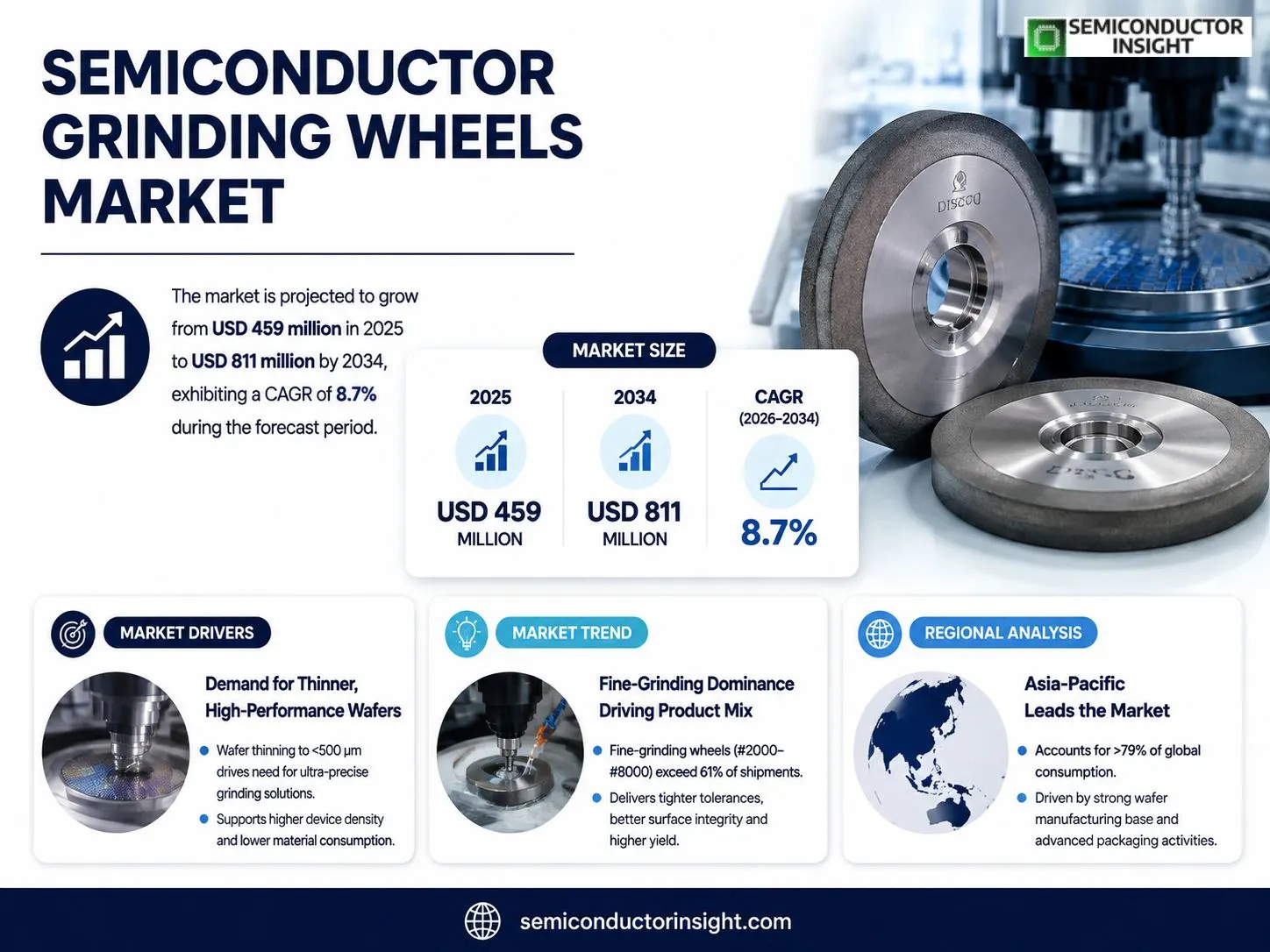
Semiconductor Grinding Wheels market size was valued at USD 459 million in 2025. The market is projected to grow from USD 459 million in 2025 to USD 811 million by 2034, exhibiting a CAGR of 8.7% during the forecast period.
Semiconductor Grinding Wheels are precision grinding consumables employed in the in‑feed grinding of semiconductor wafers, including TSV package wafers (Cu/compound), SiC wafers, sapphire wafers, silicon wafers and reclaimed wafers. The process typically comprises a rough‑grinding stage using grit sizes #325‑#1000 and a fine‑grinding stage using #2000‑#8000. Constructed from diamond abrasives bonded with customized vitrified matrices that feature a porous microstructure, these wheels deliver stable high removal rates, long service life and low grinding resistanceattributes essential for wafer thinning and surface preparation.The market is expanding because semiconductor manufacturers are scaling wafer production while demanding thinner wafers with tighter tolerances. Advanced packaging technologies increase the need for fine‑grinding solutions that ensure surface integrity, and the rapid growth of compound‑semiconductor materials creates new applications for high‑performance wheels. At the same time, reliance on capital‑intensive fab cycles and stringent qualification requirements impose constraints that suppliers must navigate through continuous innovation in abrasive formulation and bond chemistry.
MARKET DRIVERS
Advances in Wafer Thinning Techniques
Semiconductor Grinding Wheels Market is being reshaped by the push toward thinner silicon wafers, a move driven by the need for higher device density and lower material consumption. As manufacturers trim wafer thickness from the traditional 775 µm to under 500 µm, the demand for ultra‑precise grinding solutions that minimize subsurface damage escalates sharply.
Rise of 3‑D Integration
Three‑dimensional stacking of chips forces equipment makers to adopt grinding wheels capable of maintaining surface integrity while achieving tight tolerances. The resulting requirement for wheels with tailored grit composition and high thermal stability is compelling suppliers to invest in advanced ceramic‑bonded formulations.
➤ Customers who switch to low‑temperature grinding media report up to a 12 % reduction in wafer breakage rates, translating into measurable cost savings across the fab.
These technological pressures generate a clear incentive for fab operators to upgrade tooling, ensuring that Semiconductor Grinding Wheels Market experiences sustained procurement activity despite broader economic fluctuations.
MARKET CHALLENGES
Stringent Contamination Controls
In advanced fabs, even trace particles can jeopardize yield. Grinding wheels must meet contamination‑free criteria, which pushes manufacturers to adopt expensive clean‑room‑compatible materials and rigorous quality‑assurance protocols.
Other Challenges
Supply‑Chain Volatility
Fluctuations in raw‑material availability for abrasive grainsparticularly silicon carbide and diamondcreate lead‑time uncertainties that can stall production lines awaiting wheel replacements.
MARKET RESTRAINTS
High Capital Expenditure for Tooling Upgrades
Replacing legacy grinding setups with next‑generation wheels often entails significant equipment retrofits. For mid‑size fabs operating on thin margins, the upfront cost can deter timely adoption, slowing overall market penetration.
Regulatory Scrutiny on Abrasive Waste
Disposal regulations for spent abrasive media have tightened across major manufacturing hubs. Compliance requires additional waste‑handling infrastructure, adding operational expense that some players deem prohibitive.
MARKET OPPORTUNITIES
Customized Grit Engineering for Emerging Nodes
As the industry pushes toward sub‑5 nm process nodes, there is a growing appetite for grinding wheels engineered to deliver nanometer‑scale flatness without inducing micro‑cracks. Companies that can offer bespoke grit size distributions paired with low‑heat‑generation bonds stand to capture a lucrative niche within Semiconductor Grinding Wheels Market.
Service‑Based Business Models
Offering wheel‑as‑a‑servicewhere performance monitoring, predictive replacement, and on‑site refurbishment are bundledaddresses both cost‑containment concerns and the need for continuous uptime. Early adopters of such models are already reporting faster cycle times and reduced inventory overhead.
Semiconductor Grinding Wheels Market Trends
Fine‑Grinding Dominance Fuels Product Mix Shift
The latest data show that fine‑grinding wheels (#2000‑#8000) captured more than 61% of unit shipments in 2025, eclipsing coarse‑grinding offerings that are confined to early‑stage wafer thinning. This reversal reflects manufacturers’ pursuit of tighter thickness tolerances and surface integrity demanded by advanced packaging and high‑performance logic nodes. As wafer dimensions expand to 12‑inch platforms, the incremental material removal required in the rough stage becomes a smaller proportion of total processing time, while the precision finishing phase drives yield and cost efficiencies. Suppliers that can deliver consistent removal rates, low grinding resistance, and extended wheel life are therefore securing larger contract volumes, reshaping the competitive landscape of Semiconductor Grinding Wheels Market.
Other Trends
Asia‑Pacific Consumption Concentration
More than 79% of consumption originates from the Asia‑Pacific corridor, a pattern anchored by the region’s dense fab footprint and aggressive capacity expansion plans. Countries such as China, South Korea, and Taiwan host the bulk of 12‑inch wafer lines, where high‑throughput back‑grinding is a daily requirement. This geographic weighting amplifies the impact of regional policy shiftsparticularly incentives for domestic semiconductor productionon overall demand. Companies that locate production or inventory hubs within the corridor can mitigate lead‑time risks and align pricing with local cost structures, gaining a decisive advantage over rivals reliant on distant supply chains.
Margin Dynamics and Raw‑Material Constraints
Gross margins across the sector fluctuate between 35% and 65%, a range dictated by grit specification, bond chemistry, and the degree of customization required for specialty wafers such as SiC and sapphire. Premium abrasive grades from providers like Element Six command higher unit prices, yet they also enable longer service intervals that justify the expense for high‑volume fabs. Simultaneously, tighter availability of high‑purity bond resins introduces cost pressure, especially when manufacturers must qualify new formulations under stringent semiconductor qualification regimes. The interplay of margin pressure and material scarcity compels wheel makers to invest in R&D that balances performance gains with cost containment, a strategic imperative for sustaining profitability in the evolving Semiconductor Grinding Wheels Market.
COMPETITIVE LANDSCAPEKey Industry Players
Semiconductor Grinding Wheels: Competitive Overview
DISCO of Japan stands as the market’s anchor, leveraging a vertically integrated supply chain that couples diamond‑abrasive sourcing with proprietary vitrified‑bond technology. Its capacity to deliver both coarse and fine grinding solutions across 12‑inch and 8‑inch wafer platforms has translated into a premium positioning among leading fabs such as SMIC and Wolfspeed. The firm’s emphasis on long‑life consumables and tight tolerances enables customers to compress cycle times, a factor that reinforces DISCO’s pricing power and solidifies its role as the primary reference supplier for high‑volume wafer back‑grinding operations.Beyond the dominant player, the landscape is populated by a mix of established multinational abrasives groups and specialist Asian manufacturers. Saint‑Gobain (France) and TOKYO SEIMITSU (Japan) differentiate themselves through diversified abrasive portfolios and advanced bond formulations that cater to niche applications like SiC and sapphire wafer thinning. Korean firms EHWA DIAMOND and SAESOL specialize in ultra‑fine grit ranges, targeting advanced packaging nodes where surface integrity is critical. Smaller but technically aggressive players such as Noritake, Meister Abrasives (Switzerland), and KINIK COMPANY (Taiwan) focus on custom‑engineered wheels for emerging compound‑semiconductor markets, while Chinese entities Sinomach‑pi, Sail Science & Technology, Tokyo Diamond Tools, Nanjing Sanchao and UKAM (USA) compete on cost‑effective volume production for regional fabs.
List of Key Semiconductor Grinding Wheels Companies Profiled
- DISCO
- Saint‑Gobain
- TOKYO SEIMITSU
- EHWA DIAMOND
- Asahi Diamond Industrial Co.,Ltd.
- SAESOL
- Noritake
- Meister Abrasives
- KINIK COMPANY
- A.L.M.T. Corp.
- Sinomach-pi
- Sail Science & Technology
- Tokyo Diamond Tools
- Nanjing Sanchao
- UKAM
Segment Analysis:
| Segment Category | Sub-Segments | Key Insights |
| By Type |
|
Fine Grinding is emerging as the dominant product class because it meets the heightened precision requirements of advanced wafer thinning. – Enables superior surface integrity and uniform thickness, essential for 3D‑IC and TSV packaging. – Offers low grinding resistance and extended wheel life, supporting cost‑effective high‑volume production. – Aligns with industry trends toward sub‑10 µm wafer thicknesses, driving continuous demand for refined finishing solutions. |
| By Application |
|
12‑Inch Wafer continues to dominate application usage because it delivers economies of scale for high‑volume fabs. – Larger die count per wafer reduces per‑chip cost, reinforcing its preference in mainstream logic and memory fabs. – Grinding wheels tailored for 12‑inch substrates provide consistent removal rates across the expanded surface, enhancing throughput. – The shift toward heterogeneous integration amplifies demand for reliable thinning of large wafers, cementing this segment’s strategic importance. |
| By End User |
|
Wafer Fabricators drive the core demand for grinding wheels, seeking high productivity and minimal defectivity. – Require wheels that balance rapid material removal with tight thickness control to meet fab throughput targets. – Emphasize long service life to reduce downtime and change‑over costs. – Favor suppliers that can meet rigorous qualification protocols and provide consistent micro‑structure performance. |
| By Wafer Material |
|
Silicon Carbide (SiC) Wafer is gaining traction as a high‑performance material for power electronics, influencing wheel design. – Requires wheels with superior hardness and thermal stability to avoid chipping. – Drives innovation in bond chemistry to maintain consistent removal rates on harder substrates. – The growing adoption of SiC in automotive and renewable energy sectors expands the niche but strategic importance of this sub‑segment. |
| By Process Stage |
|
Fine Grinding Stage is pivotal for achieving dimensional tolerance and surface quality demanded by advanced nodes. – Enables precise thickness uniformity crucial for 3D stacking and interposer technologies. – Supports low defect density, directly influencing yield improvements in high‑volume manufacturing. – Encourages adoption of customized vitrified bonds that deliver stable micro‑porosity and controlled abrasive exposure. |
Regional Analysis: Semiconductor Grinding Wheels Market
Asia-Pacific
Concentrated research districts in Taiwan, South Korea and Singapore host collaborative labs where wheel manufacturers and chipset designers co‑develop abrasive chemistries. These hubs accelerate the translation of breakthrough grain structures into production‑ready tooling, shortening the innovation pipeline.
Integrated logistics networks align raw alumina deliveries with just‑in‑time wheel fabrication, reducing inventory burdens. This synchronisation supports tighter tolerances and enables manufacturers to meet the aggressive turnaround demanded by fab clients.
Regional standards bodies have harmonised surface‑integrity criteria, allowing vendors to scale solutions across borders without extensive redesign, thereby fostering a pan‑Asian market for standardized grinding wheel platforms.
Universities with specialised programmes in precision engineering feed a pipeline of engineers skilled in abrasive dynamics, ensuring a steady flow of expertise that underpins product evolution and customer support.
North America
North America retains a sophisticated client base anchored by legacy chipmakers that demand highly customised grinding solutions. Suppliers here differentiate through advanced analytics that model wheel wear patterns, offering predictive maintenance advice that extends tool life. Proximity to research institutions fuels niche innovations such as hybrid ceramic‑bonded wheels designed for high‑volume manufacturing environments.
Europe
European players leverage stringent quality regimes and a strong emphasis on environmental stewardship, prompting the development of low‑emission abrasive formulations. The market is characterised by collaboration between wheel manufacturers and equipment integrators, delivering turnkey grinding stations optimized for energy efficiency. This focus on sustainability resonates with OEMs seeking to reduce the carbon footprint of their fabrication lines.
South America
South America’s semiconductor activity remains modest, yet emerging investment in localized fabs is reshaping demand. Companies are establishing regional service centres to provide rapid technical assistance, a move that mitigates the logistical challenges of importing precision tools. This hands‑on approach helps to build confidence among local manufacturers exploring advanced packaging techniques.
Middle East & Africa
In the Middle East and Africa, growth is tied to diversification strategies that prioritize high‑tech manufacturing. Early‑stage partnerships between wheel producers and government‑backed technology parks aim to create foundational capabilities. While the market is still nascent, the emphasis on skill development and technology transfer suggests a gradual ramp‑up of demand for specialized grinding wheels.
Report Scope
This market research report provides a comprehensive analysis of the Semiconductor Grinding Wheels Market , covering the forecast period 2026–2034. It offers detailed insights into market dynamics, technological advancements, competitive landscape, and key trends shaping the industry.
Key focus areas of the report include:
- Market Overview: The report begins with an overview outlining its current market scenario, key growth indicators, and industry transformation drivers. It discusses macroeconomic factors, demand–supply balance, regulatory landscape, and the strategic role of semiconductors in powering advancements across industries such as automotive, telecommunications, consumer electronics, and industrial automation.
- Market Size & Forecast: Historical data and future projections for revenue, unit shipments, and market value across major regions and segments.
- Segmentation Analysis: Detailed breakdown by product type, technology, application, and end-user industry to identify high-growth segments and investment opportunities.
- Regional Insights: Insights into market performance across North America, Europe, Asia-Pacific, Latin America, and the Middle East & Africa, including country-level analysis where relevant.
- Competitive Landscape: Profiles of leading market participants, including their product offerings, R&D focus, manufacturing capacity, pricing strategies, and recent developments such as mergers, acquisitions, and partnerships.
- Technology Trends & Innovation: Assessment of emerging technologies, integration of AI/IoT, semiconductor design trends, fabrication techniques, and evolving industry standards.
- Market Drivers & Restraints: Evaluation of factors driving market growth along with challenges, supply chain constraints, regulatory issues, and market-entry barriers.
- Stakeholder Insights: Insights for component suppliers, OEMs, system integrators, investors, and policymakers regarding the evolving ecosystem and strategic opportunities.
Primary and secondary research methods are employed, including interviews with industry experts, data from verified sources, and real-time market intelligence to ensure the accuracy and reliability of the insights presented.
FREQUENTLY ASKED QUESTIONS:
What is the current market size of Semiconductor Grinding Wheels Market?
-> Semiconductor Grinding Wheels Market was valued at USD 459 million in 2025 and is expected to reach USD 811 million by 2034. It is projected to grow at a CAGR of 8.7% during the forecast period.
Which key companies operate in Semiconductor Grinding Wheels Market?
-> Key players include DISCO (JP), Saint-Gobain (FR), TOKYO SEIMITSU (JP), EHWA DIAMOND (KR), Asahi Diamond Industrial Co.,Ltd. (JP), SAESOL (KR), Noritake (JP), Meister Abrasives (CH), KINIK COMPANY (TW), A.L.M.T. Corp. (JP), Sinomach-pi (CN), Sail Science & Technology (CN), Tokyo Diamond Tools (JP), Nanjing Sanchao (CN), UKAM (US).
What are the key growth drivers?
-> Key growth drivers include continuous expansion of the semiconductor industry, increasing adoption of advanced packaging technologies, and rapid growth of compound semiconductor materials and specialty wafers.
Which region dominates the market?
-> Asia-Pacific is the largest regional market, accounting for more than 79% of demand, driven by its extensive wafer manufacturing base and advanced packaging activities.
What are the emerging trends?
-> Emerging trends include greater emphasis on fine‑grinding products (#2000‑#8000) for precision wafer thinning, development of high‑performance diamond‑abrasive formulations, and increasing focus on supporting thinner, higher‑density semiconductor wafers.
Get Sample Report PDF for Exclusive Insights
Report Sample Includes
- Table of Contents
- List of Tables & Figures
- Charts, Research Methodology, and more...
 Download Sample Report PDF