Midrange Speakers Market Insights
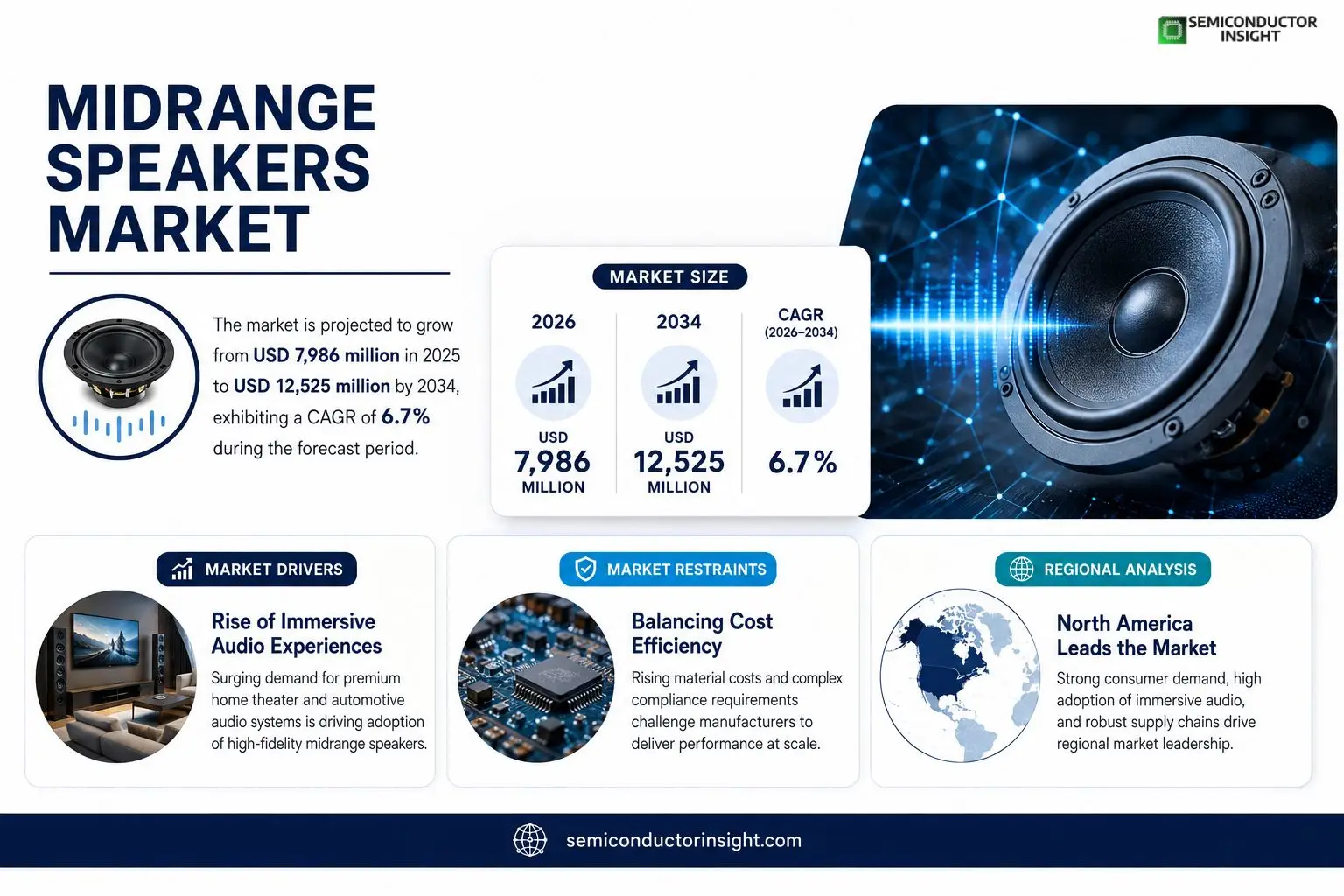
Midrange Speakers market was valued at USD 7,986 million in 2025 and is forecasted to reach USD 12,525 million by 2034, reflecting a compound annual growth rate (CAGR) of 6.7% over the forecast period.
Midrange speakers are audio transducers engineered to reproduce frequencies roughly between 300 Hz and 3 kHz. This band encompasses vocals, string instruments and brass tones that form the core of most musical content; consequently, the fidelity of mid‑range reproduction directly influences perceived clarity and naturalness of an audio system. Modern designs integrate advanced driver units, lightweight polymer or composite diaphragms, and precision acoustic tuning, which together elevate efficiency while reducing distortion. These technical advances have broadened applications across high‑end home‑theater installations, automotive infotainment systems, professional sound reinforcement rigs and portable Bluetooth devices, positioning midrange speakers as a pivotal segment within the broader audio equipment industry.
MARKET DRIVERS
Rise of Immersive Audio Experiences
The growing appetite for three‑dimensional sound in premium home‑theater and automotive cabins is nudging OEMs to prioritize the Midrange Speakers Market. Consumers now expect dialogue and on‑screen effects to emerge from a precise sound field, a demand that only well‑engineered mid‑range drivers can fulfill. This preference fuels investment in advanced diaphragm materials and crossover designs, positioning mid‑range speakers as a decisive factor in overall audio fidelity.
Shift Toward Compact Home‑Theater Architectures
Design trends favoring sleek, space‑efficient speaker arrays are reshaping product road‑maps. Manufacturers are trimming cabinet dimensions while preserving acoustic output, prompting a surge in innovative enclosure engineering. The Midrange Speakers Market benefits from this push because mids can deliver both power and nuance within tighter enclosures, allowing brands to market sleek solutions without compromising performance.
➤ “Mid‑range drivers now account for the majority of perceived clarity in modern surround‑sound systems, making them a focal point for differentiation.”
Another catalyst is the expanding ecosystem of streaming platforms that are delivering high‑resolution audio tracks. As streaming services roll out lossless tiers, end‑users are increasingly scrutinizing speaker performance, especially in the crucial mid‑frequency band where vocal and instrumental content resides. Companies that can demonstrate superior mid‑range response are poised to capture higher‑margin segments of the Midrange Speakers Market.
MARKET CHALLENGES
Balancing Cost Efficiency with Performance
While premium materials enhance diaphragm rigidity, they also inflate bill of materials. Mid‑range manufacturers must reconcile the pressure from price‑sensitive distributors with the technical imperative to sustain low distortion and wide dispersion. This tension often results in longer product development cycles as engineers iterate to meet both cost targets and acoustic benchmarks.
Other Challenges
Supply Chain Volatility
Fluctuations in the availability of specialty alloys and high‑grade polymer films have introduced lead times that strain inventory planning. Companies that lack diversified sourcing strategies risk delayed launches and diminished market share within the Midrange Speakers Market.
MARKET RESTRAINTS
Regulatory and Compliance Hurdles
Stringent electromagnetic interference (EMI) standards in Europe and North America impose additional shielding requirements on speaker enclosures, adding weight and cost. For mid‑range units that already operate near the upper limits of driver size, integrating compliant shielding can compromise design flexibility.The rising scrutiny of volatile organic compound (VOC) emissions from speaker adhesives further restricts material choices. Vendors that rely on traditional bonding agents must either reformulate or source certified low‑VOC alternatives, a shift that can delay product introductions.Lastly, the lack of unified testing protocols for mid‑frequency performance creates ambiguity in marketing claims. Without a standardized benchmark, end‑users find it challenging to compare offerings, which dampens confidence and slows adoption rates across the Midrange Speakers Market.
MARKET OPPORTUNITIES
Integration of Smart Audio Controls
Embedding voice‑activated assistants and adaptive DSP algorithms directly into mid‑range drivers opens a pathway to differentiated product lines. Consumers are gravitating toward speakers that can self‑calibrate based on room acoustics, and manufacturers that embed such intelligence are likely to command premium pricing.Another promising avenue lies in the aftermarket segment for professional audiovisual installations. As venue owners upgrade to network‑controlled sound systems, there is a clear demand for mid‑range modules that can be seamlessly managed through centralized software, creating a recurring revenue stream for OEMs.Finally, emerging markets in Southeast Asia and Latin America are witnessing a rise in disposable income paired with a cultural appetite for high‑fidelity entertainment. Early entrants that tailor mid‑range solutions to local aesthetic preferences while maintaining cost discipline can capture untapped growth pockets within the Midrange Speakers Market.
Midrange Speakers Market Trends
Material Innovation Drives Audio Fidelity
Recent advances in polymer composites, neodymium‑based magnets, and engineered diaphragms have reshaped the performance envelope of mid‑frequency drivers. By reducing mass while increasing stiffness, these materials enable tighter cone control, resulting in clearer vocal reproduction and tighter instrument definition. Manufacturers that have invested in proprietary material blends are now able to differentiate premium home‑theater and automotive offerings, capturing customers who equate acoustic precision with perceived value. The shift also forces downstream integrators to revisit enclosure design, as the altered acoustic impedance of lighter cones calls for revised cabinet tuning to fully exploit the new driver capabilities.
Other Trends
Smart Integration Expands Application Scope
The rise of voice‑activated ecosystems and networked audio has turned midrange drivers into critical nodes within connected‑home architectures. Even compact Bluetooth speakers now embed DSP‑enhanced midrange sections that sync with multi‑room controllers, blurring the line between standalone audio devices and integrated system components. Automotive manufacturers are likewise embedding intelligent sound‑field processors that rely on precise midrange output to balance cabin acoustics across different seating zones. This convergence encourages original equipment makers to source drivers that can be calibrated via firmware updates, opening a recurring‑revenue stream for component suppliers while raising the bar for firmware compatibility.
Supply‑Chain Pressures Shape Pricing Strategies
Volatility in rare‑earth magnet pricing and the limited availability of high‑grade composite plastics have introduced cost‑fluctuation cycles that ripple through the Midrange Speakers Market. Companies with diversified sourcing networks are better positioned to absorb short‑term spikes, but they also face pressure to maintain competitive price points as end‑users demand comparable performance at lower price brackets. Some manufacturers are responding by modularizing driver designs, allowing a single driver platform to serve multiple product tiers through interchangeable surrounds or magnet configurations. This approach reduces inventory complexity and provides a buffer against material cost swings, yet it requires upfront engineering investment that smaller firms may struggle to fund.
COMPETITIVE LANDSCAPE
Key Industry Players
Midrange Speakers Market – Competitive Overview
Among the incumbents, Bose maintains the most visible share of the midrange‑speaker segment, leveraging a portfolio that blends premium driver technology with a reputation for acoustic precision. The company’s strong R&D pipeline and extensive distribution network allow it to dictate pricing trends while setting performance benchmarks that smaller rivals must match. Harman Kardon, operating under the broader Samsung umbrella, follows closely, with its modular designs that cater to both automotive OEMs and high‑end home‑theater integrators. JBL’s aggressive push into the portable‑audio space has introduced a wave of cost‑effective yet technically robust units, diluting the traditional premium‑only narrative and compelling legacy players to re‑evaluate product road‑maps. This tiered structurepremium leaders, aggressive mid‑tier challengers, and volume‑oriented manufacturerscreates a competitive lattice where differentiation hinges on material innovation, driver efficiency, and integration capabilities within smart‑home ecosystems.Beyond the headline names, a cluster of niche innovators is reshaping specific application niches. Edifier and Logitech focus on compact desktop and Bluetooth solutions, exploiting the surge in remote‑work environments. Klipsch and Sennheiser double‑down on professional‑audio markets, delivering custom‑tuned diaphragms for concert venues and broadcasting studios. Yamaha and Denon, with their heritage in musical equipment, are translating instrument‑level fidelity into car‑audio modules, targeting discerning automotive consumers. Asian manufacturers such as Onkyo and Pioneer are expanding their presence in the Southeast Asian market, capitalising on localized supply chains to offer competitive pricing. Brands like Bang & Olufsen and Terratec remain boutique players, whose emphasis on design aesthetics and niche acoustic tuning secures them premium pricing and a loyal customer base despite limited volumes.
List of Key Midrange Speakers Companies Profiled
- Bose Corporation
- Harman Kardon
- JBL
- Sony Corporation
- Bang & Olufsen
- Bowers & Wilkins
- Denon
- Edifier
- Harman International (automotive division)
- Klipsch
- Logitech
- Onkyo
- Pioneer
- Sennheiser
- Terratec
- Yamaha
Segment Analysis:
| Segment Category | Sub-Segments | Key Insights |
| By Type |
|
Two‑way Speakers are widely regarded as the leading segment because:
|
| By Application |
|
Home Audio dominates due to:
|
| By End User |
|
Consumer Home Users lead the end‑user segment because:
|
| By Installation Method |
|
Flush‑Mount Midrange Speaker is gaining traction because:
|
| By Diaphragm Material |
|
Ceramic Diaphragm stands out as the leading material segment because:
|
Regional Analysis: Midrange Speakers Market
North America
Engineers in the region experiment with hybrid diaphragms that combine natural fibers and engineered composites, aiming to tame mid‑range resonance without inflating cabinet size. This approach resonates with consumers seeking sleek aesthetics alongside acoustic accuracy.
Specialty audio stores have deepened relationships with boutique brands, offering curated listening zones where shoppers can directly compare tonal character, fostering a culture of experiential purchasing.
Proximity to key component manufacturers allows quicker adaptation to material shortages, enabling firms to sustain production while competitors scramble for alternatives.
Listeners gravitate toward speakers that deliver a warm mid‑range presence, prompting brands to emphasize driver articulation and minimal coloration in marketing narratives.
Europe
European markets exhibit a nuanced stance, balancing heritage acoustic craftsmanship with emerging demand for compact multi‑room solutions. Manufacturers leverage a tradition of precision engineering to differentiate products through refined enclosure geometry and bespoke magnet systems. Meanwhile, sustainability expectations push firms toward recyclable cabinet finishes and low‑VOC adhesives, reshaping material selection. The region’s fragmented retail environmentspanning high‑end boutique shops to large‑scale electronics chainscreates opportunities for tiered product portfolios that address both discerning audiophiles and value‑conscious consumers.
Asia‑Pacific
Rapid urbanization across Asia‑Pacific nurtures a burgeoning class of first‑time home audio adopters, while established markets such as Japan and South Korea continue to demand refined tonal balance. Brands are responding with modular speaker kits that can be customized for diverse room sizes, reflecting the region’s space constraints. Local manufacturing hubs benefit from cost efficiencies, yet they also face heightened scrutiny over acoustic performance, prompting a wave of R&D collaborations with academic institutions to elevate sound quality without sacrificing price competitiveness.
South America
In South America, the Midrange Speakers Market is shaped by a mix of cultural affinity for live music and expanding digital infrastructure. Consumers value robust mid‑range delivery that supports genres ranging from samba to rock, encouraging manufacturers to prioritize driver consistency across temperature variations. Distribution channels are increasingly digital, with e‑commerce platforms offering detailed acoustic specifications and virtual trial experiences, thereby reducing reliance on traditional brick‑and‑mortar exposure.
Middle East & Africa
The Middle East & Africa region presents a heterogeneous landscape where luxury hospitality projects demand premium speaker installations, while emerging economies focus on affordable home entertainment. Brands targeting this territory often adopt a dual‑track strategy: high‑end models featuring exotic finishes for upscale venues, alongside stripped‑down variants that maintain core mid‑range fidelity for mass‑market penetration. Infrastructure development, particularly in smart‑home ecosystems, is beginning to influence integration standards, compelling manufacturers to embed wireless connectivity within speaker designs.
Report Scope
This market research report provides a comprehensive analysis of the Midrange Speakers Market , covering the forecast period 2026–2034. It offers detailed insights into market dynamics, technological advancements, competitive landscape, and key trends shaping the industry.
Key focus areas of the report include:
- Market Overview: The report begins with an overview outlining its current market scenario, key growth indicators, and industry transformation drivers. It discusses macroeconomic factors, demand–supply balance, regulatory landscape, and the strategic role of semiconductors in powering advancements across industries such as automotive, telecommunications, consumer electronics, and industrial automation.
- Market Size & Forecast: Historical data and future projections for revenue, unit shipments, and market value across major regions and segments.
- Segmentation Analysis: Detailed breakdown by product type, technology, application, and end-user industry to identify high-growth segments and investment opportunities.
- Regional Insights: Insights into market performance across North America, Europe, Asia-Pacific, Latin America, and the Middle East & Africa, including country-level analysis where relevant.
- Competitive Landscape: Profiles of leading market participants, including their product offerings, R&D focus, manufacturing capacity, pricing strategies, and recent developments such as mergers, acquisitions, and partnerships.
- Technology Trends & Innovation: Assessment of emerging technologies, integration of AI/IoT, semiconductor design trends, fabrication techniques, and evolving industry standards.
- Market Drivers & Restraints: Evaluation of factors driving market growth along with challenges, supply chain constraints, regulatory issues, and market-entry barriers.
- Stakeholder Insights: Insights for component suppliers, OEMs, system integrators, investors, and policymakers regarding the evolving ecosystem and strategic opportunities.
Primary and secondary research methods are employed, including interviews with industry experts, data from verified sources, and real-time market intelligence to ensure the accuracy and reliability of the insights presented.
FREQUENTLY ASKED QUESTIONS:
What is the current market size of Midrange Speakers Market?
-> Midrange Speakers Market was valued at USD 7,986 million in 2025 and is expected to reach USD 12,525 million by 2034, growing at a CAGR of 6.7% during the forecast period.
Which key companies operate in Midrange Speakers Market?
-> Key players include BOSE, Bang & Olufsen, Bowers & Wilkins, Denon, Edifier, Harman Kardon, JBL, Klipsch, Logitech, Onkyo, Pioneer, Sennheiser, Sony, Terratec, YAMAHA, among others.
What are the key growth drivers?
-> Key growth drivers include increasing consumer demand for high‑quality sound, advancements in high‑precision driver units, material optimization such as lightweight polymers and composite materials, and the rise of smart audio systems integrated into smart homes and connected devices.
Which region dominates the market?
-> North America remains a dominant market due to strong demand for high‑end home and automotive audio, while Asia‑Pacific is the fastest‑growing region driven by rising middle‑class consumption and expanding automotive audio applications.
What are the emerging trends?
-> Emerging trends include integration of midrange speakers into smart home ecosystems, use of advanced materials like neodymium magnets and composite plastics for improved performance, and development of energy‑efficient, sustainable speaker designs.
Get Sample Report PDF for Exclusive Insights
Report Sample Includes
- Table of Contents
- List of Tables & Figures
- Charts, Research Methodology, and more...
 Download Sample Report PDF