Microphones, Microspeakers, and Consumer Audio ICs Market Insights
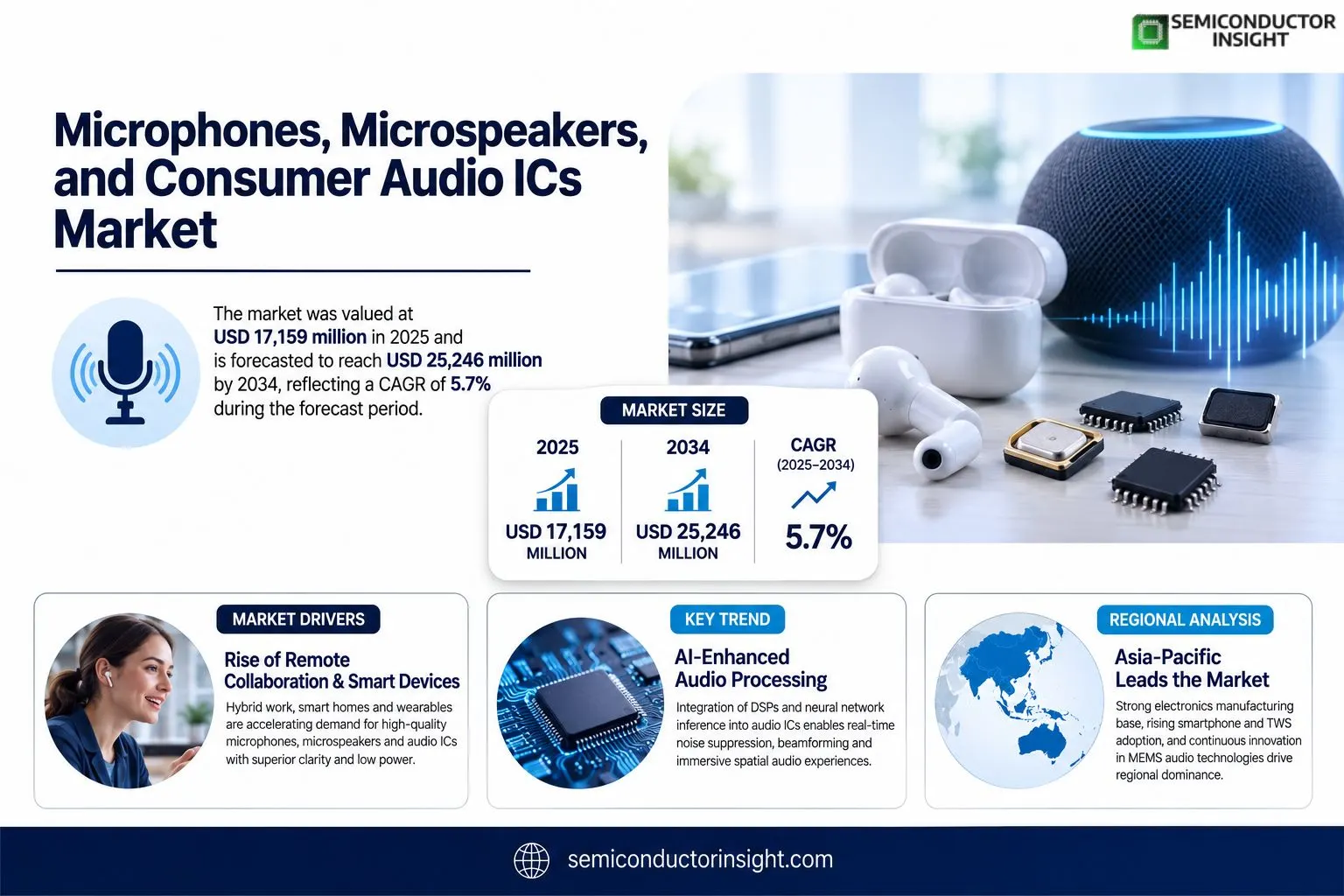
Microphones, Microspeakers, and Consumer Audio ICs market size was USD 17,159 million in 2025 and is forecasted to reach USD 25,246 million by 2034, reflecting a CAGR of 5.7% during the forecast period.
Microphones, microspeakers and consumer audio ICs constitute a family of core components and semiconductors that build the complete audio chain for consumer electronic devices. They solve sound capture, voice interaction, low‑power always‑on listening, speaker driving and high‑quality playback challenges across smartphones,TWS earbuds, headsets,PCs, tablets,smart speakers, XR glasses and smartwatches operating in space‑constrained or acoustically complex environments.The industry pushes for miniaturization together with high signal‑to‑noise ratio (SNR), high acoustic output pressure (AOP), water‑dust resistance and low power draw while embedding capabilities such as echo cancellation,beamforming, sound enhancement and wireless connectivity. Typical customers range from smartphone OEMs to wearable brands and ODM manufacturers; delivery formats span standard discrete acoustic components,acoustic modules, standalone audio ICs,chip‑plus‑algorithm platforms and fully integrated hardware‑software solutions.Diversified demand stems from smartphones remaining the largest installed base yet TWS earbuds,headsets, PCs/tablets,smart home speakers, XR devices and AI glasses are adding incremental value per device BOM. Supply‑side competition has shifted from isolated component specs toward cross‑hardware/software platforms that combine MEMS microphones with advanced codecs,
DSPs or Bluetooth audio SoCsan evolution driven by rising expectations for spatial audio,
far‑field voice activation and always‑on AI assistants.
MARKET DRIVERS
Rise of Remote Collaboration and Content Creation
The surge in hybrid work environments has forced enterprises to upgrade their audio capture solutions. High‑definition microphones and integrated microspeakers now serve as baseline equipment for virtual meetings, webinars, and live streaming. Because participants demand clearer speech and reduced latency, manufacturers are accelerating development cycles, which translates into higher unit shipments across North America and Europe.
Expansion of Smart‑Home and Wearable Devices
Smart assistants, earbuds, and health‑monitoring wearables rely on compact audio ICs to interpret voice commands and deliver feedback. The convergence of voice‑AI and low‑power microspeakers is pushing OEMs to adopt newer consumer audio ICs that balance performance with battery life. Consequently, the segment has recorded an estimated 5% compound annual growth rate since 2020.
➤ “Design engineers cite integration density as the decisive factor when selecting audio ICs for next‑generation wearables,”
Regulatory incentives for energy‑efficient electronics have also nudged firms toward chipsets that meet stricter power‑consumption standards. By complying early, companies not only avoid compliance costs but also gain a competitive edge in markets that value sustainability.
MARKET CHALLENGES
Escalating Component Costs Amid Liquidity Pressures
Raw‑material price volatilityparticularly for silicon and specialty alloyshas squeezed margins for producers of microphones and microspeakers. When component pricing spikes, OEMs often postpone product refresh cycles, which dampens demand momentum in the short term. This cost pressure is most pronounced in mid‑tier consumer segments where price elasticity is high.
Other Challenges
Supply Chain Vulnerabilities
Freight bottlenecks and limited foundry capacity for advanced process nodes create lead‑time uncertainties. Companies that fail to diversify sourcing risk stock‑outs, especially for highly integrated consumer audio ICs that are manufactured in a handful of facilities worldwide.
Technological Fragmentation
Proliferation of proprietary audio protocols across device categories forces chip designers to support multiple interfaces simultaneously. Maintaining interoperability while keeping die size low adds engineering complexity and can delay time‑to‑market.
MARKET RESTRAINTS
Stringent Acoustic Performance Regulations
Regulators in the EU and North America have tightened limits on electromagnetic emissions and acoustic output for consumer electronics. Compliance testing adds both time and expense, especially for smaller manufacturers lacking in‑house labs. As a result, some entrants choose to delay product launches, which narrows the pipeline of innovative microphones, microspeakers, and consumer audio ICs.
MARKET OPPORTUNITIES
AI‑Enhanced Audio Processing Platforms
Embedding neural‑network inference directly onto audio ICs opens a new revenue stream for chipset vendors. Real‑time noise suppression, beam‑forming, and voice‑wake‑up features can be delivered without relying on external processors, appealing to manufacturers of low‑cost smart devices. Early adopters are already capturing market share in regions where cost‑sensitive consumers demand premium voice interaction.
Microphones, Microspeakers, and Consumer Audio ICs Market Trends
Convergence of Input‑Output Chains Elevates Device Value
The most visible shift in the Microphones, Microspeakers, and Consumer Audio ICs Market stems from the blurring of traditional component boundaries. Manufacturers now bundle MEMS microphone arrays, DSP‑enabled codecs, and adaptive amplifiers into single silicon platforms that can execute echo cancellation, beamforming, and Bluetooth streaming without a separate processor. This integration reduces board space, curtails power budgets, and simplifies firmware updates, making it attractive for smartphones that must accommodate thinner profiles and wearables that demand round‑the‑clock listening. As a result, bill‑of‑materials engineers are allocating a larger share of the audio budget to multifunctional chips, which in turn raises the average selling price of the audio sub‑system across the portfolio.
Other Trends
MEMS Loudspeaker Adoption in Emerging Form Factors
While dynamic microspeakers continue to dominate headsets, MEMS loudspeakers are gaining traction in smart glasses, open‑fit earphones, and compact smartwatches. Their ultra‑thin diaphragm and low‑power actuation align with the trend toward devices that sit directly on the ear or skin. Early adopters report a measurable improvement in acoustic consistency across variable ear canal geometries, a factor that is becoming a differentiator in premium XR experiences. Consequently, supply chains are rebalancing, with several Asian foundries expanding wafer capacity to meet the projected demand from niche but high‑margin segments.
Regional Innovation Hubs Shape Competitive Landscape
The competitive geography of the market reflects a clear division of labor. Mainland China and Taiwan excel in high‑volume acoustic modules, leveraging cost‑effective packaging lines. Japan retains a distinct edge in MEMS sensor precision and high‑fidelity codec design, supplying many flagship smartphones. Meanwhile, U.S. and European firms dominate algorithmic IP for voice‑activation and spatial audio rendering, often licensing their software to Asian silicon providers. This cross‑regional collaboration creates a barrier to entry that favors players capable of orchestrating both hardware scaling and advanced signal‑processing ecosystems. Companies that can synchronize these capabilities are positioned to secure long‑term design‑win agreements with OEMs seeking to differentiate their next‑generation products.
COMPETITIVE LANDSCAPEKey Industry Players
Evolving Competitive Dynamics in Integrated Audio Solutions
Knowles Corporation dominates the high‑volume MEMS microphone segment, leveraging its long‑standing relationships with smartphone OEMs and its aggressive rollout of multi‑chip modules that combine front‑end acoustic sensors with on‑chip DSP for echo cancellation and beamforming. The company’s ability to supply both discrete parts and fully integrated acoustic modules has entrenched it as the preferred supplier for flagship smartphones, premium earbuds, and emerging XR headsets. This dual‑track strategy lets Knowles capture the bulk of the revenue stream while also positioning itself for higher‑margin system‑level contracts that bundle microphones, codecs, and smart amplifiers into a single solution.Beyond the market leader, a constellation of specialized firms shapes the competitive fabric. STMicroelectronics and Infineon deliver robust audio codecs and power‑efficient smart amplifiers that cater to automotive and wearables, while Cirrus Logic and Qualcomm focus on Bluetooth‑enabled audio SoCs that marry DSP, connectivity, and low‑power management. Regional players such as AAC Technologies, Goertek, and MEMSensing Microsystems supply cost‑effective MEMS arrays for mid‑tier devices, and TDK, ROHM, and Realtek round out the ecosystem with legacy microspeaker technologies and emerging MEMS loudspeaker form factors. The overall structure reflects a shift from isolated component sales toward tightly integrated platforms that combine acoustic hardware, signal‑processing algorithms, and wireless interfaces.
List of Key Microphones, Microspeakers, and Consumer Audio ICs Companies Profiled
- Knowles Corporation
- STMicroelectronics N.V.
- Cirrus Logic, Inc.
- Qualcomm Incorporated
- Infineon Technologies AG
- NXP Semiconductors N.V.
- AAC Technologies Holdings Inc.
- Goertek Inc.
- MEMSensing Microsystems Co., Ltd.
- Realtek Semiconductor Corp.
- TDK Corporation
- ROHM Co., Ltd.
Segment Analysis:
| Segment Category | Sub-Segments | Key Insights |
| By Type |
|
Microphones dominate the type segment because they are foundational to voice interaction and AI‑driven listening. They benefit from ongoing MEMS advancements that deliver higher SNR, greater acoustic echo cancellation, and robust water‑dust resistance. The industry trend pushes manufacturers toward multi‑array designs that enable far‑field voice capture while maintaining low power footprints, creating a strong value proposition for smartphones, wearables, and emerging XR devices. |
| By Application |
|
Smartphones remain the primary application driver, yet the growing diversity of device categories enriches the market. TWS earbuds demand ultra‑compact, high‑efficiency modules, while XR glasses require MEMS loudspeakers for open‑fit audio. Smart speakers prioritize robust acoustic output and integrated DSP functions. This multi‑application landscape fuels continuous innovation in integration, power management, and acoustic performance. |
| By End User |
|
OEMs drive demand through brand‑centric products that embed fully integrated audio solutions, emphasizing premium sound quality and advanced features such as beamforming. ODMs focus on cost‑effective modular designs that can be rapidly customized for multiple brands, fostering flexibility across product cycles. Tier‑1 suppliers act as technology partners, delivering proprietary MEMS, codecs, and algorithm stacks that enable differentiation across all end‑user tiers. |
| By Integration |
|
Integrated Audio Modules are gaining traction as manufacturers prioritize rapid time‑to‑market and reduced design complexity. These modules combine MEMS microphones, codecs, and DSPs within a single package, offering plug‑and‑play functionality. Chip‑Plus‑Algorithm platforms provide differentiated acoustic performance through software‑driven enhancements, enabling dynamic updates post‑deployment. Whole‑Device solutions represent the apex of integration, where audio hardware and firmware are co‑designed to deliver seamless AI‑enabled experiences across devices. |
| By Form Factor |
|
Ear‑Bud / Open‑Fit devices push the envelope on miniaturization, requiring MEMS loudspeakers and low‑power microphones that fit within millimeter‑scale volumes. Smart speakers emphasize robust output and acoustic enclosures, driving demand for high‑SNR microspeakers and sophisticated bass‑enhancement algorithms. Wearables and smartwatches need ultra‑low‑power, water‑resistant components to support continuous listening. XR glasses introduce novel acoustic challenges, prompting exploration of MEMS loudspeakers that can deliver spatial sound without obstructing the visual field. |
Regional Analysis: Microphones, Microspeakers, and Consumer Audio ICs Market
North America
The concentration of AI‑focused research labs in Silicon Valley accelerates the integration of adaptive beamforming into microphones, allowing devices to isolate speech in noisy environments without sacrificing battery life.
High‑volume fabs in the United States and Canada enable cost‑effective production of consumer audio ICs, supporting aggressive pricing strategies for mass‑market wearables.
Early adopters of smart assistants drive demand for microspeakers that balance volume with acoustic clarity, prompting vendors to prioritize miniaturization without compromising sound pressure levels.
Stringent emissions standards in the U.S. shape design choices for RF‑integrated microphones, encouraging developers to embed shielding solutions at the silicon level.
Europe
Europe’s audio market reflects a blend of premium brand expectations and strong regulatory oversight. Manufacturers are compelled to embed high‑resolution codecs in microphones to satisfy audiophile segments that dominate the region’s headset market. Additionally, the EU’s emphasis on sustainability drives recycling initiatives for consumer audio ICs, prompting firms to redesign packages for easier material recovery. This environment rewards companies that can demonstrate both acoustic excellence and environmental stewardship, while enforcement of privacy directives fuels interest in edge‑processing capabilities that keep voice data local to the device.
Asia‑Pacific
In Asia‑Pacific, the sheer scale of mobile device shipments fuels relentless demand for low‑cost, high‑performance microphones. Producers leverage dense supply chains in China, Taiwan, and South Korea to iterate rapidly on microspeaker form factors, aligning with the region’s appetite for compact, feature‑rich earbuds. Meanwhile, rising disposable incomes in India and Southeast Asia create pockets of premium demand, encouraging multinational firms to introduce differentiated audio ICs that cater to both budget‑conscious and high‑end consumers. The juxtaposition of volume‑driven cost pressures and emerging premium niches forces vendors to maintain flexible production strategies.
South America
South America’s market is characterized by a growing middle class that increasingly values connected audio experiences. Brands that can localize content and offer multilingual voice assistants gain traction, prompting microphone manufacturers to prioritize language‑agnostic algorithms. Infrastructure constraints in several countries also elevate the importance of energy‑efficient audio ICs, as devices often rely on limited battery capacities. Companies that invest in robust, low‑power designs are better positioned to capture market share amidst fluctuating economic conditions.
Middle East & Africa
The Middle East & Africa region presents a heterogeneous landscape where luxury‑oriented audio products coexist with cost‑sensitive segments. In Gulf nations, high disposable income sustains demand for premium headphones equipped with advanced microphone arrays, while Sub‑Saharan markets prioritize durability and affordability. Connectivity challenges in remote areas drive interest in autonomous audio processing, reducing reliance on cloud services. Firms that can tailor microspeaker performance to diverse climatic conditions and power constraints will differentiate themselves in this varied market.
Report Scope
This market research report provides a comprehensive analysis of the Microphones, Microspeakers, and Consumer Audio ICs Market , covering the forecast period 2026–2034. It offers detailed insights into market dynamics, technological advancements, competitive landscape, and key trends shaping the industry.
Key focus areas of the report include:
- Market Overview: The report begins with an overview outlining its current market scenario, key growth indicators, and industry transformation drivers. It discusses macroeconomic factors, demand–supply balance, regulatory landscape, and the strategic role of semiconductors in powering advancements across industries such as automotive, telecommunications, consumer electronics, and industrial automation.
- Market Size & Forecast: Historical data and future projections for revenue, unit shipments, and market value across major regions and segments.
- Segmentation Analysis: Detailed breakdown by product type, technology, application, and end-user industry to identify high-growth segments and investment opportunities.
- Regional Insights: Insights into market performance across North America, Europe, Asia-Pacific, Latin America, and the Middle East & Africa, including country-level analysis where relevant.
- Competitive Landscape: Profiles of leading market participants, including their product offerings, R&D focus, manufacturing capacity, pricing strategies, and recent developments such as mergers, acquisitions, and partnerships.
- Technology Trends & Innovation: Assessment of emerging technologies, integration of AI/IoT, semiconductor design trends, fabrication techniques, and evolving industry standards.
- Market Drivers & Restraints: Evaluation of factors driving market growth along with challenges, supply chain constraints, regulatory issues, and market-entry barriers.
- Stakeholder Insights: Insights for component suppliers, OEMs, system integrators, investors, and policymakers regarding the evolving ecosystem and strategic opportunities.
Primary and secondary research methods are employed, including interviews with industry experts, data from verified sources, and real-time market intelligence to ensure the accuracy and reliability of the insights presented.
FREQUENTLY ASKED QUESTIONS:
What is the current market size of Microphones, Microspeakers, and Consumer Audio ICs Market?
-> Microphones, Microspeakers, and Consumer Audio ICs Market was valued at USD 17,159 million in 2025 and is expected to reach USD 25,246 million by 2034, at a CAGR of 5.7% during the forecast period.
Which key companies operate in Microphones, Microspeakers, and Consumer Audio ICs Market?
-> Key players include AAC Technologies Holdings Inc., Goertek Inc., Shenzhen Goodix Technology Co., Ltd., Shanghai Awinic Technology Co., Ltd., Bestechnic (Shanghai) Co., Ltd., MEMSensing Microsystems Co., Ltd., Merry Electronics Co., Ltd., Realtek Semiconductor Corp., TDK Corporation, Hosiden Corporation, Asahi Kasei Corporation, ROHM Co., Ltd., Nisshinbo Holdings Inc., Foster Electric Company, Yamaha Corporation, EM‑Tech Co., Ltd., BLUECOM Co., Ltd., xMEMS Labs, Inc., Cirrus Logic, Inc., STMicroelectronics N.V., Infineon Technologies AG, NXP Semiconductors N.V., Synaptics Incorporated, Qualcomm Incorporated, Analog Devices, Inc., Knowles Corporation, Sonion A/S, and Fortemedia, Inc..
What are the key growth drivers?
-> Key growth drivers include the expanding demand across smartphones, TWS earbuds, headsets, PCs, tablets, smart speakers, XR glasses, and wearables; the rise of AI‑enabled voice interaction and spatial audio; integration of MEMS microphones and loudspeakers; miniaturization and low‑power consumption requirements; and the shift toward highly integrated audio solutions that combine echo cancellation, beamforming, sound enhancement, and wireless connectivity.
Which region dominates the market?
-> Asia dominates the market, with Mainland China, Hong Kong, and Taiwan leading in acoustic component manufacturing, while Japan and South Korea contribute strong MEMS and microspeaker capabilities. The United States and Europe remain important for premium audio chips and algorithm development.
What are the emerging trends?
-> Emerging trends include the adoption of MEMS loudspeakers for smart glasses and open‑fit earphones, increased integration of voice DSPs and Bluetooth audio SoCs, advanced beamforming and echo‑cancellation algorithms powered by AI, and the development of modular acoustic systems that enable flexible form‑factors in wearable and XR devices.
Get Sample Report PDF for Exclusive Insights
Report Sample Includes
- Table of Contents
- List of Tables & Figures
- Charts, Research Methodology, and more...
 Download Sample Report PDF