Length and Angle Sensor Market Insights
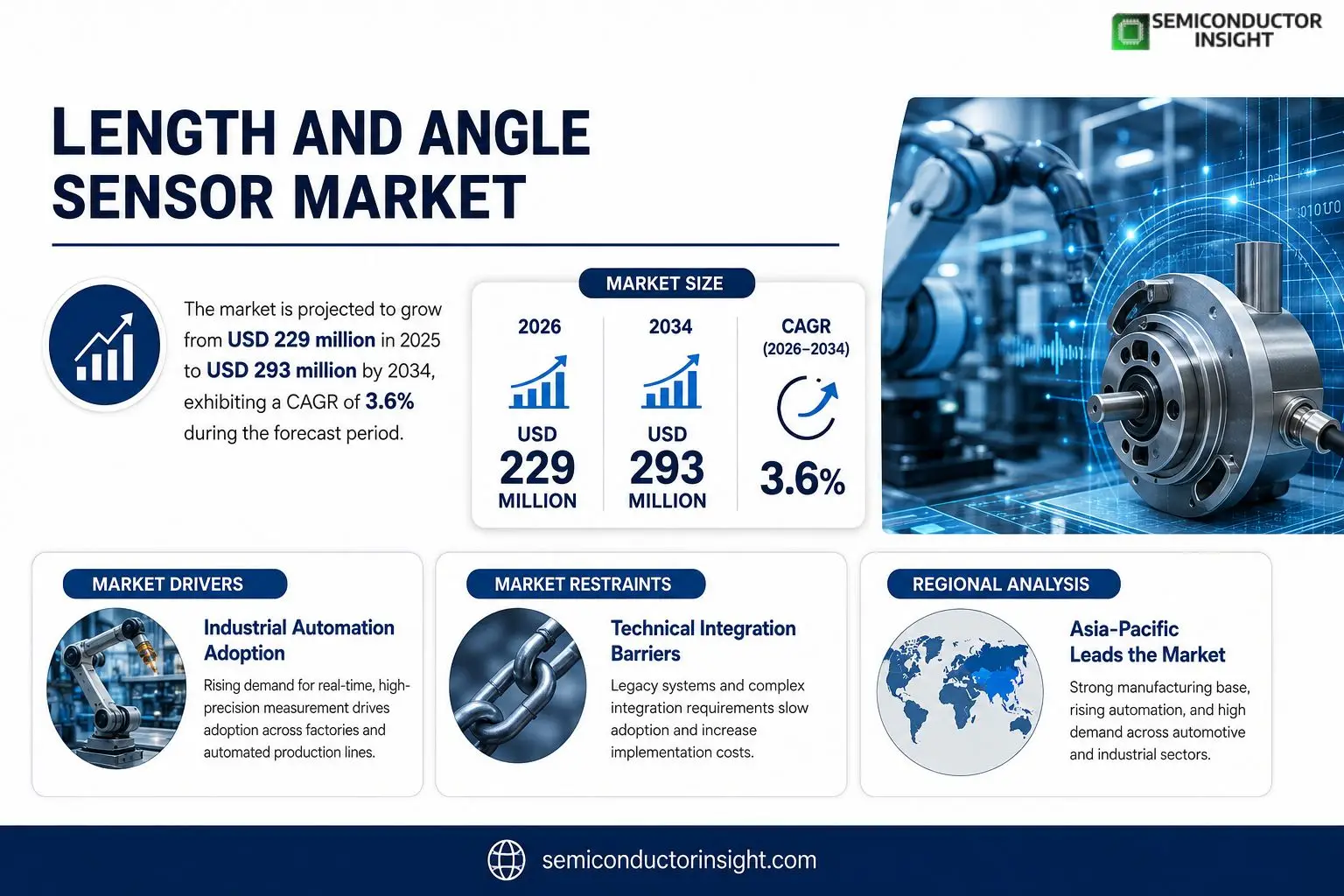
Length and Angle Sensor market was valued at USD 229 million in 2025 and is forecasted to reach USD 293 million by 2034, reflecting a CAGR of 3.6 % over the period.
Length and angle sensors are devices that simultaneously capture linear displacement and angular rotation of an object. They are employed wherever precise position tracking is requiredsuch as robot joint measurement, industrial automation, robotic arm control, and high‑precision instrumentation.The market expands rapidly because manufacturers are introducing higher‑resolution, miniaturized units with lower power consumption, while end‑users demand greater environmental robustness for temperature‑variant or vibration‑intense settings. Additionally, integration with digital control platforms, cloud‑based diagnostics, and predictive‑maintenance schemes fuels adoption across automotive, medical, and industrial sectors.
MARKET DRIVERS
Industrial Automation Adoption
The surge in modular production lines has compelled manufacturers to seek precise measurement tools that can deliver real‑time feedback. Length and Angle Sensor Market players are benefitting from this shift as customers prioritize devices that integrate seamlessly with PLCs and edge‑computing platforms. The result is a measurable uptick in demand for sensors that combine high resolution with rugged form factors.
Automotive Safety Regulations
Stricter crash‑worthiness standards across major economies are forcing OEMs to embed more sophisticated positioning systems within chassis and steering assemblies. Sensors that can simultaneously monitor linear displacement and angular deviation are becoming indispensable, prompting a noticeable reallocation of R&D budgets toward these dual‑function units.
➤ “Customers now view sensor accuracy as a competitive advantage rather than a cost line item.”
At the same time, the rise of predictive maintenance strategies in heavy‑industry fleets is creating a feedback loop: as downtime costs climb, operators lean on high‑precision sensors to fine‑tune equipment wear curves, thereby reinforcing demand for Length and Angle Sensor Market.
MARKET CHALLENGES
Supply Chain Volatility
Recent disruptions in semiconductor availability have tightened lead times for sensor cores, compelling end‑users to lengthen procurement cycles. This unpredictability forces manufacturers to maintain larger safety stocks, which inflates inventory carrying costs and erodes margin potential for sensor suppliers.
Other Challenges
Cost Sensitivity
Mid‑tier manufacturers, especially in emerging markets, often operate under tight budget constraints. While they recognize the performance benefits of advanced sensors, price elasticity remains a decisive factor, limiting the market penetration of premium offerings.
MARKET RESTRAINTS
Technical Integration Barriers
Legacy machinery frequently lacks the communication protocols required for seamless sensor integration. Retrofitting such equipment entails custom engineering, which can deter firms from adopting newer Length and Angle Sensor solutions, especially when projected ROI is uncertain.
Regulatory Hurdles
In sectors such as aerospace and medical devices, certification processes for measurement components are exhaustive. The time and expense associated with obtaining compliance can slow product roll‑out, effectively throttling market expansion for new sensor models.
MARKET OPPORTUNITIES
IoT‑Enabled Smart Factories
As factories adopt cloud‑based monitoring platforms, there is a clear opening for sensors that can transmit calibrated length and angle data over secure networks. Vendors that bundle connectivity modules with their hardware stand to capture a growing slice of Length and Angle Sensor Market.
Customization Services
Clients increasingly demand sensors tailored to niche applicationssuch as robotic exoskeletons or precision agricultural equipment. Companies that offer modular designs and rapid prototyping can differentiate themselves, turning bespoke engineering into a scalable revenue stream.
Emerging Geographic Hubs
Investment in advanced manufacturing hubs across Southeast Asia and Eastern Europe is accelerating. These regions present untapped demand for high‑accuracy measurement tools, providing a fertile ground for market entrants seeking to broaden their geographic footprint.
Length and Angle Sensor Market Trends
Integration with Digital Control and Predictive Maintenance
The sensor segment is witnessing a noticeable shift toward embedded connectivity. Manufacturers embed Ethernet‑based interfaces and cloud‑ready diagnostics, allowing end users to retrieve real‑time positional data from robotics cells and industrial automation lines. This connectivity fuels condition‑based servicing: data streams expose minute drift in joint angles before a failure materialises, prompting scheduled repairs rather than unplanned downtime. For plant operators, the economic upside lies in reduced spare‑part inventories and higher equipment utilisation. Vendors that pair high‑resolution measurement with secure data links gain a distinct advantage, especially in sectors where uptime translates directly to revenue, such as automotive assembly and high‑throughput medical device production.
Other Trends
Miniaturization and Power Efficiency
Advances in semiconductor processing and low‑loss optical materials have enabled sensor footprints that fit beneath the mechanical constraints of compact robotic arms. Today’s units weigh less than a gram and consume under 0.5 W, a stark contrast to earlier generations that required dedicated power supplies. The reduced mass lessens inertial effects on moving linkages, sharpening control loops and enhancing repeatability. From a commercial perspective, the shrinkage opens opportunities in consumer‑grade wearables and portable inspection tools, markets previously inaccessible due to size and battery limitations. Companies that can retain the 21 % gross margin while delivering sub‑millimetre resolution in a tiny package are positioned to capture this emerging demand.
Supply‑Chain Resilience and Regional Shifts
production capacity now exceeds 75 million units annually, yet the bulk of manufacturing concentrates in a handful of Asian hubs. Recent geopolitical tensions and logistics bottlenecks have prompted OEMs to diversify sourcing, establishing secondary lines in Eastern Europe and North America. This rebalancing reduces lead times for automotive and aerospace customers that require just‑in‑time delivery. Moreover, the move supports a more stable pricing environment, as the average selling price of $4.5 per unit remains insulated from volatile raw‑material costs. Enterprises that secure dual‑sourced supply chains can negotiate better terms with downstream users, reinforcing their market position amid a turbulent macro‑economic backdrop.
COMPETITIVE LANDSCAPE
Key Industry Players
Strategic positioning and technology depth define the Length and Angle Sensor arena
Among the cohort, SICK AG commands the most visible share, leveraging a portfolio that spans high‑resolution optical encoders to rugged piezoelectric angle modules. Its ability to integrate sensors directly into robotic joint controllers and industrial automation platforms gives it leverage over mid‑size OEMs that rely on third‑party integration. SICK’s extensive R&D pipeline, anchored in German semiconductor expertise, translates into products that meet the demanding temperature‑vibration envelopes of automotive and aerospace lines, thereby reinforcing a market structure where a handful of vertically integrated firms set performance benchmarks while smaller manufacturers focuss on cost‑effective solutions for niche applications.Beyond the dominant tier, a constellation of specialist firms sustains competitive pressure. Sensitech’s focus on medical‑grade, low‑power micro‑sensors addresses the burgeoning demand for minimally invasive surgical tools, while BALLUFF and Hirschmann differentiate through modular, plug‑and‑play interfaces that ease integration into legacy PLC networks. KILEWS Industrial and Anderson Controls capitalize on regional supply‑chain stability in Asia, offering localized support and rapid customization. Companies such as MultiDimension Technology (MDT) and Vishay deepen the ecosystem with mixed‑signal ASICs that enable digital output formats, catering to predictive‑maintenance strategies in energy and transportation sectors. This diversity of niche players injects innovative featuresminiaturization, cloud connectivity, and enhanced environmental resistanceinto a market otherwise dominated by a few powerhouses.
List of Key Length and Angle Sensor Companies Profiled
- SICK AG
- Sensitech
- BALLUFF
- Hirschmann
- KILEWS Industrial
- Anderson Controls
- Vishay
- MultiDimension Technology (MDT)
- HYTOP
- WIKA-MC
- SUNMOON INSTRUMENT
- SHENZHEN MILONT TECHNOLOGY
Segment Analysis:
| Segment Category | Sub-Segments | Key Insights |
| By Type |
|
Leading Segment: TMR Sensor
|
| By Application |
|
Leading Segment: Industrial Automation
|
| By End User |
|
Leading Segment: Robotics Manufacturers
|
| By Technology Trend |
|
Leading Segment: High‑Resolution Capability
|
| By Integration Approach |
|
Leading Segment: Embedded Sensor Modules
|
Regional Analysis: Length and Angle Sensor Market
North America
Manufacturers are redesigning assembly lines to incorporate closed‑loop feedback, where length and angle sensors provide the granularity needed for real‑time adjustments. This shift reduces scrap rates and shortens changeover times, giving firms a competitive edge without sizable capital outlays.
Vehicle makers are embedding sensors in suspension and steering modules to enhance driver‑assist functions. The ability to monitor component deflection under load translates directly into smoother ride experiences and tighter safety margins.
In surgical robotics, precision measurement of instrument articulation is paramount. Length and angle sensors are becoming standard in devices that must replicate human dexterity, supporting higher procedural success rates.
Emerging wearables and augmented‑reality headsets rely on miniature sensors to track head and limb movement, enabling more immersive user interactions while keeping power consumption low.
Europe
European adopters are capitalizing on stringent emissions standards that push automakers toward lighter, more dynamic chassis designs. Sensor suppliers are collaborating with automotive clusters in Germany and France to deliver calibrated units that meet the continent’s durability expectations. In the aerospace sector, the push for modular production lines has spurred interest in sensor‑driven alignment tools, shortening certification timelines for new aircraft models.
Asia-Pacific
The Asia‑Pacific region benefits from a rapidly expanding manufacturing base, where cost pressures drive firms to seek incremental efficiency gains. Length and angle sensors are being introduced into high‑volume electronics assembly lines to tighten tolerances without inflating labor costs. Moreover, emerging smart‑city projects in Japan and South Korea are integrating sensor data into infrastructure monitoring, creating ancillary demand for measurement technologies.
South America
In South America, the primary catalyst is the modernization of legacy equipment in the mining and agribusiness sectors. Companies are retrofitting older machinery with sensor modules to achieve predictive maintenance, thereby extending asset life and improving operational safety. The regional focus on sustainable practices further incentivizes precise material handling, where measurement accuracy reduces waste.
Middle East & Africa
The Middle East & Africa are witnessing early-stage adoption driven by large‑scale infrastructure projects, particularly in oil & gas and renewable‑energy installations. Sensor deployment aids in alignment of pipelines and wind‑turbine components, where minute positional errors can have costly repercussions. Partnerships between local integrators and sensor manufacturers are laying the groundwork for a more resilient supply chain in the region.
Report Scope
This market research report provides a comprehensive analysis of the Length and Angle Sensor Market , covering the forecast period 2026–2034. It offers detailed insights into market dynamics, technological advancements, competitive landscape, and key trends shaping the industry.
Key focus areas of the report include:
- Market Overview: The report begins with an overview outlining its current market scenario, key growth indicators, and industry transformation drivers. It discusses macroeconomic factors, demand–supply balance, regulatory landscape, and the strategic role of semiconductors in powering advancements across industries such as automotive, telecommunications, consumer electronics, and industrial automation.
- Market Size & Forecast: Historical data and future projections for revenue, unit shipments, and market value across major regions and segments.
- Segmentation Analysis: Detailed breakdown by product type, technology, application, and end-user industry to identify high-growth segments and investment opportunities.
- Regional Insights: Insights into market performance across North America, Europe, Asia-Pacific, Latin America, and the Middle East & Africa, including country-level analysis where relevant.
- Competitive Landscape: Profiles of leading market participants, including their product offerings, R&D focus, manufacturing capacity, pricing strategies, and recent developments such as mergers, acquisitions, and partnerships.
- Technology Trends & Innovation: Assessment of emerging technologies, integration of AI/IoT, semiconductor design trends, fabrication techniques, and evolving industry standards.
- Market Drivers & Restraints: Evaluation of factors driving market growth along with challenges, supply chain constraints, regulatory issues, and market-entry barriers.
- Stakeholder Insights: Insights for component suppliers, OEMs, system integrators, investors, and policymakers regarding the evolving ecosystem and strategic opportunities.
Primary and secondary research methods are employed, including interviews with industry experts, data from verified sources, and real-time market intelligence to ensure the accuracy and reliability of the insights presented.
FREQUENTLY ASKED QUESTIONS:
What is the current market size of Length and Angle Sensor Market?
-> Length and Angle Sensor Market was valued at USD 229 million in 2025 and is expected to reach USD 293 million by 2034, growing at a CAGR of 3.6% over the forecast period.
Which key companies operate in Length and Angle Sensor Market?
-> Key players include Sensitech, SICK, BALLUFF, Hirschmann, KILEWS Industrial, Anderson Controls, COBO, Weite Technologies, NXP, Vishay, MultiDimension Technology (MDT), HYTOP, Xuzhou Mook Electro‑hydraulic Control, WIKA‑MC, SUNMOON INSTRUMENT, Zhichuan Technology, XUZHOU CHANGHANG TECHNOLOGY, VALUER, SHENZHEN MILONT TECHNOLOGY.
What are the key growth drivers?
-> Key growth drivers include rapid demand growth from automation, robotics, energy and transportation sectors; the push for high‑resolution, high‑precision measurement; miniaturization and low‑power consumption; and increasing integration with digital control systems, cloud‑based diagnostics and predictive maintenance.
Which region dominates the market?
-> Asia leads the market, driven by strong manufacturing capabilities in China, Japan and South Korea and a high concentration of end‑use applications in automotive, industrial and medical segments.
What are the emerging trends?
-> Emerging trends include enhanced environmental resistance (temperature, vibration, dust), deeper integration with IoT and AI for smart diagnostics, and the development of compact, low‑power sensors that support cloud‑based predictive maintenance and real‑time data analytics.
Get Sample Report PDF for Exclusive Insights
Report Sample Includes
- Table of Contents
- List of Tables & Figures
- Charts, Research Methodology, and more...
 Download Sample Report PDF