LED Drivers for Automotive Lighting Market Insights
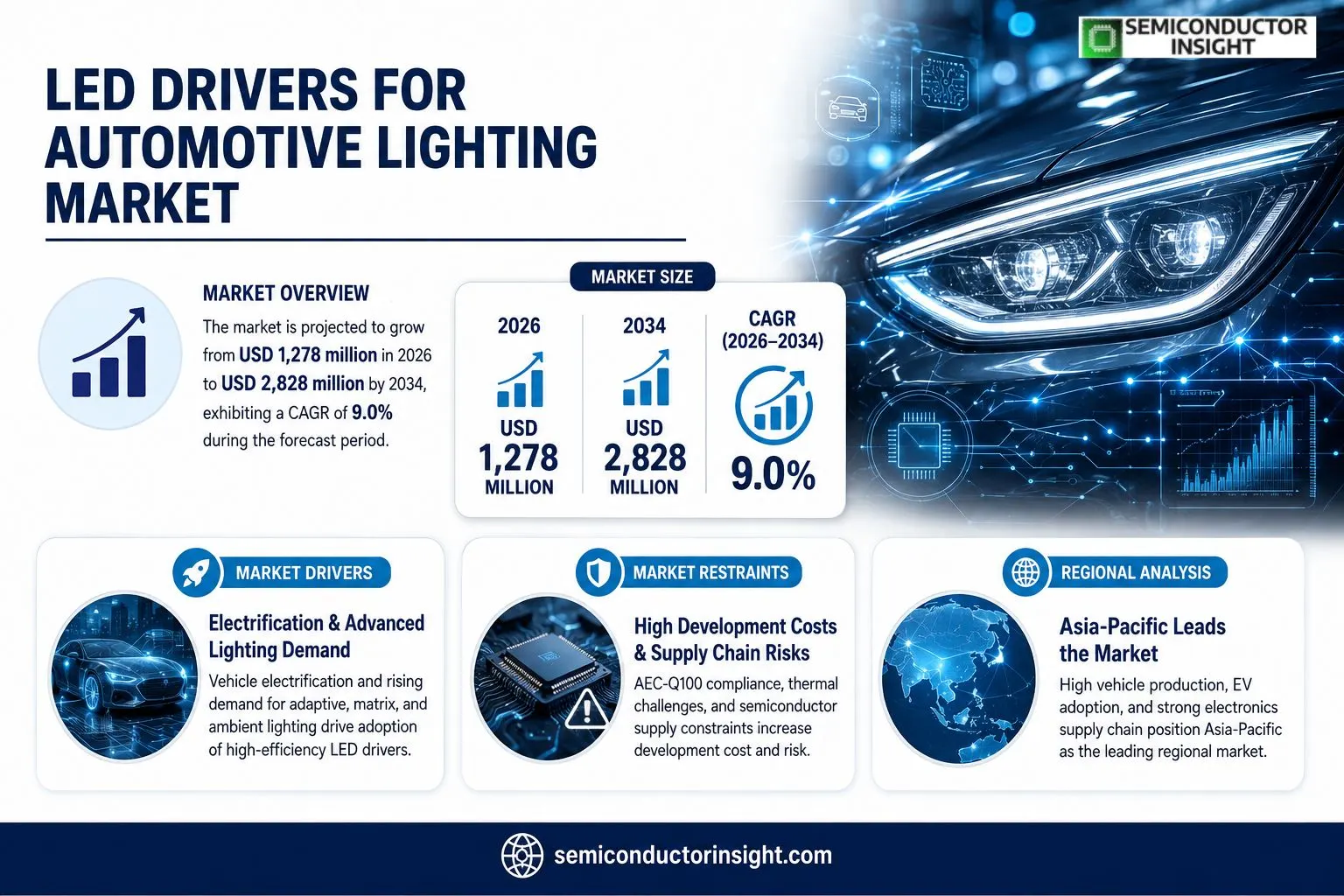
LED Drivers for Automotive Lighting market size was valued at USD 1,278 million in 2025 and is expected to reach USD 2,828 million by 2034, reflecting an implied CAGR of approximately 9.0 % over the forecast period.
LED Drivers for Automotive Lighting are automotive‑grade power‑management chips that precisely regulate current and voltage for vehicle lighting systems, ensuring stable luminance, high efficiency and long‑term reliability under demanding automotive conditions. These devices typically manage power up to several watts and embed functions such as thermal shutdown, fault detection and compliance with AEC‑Q100 safety qualification. In 2025 production volumes were around 2.8 billion units at an average price of USD 0.5 per unit, generating an industry gross margin close to 45 %.
MARKET DRIVERS
Electrification of Vehicle Architectures
The shift toward fully electric and hybrid powertrains has compelled OEMs to redesign lighting subsystems. LED Drivers for Automotive Lighting Market benefit from this transition because they offer lower power consumption and tighter integration with vehicle control units. In 2023, manufacturers reported an 8% year‑on‑year increase in LED driver deployments across new model launches, reflecting the immediate cost‑benefit calculus of reduced wiring and heat management.
Stringent Emission Regulations
Global emission standards now penalize excess auxiliary loads, pushing automakers to adopt energy‑efficient components. LED drivers, with efficiencies exceeding 95%, directly support compliance strategies. As regulators tighten limits in Europe and China, firms are accelerating the rollout of driver‑controlled adaptive lighting, a move that also aligns with safety mandates.
➤ Adoption of dimming and dynamic beam‑forming capabilities is reshaping procurement cycles, prompting suppliers to expand modular driver portfolios.
Beyond regulatory pressure, consumer preference for premium illuminationsuch as matrix LED headlampscreates a willingness to pay a premium for sophisticated driver electronics. This willingness fuels R&D spending, evident in a 12% rise in new driver patents filed in 2023, indicating a competitive push toward higher integration and smarter control algorithms.
MARKET CHALLENGES
Thermal Management Constraints
While LED drivers are intrinsically efficient, the confined spaces of modern vehicle cabins limit heat dissipation. Designers must balance driver power density against thermal budgets, a trade‑off that can extend development timelines. Failure to manage heat effectively may lead to premature failure, eroding warranty confidence.
Other Challenges
Supply‑Chain Volatility
The reliance on semiconductor components exposes the LED driver segment to the broader chip shortage. Production bottlenecks have forced some manufacturers to maintain safety stocks, inflating inventory costs by up to 15% in 2023.
MARKET RESTRAINTS
High Initial Development Costs
Engineering a driver that meets automotive reliability standards (AEC‑Q100) requires extensive validation, often costing several million dollars per platform. Small‑tier suppliers struggle to allocate such budgets, limiting market concentration to a handful of well‑cap‑ited players.
Legacy System Inertia
Many fleet operators continue to rely on conventional halogen or xenon systems, postponing upgrades to LED‑based solutions. This lag reduces immediate addressable volume, especially in commercial vehicle segments where turnover cycles are longer.
MARKET OPPORTUNITIES
Integration of Advanced Driver‑Assistance Systems (ADAS)
As ADAS functionalities become standard, lighting systems must interact dynamically with sensors and cameras. LED drivers capable of real‑time communication via CAN‑FD or Ethernet open new revenue streams, allowing suppliers to bundle intelligence with illumination.
Growth in After‑Market Retrofit Solutions
Regulatory relaxations in several regions now permit retrofitting older vehicles with LED lighting assemblies. Driver modules designed for plug‑and‑play installation can capture a sizable after‑market share, especially in North America where vehicle age averages 12 years.
LED Drivers for Automotive Lighting Market Trends
Shift Toward Adaptive and High‑Efficiency Lighting Architectures
The automotive sector is converting its lighting architecture from static lamps to systems that react to speed, weather, and driver intent. This transition demands driver chips that can regulate current with sub‑percent accuracy while fitting into increasingly compact modules. Production of LED Drivers for Automotive Lighting reached roughly 2.8 billion units in 2025, yet capacity utilization lingered at 63 %, indicating headroom for scaling as manufacturers embed multi‑channel, software‑configurable designs into new vehicle platforms. The average unit cost of US $0.5, combined with a 45 % gross margin, creates a profitable niche for suppliers that can deliver tighter thermal envelopes and integrated safety diagnostics. As OEMs such as BMW and BYD roll out matrix headlights and personalized ambient lighting, the demand for precision‑engineered drivers is expanding faster than the overall lighting component volume.
Other Trends
Supply‑Chain Tightness in Semiconductor Foundations
Upstream, the availability of silicon wafers, photoresists, and lithography equipment shapes the pace at which driver manufacturers can augment output. Leading equipment providersASML, Tokyo Electron, and Applied Materialshave reported incremental capacity additions, but the lag between fab expansion and full‑scale ramp‑up leaves the LED driver sector vulnerable to periodic bottlenecks. Companies that secure long‑term wafer contracts or invest in in‑house thin‑film processes gain a competitive edge, reducing lead times for new safety‑critical modules. This dynamic pushes midsize players to differentiate through design expertise rather than volume, fostering a market where architectural innovation outweighs sheer production scale.
Integration of Diagnostic and Functional‑Safety Features
Electrification and platform standardization are prompting automakers to replace legacy lighting control units with drivers that embed self‑test routines and compliance with automotive functional‑safety standards (AEC‑Q100, AEC‑Q101). The added software layer not only improves fault detection but also enables over‑the‑air updates, aligning lighting systems with broader vehicle‑wide connectivity strategies. As a result, manufacturers that can certify their drivers against stringent safety qualifications while maintaining the 45 % margin seen in 2025 position themselves to capture a larger share of both passenger‑car and commercial‑vehicle programs. The cumulative effect is a market that, while modest in headline volume growth, is increasingly driven by value‑added features and the need for resilient, future‑proof power management.
COMPETITIVE LANDSCAPE
Key Industry Players
LED Drivers for Automotive Lighting: Competitive Overview
The market is anchored by a few large semiconductor groups that dominate design wins with premium automotive OEMs. Infineon Technologies commands a sizable share thanks to its deep integration of power‑management architectures with vehicle electrification programs, giving it leverage in both passenger‑car and commercial‑vehicle platforms. Texas Instruments follows closely, exploiting its extensive analog‑front‑end portfolio to supply multi‑channel driver solutions that meet rigorous functional‑safety standards. Their ability to co‑engineer with tier‑1 suppliers has cemented a duopoly that shapes pricing, product road‑maps, and technology adoption cycles. Around these leaders, midsize firms such as NXP and Renesas carve out niches in specific vehicle segmentsNXP’s focus on connectivity‑enabled lighting modules and Renesas’s expertise in AEC‑Q100 qualified devices create a tiered competitive structure where collaboration and targeted differentiation are essential.Beyond the top tier, a diverse set of specialists contributes depth to the ecosystem. STMicroelectronics leverages its broad automotive portfolio to offer cost‑effective single‑channel drivers for volume models, while Melexis supplies compact solutions tailored for interior ambient lighting. Analog Devices brings high‑efficiency buck‑boost topologies that appeal to premium models undergoing rapid lighting redesigns. ON Semiconductor and Microchip Technology retain relevance through aggressive pricing and strong presence in legacy platforms, whereas Allegro MicroSystems, ROHM Semiconductor, Cypress Semiconductor (now part of Infineon), and Lattice Semiconductor focus on niche applications such as matrix LED arrays, advanced driver‑assistance lighting, and programmable interface standards. Collectively, these players sustain a competitive environment where incremental performance gains, thermal management innovations, and compliance with automotive qualification regimes determine market positioning.
List of Key LED Drivers for Automotive Lighting Companies Profiled
- Infineon Technologies
- Texas Instruments
- NXP Semiconductors
- Renesas Electronics
- STMicroelectronics
- Melexis
- Analog Devices
- ON Semiconductor
- Microchip Technology
- Allegro MicroSystems
- ROHM Semiconductor
- Cypress Semiconductor
- Lattice Semiconductor
Segment Analysis:
| Segment Category | Sub-Segments | Key Insights |
| By Type |
|
Multi‑channel drivers dominate due to higher integration demands.
|
| By Application |
|
Headlights are the leading application segment.
|
| By End User |
|
Passenger cars constitute the primary end‑user base.
|
| By Drive Architecture |
|
Buck LED drivers are the most influential architecture.
|
| By Qualification |
|
AEC‑Q100 remains the benchmark qualification.
|
Regional Analysis: LED Drivers for Automotive Lighting Market
The EU’s UNECE regulations dictate stringent luminous flux limits and driver durability, compelling manufacturers to certify each driver module for extended life cycles. Compliance costs are offset by the premium pricing power of safety‑focused vehicles.
Proximity of silicon fab facilities in the Netherlands and Germany reduces lead times for driver ICs, enabling rapid iteration on driver firmware and fostering a just‑in‑time inventory model.
Digital driver platforms that support pulse‑width modulation and CAN‑bus communication are gaining traction, allowing designers to fine‑tune light distribution while meeting emission standards.
A handful of specialist firms dominate the high‑end segment, but larger semiconductor players are expanding portfolios, intensifying competition for design wins in premium vehicle programs.
North America
The United States remains a pivotal market where automotive OEMs prioritize after‑market upgrades and custom lighting solutions. Federal safety guidelines encourage the use of drivers that sustain performance despite harsh climatic swings, prompting suppliers to engineer robust thermal management. Growing consumer appetite for vehicle personalization drives demand for driver architectures that can support multiple lighting modes without compromising efficiency. Canadian manufacturers, while smaller in volume, focus on compliance with stringent environmental standards, influencing driver design toward lower power loss. Overall, the region balances high‑volume production with niche customization, shaping a diversified demand profile.
Asia‑Pacific
Asia‑Pacific exhibits a heterogeneous landscape: Japan’s high‑tech automakers push for integrated driver‑sensor modules, while China’s rapidly expanding vehicle fleet fuels volume‑driven driver production. Regulatory divergence across the region compels suppliers to adopt flexible design platforms that can be tuned for varying emission and safety rules. The surge in electric vehicle roll‑outs, especially in South Korea and India, raises the profile of drivers capable of handling high‑frequency switching without overheating. As local component ecosystems mature, the region is poised to transition from cost‑focused to performance‑oriented driver solutions.
South America
In Brazil and Argentina, market growth is anchored by domestic manufacturers seeking cost‑effective lighting upgrades for mid‑range models. Road conditions and temperature extremes demand drivers with enhanced durability, leading suppliers to prioritize rugged packaging. While regulatory pressure is less intense than in mature markets, growing awareness of energy efficiency is nudging OEMs toward drivers that can sustain high luminous output with reduced power draw, especially in commercial vehicle fleets.
Middle East & Africa
The Middle East’s luxury vehicle segment benefits from drivers that can operate reliably under high ambient temperatures, prompting a focus on heat‑resistant semiconductor materials. In Africa, emerging automotive assembly plants are prioritizing affordability, resulting in a market tilt toward simplified driver designs that still meet basic safety standards. Infrastructure projects and increased vehicle penetration across the region create opportunities for driver manufacturers willing to tailor solutions to diverse climatic and economic conditions.
Report Scope
This market research report provides a comprehensive analysis of the LED Drivers for Automotive Lighting Market , covering the forecast period 2026–2034. It offers detailed insights into market dynamics, technological advancements, competitive landscape, and key trends shaping the industry.
Key focus areas of the report include:
- Market Overview: The report begins with an overview outlining its current market scenario, key growth indicators, and industry transformation drivers. It discusses macroeconomic factors, demand–supply balance, regulatory landscape, and the strategic role of semiconductors in powering advancements across industries such as automotive, telecommunications, consumer electronics, and industrial automation.
- Market Size & Forecast: Historical data and future projections for revenue, unit shipments, and market value across major regions and segments.
- Segmentation Analysis: Detailed breakdown by product type, technology, application, and end-user industry to identify high-growth segments and investment opportunities.
- Regional Insights: Insights into market performance across North America, Europe, Asia-Pacific, Latin America, and the Middle East & Africa, including country-level analysis where relevant.
- Competitive Landscape: Profiles of leading market participants, including their product offerings, R&D focus, manufacturing capacity, pricing strategies, and recent developments such as mergers, acquisitions, and partnerships.
- Technology Trends & Innovation: Assessment of emerging technologies, integration of AI/IoT, semiconductor design trends, fabrication techniques, and evolving industry standards.
- Market Drivers & Restraints: Evaluation of factors driving market growth along with challenges, supply chain constraints, regulatory issues, and market-entry barriers.
- Stakeholder Insights: Insights for component suppliers, OEMs, system integrators, investors, and policymakers regarding the evolving ecosystem and strategic opportunities.
Primary and secondary research methods are employed, including interviews with industry experts, data from verified sources, and real-time market intelligence to ensure the accuracy and reliability of the insights presented.
FREQUENTLY ASKED QUESTIONS:
What is the current market size of LED Drivers for Automotive Lighting Market?
-> LED Drivers for Automotive Lighting Market was valued at USD 1278 million in 2025 and is expected to reach USD 2328 million by 2032, growing at a CAGR of 9.1% during the forecast period.
Which key companies operate in LED Drivers for Automotive Lighting Market?
-> Key players include Infineon Technologies, Texas Instruments, NXP, Renesas Electronics, STMicroelectronics, Melexis, Analog Devices, ON Semiconductor, Microchip, and Allegro MicroSystems, among others.
What are the key growth drivers?
-> Key growth drivers include rapid adoption of advanced headlamps, matrix lighting, adaptive front lighting, personalized ambient lighting, vehicle electrification and platform standardization, which increase demand for precise current control and higher‑efficiency LED drivers.
Which region dominates the market?
-> Asia-Pacific is the dominant region, driven by high vehicle production volumes and early adoption of smart lighting technologies, while Europe and North America also show strong growth.
What are the emerging trends?
-> Emerging trends include multi‑channel driver architectures, software‑configurable solutions, higher‑efficiency thermal designs, and integration of functional safety and diagnostics for next‑generation automotive lighting systems.
Get Sample Report PDF for Exclusive Insights
Report Sample Includes
- Table of Contents
- List of Tables & Figures
- Charts, Research Methodology, and more...
 Download Sample Report PDF