EV IGBT Modules Heatsink Market Insights
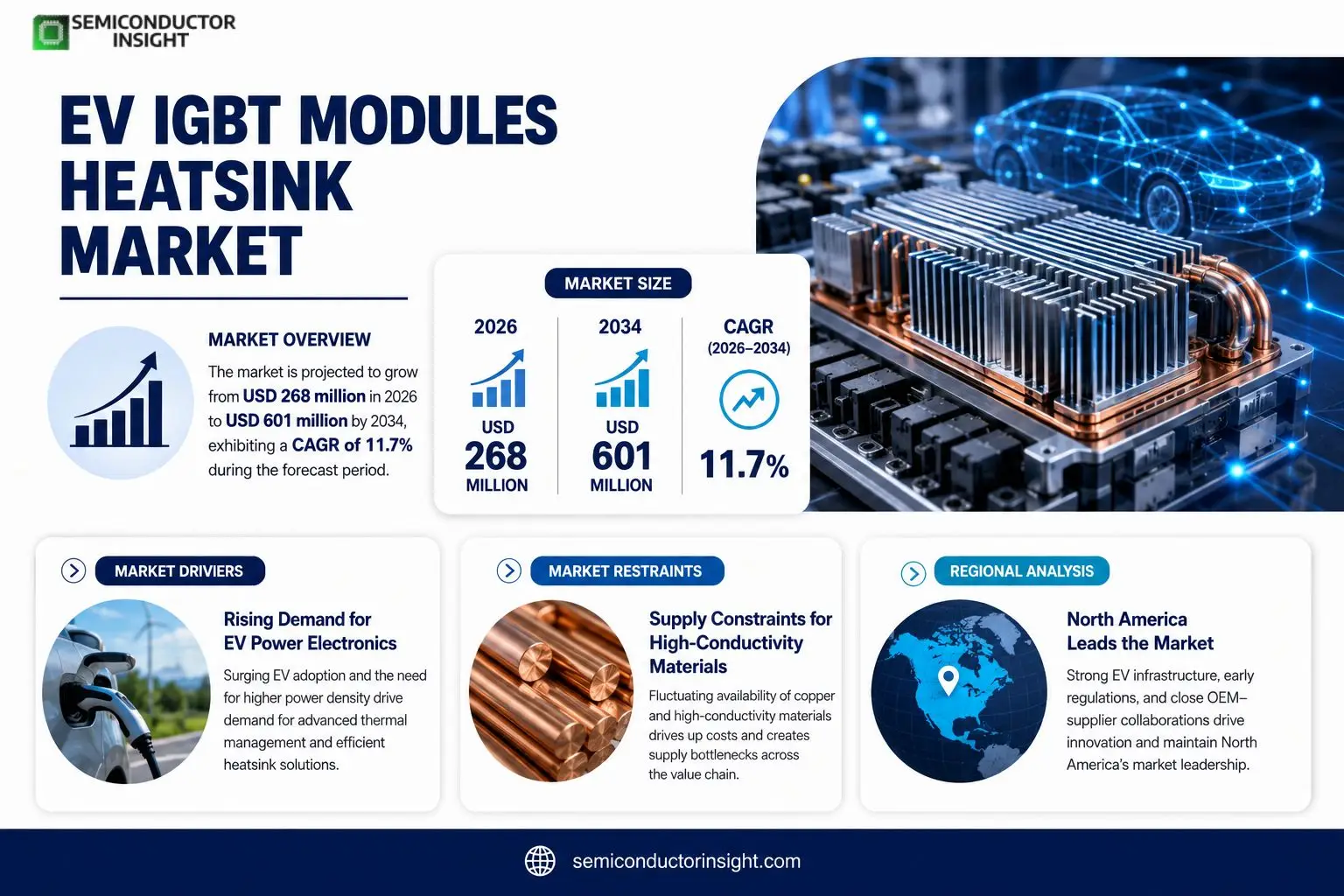
EV IGBT Modules Heatsink market was valued at USD 268 million in 2026. The market is projected to grow from USD 268 million in 2026 to USD 601 million by 2034, exhibiting a CAGR of 11.7% during the forecast period.
EV IGBT modules heatsink refers to a thermal management component specifically designed to dissipate the heat generated by IGBT (Insulated Gate Bipolar Transistor) modules used in electric vehicle power electronics such as inverters, DC‑DC converters, and onboard chargers. By transferring heat away from semiconductor junctions, these heatsinks maintain safe operating temperatures and support reliable performance of power modules.
MARKET DRIVERS
Rising Demand for Electric Vehicle Power Electronics
Electric vehicles are surging, with sales expected to exceed 30 million units by 2030. This rapid adoption forces power electronics suppliers to enhance power density while ensuring reliability, driving a need for advanced thermal management solutions within EV IGBT Modules Heatsink Market.
Innovations in IGBT Module Heat Transfer
New hot‑spot measurement techniques and the integration of graphite‑enhanced fins have cut thermal resistance by nearly 15%, allowing modules to operate at higher current densities without overheating. Manufacturers that adopt these developments can offer lower system weight and improved battery life, forming a compelling advantage in the competitive EV market.
➤ Advanced heat‑sink geometries are shifting the benchmark for thermal efficiency in high‑power modules.
Collectively, the convergence of stricter vehicle emission targets and performance expectations underscores why EV IGBT Modules Heatsink Market is positioned for rapid change.
MARKET CHALLENGES
Supply Constraints for High‑Conductivity Materials
The availability of copper grades with enhanced thermal conductivity is fluctuating, pushing component costs higher and creating supply bottlenecks that affect the cost structure of heat sink solutions across the industry.
Other Challenges
High Implementation Cost
Integrating next‑generation heat sinks into existing production lines requires significant capital investment, and the payback period can stretch beyond 36 months, discouraging smaller OEMs from adopting the latest technologies.
MARKET RESTRAINTS
Regulatory Variability Across Regions
Differences in thermal safety standards between the EU, China, and North America create certification hurdles that delay product launches. Additionally, the lack of harmonized testing protocols for heat‑sink performance means manufacturers must tailor designs to meet multiple regional specifications, raising development time and expense.
MARKET OPPORTUNITIES
Hybrid Cooling Integration
The convergence of passive heat‑sink solutions with active cooling techniquessuch as liquid or vapor‑phase flowoffers a pathway to higher power densities without proportionally increasing system volume. Companies that develop modular hybrid cooling Kits can capture a growing segment of OEMs seeking to balance cost, weight, and performance in their power electronics portfolios.
EV IGBT Modules Heatsink Market Trends
Thermal Architecture Evolution Driven by Power Density
As electric‑vehicle power modules advance toward higher operating voltages and integrated front‑end designs, the thermal footprint of every IGBT stack has intensified. Traditional flat‑base configurations, despite their simple assembly, cannot dissipate the heat flux generated by motor controllers and high‑frequency DC‑DC converters operating in 400–800 V regimes. Manufacturers are therefore favoring pin‑fin structures that expose greater surface area, allowing both air and liquid carriers to more efficiently remove heat. The move is not merely a response to heat; it also offers tighter form factor constraints and lower material burdens, directly supporting lightweight vehicle architectures that meet stringent regulatory weight limits.
Other Trends
Materials Reducing Mass While Enhancing Conductivity
Aluminium alloys with silicon carbide reinforcement are gradually supplanting pure copper in baseplate construction. The hybrid base offers a 15 % reduction in weight while maintaining thermal conductivity close to that of copper. This shift arises from the automotive push toward channeling every kilogram back into battery packaging and propulsion components, meaning the heatsink must not become a weight penalty.
Digital Thermal Management Integration
Embedded temperature sensors and real‑time coolant flow controllers have begun to double as adaptive safety nets, modifying thermal pathways on demand. By correlating inverter load with localized temperature gradients, the controls can dynamically adjust fan speeds or recycle coolant, thus prolonging semiconductor life and ensuring consistent output during peak drives. This digital overlay eliminates the need for overdesigning heatsinks as the system itself manages the extremes.
Shift Toward Integrated Liquid and Hybrid Cooling
The convergence of liquid cooling with pin‑fin architecture is becoming the preferred solution for high‑power applications, especially in plug‑in hybrid vehicles requiring rapid charge and discharge cycles. Closed‑loop systems are now coupled with optimized micro‑channel manifolds that reduce void zones, ensuring uniform temperature distribution. The combination delivers thermal resistance below 1.2 °C/W even under 5 kW heat loads, a threshold that traditional air‑cooled modules rarely achieve without cumbersome fan assemblies.
COMPETITIVE LANDSCAPE
Key Industry Players
EV IGBT Module Heatsink Market Overview
Infineon Technologies occupies the upper echelon of the EV IGBT module heatsink arena, leveraging its superior thermal management solutions to cement partnerships with Tier‑1 e‑drive integrators. By combining high‑conductivity copper‑base plates with precision‑crafted pin‑fin geometries, Infineon delivers consistent temperature control across the escalating voltage and power requirements of modern BEVs. The company’s robust manufacturing footprintspanning North America, Europe, and Asiaensures rapid replenishment cycles and aligns with the rising demand for lightweight, space‑constrained modules. In parallel, Amulaire Thermal Technology has carved out a niche by tailoring its manufacturing processes toward modular, multi‑channel flow paths, an approach that resonates with suppliers pushing for scalable, repeatable designs. The coexistence of these leaders underlines a market architecture that rewards higher material quality, tighter design tolerances, and supply‑chain resilience, especially as the sector shifts toward higher‑frequency IGBT devices that demand tighter thermal budgets.The remainder of the field is populated by a diverse constellation of regional specialists, each contributing distinct technical capabilities. Huangshan Googe and Heatsink Advanced Materials focus on flat‑base heatsinks optimized for OEM power inverters, offering cost efficiencies that appeal to emerging market players. Kunshan Gootage Thermal Technology and Jentech Precision Industrial excel in hybrid cooling solutions, integrating liquid‑cooling components with pin‑fin structures to meet the stringent reliability criteria of commercial vehicle electrical architectures. TAIWA CO., Ltd. and Wieland Microcool emphasize lightweight, high‑strength alloys to satisfy the weight‑sensitive demands of premium EV platforms. Jiangyin Saiying Electron, Suzhou Haoli Electronic Technology, Sitritec Thermal Control Materials, and Infineon together showcase a spectrum of design innovation, from advanced thermal interface materials to scalable, plug‑and‑play module architectures. This breadth of technical focus creates a competitive landscape where differentiation hinges on material science breakthroughs and integration flexibility rather than sheer scale alone.
List of Key EV IGBT Module Heatsink Companies Profiled
- Infineon Technologies
- Amulaire Thermal Technology
- Huangshan Googe
- Heatsink Advanced Materials
- Kunshan Gootage Thermal Technology
- Dana Incorporated
- Jentech Precision Industrial
- TAIWA CO., Ltd.
- Wieland Microcool
- Jiangyin Saiying Electron
- Suzhou Haoli Electronic Technology
- Sitritec Thermal Control Materials
Segment Analysis:
| Segment Category | Sub-Segments | Key Insights |
| By Type |
|
Pin‑fin Heat Sink delivers superior thermal dissipation by exploiting dense metal fins, enabling high current handling and compact design. • Ideal for motor controllers and main inverters requiring elevated heat‑flux management. • Supports hybrid liquid‑air cooling, enhancing reliability under variable operating conditions. • Facilitates lightweight assembly, contributing to overall vehicle efficiency. • Integrates seamlessly with cold‑plate systems, reducing thermal gradients across the module. |
| By Application |
|
Motor Controllers (MCU) represent the most demanding application for EV IGBT heatsinks, necessitating rapid heat removal. • Pin‑fin modules paired with cold plates exhibit high thermal transfer. • Enables continuous high‑frequency control signals with minimal temperature rise. • Provides long‑term reliability essential for electric drivetrain stability. • Allows designers to meet stringent performance targets without compromising vehicle size. |
| By End User |
|
OEM Automotive Manufacturers drive market demand by integrating EV powertrains early in vehicle design. • Require customizable heatsinks to meet weight and space constraints. • Favor modular designs for streamlined supply chain and cost control. • Seek high durability across diverse climatic conditions. • Prioritize compliance with rigorous safety and reliability standards. |
| By Cooling Technology |
|
Hybrid Cooling blends liquid and air pathways, maximizing heat removal without excessive mass. • Enables higher power densities while maintaining form factor. • Offers redundancy, improving system resilience against coolant failures. • Reduces electrical noise, supporting sensitive sensor operation. • Aligns with industry shift toward combined thermal strategies. |
| By Vehicle Type |
|
BEV markets demand the most aggressive thermal management due to high‑power battery integration. • Requires robust heat‑sink solutions to sustain peak acceleration curves. • Benefits from lightweight, high‑conductivity materials to counter weight penalties. • Substitutes SiC modules, driving demand for enhanced thermal interfaces. • Integrates with fast‑charge infrastructure, necessitating stable operating temperatures. |
Regional Analysis: EV IGBT Modules Heatsink Market
North America
The North American sector is anchored by a small group of dominant distributors who interface directly with automakers and suppliers. Their depth in logistics allows for rapid sequestration of IGBT modules, ensuring that heatsink solutions remain on schedule with vehicle roll‑outs.
R&D investments focus on additive manufacturing of fin arrays and composite housings that can endure temperature spikes typical of heavy‑duty electric drives. Pilot projects often pair advanced simulation with real‑world half‑bus testing.
State‑level mandates such as California’s Low‑Emission Vehicle requirement compel manufacturers to adopt stringent reliability checks for thermal modules, thereby tightening design criteria across the industry.
Pricing pressure emerges from emerging budget‑segment EVs that demand cost‑effective heat solutions, prompting alliances between component makers and material suppliers to balance affordability with performance.
Europe
Europe’s EV IGBT module heatsink market is tightening around sustainability mandates and the European Green Deal. Regionwide goals to curtail CO₂ emissions have accelerated the deployment of electric passenger cars and commercial fleets, creating a steady need for protectionive thermal management systems. Local suppliers are partnering with OEMs to iterate rapid‑prototype solutions that use low‑emission copper alloys. Regulatory stringency on safety and recyclability is reshaping design philosophy, pushing suppliers toward modular, serviceable units. This approach positions European players as key enablers of long‑term electrification, with a transparent supply chain that supports the region’s circular‑economy ambitions.
Asia‑Pacific
The Asia‑Pacific segment is experiencing explosive demand as governments in China, Japan, and South Korea rally to meet ambitious EV targets. In China, the platform of large domestic automakers forces a pivot from legacy motor configurations to integrated drives, requiring robust IGBT modules with embedded heat‑spreaders. Japan’s laser‑precision manufacturing culture promotes high‑grade thermal caps, while South Korea’s strong semiconductor ecosystem supplies advanced cooling assemblies. Cross‑border supply chains from Taiwan to Vietnam ensure component resilience, and local R&D hubs innovate on ceramic‑reinforced heat sinks, enhancing temperature thresholds without compromising size.
South America
South America is gradually expanding its electrification outreach. Brazilian and Chilean governments are underwriting infrastructure projects that necessitate reliable heat dissipation for heavy‑duty EVs and hybrid powertrains. The region’s limited manufacturing footprint means foreign suppliers dominate, yet strategic knowledge transfer initiatives are underway to enable local production. The trend toward urban mobility solutions, such as electric buses in urban centers, underscores the demand for resilient, cost‑effective heatsinks that can operate under high load cycles.
Middle East & Africa
Middle East & Africa’s EV segment remains nascent but is gaining visibility through pilot programs in Saudi Arabia and the UAE. Energy‑rich economies are co‑financing electrified transit, placing a premium on robust thermal management to sustain vehicle operation in high‑temperature environments. The regional market encourages partnerships between module providers and local distributors, fostering a knowledge base that can scale with infrastructure projects. As policy frameworks mature, the region is poised to shift from basic uptake to strategic integration of advanced IGBT module heatsinks.
Report Scope
This market research report provides a comprehensive analysis of the EV IGBT Modules Heatsink Market , covering the forecast period 2026–2034. It offers detailed insights into market dynamics, technological advancements, competitive landscape, and key trends shaping the industry.
Key focus areas of the report include:
- Market Overview: The report begins with an overview outlining its current market scenario, key growth indicators, and industry transformation drivers. It discusses macroeconomic factors, demand–supply balance, regulatory landscape, and the strategic role of semiconductors in powering advancements across industries such as automotive, telecommunications, consumer electronics, and industrial automation.
- Market Size & Forecast: Historical data and future projections for revenue, unit shipments, and market value across major regions and segments.
- Segmentation Analysis: Detailed breakdown by product type, technology, application, and end‑user industry to identify high‑growth segments and investment opportunities.
- Regional Insights: Insights into market performance across North America, Europe, Asia-Pacific, Latin America, and the Middle East & Africa, including country‑level analysis where relevant.
- Competitive Landscape: Profiles of leading market participants, including their product offerings, R&D focus, manufacturing capacity, pricing strategies, and recent developments such as mergers, acquisitions, and partnerships.
- Technology Trends & Innovation: Assessment of emerging technologies, integration of AI/IoT, semiconductor design trends, fabrication techniques, and evolving industry standards.
- Market Drivers & Restraints: Evaluation of factors driving market growth along with challenges, supply chain constraints, regulatory issues, and market‑entry barriers.
- Stakeholder Insights: Insights for component suppliers, OEMs, system integrators, investors, and policymakers regarding the evolving ecosystem and strategic opportunities.
Primary and secondary research methods are employed, including interviews with industry experts, data from verified sources, and real‑time market intelligence to ensure the accuracy and reliability of the insights presented.
FREQUENTLY ASKED QUESTIONS:
What is the current market size of EV IGBT Modules Heatsink Market?
-> EV IGBT Modules Heatsink Market was valued at USD 268 million in 2026 and is expected to reach USD 601 million by 2024.
Which key companies operate in EV IGBT Modules Heatsink Market?
-> Key players include Huangshan Googe, Heatsink Advanced Materials, Kunshan Gootage Thermal Technology, Dana Incorporated, Jentech Precision Industrial, Amulaire Thermal Technology, TAIWA CO., Ltd., Wieland Microcool, Jiangyin Saiying Electron, Suzhou Haoli Electronic Technology, Sitritec Thermal Control Materials.
What are the key growth drivers?
-> Key growth drivers include increasing adoption of high‑voltage, high‑frequency, and high‑power‑density IGBT modules, the shift from IGBTs to SiC devices, the demand for lightweight and compact heat‑sink designs, and the broader implementation of liquid and hybrid cooling technologies.
Which region dominates the market?
-> The Asia‑Pacific region is the fastest‑growing market, while North America contributes the largest market share in revenue, with China and Japan driving significant demand.
What are the emerging trends?
-> Emerging trends include SiC technology adoption, widespread use of liquid and hybrid cooling solutions, modular and integrated heat‑sink designs, and the trend toward lightweight, multi‑channel flow‑path structures.

Get Sample Report PDF for Exclusive Insights
Report Sample Includes
- Table of Contents
- List of Tables & Figures
- Charts, Research Methodology, and more...
 Download Sample Report PDF