Capacitive Acceleration Sensor Market Insights
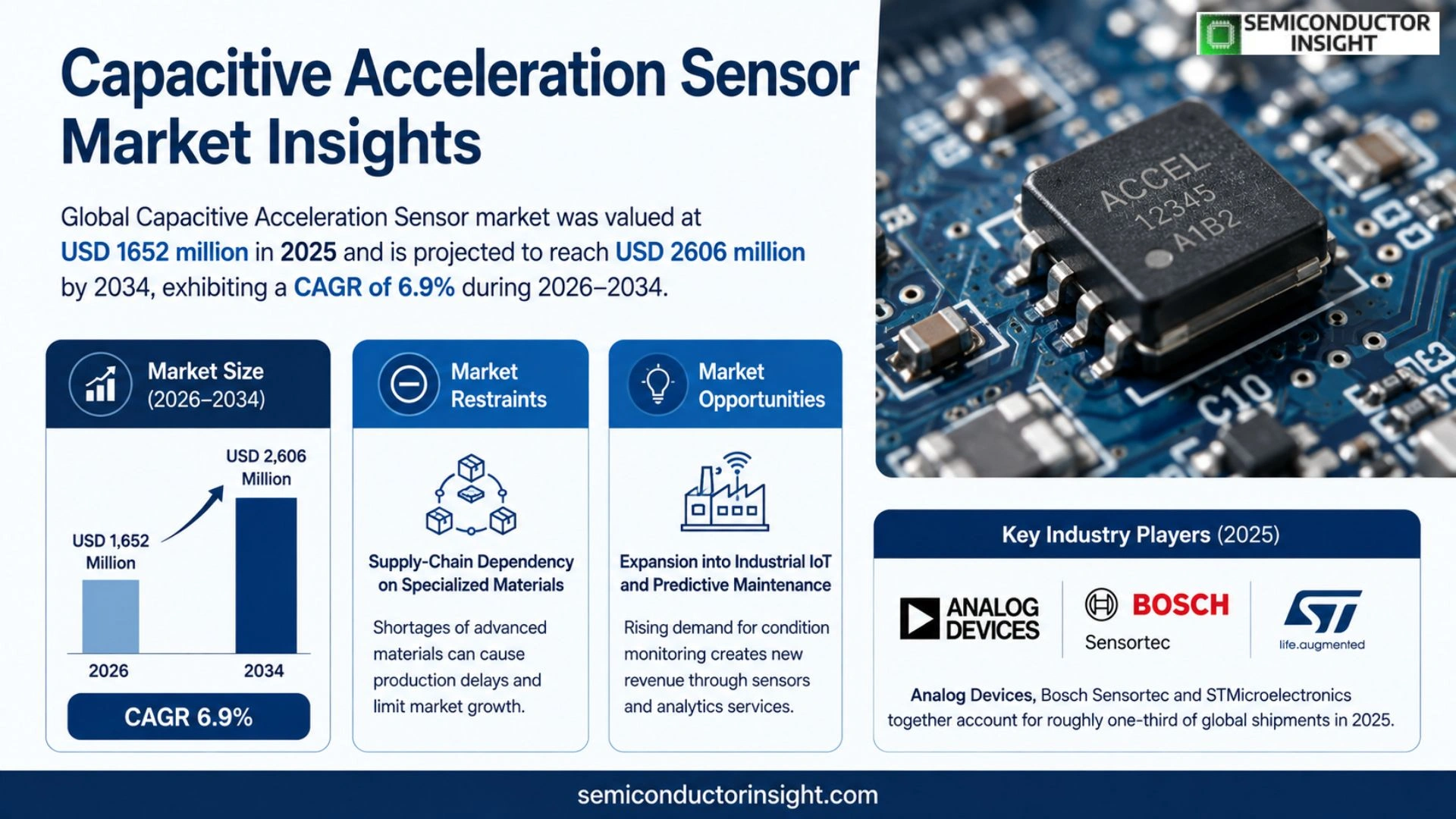
Global Capacitive Acceleration Sensor market was valued at USD 1652 million in 2025 and is projected to reach USD 2606 million by 2034, exhibiting a CAGR of 6.9% during the forecast period.
A Capacitive Acceleration Sensor measures linear acceleration through changes in capacitance within a MEMS (Micro‑Electro‑Mechanical Systems) structure. The device consists of a movable proof mass suspended between fixed electrodes; when acceleration occurs, the mass shifts slightly, altering the electrode spacing and thus the capacitance. This variation is converted by an on‑chip detection circuit into an electrical signal proportional to both magnitude and direction of acceleration. In 2025, worldwide production reached approximately 100.52 million units, with an average selling price of around USD 18 per unit. The technology’s low power consumption, compact footprint, and compatibility with digital signal processing make it indispensable for consumer wearables, automotive safety systems, and industrial condition‑monitoring applications.
MARKET DRIVERS
Rising Adoption in Consumer Electronics
Manufacturers of smartphones, wearables and gaming peripherals are substituting traditional piezo‑electric devices with capacitance‑based accelerometers because the latter deliver higher resolution at lower power draw. Cost efficiency combined with miniaturisation enables integration into thin‑form‑factor products, prompting design teams to favor capacitive solutions.
Automotive Safety and Comfort Systems
Modern vehicle architectures rely on precise motion detection for air‑bag deployment, electronic stability control and seat‑occupancy monitoring. Capacitance sensors provide the linearity needed for real‑time feedback, allowing OEMs to meet increasingly stringent safety regulations while keeping system weight under control.
➤ Manufacturers that embed capacitive acceleration sensors early in the product development cycle capture a competitive edge by reducing calibration cycles and extending battery life.
Beyond end‑use devices, the shift toward edge‑computing platforms is encouraging sensor providers to develop integrated ASICs that embed capacitive acceleration measurement, thereby shortening the data path and enhancing reliability in harsh environments.
MARKET CHALLENGES
Manufacturing Yield and Process Complexity
Capacitive structures demand precise micron‑scale spacing between electrodes; any deviation can cause drift or non‑linearity. Maintaining high yield across large volumes forces suppliers to invest in advanced lithography and clean‑room protocols, which can erode margin projections.
Other Challenges
Thermal Stability Concerns
Temperature fluctuations alter dielectric constants, affecting sensor output. While compensation algorithms exist, they add firmware overhead and may not satisfy ultra‑high‑precision applications such as aerospace inertial navigation.
Regulatory scrutiny around electromagnetic compatibility (EMC) in automotive and medical devices also imposes additional testing steps, further stretching time‑to‑market for new capacitive sensor models.
MARKET RESTRAINTS
Supply‑Chain Dependency on Specialized Materials
The performance of capacitive acceleration sensors hinges on high‑purity silicon‑on‑insulator wafers and low‑loss dielectric films. Global shortages of these niche inputs can create bottlenecks, especially when demand spikes in unrelated sectors such as 5G infrastructure. Companies that lack diversified supplier bases may face production slow‑downs, limiting market expansion.
MARKET OPPORTUNITIES
Expansion into Industrial IoT and Predictive Maintenance
Factories are retrofitting machinery with vibration monitoring suites to anticipate component wear. Capacitive acceleration sensors, with their low drift and compact footprint, fit naturally into these retrofits, offering data‑rich insights that can be monetised through subscription‑based analytics platforms. Early entrants that bundle sensors with cloud services stand to capture a sizable share of this emerging revenue stream.
Capacitive Acceleration Sensor Market Trends
Shift Toward High‑Margin Automotive and Industrial Segments
The sensor portfolio that once dominated consumer gadgets now finds a growing share of its revenue in automotive and industrial applications. While total shipments reached roughly 100.5 million units in 2025, the average selling price of $18 masks a widening gap between low‑cost wearables and premium automotive‑grade devices. In vehicles, demand for crash‑avoidance and stability‑control systems forces manufacturers to adopt MEMS designs that guarantee temperature stability and long‑term reliability, thereby supporting higher unit margins. Industrial automation similarly values the sensor’s ability to feed vibration‑based predictive‑maintenance algorithms, prompting buyers to pay a premium for rugged packaging and calibrated performance. The strategic implication for vendors is clear: expanding design IP for temperature‑drift compensation and investing in certification pipelines can unlock a profit upside that eclipses pure volume growth.
Other Trends
Pricing Pressure in Wearables
Smartphone and wearable segments continue to push unit prices down through aggressive cost engineering. High‑shipment models rely on standardized LGA or WLCSP packages, and the marginal cost of an additional million units drops dramatically once yield thresholds are crossed. Consequently, gross margins plateau in the mid‑range, and suppliers compete chiefly on yield improvement and algorithmic integration rather than raw sensor performance. Companies that diversify into mixed‑signal solutions or bundle firmware services are better positioned to preserve profitability as pure‑sensor pricing stalls.
Consumer Electronics Maintain Volume but Pressure Margins
Despite the squeeze on per‑unit earnings, consumer electronics remain the engine of total unit volume. Features such as screen rotation, step counting, and AR/VR motion tracking embed capacitive accelerometers in virtually every handheld device. The sheer scale,approaching 90 million units annually,ensures that even a modest margin contributes significantly to overall revenue. However, manufacturers must reconcile the need for ultra‑low power consumption with the demand for higher‑resolution data, driving a wave of sensor‑fusion architectures that blend analog and digital outputs. Players that can deliver integrated solutions while maintaining the cost discipline demanded by OEMs will retain market share and secure a foothold for future migration into higher‑value segments.
COMPETITIVE LANDSCAPE
Key Industry Players
Capacitive Acceleration Sensor Market – Competitive Overview
Analog Devices, Bosch Sensortec and STMicroelectronics together account for roughly one‑third of global shipments in 2025, shaping a tiered structure in which mass‑market capacity sits alongside premium, automotive‑grade designs. These firms leverage deep MEMS IP portfolios and advanced wafer‑scale packaging to push unit costs toward the low‑$10 range for consumer wearables, while preserving higher margins on automotive‑qualified parts through rigorous reliability programmes. Their extensive design‑for‑manufacturing ecosystems enable rapid scale‑up, creating entry barriers that force emerging competitors to specialize in niche form‑factors or value‑added algorithm integration. The concentration of production in East‑Asian fabs further amplifies the advantage of firms that have secured long‑term capacity agreements, allowing them to meet the 100 M‑unit demand forecast while maintaining predictable lead times for large OEM customers.
Beyond the three dominant players, a second stratum of manufacturers,Honeywell, TDK InvenSense, Murata Manufacturing, NXP Semiconductors, Texas Instruments, Infineon Technologies, Microchip Technology, TE Connectivity, ROHM Semiconductor, Safran, Thales Group, Kearfott Corporation, LITEF GmbH and ASC GmbH,targets specific segments such as high‑performance inertial navigation, aerospace‑grade vibration monitoring, or compact IoT sensor nodes. Many of these firms complement their sensor portfolios with proprietary calibration software, thereby extracting incremental value from applications that demand temperature‑stable outputs. Their strategies often involve partnerships with automotive Tier‑1 suppliers or collaborations with industrial automation vendors, which help distribute risk and accelerate time‑to‑market for new form‑factor accelerometers. The diversity of this group sustains a healthy competitive environment, encouraging continuous innovation in packaging miniaturisation and signal‑processing integration.
List of Key Capacitive Acceleration Sensor Companies Profiled
- Analog Devices
- Bosch Sensortec
- STMicroelectronics
- Honeywell
- TDK InvenSense
- Murata Manufacturing
- NXP Semiconductors
- Texas Instruments
- Infineon Technologies
- Microchip Technology
- TE Connectivity
- ROHM Semiconductor
- Safran
- Thales Group
- Kearfott Corporation
- LITEF GmbH
- ASC GmbH
Segment Analysis:
| Segment Category | Sub-Segments | Key Insights |
| By Type |
|
Analog Output – Dominates in legacy industrial control where robustness is prized. – Favoured for easy integration with traditional signal‑conditioning circuitry. – Enables designers to tailor amplification and filtering for specific reliability needs. |
| By Application |
|
Consumer Electronics – Drives demand for ultra‑low‑power, miniaturised sensors in smartphones and wearables. – Supports motion‑based user interfaces, step tracking and device orientation. – Benefits from rapid algorithmic integration for sensor‑fusion applications. |
| By End User |
|
OEMs – Prioritise design‑for‑manufacturability and cost efficiencies at scale. – Leverage mature MEMS IP to meet stringent volume targets. – Drive standardisation of package formats to simplify board‑level integration. |
| By Axes |
|
Triaxial – Preferred for automotive safety systems requiring comprehensive motion capture. – Enables richer data for predictive maintenance in industrial equipment. – Aligns with emerging edge‑AI analytics that exploit multi‑dimensional acceleration signals. |
| By Packaging |
|
Surface Mount Package – Aligns with high‑volume consumer device assembly lines. – Supports aggressive board‑space reduction and automated placement. – Facilitates tighter thermal management and reliability in automotive modules. |
Regional Analysis: Capacitive Acceleration Sensor Market
Asia-Pacific
Manufacturers of high‑speed conveyors and CNC equipment are substituting legacy piezo‑electric devices with capacitive sensors to achieve finer vibration control. The technology’s immunity to electromagnetic interference aligns with the stringent reliability standards of modern factories, prompting a steady uptick in specification revisions and supplier collaborations across the region.
Smartphone and wearable vendors are leveraging capacitive acceleration sensors to enrich motion‑based UI features while conserving battery life. The appetite for immersive gaming and health‑monitoring applications fuels incremental design cycles, encouraging component makers to tailor sensor footprints for ultra‑slim device architectures.
Vehicle manufacturers are integrating these sensors into air‑bag deployment systems and electronic stability controls, capitalizing on their fast response times. As autonomous driving prototypes proliferate in the region, the demand for accurate motion detection intensifies, prompting joint development programs between automakers and sensor specialists.
Edge‑enabled IoT nodes increasingly embed capacitive acceleration sensors to monitor structural health in smart cities and industrial sites. The low‑cost, low‑maintenance profile of the devices fits budgetary constraints, while their data fidelity enhances predictive‑maintenance algorithms, solidifying their role in next‑generation connectivity platforms.
North America
North America remains a sophisticated market where end‑users prioritize sensor accuracy for high‑performance aerospace and defense platforms. Defense contractors value the technology’s resilience in harsh environments, prompting collaborations with niche manufacturers that can deliver bespoke calibration services. Meanwhile, the region’s venture ecosystem nurtures startups exploring sensor fusion for augmented reality, creating a pipeline of specialized applications that could ripple through adjacent industries.
Europe
In Europe, regulatory alignment around safety standards drives adoption within medical device manufacturers, especially for portable diagnostics that monitor patient movement. The emphasis on data privacy also steers vendors toward on‑device processing, leveraging the low‑power nature of capacitive sensors to keep computational loads local. Collaborative research initiatives funded by the EU reinforce material innovations that aim to further shrink sensor dimensions without compromising signal integrity.
South America
South American manufacturers are gradually transitioning from imported piezo‑electric components to locally assembled capacitive solutions, attracted by reduced lead times and adaptable form‑factors. The agricultural sector, a key economic pillar, is experimenting with sensor‑enabled equipment to optimize machinery vibration and improve crop‑handling efficiency. Such early‑stage deployments hint at a broader regional shift toward precision‑farm technologies.
Middle East & Africa
The Middle East & Africa region is witnessing nascent interest from oil‑and‑gas operators seeking vibration monitoring that can survive extreme temperature swings. Pilot projects in offshore platforms demonstrate that capacitive acceleration sensors can deliver continuous diagnostics with minimal maintenance overhead. Simultaneously, infrastructure upgrades in several African nations are incorporating sensor‑based monitoring for bridge and rail health, suggesting a long‑term appetite for the technology’s reliability and cost‑effectiveness.
Report Scope
This market research report provides a comprehensive analysis of the Capacitive Acceleration Sensor Market , covering the forecast period 2026–2034. It offers detailed insights into market dynamics, technological advancements, competitive landscape, and key trends shaping the industry.
Key focus areas of the report include:
- Market Overview: The report begins with an overview outlining its current market scenario, key growth indicators, and industry transformation drivers. It discusses macroeconomic factors, demand–supply balance, regulatory landscape, and the strategic role of semiconductors in powering advancements across industries such as automotive, telecommunications, consumer electronics, and industrial automation.
- Market Size & Forecast: Historical data and future projections for revenue, unit shipments, and market value across major regions and segments.
- Segmentation Analysis: Detailed breakdown by product type, technology, application, and end-user industry to identify high-growth segments and investment opportunities.
- Regional Insights: Insights into market performance across North America, Europe, Asia-Pacific, Latin America, and the Middle East & Africa, including country-level analysis where relevant.
- Competitive Landscape: Profiles of leading market participants, including their product offerings, R&D focus, manufacturing capacity, pricing strategies, and recent developments such as mergers, acquisitions, and partnerships.
- Technology Trends & Innovation: Assessment of emerging technologies, integration of AI/IoT, semiconductor design trends, fabrication techniques, and evolving industry standards.
- Market Drivers & Restraints: Evaluation of factors driving market growth along with challenges, supply chain constraints, regulatory issues, and market-entry barriers.
- Stakeholder Insights: Insights for component suppliers, OEMs, system integrators, investors, and policymakers regarding the evolving ecosystem and strategic opportunities.
Primary and secondary research methods are employed, including interviews with industry experts, data from verified sources, and real-time market intelligence to ensure the accuracy and reliability of the insights presented.
FREQUENTLY ASKED QUESTIONS:
What is the current market size of Capacitive Acceleration Sensor Market?
-> Capacitive Acceleration Sensor market is projected to reach USD 2606 million by 2034, exhibiting a CAGR of 6.9% during the forecast period.
Which key companies operate in Capacitive Acceleration Sensor Market?
-> Key players include Analog Devices, Bosch Sensortec, STMicroelectronics, Honeywell, TDK InvenSense, Murata Manufacturing, NXP Semiconductors, Texas Instruments, Infineon Technologies, Microchip Technology, TE Connectivity, ROHM Semiconductor, Safran, Thales Group, Kearfott Corporation, LITEF GmbH, ASC GmbH.
What are the key growth drivers?
-> Key growth drivers include expansion of consumer electronics and wearables, electrification and intelligentization of automobiles, and industrial automation with predictive maintenance.
Which region dominates the market?
-> Asia-Pacific holds the largest market share driven by high‑volume smartphone and automotive production, while North America and Europe are also significant contributors.
What are the emerging trends?
-> Emerging trends include integration of MEMS accelerometers in IoT edge devices, AI‑enabled motion analytics, and development of low‑power, high‑accuracy sensors for AR/VR and autonomous driving applications.

Get Sample Report PDF for Exclusive Insights
Report Sample Includes
- Table of Contents
- List of Tables & Figures
- Charts, Research Methodology, and more...
 Download Sample Report PDF