CMOS Line Scan Camera Market Insights
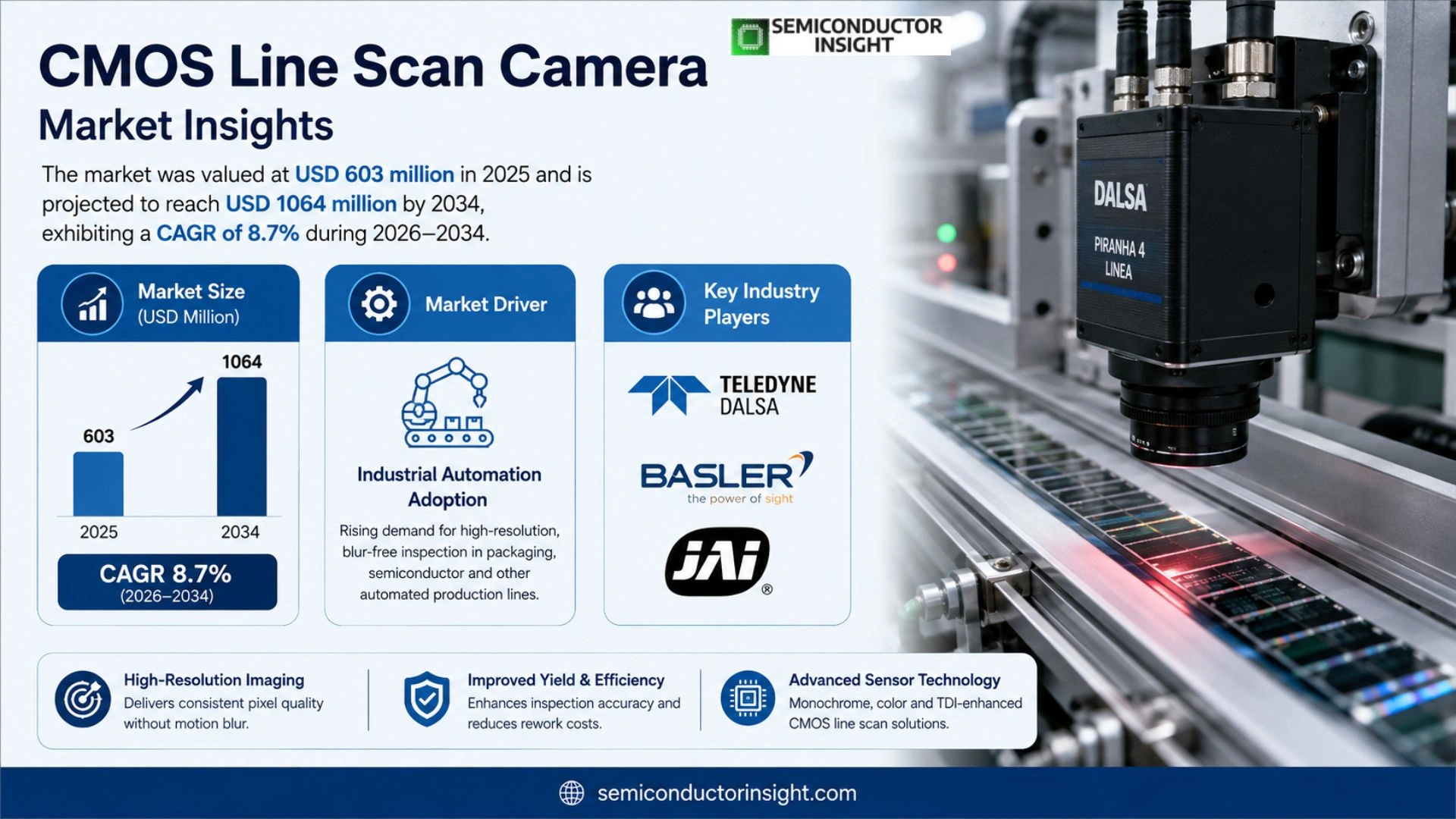
CMOS Line Scan Camera market was valued at USD 603 million in 2025 and is projected to reach USD 1064 million by 2034, exhibiting a CAGR of 8.7% during the forecast period.
CMOS Line Scan Camera is a highly specialized digital imaging device essential for high‑speed machine‑vision applications. Unlike area‑scan cameras, it employs a sensor chip comprising a single row (or few parallel rows) of photosensitive CMOS pixels that capture one‑dimensional scan lines while the target or camera moves, later reconstructing a full two‑dimensional image via host software.
The market’s expansion is fueled by increasing demand for ultra‑high‑resolution inspection on fast‑moving webs such as textiles, paper, foil, and packaging labels, as well as growing adoption of color and multi‑spectral line‑scan solutions in food sorting and recycling. Advances in CMOS sensor speed, low read noise, & integration of Time Delay Integration further enhance sensitivity, enabling higher conveyor speeds without compromising image quality.
MARKET DRIVERS
Industrial Automation Adoption
CMOS Line Scan Camera Market is gaining traction as manufacturers replace legacy point‑focus sensors with line‑scan solutions that can capture high‑resolution images of moving objects. Continuous production lines, especially in packaging and semiconductor inspection, demand a sensor that delivers consistent pixel quality without motion blur. This technical fit translates into higher yield rates and lower rework costs, prompting equipment OEMs to specify line‑scan cameras as standard components.
Advancements in Sensor Technology
Recent CMOS processes have pushed quantum efficiency above 60 % while shrinking pixel pitch to sub‑5 µm dimensions. The resulting sensors combine low noise with fast readout, allowing real‑time defect detection on high‑speed belts. These improvements reduce the total cost of ownership because downstream quality‑control stations can operate at line speeds previously unattainable with CCD‑based alternatives.
➤ “The convergence of lower power draw and superior image fidelity is reshaping how factories monitor product quality, making line‑scan cameras a cornerstone of next‑generation automation.”
Against this backdrop, system integrators are expanding their portfolio to include modular line‑scan cameras that can be retrofitted onto existing lines. The flexibility to mount cameras at varying angles and distances encourages broader adoption across sectors such as food processing, textiles, and metal sheet inspection, cementing a sustainable demand base for CMOS Line Scan Camera Market.
MARKET CHALLENGES
Integration Complexity
Deploying a line‑scan camera often requires synchronizing illumination, trigger timing, and data pipelines. Small‑to‑mid‑size manufacturers, which lack dedicated engineering resources, encounter steep learning curves when trying to harmonize these elements with legacy PLC systems. The resulting implementation delays can erode the perceived advantage of faster inspection cycles.
Other Challenges
Cost Sensitivity
While sensor prices have fallen, the ancillary ecosystem,high‑intensity LED arrays, precision optics, and rugged enclosures,still represents a sizable upfront investment. Buyers operating on thin margins must justify the expense through demonstrable reductions in scrap or warranty claims, a calculation that varies widely across applications.
Furthermore, the scarcity of qualified technicians able to calibrate and maintain line‑scan setups adds a hidden cost. Companies that cannot secure skilled support may experience unplanned downtime, offsetting the efficiency gains promised by the technology.
MARKET RESTRAINTS
Supply Chain Volatility
Global semiconductor fab capacity is under pressure from geopolitical tensions and fluctuating demand cycles. When wafer throughput tightens, lead times for high‑performance CMOS dies extend, causing bottlenecks for camera manufacturers. This delay ripples through the downstream supply chain, limiting the ability of end users to scale projects on schedule.
In addition, the reliance on specialized optical components sourced from a limited number of vendors creates a parallel vulnerability. Any disruption in raw material availability,such as rare‑earth phosphors used in illumination modules,can force manufacturers to hold excess inventory, thereby inflating overall system cost.
MARKET OPPORTUNITIES
Emerging Applications in Autonomous Vehicles
As autonomous driving platforms demand precise lane‑mark detection and high‑speed object profiling, line‑scan sensors present a uniquely suited solution. Their ability to generate continuous image strips matches the forward‑facing camera geometry required for real‑time road surface analysis. Early pilots by OEMs indicate that integrating CMOS line‑scan cameras can improve detection accuracy without incurring the bandwidth penalties of full‑frame imaging.
Beyond automotive, the rise of smart agriculture,specifically high‑throughput sorting of fruits and vegetables,creates a parallel growth vector. Line‑scan cameras can be mounted on conveyor belts to evaluate shape, color, and surface defects at speeds exceeding 200 m/min, a performance level that traditional vision systems struggle to meet.
Investors and product developers who prioritize modular hardware architectures stand to capture the bulk of this upside. By offering plug‑and‑play line‑scan units that interface with standard Ethernet or PCIe backbones, vendors can lower the adoption barrier and accelerate market penetration across these nascent verticals.
CMOS Line Scan Camera Market Trends
Shift to Ultra‑High‑Resolution Sensors
The latest generation of line‑scan devices now routinely ships with sensor rows of 8K, 16K and even 32K pixels. This resolution jump allows manufacturers to widen the field of view while preserving the minute detail required for web‑inspection of paper, foil and textile substrates. Because the data rate grows proportionally with pixel count, vendors have migrated to CoaXPress interfaces that sustain multi‑gigabit throughput. The operational impact is clear: conveyor speeds can be increased without sacrificing defect detection, which translates directly into higher plant productivity and lower scrap rates.
Other Trends
Color and Multi‑Spectral Line Scan Growth
Three‑line and four‑line CMOS architectures now embed RGB and a near‑infrared channel in a single sensor package. This capability is reshaping applications that previously relied on separate lighting rigs, such as food sorting where material composition must be distinguished, and recycling streams that need precise polymer identification. By delivering color fidelity and spectral contrast in one pass, system integrators reduce bill of materials and simplify calibration, creating a compelling value proposition for high‑volume producers.
Regional Acceleration in Asia‑Pacific
Production data from 2024 show roughly 300 K units shipped worldwide, with more than half originating from China and surrounding economies. Heavy investment in electronics, battery packs for electric vehicles and advanced packaging lines drives this surge. Local manufacturers such as Teledyne DALSA, Basler and a cadre of Chinese suppliers are intensifying R&D to meet domestic demand, while also positioning themselves for export. The concentration of high‑speed manufacturing in the region raises competitive pressure on pricing and accelerates the adoption of newer sensor technologies, compelling Western players to seek strategic partnerships or localized production to stay relevant.
COMPETITIVE LANDSCAPE
Key Industry Players
CMOS Line Scan Camera Market – Competitive Overview
Teledyne DALSA, Basler AG and JAI dominate the upper tier of the CMOS line‑scan segment, each leveraging a deep sensor portfolio that spans monochrome, color and TDI‑enhanced devices. Their market weight stems from a combination of global sales networks, long‑standing OEM relationships in packaging, web printing and semiconductor inspection, and sustained R&D pipelines that push line rates beyond 100 kHz while maintaining sub‑electron read noise. The three firms differentiate through vertically integrated optics, high‑speed interfaces such as CoaXPress and proprietary image‑processing firmware, enabling end‑users to achieve sub‑micron defect detection without sacrificing conveyor speed. This concentration of capability forces smaller rivals to specialize, either by targeting niche verticals,such as food‑sorting or recycling,or by offering highly customized form factors that the majors cannot address cost‑effectively.
Beyond the headline trio, a cadre of regionally strong players enriches the competitive fabric. German‑based Baumer Holding, French‑origin Cognex, and Swiss‑led Keyence provide robust engineering support and modular hardware that appeal to mid‑size system integrators. Asian manufacturers,including Hikvision‑affiliated Hikrobot, Chinese market‑leader Dahua Technology, and home‑grown Hefei I‑TEK OptoElectronics,exploit proximity to high‑volume assembly lines in China, Japan and South Korea, delivering price‑competitive units with rapid service cycles. Niche innovators such as Daheng Image, Omron, Schäfter+Kirchhoff and OPT Machine Vision Tech focus on ultra‑high‑resolution (32K‑pixel) and multi‑spectral line‑scan cameras, catering to emerging applications in advanced composite inspection and medical device manufacturing. Their agility in adopting emerging standards (e.g., USB 3.0, 10 GbE) and bespoke lighting solutions creates a layered market where differentiation hinges on technical nuance rather than sheer volume.
List of Key CMOS Line Scan Camera Companies Profiled
- Teledyne DALSA
- Basler AG
- JAI
- Keyence Corporation
- Cognex Corporation
- Baumer Holding AG
- Hikrobot
- Dahua Technology
- Hefei I‑TEK OptoElectronics
- Schäfter+Kirchhoff
- OPT Machine Vision Tech
- Omron Corporation
Segment Analysis:
| Segment Category | Sub-Segments | Key Insights |
| By Type |
|
Color Line Scan is emerging as the leading type because it combines high resolution with multi‑spectral sensing.
|
| By Application |
|
Manufacturing dominates due to its demand for continuous web inspection.
|
| By End User |
|
Packaging is the leading end‑user segment.
|
| By Technology |
|
Ultra‑High Resolution leads technology evolution.
|
| By Market Trend |
|
AI/ML Integration is reshaping the market.
|
Regional Analysis: CMOS Line Scan Camera Market
North America
Investment in sensor miniaturization and on‑chip processing accelerates, allowing manufacturers to embed denoising functions directly within the line‑scan array. This reduces reliance on external electronics and shortens system integration cycles.
Proximity to semiconductor foundries shields North America from the logistical bottlenecks that affect other regions, ensuring steady component availability for high‑volume production lines.
Stringent quality‑control standards in aerospace and medical imaging foster early adoption of line‑scan solutions that meet precise calibration and traceability requirements.
Collaborative development programs between camera producers and end‑users enable rapid prototyping, aligning sensor specifications with evolving production line geometries.
Europe
European manufacturers benefit from a dense network of optical component specialists and a strong emphasis on precision engineering. Industries such as automotive electronics and high‑speed printing leverage the market’s capacity for fine‑detail capture, prompting local players to prioritize wavelength‑specific filters and robust thermal management. Moreover, EU‑wide sustainability initiatives encourage the integration of energy‑efficient cameras, nudging vendors toward lower power consumption footprints without sacrificing image fidelity.
Asia‑Pacific
The Asia‑Pacific region exhibits a rapid assimilation of line‑scan technology within emerging smart‑factory projects, especially in China, Japan, and South Korea. Competitive pricing pressures drive firms to adopt scalable production platforms, while the surge in consumer electronics manufacturing indirectly fuels demand for high‑throughput inspection systems. Government incentives for advanced manufacturing further amplify investment in sensor R&D, creating a fertile ground for niche applications such as printed circuit board verification.
South America
In South America, adoption is anchored by the expanding food‑processing and agricultural‑equipment sectors, where line‑scan cameras are employed for quality grading and defect detection. Local distributors increasingly emphasize after‑sales technical support, addressing skill gaps that have historically hampered market penetration. The region’s modest but growing emphasis on automation suggests a gradual shift from legacy vision systems to modern CMOS solutions.
Middle East & Africa
The Middle East & Africa market is characterized by selective uptake, primarily within oil‑and‑gas pipeline inspection and aerospace maintenance facilities. Strategic partnerships with global OEMs introduce advanced line‑scan platforms, while regional training initiatives aim to upskill personnel in high‑precision imaging. Although volume remains limited, the sector’s focus on reliability and long‑term asset protection positions CMOS line‑scan cameras as a preferred choice for critical infrastructure monitoring.
Report Scope
This market research report provides a comprehensive analysis of the CMOS Line Scan Camera Market , covering the forecast period 2026–2034. It offers detailed insights into market dynamics, technological advancements, competitive landscape, and key trends shaping the industry.
Key focus areas of the report include:
- Market Overview: The report begins with an overview outlining its current market scenario, key growth indicators, and industry transformation drivers. It discusses macroeconomic factors, demand–supply balance, regulatory landscape, and the strategic role of semiconductors in powering advancements across industries such as automotive, telecommunications, consumer electronics, and industrial automation.
- Market Size & Forecast: Historical data and future projections for revenue, unit shipments, and market value across major regions and segments.
- Segmentation Analysis: Detailed breakdown by product type, technology, application, and end-user industry to identify high-growth segments and investment opportunities.
- Regional Insights: Insights into market performance across North America, Europe, Asia-Pacific, Latin America, and the Middle East & Africa, including country-level analysis where relevant.
- Competitive Landscape: Profiles of leading market participants, including their product offerings, R&D focus, manufacturing capacity, pricing strategies, and recent developments such as mergers, acquisitions, and partnerships.
- Technology Trends & Innovation: Assessment of emerging technologies, integration of AI/IoT, semiconductor design trends, fabrication techniques, and evolving industry standards.
- Market Drivers & Restraints: Evaluation of factors driving market growth along with challenges, supply chain constraints, regulatory issues, and market-entry barriers.
- Stakeholder Insights: Insights for component suppliers, OEMs, system integrators, investors, and policymakers regarding the evolving ecosystem and strategic opportunities.
Primary and secondary research methods are employed, including interviews with industry experts, data from verified sources, and real-time market intelligence to ensure the accuracy and reliability of the insights presented.
FREQUENTLY ASKED QUESTIONS:
What is the current market size of CMOS Line Scan Camera Market?
-> CMOS Line Scan Camera market is projected to reach USD 1064 million by 2034, exhibiting a CAGR of 8.7% during the forecast period.
Which key companies operate in CMOS Line Scan Camera Market?
-> Key players include Keyence, Basler AG, Teledyne, TKH Group, Cognex Corporation, Baumer Holding AG, Hikrobot, Dahua Technology, Jai, Daheng Image, Omron, Lucid, Hefei I-TEK OptoElectronics, Schäfter+Kirchhoff, OPT Machine Vision Tech, among others.
What are the key growth drivers?
-> Key growth drivers include increasing demand for 100% web inspection in packaging, high‑speed print inspection, semiconductor and electronics substrate inspection, and the transition to CMOS technology offering higher line rates, lower read noise and superior light sensitivity.
Which region dominates the market?
-> Asia-Pacific is the fastest‑growing region, driven by strong investments in electronics, EV battery production, and high‑speed packaging automation, while Europe and North America remain major markets.
What are the emerging trends?
-> Emerging trends include ultra‑high resolution sensors (8K, 16K, 32K pixels per line), growth of color and multi‑spectral line‑scan solutions, and adoption of Time Delay Integration (TDI) technology for low‑light and ultra‑high‑speed applications.

Get Sample Report PDF for Exclusive Insights
Report Sample Includes
- Table of Contents
- List of Tables & Figures
- Charts, Research Methodology, and more...
 Download Sample Report PDF