
Beam Field Homogenizer Market Insights
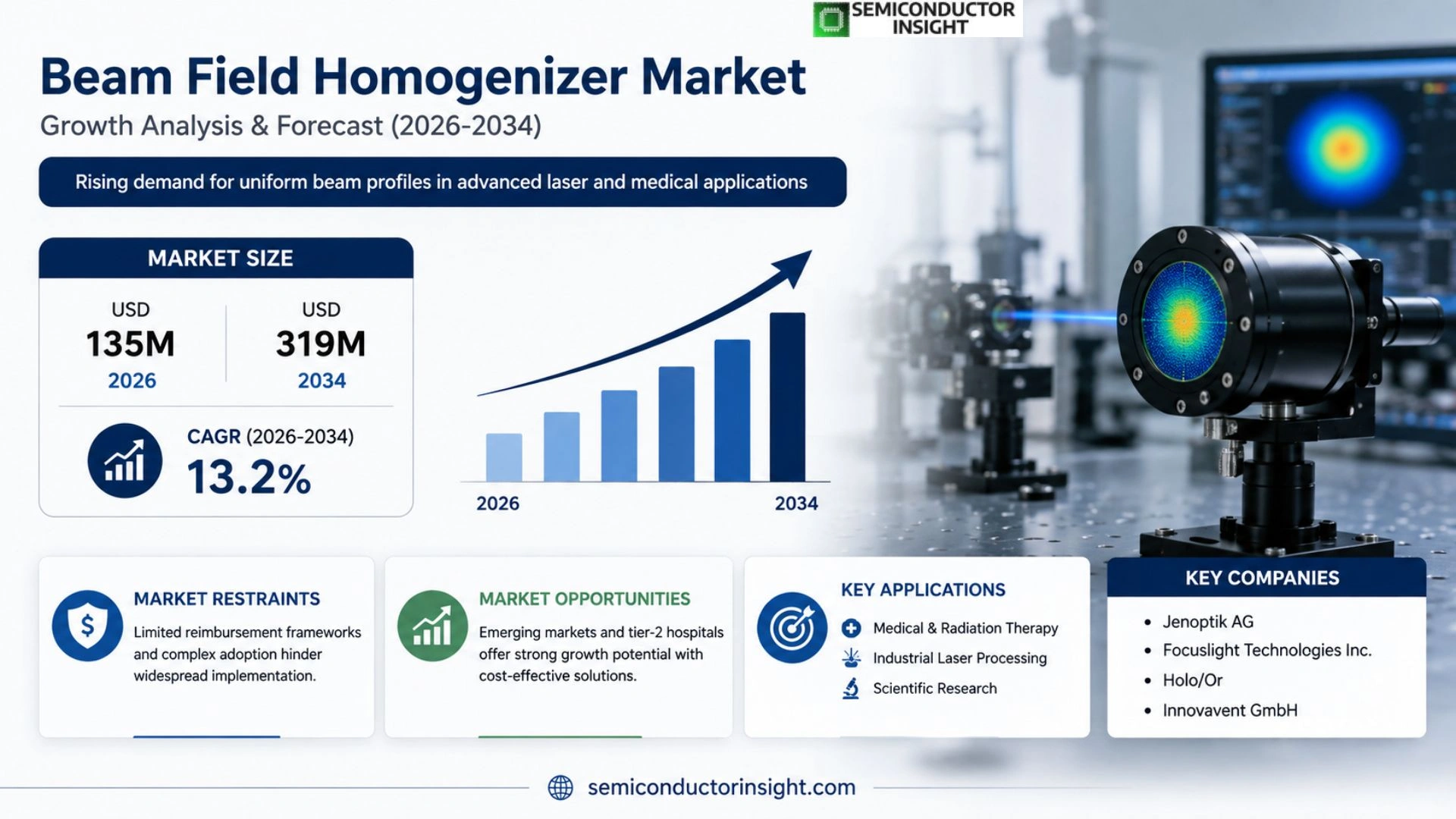
Beam Field Homogenizer market is projected to grow from USD 135 million in 2026 to USD 319 million by 2034, exhibiting a CAGR of 13.2% during the forecast period.
A Beam Field Homogenizer is an optical component or module designed for laser‑based and high‑uniformity illumination systems. Rather than merely diffusing light, it converts a Gaussian or hot‑spot‑prone input beam into a controlled, uniform output field through routes such as refractive microlens arrays, paired fly‑eye arrays, diffractive diffusers, field‑mapping shapers or beam‑splitting‑and‑overlap architectures. The device can generate line, square, rectangular, circular, hexagonal or custom geometries while maintaining non‑uniformity levels between 1% and 5%, high optical efficiency and long working distances across a spectral range that spans roughly 193 nm to 10.6 µm.
The upward trajectory of Beam Field Homogenizer Market reflects expanding demand from semiconductor manufacturing, laser material processing, medical aesthetics and surgery, advanced lighting and projection, machine vision and scientific instrumentation. Policy initiatives such as Europe’s Chips Act and U.S. CHIPS programs reinforce investment in lithography and inspection equipment, indirectly boosting homogenizer adoption. Recent activity includes Jenoptik AG’s collaboration with an industrial laser OEM announced in early 2024 and Focuslight Technologies’ launch of a new diffractive homogenizer platform targeting high‑throughput wafer inspection lines.
MARKET DRIVERS
Rising Demand for Uniform Radiation Therapy
Beam Field Homogenizer Market is energized by clinics seeking tighter dose uniformity in photon and electron treatments. Practitioners recognize that a homogeneous field reduces hot‑spot formation, thereby improving patient safety and therapeutic outcomes. This operational imperative pushes manufacturers to refine electro‑magnetic designs that deliver consistent fluence across larger treatment zones.
Advances in Material Science
Emerging alloys and composite structures now allow homogenizers to operate at higher power levels without sacrificing thermal stability. Such material breakthroughs translate into longer service intervals and lower total cost of ownership, a factor that resonates with budget‑conscious oncology centers.
➤ Integrating real‑time beam monitoring with homogenizer control loops has emerged as a differentiator, enabling clinicians to correct dose variations instantaneously.
Regulatory bodies are also tightening tolerances for dose heterogeneity, compelling equipment vendors to embed advanced homogenization technologies. Consequently, Beam Field Homogenizer Market experiences a feedback loop where tighter standards spur innovation, which in turn satisfies the stricter guidelines.
MARKET CHALLENGES
High Capital Expenditure for Up‑Front Installation
Large‑scale homogenizer systems command significant initial outlays, often exceeding the budget thresholds of smaller outpatient facilities. This expense barrier can delay adoption cycles, especially in regions where reimbursement mechanisms remain fragmented.
Other Challenges
Integration Complexity
Synchronizing homogenizer hardware with existing treatment planning software demands specialized engineering resources. Facilities lacking in‑house expertise may encounter prolonged commissioning times, which erodes the perceived return on investment.
Moreover, the scarcity of trained technicians capable of performing routine calibrations adds another layer of operational risk, prompting some providers to postpone upgrades until a robust support ecosystem matures.
MARKET RESTRAINTS
Limited Reimbursement Frameworks
Health insurers in several major markets have not yet codified specific reimbursement codes for procedures that rely on advanced beam homogenization. This omission creates financial uncertainty for providers contemplating new capital projects.
In addition, the steep learning curve associated with optimal homogenizer settings can deter early‑stage adopters. Institutions wary of potential treatment delays may opt for conventional beam shaping techniques, thereby suppressing market momentum.
MARKET OPPORTUNITIES
Emerging Markets and Tier‑2 Hospitals
Rapid expansion of oncology services in emerging economies opens a pathway for vendors to introduce scaled‑down homogenizer solutions tailored to tier‑2 hospitals. These units, priced competitively, can deliver acceptable uniformity while respecting local budget constraints.
Additionally, collaborations between equipment manufacturers and software firms are birthing integrated platforms that automate homogenizer configuration based on patient‑specific anatomy. Such turnkey offerings reduce the expertise gap and accelerate deployment timelines.
Finally, the growing emphasis on value‑based care incentivizes providers to adopt technologies that demonstrably improve clinical outcomes. Beam homogenization, by minimizing dose variability, aligns with this strategic shift, positioning Beam Field Homogenizer Market for sustained relevance.
Beam Field Homogenizer Market Trendsoptical communication
Uniformity Demands in Semiconductor Lithography
The escalating precision requirements of semiconductor lithography and high‑throughput laser material processing are reshaping purchasing patterns for optical components. As patterning nodes migrate below 10 nm, manufacturers cannot tolerate beam hotspots or edge roll‑off; a homogenized field becomes a prerequisite for yield stability. Recent equipment releases demonstrate that a 1‑5 % non‑uniformity specification is now standard, pushing system integrators to source homogenizers that combine broad spectral coverage (200 nm–1.6 µm) with high optical efficiency. This shift elevates the component from an ancillary diffuser to a core enabler of process windows, influencing throughput, defect density, and ultimately product cost. Suppliers that can guarantee long working distances and compatibility with both single‑mode and multimode sources are gaining preferred‑vendor status, especially in fabs where downtime directly translates into financial penalties. These dynamics are reshaping the competitive landscape of Beam Field Homogenizer Market.
Other Trends
Technology Route Diversification
Suppliers are no longer competing on a single optical principle; the market now hosts five mature routes,refractive microlens arrays, diffractive diffusers, paired fly’s‑eye modules, field‑mapping shapers, and beam‑splitting overlap systems. Each solution maps to distinct application constraints. Refractive designs retain an advantage where ultra‑wide spectral bandwidth and low zero‑order diffraction are critical, making them prevalent in inspection tools that span UV to IR. Diffractive formats excel in custom geometries such as hexagonal or arbitrary shapes, supporting emerging display‑backplane lithography. Fly’s‑eye and microlens arrays dominate high‑volume laser‑drilling lines because of their modularity and proven reliability. Field‑mapping shapers differentiate themselves by delivering steep edge transitions and extended working distances, a trait required for large‑area welding stations. Consequently, OEMs are forming co‑development programs with optics vendors to lock in specific performance envelopes, which raises entry barriers for newcomers lacking in‑house design and coating capabilities.
Regional Supply‑Chain Realignment
Geographically, the supply chain is fragmenting along a north‑south axis. European firms, anchored by strong R&D tax incentives, focus on bespoke beam‑shaping platforms for photonic‑switching and high‑resolution inspection, while Chinese manufacturers leverage scale in microlens‑array production to meet the surge in domestic semiconductor fabs. Japanese players maintain a reputation for tight dimensional tolerance and stable fly’s‑eye assemblies, attracting customers in precision medical‑surgery equipment. Meanwhile, Israeli companies specialize in diffractive metasurfaces that enable ultra‑compact top‑hat outputs for emerging lidar and optical‑communication modules. Policy measures such as the European Chips Act and U.S. semiconductor subsidies are nudging fabs to source locally, which in turn stimulates regional demand for integrated homogenizer subsystems. The net effect is a gradual shift from a single global vendor pool toward multiple regional ecosystems that align closely with localized production roadmaps.
COMPETITIVE LANDSCAPE
Key Industry Players
Beam Field Homogenizer Market – Competitive Overview
Jenoptik AG dominates the upper tier of the market, leveraging a portfolio that spans refractive microlens arrays, diffractive diffusers and integrated field‑mapping shapers. Its ability to deliver sub‑percent non‑uniformity across a spectral span from deep‑UV to infrared has cemented relationships with leading semiconductor lithography equipment makers. The company’s vertical integration,from precision glass polishing to proprietary coating processes,creates a barrier that few challengers can match, and it routinely secures long‑term supply contracts for high‑volume wafer inspection tools. This leadership forces the competitive arena to fragment into distinct technology lanes, with each lane attracting specialists that excel in a particular performance metric such as working distance, edge steepness, or custom geometry generation.
Beyond the market leader, a cadre of niche innovators is shaping the field through focused differentiation. Focuslight Technologies Inc. (USA) concentrates on fly‑eye paired arrays tailored for laser‑material‑processing platforms, while Germany’s Holo/Or and Innovavent GmbH specialize in diffractive homogenizers that enable arbitrary shape outputs for medical‑aesthetic lasers. Gooch & Housego PLC (UK) and asphericon GmbH (Germany) offer hybrid solutions that blend refractive and diffractive elements, targeting scientific instrumentation where stability outweighs cost. Asian manufacturers such as Shanghai North Ocean Photonics Technology Co., Ltd. and MPNICS Co., Ltd. (Korea) provide high‑throughput microlens‑array modules for display and projection applications, capitalizing on cost‑effective volume production. SIGMA KOKI CO., LTD. (Japan) and AGC Inc. (Japan) remain strong in standardized fly‑eye optics, delivering reliable performance for machine‑vision systems. Smaller yet technically agile firms,Chengdu NG‑OE (China) and AdlOptica GmbH (Germany),focus on custom‑engineered beam‑splitting‑and‑overlap architectures that meet the stringent uniformity requirements of emerging quantum‑chip fabrication lines.
List of Key Beam Field Homogenizer Companies Profiled
- Jenoptik AG
- Focuslight Technologies Inc.
- Holo/Or
- Innovavent GmbH
- Gooch & Housego PLC
- AdlOptica GmbH
- asphericon GmbH
- Shanghai North Ocean Photonics Technology Co., Ltd.
- MPNICS Co., Ltd.
- SIGMA KOKI CO., LTD.
- AGC Inc.
- Chengdu NG‑OE
Segment Analysis:
| Segment Category | Sub-Segments | Key Insights |
| By Type |
|
Refractive Solutions
|
| By Application |
|
Semiconductor Manufacturing
|
| By End User |
|
Equipment Manufacturers
|
| By Technology Route |
|
Diffractive Solutions
|
| By Output Geometry |
|
Custom Arbitrary Shapes
|
Regional Analysis: Beam Field Homogenizer Market
Europe
EU directives enforce strict conformity testing, compelling manufacturers to embed traceability and redundancy into hardware design. This pressure fosters higher reliability, which in turn convinces clinicians to replace legacy systems with homogenizers that meet the elevated safety bar.
Leading cancer centres have piloted adaptive beam shaping, leveraging real‑time feedback loops. Early successes accelerate peer‑influence, prompting a cascade of procurement decisions across public and private institutions.
Proximity of precision optics manufacturers shortens lead times for critical components. This logistical advantage reduces inventory risk and supports just‑in‑time assembly practices favored by European integrators.
Clinicians prioritise dose uniformity and system interoperability. Vendors that bundle homogenizer modules with existing treatment planning platforms enjoy higher acceptance rates in multidisciplinary hospitals.
North America
The United States market is shaped by a competitive landscape where large medical‑device conglomerates dominate procurement discussions. Payers increasingly tie reimbursement to treatment precision, prompting providers to explore Beam Field Homogenizer solutions that can demonstrably reduce marginal dose variations. However, the fragmented regulatory environment, with both FDA and state‑level approvals, introduces longer certification timelines compared with Europe. Manufacturers respond by establishing dedicated compliance teams to navigate the dual‑track process, a practice that raises development costs but also yields differentiated product portfolios appealing to high‑volume cancer centres.
Asia‑Pacific
Rapid urbanisation and expanding private healthcare networks in China, India, and South Korea create a sizeable pool of potential adopters. While cost sensitivity remains a dominant consideration, emerging reimbursement frameworks are gradually rewarding advanced radiation technologies. Local firms are investing in joint ventures with European suppliers to acquire homogenizer expertise, effectively shortening the learning curve. The region’s relative scarcity of high‑precision component manufacturers, however, forces many projects to rely on imported optics, adding logistical complexity that can delay implementation.
South America
Brazil and Argentina host a modest but growing cohort of oncology facilities seeking to modernise legacy linac fleets. Governmental health initiatives aim to improve cancer outcomes, yet fiscal constraints limit large‑scale capital expenditures. As a result, institutions favour turnkey homogenizer packages that bundle equipment, training, and service contracts. The market’s slower pace is offset by a willingness to adopt proven technologies from established overseas vendors, granting them a foothold despite limited local production capacity.
Middle East & Africa
Gulf Cooperation Council countries are channeling sovereign wealth into state‑of‑the‑art medical hubs, where Beam Field Homogenizer installations are positioned as symbols of clinical excellence. In contrast, sub‑Saharan markets contend with infrastructure challenges and lower awareness of advanced radiotherapy options. Partnerships between multinational OEMs and regional distributors help bridge this gap, delivering tailored financing solutions that align with diverse budgetary realities while introducing the technology to a broader patient base.
Report Scope
This market research report provides a comprehensive analysis of the Beam Field Homogenizer Market , covering the forecast period 2026–2034. It offers detailed insights into market dynamics, technological advancements, competitive landscape, and key trends shaping the industry.
Key focus areas of the report include:
- Market Overview: The report begins with an overview outlining its current market scenario, key growth indicators, and industry transformation drivers. It discusses macroeconomic factors, demand–supply balance, regulatory landscape, and the strategic role of semiconductors in powering advancements across industries such as automotive, telecommunications, consumer electronics, and industrial automation.
- Market Size & Forecast: Historical data and future projections for revenue, unit shipments, and market value across major regions and segments.
- Segmentation Analysis: Detailed breakdown by product type, technology, application, and end-user industry to identify high-growth segments and investment opportunities.
- Regional Insights: Insights into market performance across North America, Europe, Asia-Pacific, Latin America, and the Middle East & Africa, including country-level analysis where relevant.
- Competitive Landscape: Profiles of leading market participants, including their product offerings, R&D focus, manufacturing capacity, pricing strategies, and recent developments such as mergers, acquisitions, and partnerships.
- Technology Trends & Innovation: Assessment of emerging technologies, integration of AI/IoT, semiconductor design trends, fabrication techniques, and evolving industry standards.
- Market Drivers & Restraints: Evaluation of factors driving market growth along with challenges, supply chain constraints, regulatory issues, and market-entry barriers.
- Stakeholder Insights: Insights for component suppliers, OEMs, system integrators, investors, and policymakers regarding the evolving ecosystem and strategic opportunities.
Primary and secondary research methods are employed, including interviews with industry experts, data from verified sources, and real-time market intelligence to ensure the accuracy and reliability of the insights presented.
FREQUENTLY ASKED QUESTIONS:
What is the current market size of Beam Field Homogenizer Market?
-> Beam Field Homogenizer market is projected to grow from USD 135 million in 2026 to USD 319 million by 2034, exhibiting a CAGR of 13.2%
Which key companies operate in Beam Field Homogenizer Market?
-> Key players include Jenoptik AG, Focuslight Technologies Inc., Holo/Or, Innovavent GmbH, Gooch & Housego PLC, ADLOptica GmbH, asphericon GmbH, Shanghai North Ocean Photonics Technology Co., Ltd., MPNICS Co., Ltd., SIGMA KOKI CO., LTD., AGC Inc., Chengdu NG-OE, among others.
What are the key growth drivers?
-> Key growth drivers include rising demand for high‑precision semiconductor manufacturing, expansion of laser material processing, growth in medical and aesthetic laser applications, increased adoption in machine vision and scientific instrumentation, and broader uptake of advanced display and optical communication technologies.
Which region dominates the market?
-> Asia leads the market owing to strong manufacturing capabilities in China and Japan and growing demand across semiconductor and laser‑processing sectors, while Europe and North America also retain significant shares.
What are the emerging trends?
-> Emerging trends include multi‑route homogenization technologies (refractive, diffractive, fly’s‑eye, field‑mapping, beam‑splitting), customized output field geometries, integration with AI‑driven process control, and expanding applications in co‑packaged optics and intelligent sensing.
Get Sample Report PDF for Exclusive Insights
Report Sample Includes
- Table of Contents
- List of Tables & Figures
- Charts, Research Methodology, and more...
 Download Sample Report PDF