Automotive LIN RGB LED Driver Market Insights
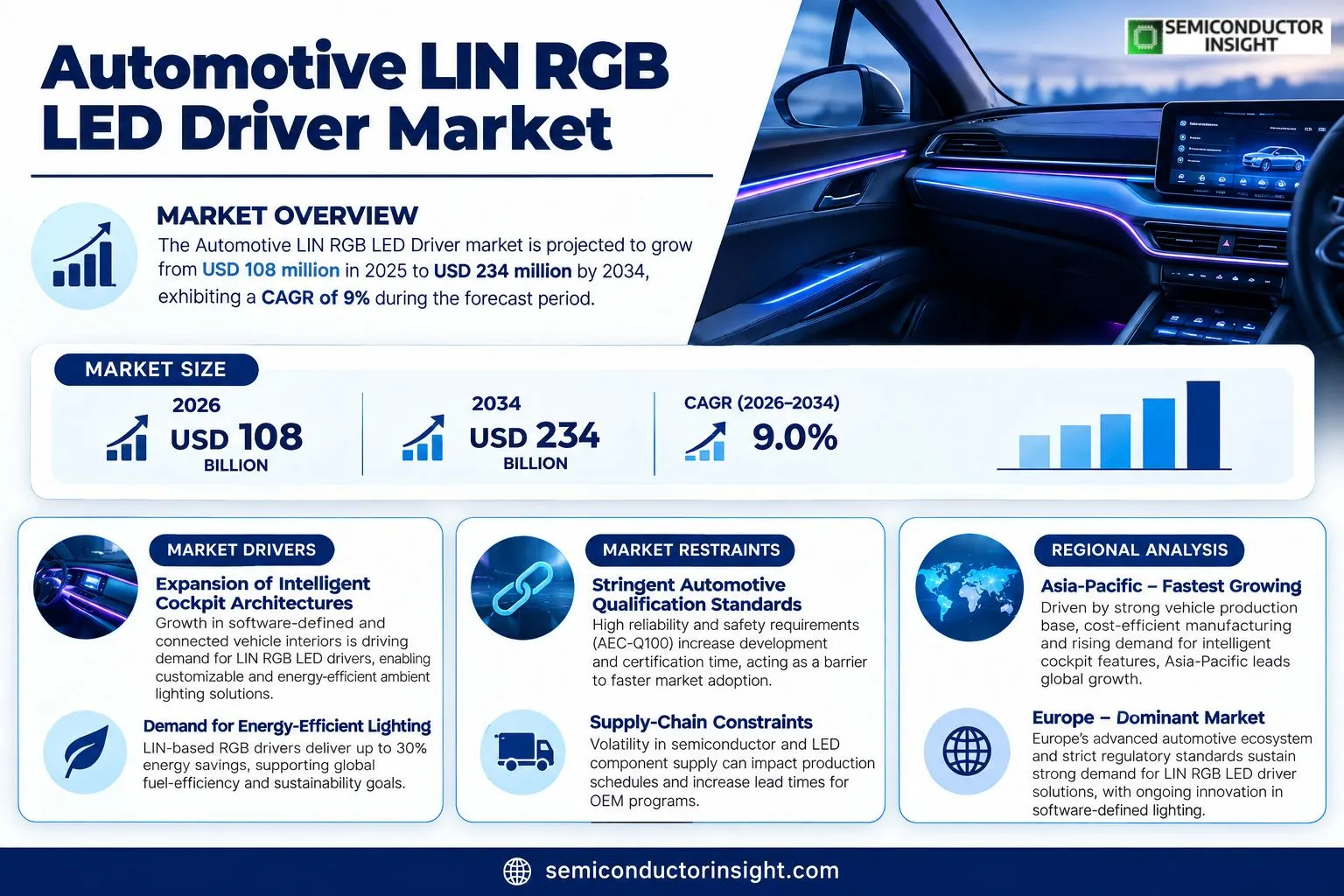
Automotive LIN RGB LED Driver market size was valued at USD 108 million in 2025. The market is projected to grow from USD 108 million in 2025 to USD 234 million by 2034, exhibiting a CAGR of 9 % during the forecast period.
Automotive LIN RGB LED Driver is an automotive‑grade driver device designed for in‑cabin ambient lighting systems, using a bus‑based control architecture to precisely regulate red, green, and blue multi‑channel LED loads. It enables stable dimming, accurate color mixing, and consistent brightness output, meeting the requirements of intelligent cockpits for visual uniformity, system reliability, and cost efficiency.The market is gaining momentum because vehicle manufacturers are expanding ambient lighting from premium models into mass‑market cars, while LIN‑based solutions offer a cost‑effective balance of bandwidth and diagnostics for multi‑zone lighting nodes. However, challenges such as stringent automotive qualification standards and supply constraints for semiconductor equipment temper growth prospects. Recent collaborationssuch as Infineon’s partnership with major OEMs on next‑generation cockpit platformsillustrate how manufacturers are addressing these hurdles while pursuing higher channel integration and improved thermal performance.
MARKET DRIVERS
Integration of LIN Protocol with Interior Lighting
The shift toward modular vehicle architectures has encouraged manufacturers to embed LIN (Local Interconnect Network) controllers directly into RGB LED driver modules. This consolidation trims wiring complexity and cuts assembly time, giving OEMs a tangible cost advantage while preserving the flexibility needed for customizable cabin ambience.
Demand for Energy‑Efficient Lighting Solutions
Regulatory pressure to lower vehicle‑level power consumption is prompting designers to replace legacy incandescent fixtures with low‑draw LED arrays. Because LIN‑based drivers can dynamically dim and colour‑shift LEDs, they deliver up to 30 % energy savings compared with conventional lighting architectures, a margin that directly improves fuel‑efficiency targets.
➤ Manufacturers that standardize on LIN‑controlled RGB drivers are seeing faster design cycles, enabling new model launches within 10‑12 months versus the 14‑month timelines of prior generations.
In parallel, the rise of human‑centred vehicle interiorswhere mood lighting supports driver alertness and passenger comfortcreates a premium segment that values fine‑grained colour control, reinforcing the strategic importance of Automotive LIN RGB LED Driver Market.
MARKET CHALLENGES
Compatibility with Legacy ECUs
Many Tier‑1 suppliers still rely on legacy electronic control units that were not designed for high‑frequency LIN communication, leading to integration friction and the need for additional gateway modules.
Other Challenges
Supply‑Chain Volatility
Fluctuating silicon availability and the concentration of LED component manufacturing in a limited number of regions expose the market to lead‑time extensions, which can delay vehicle programs.
MARKET RESTRAINTS
Cost Sensitivity in Volume Segments
While premium models eagerly adopt advanced RGB lighting, mass‑market vehicles remain price‑driven. The incremental expense of LIN‑enabled driver ICsoften 15‑20 % higher than simple PWM solutionsacts as a barrier to broader diffusion, especially where profit margins are thin.
MARKET OPPORTUNITIES
Expansion into Aftermarket Customisation
The aftermarket presents a fertile niche for retrofit kits that leverage LIN‑controlled RGB drivers to upgrade fleet vehicles and consumer cars with dynamic interior lighting. As regulatory frameworks relax for non‑essential vehicle modifications, third‑party providers can capture a sizable share of the growth trajectory.
Automotive LIN RGB LED Driver Market Trends
LIN‑Based Ambient Lighting Gains Traction
Automotive LIN RGB LED Driver Market is being reshaped by the broader move toward cost‑efficient, software‑centric cockpit designs. Automakers increasingly favor LIN as the control bus for in‑cabin ambient lighting because it delivers adequate bandwidth while keeping wiring complexity low. This architectural choice enables designers to place multiple lighting nodes throughout the cabin without incurring the expense of high‑speed CAN or Ethernet networks. The result is a finer granularity of color zones, which translates into a more immersive passenger experience and a new dimension of brand differentiation. For suppliers, the shift creates a clear incentive to integrate fault‑diagnosis and reconfiguration capabilities directly into the driver IC, thereby aligning hardware functionality with the emerging trend of over‑the‑air updates.
Other Trends
Supply‑Chain Rationalisation
Upstream, Automotive LIN RGB LED Driver Market is witnessing tighter coordination between semiconductor equipment manufacturers and driver designers. The reliance on a limited set of high‑precision lithography tools has spurred joint development programs that aim to reduce cycle time for new node adoption. Mid‑stream design houses are consolidating multi‑channel constant‑current architectures into single‑chip solutions, which lowers board‑level part counts and improves thermal performance. Downstream, OEMs are standardising on a core set of driver specifications across multiple vehicle platforms, allowing volume discounts and more predictable demand patterns. This harmonisation reduces inventory risk for Tier‑1 suppliers and opens space for smaller vendors that can specialise in niche qualification standards such as AEC‑Q100.
Expansion Beyond Premium Segments
Historically, sophisticated ambient lighting was confined to premium models, but Automotive LIN RGB LED Driver Market now sees adoption in high‑volume passenger cars. The driver’s modest price point and its ability to operate reliably under automotive temperature extremes make it an attractive upgrade for mid‑range fleets seeking to offer a differentiated cabin ambience without a hefty cost premium. As regulatory scrutiny on vehicle lighting uniformity loosens, manufacturers can experiment with dynamic colour schemes that enhance perceived interior quality. This diffusion creates a feedback loop: broader deployment drives higher production volumes, which in turn pushes unit prices down and encourages further integration of advanced lighting effects such as synchronised music‑responsive zones.
COMPETITIVE LANDSCAPE
Key Industry Players
Competitive Landscape of Automotive LIN RGB LED Drivers
The market is anchored by a handful of semiconductor groups that have translated deep automotive‑grade expertise into dominant LIN‑based RGB driver portfolios. Infineon Technologies, leveraging its extensive automotive‑qualified product line and long‑standing relationships with OEMs such as BMW and Volkswagen, commands the largest share of volume shipments. Its ability to integrate multi‑channel constant‑current architectures with robust diagnostic features has set a benchmark for cost‑effective ambient lighting solutions. NXP Semiconductors follows closely, differentiating through a tight coupling of LIN communication stacks with advanced color‑mixing algorithms that satisfy the growing demand for software‑defined cockpit experiences. Melexis, while smaller in scale, has carved a niche by offering highly integrated, low‑power modules that fit within tight packaging constraints, making it especially attractive to compact vehicle platforms and Chinese manufacturers expanding premium interiors.Beyond the tier‑one leaders, a diverse cohort of specialists contributes depth and regional balance to the ecosystem. Elmos and Shanghai Tinychip Limited supply silicon that emphasizes high‑temperature tolerance, essential for under‑hood ambient lighting nodes. ON Semiconductor and Microchip Technology provide broad driver families that are easily re‑targeted across passenger‑car and commercial‑vehicle platforms. Lumissil, ROHM Semiconductor, STMicroelectronics, Renesas Electronics, Texas Instruments, and Cypress (now part of Infineon) each bring distinctive design philosophiesranging from linear to boost topologiesthat enable OEMs to tailor performance to specific vehicle segments. This mix of powerhouses and agile niche players creates a competitive fabric where innovation cycles are rapid, pricing pressure is tangible, and supply‑chain resilience is increasingly a differentiator.
List of Key Automotive LIN RGB LED Driver Companies Profiled
- Infineon Technologies
- NXP Semiconductors
- Melexis
- ON Semiconductor
- Microchip Technology
- Elmos
- Shanghai Tinychip Limited
- Lumissil
- ROHM Semiconductor
- STMicroelectronics
- Renesas Electronics
- Texas Instruments
- Cypress Semiconductor
Segment Analysis:
| Segment Category | Sub-Segments | Key Insights |
| By Type |
|
Multi‑channel is emerging as the preferred architecture because it consolidates control logic, reduces wiring complexity, and enables richer ambient lighting palettes.
|
| By Application |
|
Passenger Cars dominate the demand landscape as automakers embed ambient lighting throughout interior cabins to reinforce premium brand experiences.
|
| By End User |
|
OEMs shape specifications because they integrate drivers directly into vehicle ECUs and must satisfy stringent automotive reliability standards.
|
| By Drive Type |
|
Buck LED Driver is most widely adopted due to its efficiency in stepping down vehicle battery voltage while maintaining stable current for RGB LEDs.
|
| By Qualification |
|
AEC‑Q100 remains the benchmark qualification because it addresses the rigorous temperature cycling, vibration, and electrical stress tests required for automotive electronics.
|
Regional Analysis: Automotive LIN RGB LED Driver Market
The EU’s recent update to the Whole Vehicle Type Approval (WVTA) mandates tighter electromagnetic compatibility for lighting systems. This compels designers to adopt LIN‑based drivers that can be precisely calibrated, ensuring compliance without extensive hardware redesign, and accelerates supplier alignment with regulatory timelines.
Semiconductor fabs in the Netherlands and Germany have shortened lead times by consolidating wafer processing for automotive‑grade RGB drivers. Coupled with a robust logistics network, this reduces inventory risk for assemblers and enables just‑in‑time delivery to chassis lines across the continent.
European buyers increasingly associate interior lighting with brand identity. Premium brands are therefore embedding driver firmware that supports user‑defined color palettes via infotainment interfaces, creating a direct link between driver capability and perceived vehicle luxury.
Key players such as Infineon and NXP are forming joint development programs with German automotive suppliers, targeting integrated LIN master‑slave architectures that reduce PCB footprint while enhancing diagnostic access for service workshops.
North America
In the United States and Canada, Automotive LIN RGB LED Driver Market is shaped by a fast‑adopting consumer segment that values personalization. Tier‑1 suppliers are embedding LIN drivers within combined lighting and infotainment modules to meet the demand for dynamic cabin moods that can be synchronized with voice assistants. While regulatory pressure is lighter than in Europe, durability standards imposed by large fleet operators necessitate drivers that can endure harsh temperature swings, prompting a preference for hardened silicon solutions. The aftermarket is gaining traction as owners of older models seek retrofit kits that add programmable ambience, creating a secondary growth channel outside original equipment.
Asia‑Pacific
China, Japan and South Korea drive volume in Automotive LIN RGB LED Driver Market through expansive production capacities and aggressive pricing strategies. Manufacturers prioritize cost‑efficiency, often selecting drivers that can be integrated with existing LIN networks without extensive re‑engineering. Simultaneously, a rising middle class in India and Southeast Asia is elevating expectations for vehicle interior aesthetics, nudging local OEMs to adopt higher‑spec drivers that support richer color spectra. Supply‑chain resilience is a focal point, with regional fabs scaling output to offset semiconductor shortages that have previously disrupted launch schedules.
South America
Brazil and Argentina exhibit cautious optimism toward LIN‑based lighting control. Limited domestic semiconductor capability leads many automakers to import drivers, inflating unit costs but also exposing the market to price fluctuations. Nevertheless, the region’s growing emphasis on safety‑related lightingsuch as adaptive turn signalscreates an ancillary demand for reliable LIN drivers that can interface with advanced driver‑assistance systems. Local distributors are beginning to offer value‑added services, including firmware updates that extend the functional life of installed drivers, thereby mitigating the impact of higher acquisition costs.
Middle East & Africa
The market in this region is fragmented, with the Gulf Cooperation Council states focusing on premium vehicle segments where interior customization is a status symbol. High ambient temperatures impose strict thermal performance requirements on LED drivers, prompting suppliers to adopt enhanced heat‑dissipation architectures. In Africa, the growth trajectory is slower, yet the expansion of ride‑hailing fleets introduces a modest demand for durable lighting solutions that can be serviced remotely through LIN‑enabled diagnostics. Collaborative projects between European component makers and local assembly plants aim to localize production, reducing lead times and fostering a nascent ecosystem for Automotive LIN RGB LED Driver Market.
Report Scope
This market research report provides a comprehensive analysis of Automotive LIN RGB LED Driver Market , covering the forecast period 2026–2034. It offers detailed insights into market dynamics, technological advancements, competitive landscape, and key trends shaping the industry.
Key focus areas of the report include:
- Market Overview: The report begins with an overview outlining its current market scenario, key growth indicators, and industry transformation drivers. It discusses macroeconomic factors, demand–supply balance, regulatory landscape, and the strategic role of semiconductors in powering advancements across industries such as automotive, telecommunications, consumer electronics, and industrial automation.
- Market Size & Forecast: Historical data and future projections for revenue, unit shipments, and market value across major regions and segments.
- Segmentation Analysis: Detailed breakdown by product type, technology, application, and end-user industry to identify high-growth segments and investment opportunities.
- Regional Insights: Insights into market performance across North America, Europe, Asia-Pacific, Latin America, and the Middle East & Africa, including country-level analysis where relevant.
- Competitive Landscape: Profiles of leading market participants, including their product offerings, R&D focus, manufacturing capacity, pricing strategies, and recent developments such as mergers, acquisitions, and partnerships.
- Technology Trends & Innovation: Assessment of emerging technologies, integration of AI/IoT, semiconductor design trends, fabrication techniques, and evolving industry standards.
- Market Drivers & Restraints: Evaluation of factors driving market growth along with challenges, supply chain constraints, regulatory issues, and market-entry barriers.
- Stakeholder Insights: Insights for component suppliers, OEMs, system integrators, investors, and policymakers regarding the evolving ecosystem and strategic opportunities.
Primary and secondary research methods are employed, including interviews with industry experts, data from verified sources, and real-time market intelligence to ensure the accuracy and reliability of the insights presented.
FREQUENTLY ASKED QUESTIONS:
What is the current market size of Automotive LIN RGB LED Driver Market?
-> Automotive LIN RGB LED Driver Market was valued at USD 108 million in 2025 and is expected to reach USD 198 million by 2032.
Which key companies operate in Automotive LIN RGB LED Driver Market?
-> Key players include Elmos, Infineon Technologies, NXP Semiconductors, Melexis, ON Semiconductor, Microchip Technology, Shanghai Tinychip Limited, Lumissil, among others.
What are the key growth drivers?
-> Key growth drivers include expansion of intelligent cockpit architectures, demand for cost‑efficient multi‑zone ambient lighting, and software‑defined lighting control features.
Which region dominates the market?
-> Asia is the fastest‑growing region, while Europe remains a dominant market.
What are the emerging trends?
-> Emerging trends include integration of LIN‑controlled RGB drivers in high‑volume passenger cars, enhanced fault‑diagnostics, and higher channel integration for robustness.
Get Sample Report PDF for Exclusive Insights
Report Sample Includes
- Table of Contents
- List of Tables & Figures
- Charts, Research Methodology, and more...