AC Power Plugs Market Insights
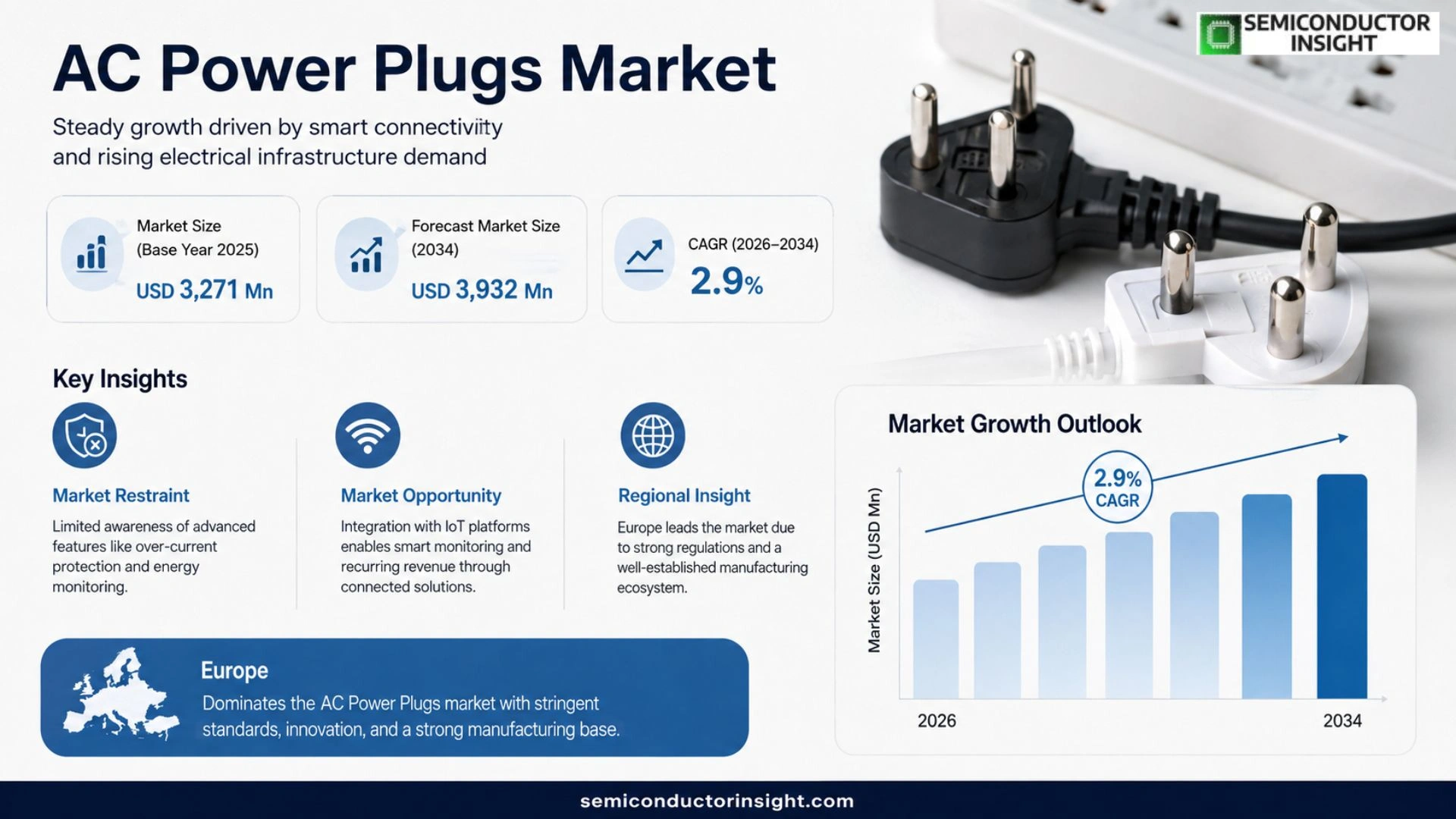
AC Power Plugs market was valued at USD 3,271 million in 2025 and is projected to reach USD 3,932 million by 2034, exhibiting a CAGR of 2.9% during the forecast period.
AC Power Plugs are standardized electrical connector components that provide a safe, detachable link between an alternating‑current source and an electrical load. Typically mounted on power cords or portable equipment, the plugs contain pins or blades that mate with receptacle contacts fixed to walls, panels, distribution units or enclosures. Designs incorporate grounding, polarization, finger‑safe geometry, flame‑retardant insulation and mechanical locking to meet residential (e.g., NEMA, Schuko), commercial and industrial (e.g., IEC 60309) requirements.
The market is being shaped by rising electricity consumption worldwide,global demand grew 1.9% in 2022,and expanding construction of power infrastructure in China and other emerging economies. At the same time, manufacturers face pressure from raw‑material cost volatility and stricter safety standards, prompting product innovation such as IP‑rated housings for harsh environments. Leading suppliers including Eaton, ABB, Siemens and Schneider Electric continue to broaden portfolios through modular designs and digital integration.
MARKET DRIVERS
Electrification of Residential and Commercial Spaces
Across North America and Europe, the replacement cycle for legacy wiring is accelerating as building owners adopt smart‑ready infrastructure. This shift fuels demand for AC Power Plugs that comply with newer safety standards and accommodate higher current loads, prompting manufacturers to expand product portfolios.
Growth of Consumer Electronics
The proliferation of high‑performance laptops, gaming consoles, and home‑office equipment has raised the average power draw per outlet. Vendors that integrate surge‑protection and USB‑PD capabilities into conventional plugs are capturing a larger share of AC Power Plugs market.
➤ Regulatory convergence on plug design, especially the EU’s revised safety directive, is encouraging global manufacturers to harmonize production lines, reducing unit costs and opening cross‑border sales channels.
As retailers consolidate inventory to improve shelf efficiency, the trend toward modular plug assemblies,where interchangeable pins serve multiple regions,has become a decisive factor in procurement decisions.
MARKET CHALLENGES
Component Shortages and Price Volatility
The semiconductor bottleneck that began in 2022 continues to affect the supply of contact alloys and embedded circuitry. Manufacturers face margin compression as they absorb higher material costs while competing on price.
Other Challenges
Compliance Complexity
Differing national certifications,such as UL, CE, and CSA,require distinct testing regimes, lengthening time‑to‑market for new designs and increasing engineering overhead.
MARKET RESTRAINTS
Limited Awareness of Advanced Features
End‑users often perceive AC Power Plugs as interchangeable, overlooking benefits such as over‑current protection or energy‑monitoring. This knowledge gap dampens premium‑segment growth, forcing vendors to rely on volume sales of basic units.
MARKET OPPORTUNITIES
Integration with IoT Platforms
Manufacturers that embed wireless modules capable of reporting outlet status to building‑management systems are positioned to tap emerging smart‑building contracts. The convergence of power delivery and data analytics opens recurring‑revenue streams through subscription‑based monitoring services.
AC Power Plugs Market Trends
Standardization and Safety Compliance Driving Volume Growth
AC Power Plugs market recorded roughly 710 million units in 2025, averaging about US$5 per plug. A modest gross margin of 10‑20 % reflects the commodity nature of the product, yet manufacturers are extracting value by aligning with tightening safety codes in both residential and heavy‑duty sectors. Uniform pin configurations, grounding requirements, and flame‑retardant housings have become de‑facto specifications in new construction, prompting OEMs to prioritize compliant designs over low‑cost alternatives. Because a single plug interfaces directly with the power distribution network, any deviation from prescribed standards can trigger costly liability claims, making compliance a decisive factor in procurement decisions. Consequently, volume growth is sustained even as overall pricing remains flat, supporting a steady revenue uplift from US$3.27 billion in 2025 toward an anticipated US$3.93 billion by 2032.
Other Trends
Regional Investment and Grid Expansion
China’s power generation surged 3.7 % in 2022, with installed capacity climbing 7.8 % to 2.56 billion kW. Government‑backed spending of approximately 720.8 billion yuan on supply‑side engineering and 501.2 billion yuan on grid upgrades fuels demand for robust, high‑current plugs such as IEC 60309 types. Parallelly, the United States added 42.4 billion kWh of electricity in the same year, sustaining a healthy market for residential‑grade two‑hole and three‑hole plugs. The combination of expanding generation assets and renewed focus on grid reliability creates a fertile environment for plug manufacturers to capture incremental sales across both low‑ and high‑current segments.
Technology‑Driven Design Evolution
Beyond compliance, manufacturers are embedding advanced features,IP‑rated enclosures for outdoor installations, smart‑module interfaces for IoT connectivity, and reinforced mechanical locking for industrial machinery. These innovations address the growing need for durability in harsh environments while opening new revenue streams tied to data‑enabled energy management. As building automation systems proliferate, plug designs that facilitate remote monitoring and fault detection become attractive differentiators. Companies that accelerate R&D on such capabilities are positioned to command premium pricing and strengthen their foothold in niche applications like construction equipment, sports venues, and agricultural automation, where reliability and data visibility are increasingly decisive.
COMPETITIVE LANDSCAPE
Key Industry Players
Competitive Overview of AC Power Plugs market
Schneider Electric dominates the high‑volume residential segment, leveraging a worldwide sales network and a portfolio that spans the two‑hole and three‑hole families. Its ability to integrate safety‑critical features,grounding, polarization, and flame‑retardant housings,into mass‑produced units has secured long‑term contracts with major appliance OEMs and utility‑grade distributors. The firm’s strategic focus on standardized designs for Europe and North America, combined with aggressive pricing tactics, sustains a margin that comfortably sits within the 10‑20 % range reported for the sector. By aligning product development with evolving building‑code requirements, Schneider not only protects its market share but also creates entry barriers for smaller entrants lacking comparable compliance engineering resources.
Beyond the market leader, a constellation of specialized manufacturers competes on niche performance attributes and regional strengths. ABB and Siemens concentrate on industrial‑grade IEC 60309 solutions, offering rugged housings and higher IP ratings for outdoor installations. TE Connectivity and Molex differentiate through modular connector systems that serve data‑center power distribution and automation equipment. Panasonic and Leviton retain strong footholds in the consumer‑electronics space by coupling aesthetic design with cost‑effective tooling. Meanwhile, companies such as Amphenol, Hubbell, and Legrand focus on tailored product lines for commercial building infrastructure, emphasizing durability and serviceability. This dispersion of expertise across product types and geographic markets generates a competitive environment where differentiation hinges on engineering depth, certification portfolios, and the agility to adapt to regulatory shifts.
List of Key AC Power Plugs Companies Profiled
- Schneider Electric
- ABB
- Siemens
- TE Connectivity
- Molex
- Panasonic
- Legrand
- Leviton
- Hubbell
- Amphenol
- MEAN WELL
- Bulgin
- NESNE
- Hirose Connector
- Qualtek
Segment Analysis:
| Segment Category | Sub-Segments | Key Insights |
| By Type |
|
Leading Segment
|
| By Application |
|
Leading Segment
|
| By End User |
|
Leading Segment
|
| By Safety Feature |
|
Leading Segment
|
| By Environment |
|
Leading Segment
|
Regional Analysis: AC Power Plugs Market
Europe
The EU’s harmonized safety and electromagnetic‑compatibility standards compel manufacturers to certify every product across member states. This uniformity streamlines cross‑border sales but raises the cost of entry for newcomers lacking established testing capabilities. Companies that invest in in‑house certification labs gain a competitive edge by accelerating time‑to‑market.
Smart‑grid initiatives across Germany and Scandinavia encourage the rollout of plugs capable of handling higher currents and embedded communication modules. OEMs are integrating IoT‑ready designs that allow remote monitoring of load, which appeals to facility managers seeking operational insight.
A well‑established logistics corridor links raw‑material hubs in Poland with assembly plants in Italy, reducing lead times. Yet geopolitical tensions around rare‑earth sourcing compel manufacturers to diversify suppliers, a trend reshaping contract structures across the continent.
End‑users in Europe place premium value on durability and plug‑type consistency, especially in residential retrofits. Brands that communicate long‑life warranties and offer recyclable designs are gaining traction among environmentally conscious purchasers.
North America
North America’s market dynamics revolve around a fragmented standard landscape, where NEMA and IEC plug types coexist. This multiplicity creates niche opportunities for converters and hybrid designs, especially in industrial sectors that import European‑spec equipment. The United States’ emphasis on energy‑efficiency codes, such as the latest amendments to the National Electrical Code, nudges manufacturers toward lower‑loss contact materials. Meanwhile, Canada’s aggressive electrification of public transport introduces a demand for rugged, weather‑sealed plugs capable of sustained high‑current operation. Companies that can harmonize product lines across the continent while maintaining compliance with both federal and provincial regulations capture a sizable share of the value chain.
Asia‑Pacific
The Asia‑Pacific region presents a contrasting picture where rapid urbanization collides with diverse electrical standards across China, India, Japan, and Southeast Asian nations. Emerging economies prioritize cost‑effective solutions, prompting OEMs to favor injection‑molded housings and locally sourced copper. Nonetheless, a surge in data‑center construction in Singapore and Hong Kong is elevating demand for high‑density, fire‑rated plugs. Manufacturers that adapt modular designs to accommodate both legacy 220‑V systems and newer 380‑V installations are better positioned to serve a market that shifts quickly from price sensitivity to performance‑driven specifications.
South America
South America’s market is shaped by a combination of aging electrical grids and a growing middle class that upgrades household appliances at an accelerated pace. Brazil’s recent incentive program for renewable‑energy integration has spurred interest in plugs compatible with solar‑inverter outputs, while Argentina’s import‑substitution policies encourage local assembly. The region’s logistical hurdles, characterized by port congestion and inland transport bottlenecks, raise the importance of inventory strategies that buffer against delays. Suppliers that establish regional distribution hubs and offer flexible payment terms tend to outpace competitors in securing long‑term contracts.
Middle East & Africa
In the Middle East & Africa, climate extremes dictate a focus on corrosion‑resistant materials and thermal‑stable designs. The Gulf Cooperation Council’s investment in megaprojects,ranging from airport expansions to offshore platforms,drives demand for plugs rated for high ambient temperatures and sand‑ingress protection. Sub‑Saharan nations, meanwhile, are entering the formal electricity market, where low‑cost, robust solutions are essential for rural electrification schemes. Firms that blend durability with cost efficiency, often through strategic partnerships with local fabricators, capture a segment that values reliability over brand prestige.
Report Scope
This market research report provides a comprehensive analysis of the AC Power Plugs Market , covering the forecast period 2026–2034. It offers detailed insights into market dynamics, technological advancements, competitive landscape, and key trends shaping the industry.
Key focus areas of the report include:
- Market Overview: The report begins with an overview outlining its current market scenario, key growth indicators, and industry transformation drivers. It discusses macroeconomic factors, demand–supply balance, regulatory landscape, and the strategic role of semiconductors in powering advancements across industries such as automobile, telecommunications, consumer electronics, and industrial automation.
- Market Size & Forecast: Historical data and future projections for revenue, unit shipments, and market value across major regions and segments.
- Segmentation Analysis: Detailed breakdown by product type, technology, application, and end-user industry to identify high-growth segments and investment opportunities.
- Regional Insights: Insights into market performance across North America, Europe, Asia-Pacific, Latin America, and the Middle East & Africa, including country-level analysis where relevant.
- Competitive Landscape: Profiles of leading market participants, including their product offerings, R&D focus, manufacturing capacity, pricing strategies, and recent developments such as mergers, acquisitions, and partnerships.
- Technology Trends & Innovation: Assessment of emerging technologies, integration of AI/IoT, semiconductor design trends, fabrication techniques, and evolving industry standards.
- Market Drivers & Restraints: Evaluation of factors driving market growth along with challenges, supply chain constraints, regulatory issues, and market-entry barriers.
- Stakeholder Insights: Insights for component suppliers, OEMs, system integrators, investors, and policymakers regarding the evolving ecosystem and strategic opportunities.
Primary and secondary research methods are employed, including interviews with industry experts, data from verified sources, and real-time market intelligence to ensure the accuracy and reliability of the insights presented.
FREQUENTLY ASKED QUESTIONS:
What is the current market size of AC Power Plugs Market?
-> AC Power Plugs market is projected to reach USD 3,932 million by 2034, exhibiting a CAGR of 2.9% during the forecast period.
Which key companies operate in AC Power Plugs Market?
-> Key players include Eaton, ABB, Siemens, Schneider Electric, Panasonic, Neutrik, Molex, TE Connectivity, MEAN WELL, Altech, Phoenix Contact, Amphenol, Bulgin, Legrand, MENNEKES, Hubbell, Leviton, GEWISS, Hirose Connector, Apem, Olimex, Heyco, Qualtek, Schurter, Etman.
What are the key growth drivers?
-> Key growth drivers include increasing residential and commercial electrification, stricter safety and standardization regulations, growth of industrial automation, and rising demand for robust, IP‑rated connectors for harsh‑duty applications.
Which region dominates the market?
-> Asia holds the largest share of AC Power Plugs market, driven by extensive manufacturing activity and high electricity consumption in countries such as China and India.
What are the emerging trends?
-> Emerging trends include integration of smart and IoT‑enabled plugs, development of higher‑current industrial connectors, and increased use of flame‑retardant and environmentally‑friendly materials.

Get Sample Report PDF for Exclusive Insights
Report Sample Includes
- Table of Contents
- List of Tables & Figures
- Charts, Research Methodology, and more...