MARKET INSIGHTS
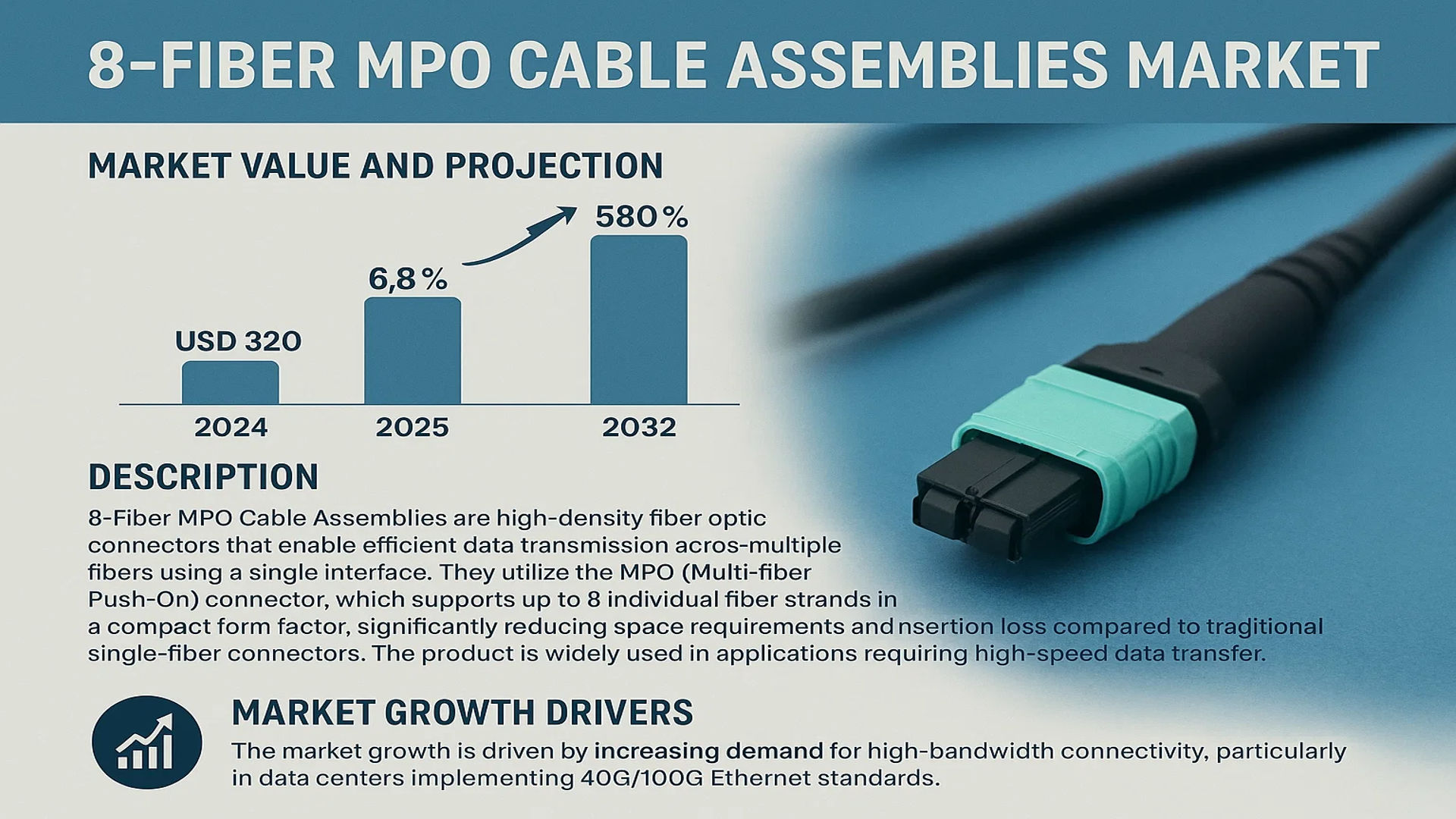
The global 8-Fiber MPO Cable Assemblies Market was valued at USD 320 million in 2024. The market is projected to grow from USD 352 million in 2025 to USD 580 million by 2032, exhibiting a CAGR of 6.8% during the forecast period.
8-Fiber MPO Cable Assemblies are high-density fiber optic connectors that enable efficient data transmission across multiple fibers using a single interface. These assemblies utilize the MPO (Multi-fiber Push-On) connector, which supports up to 8 individual fiber strands in a compact form factor, significantly reducing space requirements and insertion loss compared to traditional single-fiber connectors. The product is widely used in applications requiring high-speed data transfer, such as data centers and telecommunications networks.
The market growth is driven by increasing demand for high-bandwidth connectivity, particularly in data centers implementing 40G/100G Ethernet standards. While North America currently dominates the market with a 38% revenue share in 2024, Asia-Pacific is expected to witness the fastest growth due to rapid digital infrastructure development. Key manufacturers including CommScope, Molex, and Panduit are investing in product innovations to meet evolving industry requirements for higher density and improved performance in next-generation networks.
MARKET DYNAMICS
MARKET DRIVERS
Exploding Data Center Demand Accelerates 8-Fiber MPO Adoption
The rapid expansion of hyperscale data centers is a primary driver for the 8-fiber MPO cable assemblies market. With global data center IP traffic projected to grow at a compound annual rate of over 25% through 2030, infrastructure providers are adopting high-density fiber solutions to accommodate increasing bandwidth requirements. 8-fiber MPO configurations offer an optimal balance between port density and future scalability, enabling efficient 40G/100G Ethernet deployments while maintaining compatibility with emerging 400G standards. Major cloud service providers have begun standardizing on 8-fiber MPO trunks for spine-leaf architectures, creating significant demand pull through their supply chains.
5G Network Rollouts Fuel Infrastructure Upgrades
The global transition to 5G networks is driving substantial investments in fiber-rich fronthaul and backhaul infrastructure. 8-fiber MPO assemblies provide telecom operators with the necessary fiber density to support massive MIMO antenna systems and distributed unit deployments. With over 2 million 5G base stations expected to be deployed by 2026, particularly in Asia-Pacific markets, the demand for pre-terminated MPO solutions is surging. These cables enable rapid deployment of fiber-dense connections between BBU hotels and remote radio heads while reducing installation time by up to 70% compared to field-terminated alternatives.
Enterprise Digital Transformation Expands Adoption
Enterprise migration to high-performance computing environments and private cloud architectures is creating new opportunities for 8-fiber MPO deployments. The technology’s ability to support breakout configurations for high-density switch connectivity makes it ideal for campus networks and enterprise data rooms. Industries with critical bandwidth requirements, such as financial services and healthcare, are increasingly adopting MPO-based solutions to future-proof their infrastructure. The enterprise segment is projected to account for over 30% of total MPO cable assembly demand by 2025 as organizations upgrade legacy cabling systems.
➤ The military and aerospace sector represents a high-growth vertical, with 8-fiber MPO assemblies being specified in over 60% of new tactical communications systems due to their reliability in harsh environments.
MARKET CHALLENGES
Precision Manufacturing Requirements Limit Supplier Capacity
The production of high-performance 8-fiber MPO cable assemblies requires specialized manufacturing capabilities and stringent quality control measures. Achieving consistent insertion loss below 0.5 dB across all fibers demands precision polishing equipment and cleanroom assembly environments. Many manufacturers face challenges in scaling production while maintaining these tight tolerances, particularly for single-mode variants. This capacity constraint has led to extended lead times during periods of peak demand, creating bottlenecks in deployment schedules for large-scale data center projects.
Other Challenges
Field Maintenance Complexities
Unlike traditional fiber connections, MPO trunks require specialized test equipment and trained technicians for troubleshooting and repairs. The multi-fiber nature of these assemblies makes fault isolation more challenging, requiring expensive OTDR testing rather than simple light source/power meter combinations. This increases total cost of ownership for some end-users.
Interoperability Issues
Despite industry standardization efforts, compatibility challenges persist between MPO components from different manufacturers. Variation in ferrule geometries and keying mechanisms can create connection issues, particularly in mixed-vendor environments common in telecom networks.
MARKET RESTRAINTS
Disruptive Alternative Technologies Emerge
The 8-fiber MPO market faces competitive pressure from newer interconnect solutions offering higher density or simplified management. Emerging technologies like multi-fiber push-on (MTP) connectors and ultra-high-density single-fiber systems present alternatives for specific applications. While MPO maintains advantages in installed base compatibility, some hyperscale operators are evaluating next-generation options that could potentially reduce fiber counts while maintaining throughput. This technological evolution requires continuous R&D investment from MPO providers to maintain market position.
Supply Chain Vulnerabilities Affect Material Availability
The 8-fiber MPO ecosystem remains susceptible to disruptions in the specialty materials supply chain. Critical components including precision ceramic ferrules and ultra-low-loss fiber require dedicated production lines with limited global capacity. Recent geopolitical tensions and trade restrictions have exposed vulnerabilities in material sourcing, with lead times for key components extending to six months in some cases. These constraints pose challenges for manufacturers attempting to scale production in line with market demand.
MARKET OPPORTUNITIES
Data Center Liquid Cooling Creates New Application Scenarios
The adoption of liquid cooling in high-performance computing environments presents novel opportunities for 8-fiber MPO technology. Unlike traditional cabling solutions, MPO assemblies can be easily integrated into coolant distribution systems while maintaining signal integrity. Leading hyperscalers are developing optimized cable management solutions that combine fiber pathways with cooling infrastructure, creating demand for specialized MPO variants with enhanced fluid resistance and thermal stability characteristics.
Smart Manufacturing Drives Industrial Fiber Adoption
The Industry 4.0 revolution is accelerating fiber penetration in factory automation environments, where 8-fiber MPO solutions offer advantages for industrial Ethernet networks. These high-density connectors enable reliable connectivity in harsh manufacturing environments while supporting time-sensitive networking protocols. The industrial sector is projected to account for nearly 20% of MPO assembly demand growth through 2030, particularly in automotive and semiconductor production facilities implementing real-time data collection systems.
Emerging Markets Present Untapped Potential
Developing economies in Southeast Asia, Latin America, and Africa represent significant growth frontiers as they modernize digital infrastructure. Government initiatives to expand broadband access and build domestic data center capacity are driving investments in fiber optic connectivity. 8-fiber MPO solutions provide a cost-effective approach for these markets to deploy high-capacity networks while allowing for gradual capacity expansion. Localized production partnerships and training programs present strategic opportunities for market leaders to establish early footholds in these emerging regions.
8-FIBER MPO CABLE ASSEMBLIES MARKET TRENDS
Rising Demand for High-Speed Data Transmission to Drive Market Growth
The global 8-Fiber MPO Cable Assemblies market is witnessing significant growth, driven by increasing demand for high-speed data transmission in data centers and telecommunications. With a market valuation of million in 2024, the sector is projected to reach US$ million by 2032, growing at a compound annual growth rate (CAGR) of %. The adoption of 8-fiber MPO cables, which consolidate multiple fibers into a single connector, helps reduce insertion loss and simplifies cable management in high-density environments. The rising deployment of cloud computing and 5G networks has further accelerated demand, particularly for single-mode variants, which are expected to reach $ million by 2032.
Other Trends
Expansion in Hyperscale Data Centers
The exponential growth of hyperscale data centers, particularly in North America and Asia-Pacific, is significantly boosting the adoption of 8-Fiber MPO Cable Assemblies. These facilities require scalable and high-bandwidth solutions to support AI-driven workloads, edge computing, and real-time data processing. Leading market players, including WCFO and Molex, are actively innovating to enhance fiber density and reduce signal attenuation, further driving adoption in mission-critical applications.
Telecommunications Infrastructure Modernization
Telecom operators globally are investing heavily in modernizing their infrastructure to support 5G deployments, which is another key driver for the market. 8-Fiber MPO Cable Assemblies offer significant advantages in reducing installation time and maintenance costs while ensuring high-speed, low-latency connectivity. The U.S. market alone is valued at $ million in 2024, while China is rapidly catching up with investments in next-generation networks. Furthermore, collaborations between cable assembly manufacturers and telecom service providers are expected to enhance product standardization and reliability in emerging markets. The increasing adoption of fiber-to-the-home (FTTH) and fiber-to-the-premises (FTTP) solutions further underscores the importance of efficient cabling systems in modern telecommunication ecosystems.
COMPETITIVE LANDSCAPE
Key Industry Players
Leading Manufacturers Focus on High-Density Fiber Solutions to Expand Market Share
The global 8-Fiber MPO Cable Assemblies market features a mix of established players and emerging competitors, creating a dynamic competitive environment. CommScope and AFL currently dominate the market share due to their extensive product portfolios and longstanding presence in telecommunications infrastructure. These companies leverage their technical expertise in fiber optic solutions to maintain leadership positions.
Meanwhile, Molex and Panduit are rapidly gaining traction through strategic innovations in high-speed data transmission solutions. The growth of these companies stems from their ability to deliver customized MPO assemblies that meet the evolving needs of data centers and 5G networks.
Recent industry shifts show that manufacturers are increasingly focusing on compact, high-density fiber solutions to address space constraints in modern network architectures. Several key players have introduced next-generation MPO connectors with improved insertion loss performance and dust resistance, creating differentiation in a competitive market.
Notably, WCFO and Optec Technology Limited are expanding their production capacities in Asia to capitalize on the region’s growing demand. Their investments in automated manufacturing processes enable them to compete effectively on both quality and price points. Additionally, partnerships between cable assembly specialists like Siemon and network equipment providers are reshaping supply chain dynamics.
List of Key 8-Fiber MPO Cable Assembly Manufacturers
- CommScope (U.S.)
- AFL (U.S.)
- Molex (U.S.)
- Panduit (U.S.)
- WCFO (China)
- Optec Technology Limited (China)
- Infinite Electronics (U.S.)
- T&S Communications (China)
- FSG Networks Limited (China)
- Siemon (U.S.)
The competitive intensity in the 8-Fiber MPO Cable Assemblies market is expected to increase as data center operators demand more cost-effective, high-performance solutions. Market leaders are responding by developing products with enhanced durability and easier installation features, while smaller players focus on niche applications in military and industrial sectors. This diversification of offerings indicates healthy competition that ultimately benefits end users through better products and pricing structures.
Segment Analysis:
By Type
Single-Mode Segment Leads the Market Due to Higher Bandwidth and Lower Signal Loss Characteristics
The market is segmented based on type into:
- Single-Mode
- Multi-Mode
By Application
Data Centers Segment Dominates Owing to High Adoption of High-Density Fiber Optic Connections
The market is segmented based on application into:
- Data Centers
- Telecommunications
- Military and Aerospace
- Others
By Connector Type
MPO-12 Connectors Hold Significant Market Share Due to Industry Standardization
The market is segmented based on connector type into:
- MPO-8
- MPO-12
- MPO-24
- Others
By Length
1-5 Meter Cables Are Most Commonly Used for Rack-to-Rack Connections in Data Centers
The market is segmented based on length into:
- Below 1 Meter
- 1-5 Meters
- 5-10 Meters
- Above 10 Meters
Regional Analysis: 8-Fiber MPO Cable Assemblies Market
Asia-Pacific
The Asia-Pacific region dominates the global 8-Fiber MPO Cable Assemblies market, accounting for over 40% of the total revenue share in 2024. This leadership position is driven by massive investments in data center infrastructure and 5G deployments across China, India, and Japan. China, in particular, holds the largest market share due to aggressive fiber optic network expansion under the “Digital China” initiative. Meanwhile, India is witnessing rapid growth with projects like the BharatNet broadband program fueling demand. While cost sensitivity remains a factor, the shift toward high-density fiber solutions in telecom and cloud computing is accelerating adoption. Key players like Optec Technology and Suzhou Agix are strengthening their footprint to capitalize on this demand.
North America
North America is the second-largest market, propelled by high-performance data center requirements and telecom carrier upgrades. The U.S. leads the region, with hyperscale data center operators such as Google and Amazon driving demand for high-bandwidth MPO solutions. Government initiatives like the Broadband Equity, Access, and Deployment (BEAD) Program, allocating $42.45 billion for broadband infrastructure, further support market growth. Single-mode MPO assemblies are gaining traction for long-haul applications, while multi-mode variants remain popular in enterprise networks. Major suppliers, including Molex and CommScope, are investing in R&D to meet evolving industry standards.
Europe
Europe’s market is characterized by strict regulatory compliance and investments in next-gen fiber networks. The EU’s Digital Decade 2030 targets, which emphasize widespread gigabit connectivity, are accelerating deployments of MPO-based infrastructures. Germany and the U.K. are key contributors, supported by data center expansions and 5G rollouts. However, high costs and competition from 12-fiber/24-fiber alternatives pose challenges. Companies like Siemon and Nexconec are focusing on customized, high-reliability solutions to differentiate themselves in this mature market.
Middle East & Africa
The MEA region is experiencing steady growth, with the UAE and Saudi Arabia leading due to smart city projects (e.g., NEOM) and data center investments. While adoption is slower compared to other regions, the shift from traditional copper to fiber optics in telecom and oil & gas sectors presents opportunities. Challenges include budget constraints and limited technical expertise in fiber optic deployments. Vendors like AFL and Panduit are targeting niche applications in military and aerospace to gain a foothold.
South America
South America remains a developing market, with Brazil as the primary growth driver. Rising internet penetration and investments in submarine cable projects are boosting demand. However, economic instability and infrastructure bottlenecks hinder rapid adoption. Local players, alongside global brands like Amphenol-FOP, are focusing on cost-effective multi-mode solutions for enterprise and data center applications.
Report Scope
This market research report provides a comprehensive analysis of the global and regional 8-Fiber MPO Cable Assemblies market, covering the forecast period 2024–2032. It offers detailed insights into market dynamics, technological advancements, competitive landscape, and key trends shaping the industry.
Key focus areas of the report include:
- Market Size & Forecast: Historical data and future projections for revenue, unit shipments, and market value across major regions and segments.
- Segmentation Analysis: Detailed breakdown by product type (Single-Mode vs. Multi-Mode), application (Data Centers, Telecommunications, Military & Aerospace), and end-user industry.
- Regional Outlook: Insights into market performance across North America, Europe, Asia-Pacific, Latin America, and Middle East & Africa, with country-level analysis for key markets.
- Competitive Landscape: Profiles of 13 leading manufacturers including WCFO, Molex, CommScope and Panduit, covering product portfolios, market share, and strategic developments.
- Technology Trends: Analysis of evolving MPO connector standards, high-density fiber solutions, and integration with next-gen networking infrastructure.
- Market Dynamics: Evaluation of growth drivers (5G deployment, hyperscale data centers) and challenges (price competition, supply chain constraints).
- Value Chain Analysis: Insights for fiber optic component suppliers, cable manufacturers, system integrators and end-users across verticals.
The research methodology combines primary interviews with industry experts and analysis of verified market data from regulatory filings, trade associations and company financial reports to ensure accuracy.
FREQUENTLY ASKED QUESTIONS:
What is the current market size of Global 8-Fiber MPO Cable Assemblies Market?
->8-Fiber MPO Cable Assemblies Market was valued at USD 320 million in 2024. The market is projected to grow from USD 352 million in 2025 to USD 580 million by 2032, exhibiting a CAGR of 6.8% during the forecast period.
Which key companies operate in this market?
-> Leading players include CommScope, Molex, Panduit, Nexconec, AFL, Amphenol-FOP, Siemon, and Optec Technology Limited, with the top 5 holding 38% market share in 2024.
What are the key growth drivers?
-> Primary drivers are data center expansion (45% of demand), 5G network deployments, and adoption in high-performance computing applications requiring high-density fiber connectivity.
Which region dominates the market?
-> North America accounted for 42% revenue share in 2024, while Asia-Pacific is projected to grow at 6.1% CAGR through 2032 led by China and India.
What are the emerging trends?
-> Key trends include pre-terminated MPO solutions for faster deployment, low-loss connector designs, and integration with 400G/800G data center architectures.

Get Sample Report PDF for Exclusive Insights
Report Sample Includes
- Table of Contents
- List of Tables & Figures
- Charts, Research Methodology, and more...
 Download Sample Report PDF