77-81 GHz Automotive Radar Transceiver Market Trends, Business Strategies 2026-2036

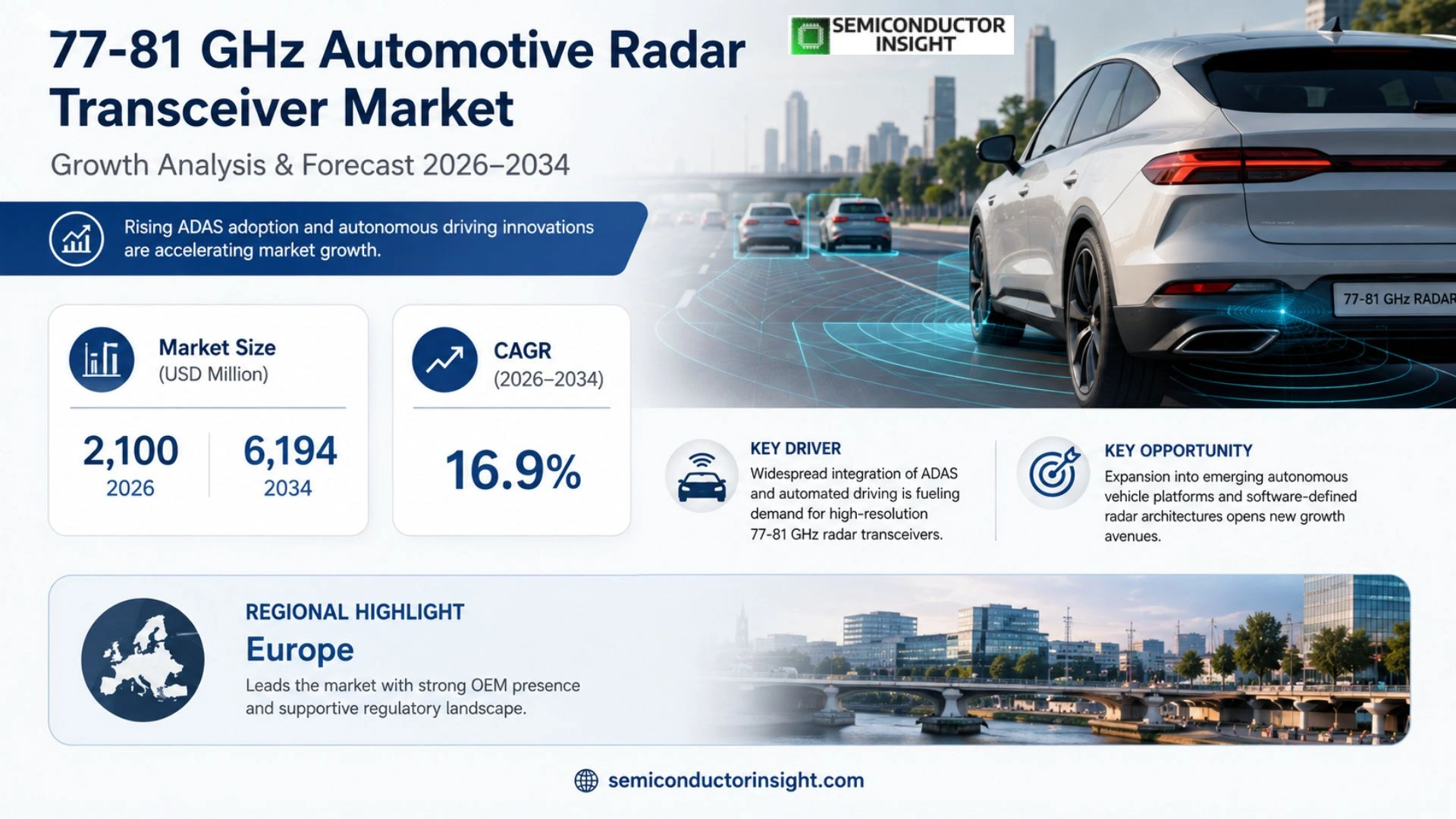
77-81 GHz Automotive Radar Transceiver market is projected to grow from USD 2100 million in 2026 to USD 6194 million by 2034, exhibiting a CAGR of 16.9% during the forecast period.

PDF Icon Download Sample Report PDF
  • Quick Dispatch

    All Orders

  • Secure Payment

    100% Secure Payment

Price range: $1,500.00 through $4,250.00

Clear

77-81 GHz Automotive Radar Transceiver Market Insights

77-81 GHz Automotive Radar Transceiver market is projected to grow from USD 2100 million in 2026 to USD 6194 million by 2034, exhibiting a CAGR of 16.9% during the forecast period.

The 77‑81 GHz automotive radar transceiver serves as the core front‑end chip or highly integrated single‑chip platform for vehicle millimeter‑wave radar systems. It enables passenger and commercial‑vehicle active‑safety functions such as automatic emergency braking, adaptive cruise control, blind‑spot detection and higher‑resolution imaging for L2+ assistance by transmitting signals, receiving echoes and resolving range, velocity and angle under all‑weather conditions.

Growth is reinforced by stricter safety regulations,mandatory AEB standards in the United States, updated Euro NCAP requirements for 2026 and China’s C‑NCAP 2024 edition,prompting OEMs and Tier‑1 suppliers to adopt radar chips across multiple sensor locations per vehicle. At the same time, vendors are shifting from isolated RF components toward integrated radar SoCs and imaging chipsets that combine analog‑to‑digital conversion, on‑chip processing and functional‑safety monitoring, thereby expanding the value proposition beyond pure silicon sales.
MARKET DRIVERS

Widespread Integration of ADAS and Automated Driving

The surge in Advanced Driver Assistance Systems (ADAS) across vehicle line‑ups has compelled OEMs to seek higher‑resolution sensing solutions. 77-81 GHz Automotive Radar Transceiver Market participants are benefitting from the frequency band’s ability to deliver finer angular discrimination, which translates into more reliable lane‑keeping and collision‑avoidance functionalities. As regulatory bodies tighten safety mandates, manufacturers are compelled to embed multiple radar units per vehicle, directly inflating demand for these transceivers.

Shift Toward Higher Frequency Bands for Spectrum Congestion Relief

Congestion in the traditional 76‑77 GHz range has prompted a regulatory shift toward the 77‑81 GHz window. This migration unlocks additional bandwidth, permitting richer data streams and finer target classification. Suppliers that have re‑engineered their semiconductor processes to operate efficiently at these higher frequencies now command a premium, driving a measurable uptick in market activity.

➤ “Customers are willing to absorb a modest cost premium for the safety margin that 77‑81 GHz radars provide.”

Automakers are also leveraging the 77‑81 GHz band to consolidate sensor suites, replacing separate lidar and short‑range radar modules with a single, multi‑function transceiver. This integration reduces wiring complexity and overall vehicle weight, delivering cost savings that offset the higher component price, thereby reinforcing buyer interest.

MARKET CHALLENGES

Escalating Semiconductor Fabrication Costs

Manufacturing processes capable of delivering consistent performance at 77‑81 GHz demand advanced lithography and tighter tolerances, which inflate capital expenditures. Small‑to‑mid‑size suppliers often lack the scale to amortize these costs, leading to a concentration of market power among a few large players and limiting entry for innovative newcomers.

Other Challenges

Supply Chain Vulnerabilities

The reliance on specialized gallium‑arsenide and silicon‑germanium wafers creates exposure to geopolitical constraints and raw‑material shortages. Any disruption ripples through production schedules, forcing OEMs to maintain larger safety stocks and inflating overall vehicle costs.

MARKET RESTRAINTS

Stringent Electromagnetic Compatibility (EMC) Regulations

Regulators in major markets require rigorous EMC testing for radar systems operating above 77 GHz. The certification process adds time and expense, discouraging some automakers from adopting the latest transceiver designs until compliance pathways are clearly defined.

Furthermore, the need for extensive shielding and antenna integration to meet these standards can increase vehicle development cycles, prompting some manufacturers to postpone upgrades in favor of proven legacy solutions.

MARKET OPPORTUNITIES

Expansion into Emerging Autonomous Vehicle Platforms

Start‑up mobility firms and Tier‑1 suppliers targeting Level‑3 and Level‑4 autonomy are actively scouting high‑frequency radar modules that can be seamlessly embedded into sleek vehicle architectures. 77-81 GHz Automotive Radar Transceiver Market stands to capture a sizable share of this nascent segment, especially as software‑defined radar architectures mature and enable over‑the‑air updates that extend product lifecycles.

In parallel, partnerships between semiconductor manufacturers and automotive software providers are fostering ecosystem solutions that bundle radar hardware with advanced signal‑processing algorithms, creating differentiated value propositions that can accelerate market adoption.

77-81 GHz Automotive Radar Transceiver Market Trends

Integration and Platform Consolidation

The dominant shift in 77-81 GHz Automotive Radar Transceiver Market is the migration from discrete front‑end modules to highly integrated solutions that bundle RF, conversion, processing and safety monitoring on a single die. Tier‑1 customers are rewarding suppliers that can deliver a radar semiconductor that accommodates multiple ADAS and autonomous‑driving functions without a redesign for each new vehicle generation. By collapsing the bill of materials and reducing board‑level complexity, manufacturers achieve lower power budgets, smaller footprints and tighter environmental margins,attributes that directly influence vehicle assembly line throughput and cost of ownership. The strategic implication is clear: companies that master system‑on‑chip architectures will command the majority of platform nominations for the next vehicle cycles.

Other Trends

Regulatory Momentum and Sensor Proliferation

Mandates for automatic emergency braking in the United States, tightened Euro‑NCAP safety scoring and the upcoming C‑NCAP revisions are turning radar from a convenience add‑on into a compliance requirement. As regulators embed radar performance into vehicle type‑approval, OEMs are compelled to equip every model with at least one 77‑81 GHz sensor and increasingly add corner‑radar, door‑radar and imaging units to satisfy higher safety ratings. This regulatory pressure is accelerating the adoption rate of radar chips and expanding the total sensor count per vehicle, thereby inflating the demand for versatile transceiver platforms that can be reused across diverse mounting locations.

Imaging Radar Chipsets Gain Traction

Parallel to the integration trend, a subset of vendors is pushing the envelope with imaging‑radar chipsets that deliver dense point‑cloud data comparable to lidar at a fraction of the cost. These devices exploit larger channel counts, virtual‑array techniques and on‑chip interference mitigation to resolve fine‑grained object shapes, a capability critical for L2+ and autonomous‑driving stacks. The market consequence is a bifurcation: traditional transceiver and SoC families continue to serve cost‑sensitive models, while imaging chipsets become the preferred choice for premium and semi‑autonomous platforms. Suppliers that can bundle robust development toolchains, safety‑certified IP and localized engineering support are poised to capture the premium segment and influence vehicle architecture decisions beyond the sensor layer.

COMPETITIVE LANDSCAPE

Key Industry Players

77‑81 GHz Automotive Radar Transceiver Market – Competitive Overview

The tier‑1 landscape is anchored by long‑standing semiconductor powerhouses such as Texas Instruments, NXP Semiconductors, Infineon Technologies, STMicroelectronics and Renesas Electronics. Their transceiver MMIC families retain the bulk of volume because they combine automotive qualification, price elasticity and a proven supply chain that appeals to Tier‑1 system integrators seeking incremental upgrades across multiple vehicle programs. These firms continue to broaden their portfolios, adding low‑power modes, on‑chip safety monitors and cascade‑ready interfaces, thereby converting a pure RF component into a reusable platform for forward, corner and door‑radar subsystems. Their entrenched relationships with OEM engineering groups give them a strategic edge in early‑stage architecture selection, which translates into a durable share of the forecast‑period growth.

Beyond the traditional front‑ends, a second wave of challengers is reshaping the value chain. Calterah (now part of NXP) delivers highly integrated radar SoCs that embed ADC, digital processing and software stacks, targeting cost‑sensitive mass‑production programs. Israeli‑based Uhnder and Germany’s Arbe Robotics push the imaging‑radar frontier with 64‑channel chipsets that generate dense point clouds for L2+ and autonomous‑driving use cases. Additional niche contributors,such as China’s RFI, Japan’s ROHM, France’s CEA‑LETI, Israel’s Qorvo, United States’ Skyworks, Taiwan’s MediaTek, Canada’s MagnaChip and Korea’s Samsung Electronics,supply specialty MMICs, custom SiGe processes or hybrid modules that address regional mandates and emerging safety standards. Their agility in regional support, co‑development projects and localized validation labs is becoming a decisive differentiator as OEMs diversify their supplier base.

List of Key Automotive Radar Transceiver Companies Profiled

  • Texas Instruments
  • NXP Semiconductors
  • Infineon Technologies
  • STMicroelectronics
  • Renesas Electronics
  • Calterah (NXP subsidiary)
  • Uhnder, Inc.
  • Arbe Robotics Ltd.
  • ROHM Semiconductor
  • Qorvo
  • Skyworks Solutions
  • MediaTek Inc.
  • MagnaChip Semiconductor
  • Samsung Electronics
  • CEA‑LETI

Segment Analysis:

Segment Category Sub-Segments Key Insights
By Type
  • Transceiver MMIC
  • Radar SoC
  • Imaging Radar Chipset
Radar SoC is emerging as the leading segment because it combines RF front‑end, conversion, and on‑chip processing, delivering a compact footprint and faster time‑to‑market.

  • Enables platform‑level reuse across multiple ADAS functions, reducing development duplication.
  • Offers built‑in functional‑safety monitors and software toolchains that align with regulatory safety standards.
  • Supports higher channel counts for imaging radar, positioning it for L2+ and autonomous driving roadmaps.
By Application
  • General ADAS Radar
  • Surround Short‑Range Radar
  • Forward High‑Resolution / Imaging Radar
  • Others
Forward High‑Resolution / Imaging Radar drives the most strategic attention as OEMs shift toward higher‑level perception.

  • Provides detailed point‑cloud data that complements camera and lidar, enhancing robustness under adverse weather.
  • Facilitates consolidation of multiple radar functions (forward, corner, door) onto a single chipset, improving cost efficiency.
  • Aligns with tightening safety regulations in the US, Europe and China, making it a prerequisite for next‑generation vehicle platforms.
By End User
  • Tier 1 Suppliers
  • OEM Perception Platform Teams
  • Autonomous‑Driving Solution Providers
Tier 1 Suppliers dominate adoption because they orchestrate module integration, validation, and volume production.

  • Require chips that offer low power, robust environmental tolerance, and safety‑critical monitoring.
  • Leverage platform services (SDKs, reference designs) to accelerate program schedules across vehicle families.
  • Act as the primary conduit for regulatory compliance documentation, influencing supplier selection.
By Integration Level
  • Standalone MMIC
  • Integrated SoC
  • Imaging Chipset
Integrated SoC is the preferred route for mass‑production vehicle programs.

  • Combines RF, ADC, digital processing, and safety monitors on a single die, shrinking board size.
  • Reduces BOM complexity and enables tighter control over power consumption, crucial for electric vehicles.
  • Provides a scalable foundation for adding corner and door radars without redesigning hardware.
By Value‑Chain Role
  • Chip Supplier
  • Module Integrator
  • Platform Service Provider
Platform Service Provider is emerging as a strategic differentiator.

  • Offers end‑to‑end toolchains, algorithm libraries, and validation platforms, reducing OEM integration risk.
  • Provides regional technical support that aligns with localized safety standards and program timelines.
  • Creates recurring revenue through software licensing and post‑silicon services, extending the value beyond chip sales.

Regional Analysis: 77-81 GHz Automotive Radar Transceiver Market

Europe

Europe has consolidated its position as the premier arena for 77-81 GHz Automotive Radar Transceiver Market, driven by a dense network of original equipment manufacturers and a proactive regulatory environment. The region’s commitment to stringent safety standards compels manufacturers to embed higher‑frequency radar solutions early in vehicle platforms, fostering a feedback loop that accelerates component refinement. Additionally, the convergence of advanced driver‑assistance system (ADAS) initiatives across multiple EU member states creates a shared pool of testing facilities, reducing time‑to‑market for emerging transceiver designs. This collaborative ecosystem not only attracts established semiconductor players but also nurtures niche innovators, establishing Europe as both a testing ground and a launchpad for next‑generation radar technologies.

Regulatory Landscape
EU directives mandating higher-resolution sensing thresholds compel automakers to prioritize 77-81 GHz radar modules, elevating demand for transceiver components that meet strict electromagnetic compatibility criteria. This regulatory pressure translates into a steady pipeline of procurement opportunities for suppliers attuned to compliance nuances.
OEM Adoption Patterns
Leading European carmakers integrate high‑frequency radar early in premium model cycles, using it as a differentiator for advanced cruise‑control and emergency‑braking functions. Their procurement strategies favor partners who can deliver both performance and cost‑efficiency at volume.
Supply‑Chain Resilience
The region benefits from a tightly knit supply chain anchored by German and French silicon foundries, which mitigates lead‑time volatility. Close proximity between design houses and manufacturing hubs enables rapid iteration cycles for radar transceiver architectures.
Innovation Hubs
Clusters in Stuttgart, Turin and Sweden blend automotive engineering with semiconductor R&D, producing collaborative prototypes that test the limits of 77-81 GHz waveforms. These hubs act as incubators for breakthroughs that later diffuse across the broader market.

North America
North America remains a vigorous contender, propelled by a blend of legacy automakers and an aggressive start‑up ecosystem focused on autonomous‑vehicle validation. The United States’ emphasis on federal safety incentives encourages manufacturers to trial higher‑frequency radars in pilot fleets, creating a parallel stream of demand that complements traditional volume sales. Moreover, the presence of several large‑scale silicon foundries grants suppliers the flexibility to scale production without compromising design integrity, a factor that fuels confidence among OEM procurement teams. Strategic alliances between chipmakers and software firms are also reshaping the value chain, positioning North America as a crucible for integrated radar‑sensor solutions that could dictate future market standards.

Asia‑Pacific
The Asia‑Pacific arena exhibits a dynamic mix of rapid adoption and cost‑sensitivity, with Chinese and Japanese manufacturers experimenting with 77-81 GHz radar to meet ambitious ADAS roadmaps. While price considerations temper wholesale uptake, the region’s massive vehicle production volume ensures a baseline demand that sustains component manufacturers. Government‑led electrification programs in India and South Korea further incentivize the incorporation of high‑frequency radar as part of broader safety mandates, prompting local suppliers to upgrade fabrication capabilities. Cross‑border collaborations, particularly between Taiwanese semiconductor firms and Korean automakers, are beginning to close the technology gap with Western counterparts.

South America
In South America, market momentum is anchored by Brazil’s emerging premium‑vehicle segment, where manufacturers view advanced radar as a means to compete with imported models. Although overall vehicle penetration is modest, a growing middle class seeks safety‑enhanced features, prompting importers to prioritize 77-81 GHz transceiver components for new model launches. Regional trade agreements facilitate the flow of European‑sourced radar modules, while local assembly plants gradually develop the expertise needed for integration, hinting at a gradual shift toward domestic value‑addition.

Middle East & Africa
The Middle East & Africa region displays a niche but strategically important landscape for 77-81 GHz Automotive Radar Transceiver Market. Wealthier Gulf states, driven by luxury‑vehicle demand, are early adopters of high‑resolution radar suites, often importing complete systems from Europe. Meanwhile, African markets focus on ruggedness and cost, leading to selective adoption in premium commercial fleets rather than mass‑market vehicles. Emerging partnerships between regional distributors and Asian component manufacturers aim to bridge the price‑performance divide, setting the stage for incremental growth as regulatory attention to vehicle safety matures across the continent.

Report Scope

This market research report provides a comprehensive analysis of the 77-81 GHz Automotive Radar Transceiver Market , covering the forecast period 2026–2034. It offers detailed insights into market dynamics, technological advancements, competitive landscape, and key trends shaping the industry.

Key focus areas of the report include:

  • Market Overview: The report begins with an overview outlining its current market scenario, key growth indicators, and industry transformation drivers. It discusses macroeconomic factors, demand–supply balance, regulatory landscape, and the strategic role of semiconductors in powering advancements across industries such as automotive, telecommunications, consumer electronics, and industrial automation.
  • Market Size & Forecast: Historical data and future projections for revenue, unit shipments, and market value across major regions and segments.
  • Segmentation Analysis: Detailed breakdown by product type, technology, application, and end-user industry to identify high-growth segments and investment opportunities.
  • Regional Insights: Insights into market performance across North America, Europe, Asia-Pacific, Latin America, and the Middle East & Africa, including country-level analysis where relevant.
  • Competitive Landscape: Profiles of leading market participants, including their product offerings, R&D focus, manufacturing capacity, pricing strategies, and recent developments such as mergers, acquisitions, and partnerships.
  • Technology Trends & Innovation: Assessment of emerging technologies, integration of AI/IoT, semiconductor design trends, fabrication techniques, and evolving industry standards.
  • Market Drivers & Restraints: Evaluation of factors driving market growth along with challenges, supply chain constraints, regulatory issues, and market-entry barriers.
  • Stakeholder Insights: Insights for component suppliers, OEMs, system integrators, investors, and policymakers regarding the evolving ecosystem and strategic opportunities.

Primary and secondary research methods are employed, including interviews with industry experts, data from verified sources, and real-time market intelligence to ensure the accuracy and reliability of the insights presented.

FREQUENTLY ASKED QUESTIONS:

What is the current market size of 77-81 GHz Automotive Radar Transceiver Market?

-> 77-81 GHz Automotive Radar Transceiver market is projected to grow from USD 2100 million in 2026 to USD 6194 million by 2034, exhibiting a CAGR of 16.9%

Which key companies operate in 77-81 GHz Automotive Radar Transceiver Market?

-> Key players include NXP, STMicroelectronics, Infineon Technologies, Texas Instruments (TI), Calterah, Renesas Electronics, Uhnder, Inc., and Arbe Robotics Ltd.

What are the key growth drivers?

-> Key growth drivers include mandatory active‑safety regulations such as automatic emergency braking standards, increasing vehicle safety rating requirements (Euro NCAP, US FMVSS), rising adoption of advanced driver‑assistance systems (ADAS), and the shift toward higher‑resolution imaging radar for L2+ and autonomous driving.

Which region dominates the market?

-> Asia‑Pacific currently holds the largest share, driven by strong automotive production in China, Japan, and South Korea, while North America and Europe remain important growth corridors.

What are the emerging trends?

-> Emerging trends include integration of analog‑to‑digital conversion and on‑chip signal processing into radar SoCs, higher‑channel‑count imaging radar chipsets, platform‑centric business models that combine chip, safety monitoring and software toolchains, and expanded regional support for OEMs and Tier‑1 suppliers.

77-81 GHz Automotive Radar Transceiver Market Trends, Business Strategies 2026-2036

Get Sample Report PDF for Exclusive Insights

Report Sample Includes

  • Table of Contents
  • List of Tables & Figures
  • Charts, Research Methodology, and more...
PDF Icon Download Sample Report PDF
SKU: f5d506b15276
Category:
License Type

Corporate License, Excel License, PDF and Excel Databook License

Download Sample Report

Table of Content

1 Introduction to Research & Analysis Reports
1.1 77-81 GHz Automotive Radar Transceiver Market Definition
1.2 Market Segments
1.2.1 Segment by Type
1.2.2 Segment by Product Form Factor
1.2.3 Segment by Channel Configuration
1.2.4 Segment by Application
1.3 Global 77-81 GHz Automotive Radar Transceiver Market Overview
1.4 Features & Benefits of This Report
1.5 Methodology & Sources of Information
1.5.1 Research Methodology
1.5.2 Research Process
1.5.3 Base Year
1.5.4 Report Assumptions & Caveats
2 Global 77-81 GHz Automotive Radar Transceiver Overall Market Size
2.1 Global 77-81 GHz Automotive Radar Transceiver Market Size: 2025 VS 2034
2.2 Global 77-81 GHz Automotive Radar Transceiver Market Size, Prospects & Forecasts: 2021-2034
2.3 Global 77-81 GHz Automotive Radar Transceiver Sales: 2021-2034
3 Company Landscape
3.1 Top 77-81 GHz Automotive Radar Transceiver Players in Global Market
3.2 Top Global 77-81 GHz Automotive Radar Transceiver Companies Ranked by Revenue
3.3 Global 77-81 GHz Automotive Radar Transceiver Revenue by Companies
3.4 Global 77-81 GHz Automotive Radar Transceiver Sales by Companies
3.5 Global 77-81 GHz Automotive Radar Transceiver Price by Manufacturer (2021-2026)
3.6 Top 3 and Top 5 77-81 GHz Automotive Radar Transceiver Companies in Global Market, by Revenue in 2025
3.7 Global Manufacturers 77-81 GHz Automotive Radar Transceiver Product Type
3.8 Tier 1, Tier 2, and Tier 3 77-81 GHz Automotive Radar Transceiver Players in Global Market
3.8.1 List of Global Tier 1 77-81 GHz Automotive Radar Transceiver Companies
3.8.2 List of Global Tier 2 and Tier 3 77-81 GHz Automotive Radar Transceiver Companies
4 Sights by Type
4.1 Overview
4.1.1 Segment by Type – Global 77-81 GHz Automotive Radar Transceiver Market Size Markets, 2025 & 2034
4.1.2 77-79GHz
4.1.3 79-81GHz
4.2 Segment by Type – Global 77-81 GHz Automotive Radar Transceiver Revenue & Forecasts
4.2.1 Segment by Type – Global 77-81 GHz Automotive Radar Transceiver Revenue, 2021-2026
4.2.2 Segment by Type – Global 77-81 GHz Automotive Radar Transceiver Revenue, 2027-2034
4.2.3 Segment by Type – Global 77-81 GHz Automotive Radar Transceiver Revenue Market Share, 2021-2034
4.3 Segment by Type – Global 77-81 GHz Automotive Radar Transceiver Sales & Forecasts
4.3.1 Segment by Type – Global 77-81 GHz Automotive Radar Transceiver Sales, 2021-2026
4.3.2 Segment by Type – Global 77-81 GHz Automotive Radar Transceiver Sales, 2027-2034
4.3.3 Segment by Type – Global 77-81 GHz Automotive Radar Transceiver Sales Market Share, 2021-2034
4.4 Segment by Type – Global 77-81 GHz Automotive Radar Transceiver Price (Manufacturers Selling Prices), 2021-2034
5 Sights by Product Form Factor
5.1 Overview
5.1.1 Segment by Product Form Factor – Global 77-81 GHz Automotive Radar Transceiver Market Size Markets, 2025 & 2034
5.1.2 Transceiver MMIC
5.1.3 Radar SoC
5.1.4 Imaging Radar Chipset
5.2 Segment by Product Form Factor – Global 77-81 GHz Automotive Radar Transceiver Revenue & Forecasts
5.2.1 Segment by Product Form Factor – Global 77-81 GHz Automotive Radar Transceiver Revenue, 2021-2026
5.2.2 Segment by Product Form Factor – Global 77-81 GHz Automotive Radar Transceiver Revenue, 2027-2034
5.2.3 Segment by Product Form Factor – Global 77-81 GHz Automotive Radar Transceiver Revenue Market Share, 2021-2034
5.3 Segment by Product Form Factor – Global 77-81 GHz Automotive Radar Transceiver Sales & Forecasts
5.3.1 Segment by Product Form Factor – Global 77-81 GHz Automotive Radar Transceiver Sales, 2021-2026
5.3.2 Segment by Product Form Factor – Global 77-81 GHz Automotive Radar Transceiver Sales, 2027-2034
5.3.3 Segment by Product Form Factor – Global 77-81 GHz Automotive Radar Transceiver Sales Market Share, 2021-2034
5.4 Segment by Product Form Factor – Global 77-81 GHz Automotive Radar Transceiver Price (Manufacturers Selling Prices), 2021-2034
6 Sights by Channel Configuration
6.1 Overview
6.1.1 Segment by Channel Configuration – Global 77-81 GHz Automotive Radar Transceiver Market Size Markets, 2025 & 2034
6.1.2 3T4R
6.1.3 4T4R
6.1.4 6T6R And Above
6.2 Segment by Channel Configuration – Global 77-81 GHz Automotive Radar Transceiver Revenue & Forecasts
6.2.1 Segment by Channel Configuration – Global 77-81 GHz Automotive Radar Transceiver Revenue, 2021-2026
6.2.2 Segment by Channel Configuration – Global 77-81 GHz Automotive Radar Transceiver Revenue, 2027-2034
6.2.3 Segment by Channel Configuration – Global 77-81 GHz Automotive Radar Transceiver Revenue Market Share, 2021-2034
6.3 Segment by Channel Configuration – Global 77-81 GHz Automotive Radar Transceiver Sales & Forecasts
6.3.1 Segment by Channel Configuration – Global 77-81 GHz Automotive Radar Transceiver Sales, 2021-2026
6.3.2 Segment by Channel Configuration – Global 77-81 GHz Automotive Radar Transceiver Sales, 2027-2034
6.3.3 Segment by Channel Configuration – Global 77-81 GHz Automotive Radar Transceiver Sales Market Share, 2021-2034
6.4 Segment by Channel Configuration – Global 77-81 GHz Automotive Radar Transceiver Price (Manufacturers Selling Prices), 2021-2034
7 Sights by Application
7.1 Overview
7.1.1 Segment by Application – Global 77-81 GHz Automotive Radar Transceiver Market Size, 2025 & 2034
7.1.2 General ADAS Radar
7.1.3 Surround Short-Range Radar
7.1.4 Forward High-Resolution / Imaging Radar
7.2 Segment by Application – Global 77-81 GHz Automotive Radar Transceiver Revenue & Forecasts
7.2.1 Segment by Application – Global 77-81 GHz Automotive Radar Transceiver Revenue, 2021-2026
7.2.2 Segment by Application – Global 77-81 GHz Automotive Radar Transceiver Revenue, 2027-2034
7.2.3 Segment by Application – Global 77-81 GHz Automotive Radar Transceiver Revenue Market Share, 2021-2034
7.3 Segment by Application – Global 77-81 GHz Automotive Radar Transceiver Sales & Forecasts
7.3.1 Segment by Application – Global 77-81 GHz Automotive Radar Transceiver Sales, 2021-2026
7.3.2 Segment by Application – Global 77-81 GHz Automotive Radar Transceiver Sales, 2027-2034
7.3.3 Segment by Application – Global 77-81 GHz Automotive Radar Transceiver Sales Market Share, 2021-2034
7.4 Segment by Application – Global 77-81 GHz Automotive Radar Transceiver Price (Manufacturers Selling Prices), 2021-2034
8 Sights Region
8.1 By Region – Global 77-81 GHz Automotive Radar Transceiver Market Size, 2025 & 2034
8.2 By Region – Global 77-81 GHz Automotive Radar Transceiver Revenue & Forecasts
8.2.1 By Region – Global 77-81 GHz Automotive Radar Transceiver Revenue, 2021-2026
8.2.2 By Region – Global 77-81 GHz Automotive Radar Transceiver Revenue, 2027-2034
8.2.3 By Region – Global 77-81 GHz Automotive Radar Transceiver Revenue Market Share, 2021-2034
8.3 By Region – Global 77-81 GHz Automotive Radar Transceiver Sales & Forecasts
8.3.1 By Region – Global 77-81 GHz Automotive Radar Transceiver Sales, 2021-2026
8.3.2 By Region – Global 77-81 GHz Automotive Radar Transceiver Sales, 2027-2034
8.3.3 By Region – Global 77-81 GHz Automotive Radar Transceiver Sales Market Share, 2021-2034
8.4 North America
8.4.1 By Country – North America 77-81 GHz Automotive Radar Transceiver Revenue, 2021-2034
8.4.2 By Country – North America 77-81 GHz Automotive Radar Transceiver Sales, 2021-2034
8.4.3 United States 77-81 GHz Automotive Radar Transceiver Market Size, 2021-2034
8.4.4 Canada 77-81 GHz Automotive Radar Transceiver Market Size, 2021-2034
8.4.5 Mexico 77-81 GHz Automotive Radar Transceiver Market Size, 2021-2034
8.5 Europe
8.5.1 By Country – Europe 77-81 GHz Automotive Radar Transceiver Revenue, 2021-2034
8.5.2 By Country – Europe 77-81 GHz Automotive Radar Transceiver Sales, 2021-2034
8.5.3 Germany 77-81 GHz Automotive Radar Transceiver Market Size, 2021-2034
8.5.4 France 77-81 GHz Automotive Radar Transceiver Market Size, 2021-2034
8.5.5 U.K. 77-81 GHz Automotive Radar Transceiver Market Size, 2021-2034
8.5.6 Italy 77-81 GHz Automotive Radar Transceiver Market Size, 2021-2034
8.5.7 Russia 77-81 GHz Automotive Radar Transceiver Market Size, 2021-2034
8.5.8 Nordic Countries 77-81 GHz Automotive Radar Transceiver Market Size, 2021-2034
8.5.9 Benelux 77-81 GHz Automotive Radar Transceiver Market Size, 2021-2034
8.6 Asia
8.6.1 By Region – Asia 77-81 GHz Automotive Radar Transceiver Revenue, 2021-2034
8.6.2 By Region – Asia 77-81 GHz Automotive Radar Transceiver Sales, 2021-2034
8.6.3 China 77-81 GHz Automotive Radar Transceiver Market Size, 2021-2034
8.6.4 Japan 77-81 GHz Automotive Radar Transceiver Market Size, 2021-2034
8.6.5 South Korea 77-81 GHz Automotive Radar Transceiver Market Size, 2021-2034
8.6.6 Southeast Asia 77-81 GHz Automotive Radar Transceiver Market Size, 2021-2034
8.6.7 India 77-81 GHz Automotive Radar Transceiver Market Size, 2021-2034
8.7 South America
8.7.1 By Country – South America 77-81 GHz Automotive Radar Transceiver Revenue, 2021-2034
8.7.2 By Country – South America 77-81 GHz Automotive Radar Transceiver Sales, 2021-2034
8.7.3 Brazil 77-81 GHz Automotive Radar Transceiver Market Size, 2021-2034
8.7.4 Argentina 77-81 GHz Automotive Radar Transceiver Market Size, 2021-2034
8.8 Middle East & Africa
8.8.1 By Country – Middle East & Africa 77-81 GHz Automotive Radar Transceiver Revenue, 2021-2034
8.8.2 By Country – Middle East & Africa 77-81 GHz Automotive Radar Transceiver Sales, 2021-2034
8.8.3 Turkey 77-81 GHz Automotive Radar Transceiver Market Size, 2021-2034
8.8.4 Israel 77-81 GHz Automotive Radar Transceiver Market Size, 2021-2034
8.8.5 Saudi Arabia 77-81 GHz Automotive Radar Transceiver Market Size, 2021-2034
8.8.6 UAE 77-81 GHz Automotive Radar Transceiver Market Size, 2021-2034
9 Manufacturers & Brands Profiles
9.1 NXP
9.1.1 NXP Company Summary
9.1.2 NXP Business Overview
9.1.3 NXP 77-81 GHz Automotive Radar Transceiver Major Product Offerings
9.1.4 NXP 77-81 GHz Automotive Radar Transceiver Sales and Revenue in Global (2021-2026)
9.1.5 NXP Key News & Latest Developments
9.2 STMicroelectronics
9.2.1 STMicroelectronics Company Summary
9.2.2 STMicroelectronics Business Overview
9.2.3 STMicroelectronics 77-81 GHz Automotive Radar Transceiver Major Product Offerings
9.2.4 STMicroelectronics 77-81 GHz Automotive Radar Transceiver Sales and Revenue in Global (2021-2026)
9.2.5 STMicroelectronics Key News & Latest Developments
9.3 Infineon Technologies
9.3.1 Infineon Technologies Company Summary
9.3.2 Infineon Technologies Business Overview
9.3.3 Infineon Technologies 77-81 GHz Automotive Radar Transceiver Major Product Offerings
9.3.4 Infineon Technologies 77-81 GHz Automotive Radar Transceiver Sales and Revenue in Global (2021-2026)
9.3.5 Infineon Technologies Key News & Latest Developments
9.4 TI
9.4.1 TI Company Summary
9.4.2 TI Business Overview
9.4.3 TI 77-81 GHz Automotive Radar Transceiver Major Product Offerings
9.4.4 TI 77-81 GHz Automotive Radar Transceiver Sales and Revenue in Global (2021-2026)
9.4.5 TI Key News & Latest Developments
9.5 Calterah
9.5.1 Calterah Company Summary
9.5.2 Calterah Business Overview
9.5.3 Calterah 77-81 GHz Automotive Radar Transceiver Major Product Offerings
9.5.4 Calterah 77-81 GHz Automotive Radar Transceiver Sales and Revenue in Global (2021-2026)
9.5.5 Calterah Key News & Latest Developments
9.6 Renesas Electronics Corporation
9.6.1 Renesas Electronics Corporation Company Summary
9.6.2 Renesas Electronics Corporation Business Overview
9.6.3 Renesas Electronics Corporation 77-81 GHz Automotive Radar Transceiver Major Product Offerings
9.6.4 Renesas Electronics Corporation 77-81 GHz Automotive Radar Transceiver Sales and Revenue in Global (2021-2026)
9.6.5 Renesas Electronics Corporation Key News & Latest Developments
9.7 Uhnder, Inc.
9.7.1 Uhnder, Inc. Company Summary
9.7.2 Uhnder, Inc. Business Overview
9.7.3 Uhnder, Inc. 77-81 GHz Automotive Radar Transceiver Major Product Offerings
9.7.4 Uhnder, Inc. 77-81 GHz Automotive Radar Transceiver Sales and Revenue in Global (2021-2026)
9.7.5 Uhnder, Inc. Key News & Latest Developments
9.8 Arbe Robotics Ltd.
9.8.1 Arbe Robotics Ltd. Company Summary
9.8.2 Arbe Robotics Ltd. Business Overview
9.8.3 Arbe Robotics Ltd. 77-81 GHz Automotive Radar Transceiver Major Product Offerings
9.8.4 Arbe Robotics Ltd. 77-81 GHz Automotive Radar Transceiver Sales and Revenue in Global (2021-2026)
9.8.5 Arbe Robotics Ltd. Key News & Latest Developments
10 Global 77-81 GHz Automotive Radar Transceiver Production Capacity, Analysis
10.1 Global 77-81 GHz Automotive Radar Transceiver Production Capacity, 2021-2034
10.2 77-81 GHz Automotive Radar Transceiver Production Capacity of Key Manufacturers in Global Market
10.3 Global 77-81 GHz Automotive Radar Transceiver Production by Region
11 Key Market Trends, Opportunity, Drivers and Restraints
11.1 Market Opportunities & Trends
11.2 Market Drivers
11.3 Market Restraints
12 77-81 GHz Automotive Radar Transceiver Supply Chain Analysis
12.1 77-81 GHz Automotive Radar Transceiver Industry Value Chain
12.2 77-81 GHz Automotive Radar Transceiver Upstream Market
12.3 77-81 GHz Automotive Radar Transceiver Downstream and Clients
12.4 Marketing Channels Analysis
12.4.1 Marketing Channels
12.4.2 77-81 GHz Automotive Radar Transceiver Distributors and Sales Agents in Global
13 Conclusion
14 Appendix
14.1 Note
14.2 Examples of Clients
14.3 DisclaimerList of Tables
Table 1. Key Players of 77-81 GHz Automotive Radar Transceiver in Global Market
Table 2. Top 77-81 GHz Automotive Radar Transceiver Players in Global Market, Ranking by Revenue (2025)
Table 3. Global 77-81 GHz Automotive Radar Transceiver Revenue by Companies, (US$, Mn), 2021-2026
Table 4. Global 77-81 GHz Automotive Radar Transceiver Revenue Share by Companies, 2021-2026
Table 5. Global 77-81 GHz Automotive Radar Transceiver Sales by Companies, (Million Units), 2021-2026
Table 6. Global 77-81 GHz Automotive Radar Transceiver Sales Share by Companies, 2021-2026
Table 7. Key Manufacturers 77-81 GHz Automotive Radar Transceiver Price (2021-2026) & (US$/Unit)
Table 8. Global Manufacturers 77-81 GHz Automotive Radar Transceiver Product Type
Table 9. List of Global Tier 1 77-81 GHz Automotive Radar Transceiver Companies, Revenue (US$, Mn) in 2025 and Market Share
Table 10. List of Global Tier 2 and Tier 3 77-81 GHz Automotive Radar Transceiver Companies, Revenue (US$, Mn) in 2025 and Market Share
Table 11. Segment by Type – Global 77-81 GHz Automotive Radar Transceiver Revenue, (US$, Mn), 2025 & 2034
Table 12. Segment by Type – Global 77-81 GHz Automotive Radar Transceiver Revenue (US$, Mn), 2021-2026
Table 13. Segment by Type – Global 77-81 GHz Automotive Radar Transceiver Revenue (US$, Mn), 2027-2034
Table 14. Segment by Type – Global 77-81 GHz Automotive Radar Transceiver Sales (Million Units), 2021-2026
Table 15. Segment by Type – Global 77-81 GHz Automotive Radar Transceiver Sales (Million Units), 2027-2034
Table 16. Segment by Product Form Factor – Global 77-81 GHz Automotive Radar Transceiver Revenue, (US$, Mn), 2025 & 2034
Table 17. Segment by Product Form Factor – Global 77-81 GHz Automotive Radar Transceiver Revenue (US$, Mn), 2021-2026
Table 18. Segment by Product Form Factor – Global 77-81 GHz Automotive Radar Transceiver Revenue (US$, Mn), 2027-2034
Table 19. Segment by Product Form Factor – Global 77-81 GHz Automotive Radar Transceiver Sales (Million Units), 2021-2026
Table 20. Segment by Product Form Factor – Global 77-81 GHz Automotive Radar Transceiver Sales (Million Units), 2027-2034
Table 21. Segment by Channel Configuration – Global 77-81 GHz Automotive Radar Transceiver Revenue, (US$, Mn), 2025 & 2034
Table 22. Segment by Channel Configuration – Global 77-81 GHz Automotive Radar Transceiver Revenue (US$, Mn), 2021-2026
Table 23. Segment by Channel Configuration – Global 77-81 GHz Automotive Radar Transceiver Revenue (US$, Mn), 2027-2034
Table 24. Segment by Channel Configuration – Global 77-81 GHz Automotive Radar Transceiver Sales (Million Units), 2021-2026
Table 25. Segment by Channel Configuration – Global 77-81 GHz Automotive Radar Transceiver Sales (Million Units), 2027-2034
Table 26. Segment by Application – Global 77-81 GHz Automotive Radar Transceiver Revenue, (US$, Mn), 2025 & 2034
Table 27. Segment by Application – Global 77-81 GHz Automotive Radar Transceiver Revenue, (US$, Mn), 2021-2026
Table 28. Segment by Application – Global 77-81 GHz Automotive Radar Transceiver Revenue, (US$, Mn), 2027-2034
Table 29. Segment by Application – Global 77-81 GHz Automotive Radar Transceiver Sales, (Million Units), 2021-2026
Table 30. Segment by Application – Global 77-81 GHz Automotive Radar Transceiver Sales, (Million Units), 2027-2034
Table 31. By Region – Global 77-81 GHz Automotive Radar Transceiver Revenue, (US$, Mn), 2025 & 2034
Table 32. By Region – Global 77-81 GHz Automotive Radar Transceiver Revenue, (US$, Mn), 2021-2026
Table 33. By Region – Global 77-81 GHz Automotive Radar Transceiver Revenue, (US$, Mn), 2027-2034
Table 34. By Region – Global 77-81 GHz Automotive Radar Transceiver Sales, (Million Units), 2021-2026
Table 35. By Region – Global 77-81 GHz Automotive Radar Transceiver Sales, (Million Units), 2027-2034
Table 36. By Country – North America 77-81 GHz Automotive Radar Transceiver Revenue, (US$, Mn), 2021-2026
Table 37. By Country – North America 77-81 GHz Automotive Radar Transceiver Revenue, (US$, Mn), 2027-2034
Table 38. By Country – North America 77-81 GHz Automotive Radar Transceiver Sales, (Million Units), 2021-2026
Table 39. By Country – North America 77-81 GHz Automotive Radar Transceiver Sales, (Million Units), 2027-2034
Table 40. By Country – Europe 77-81 GHz Automotive Radar Transceiver Revenue, (US$, Mn), 2021-2026
Table 41. By Country – Europe 77-81 GHz Automotive Radar Transceiver Revenue, (US$, Mn), 2027-2034
Table 42. By Country – Europe 77-81 GHz Automotive Radar Transceiver Sales, (Million Units), 2021-2026
Table 43. By Country – Europe 77-81 GHz Automotive Radar Transceiver Sales, (Million Units), 2027-2034
Table 44. By Region – Asia 77-81 GHz Automotive Radar Transceiver Revenue, (US$, Mn), 2021-2026
Table 45. By Region – Asia 77-81 GHz Automotive Radar Transceiver Revenue, (US$, Mn), 2027-2034
Table 46. By Region – Asia 77-81 GHz Automotive Radar Transceiver Sales, (Million Units), 2021-2026
Table 47. By Region – Asia 77-81 GHz Automotive Radar Transceiver Sales, (Million Units), 2027-2034
Table 48. By Country – South America 77-81 GHz Automotive Radar Transceiver Revenue, (US$, Mn), 2021-2026
Table 49. By Country – South America 77-81 GHz Automotive Radar Transceiver Revenue, (US$, Mn), 2027-2034
Table 50. By Country – South America 77-81 GHz Automotive Radar Transceiver Sales, (Million Units), 2021-2026
Table 51. By Country – South America 77-81 GHz Automotive Radar Transceiver Sales, (Million Units), 2027-2034
Table 52. By Country – Middle East & Africa 77-81 GHz Automotive Radar Transceiver Revenue, (US$, Mn), 2021-2026
Table 53. By Country – Middle East & Africa 77-81 GHz Automotive Radar Transceiver Revenue, (US$, Mn), 2027-2034
Table 54. By Country – Middle East & Africa 77-81 GHz Automotive Radar Transceiver Sales, (Million Units), 2021-2026
Table 55. By Country – Middle East & Africa 77-81 GHz Automotive Radar Transceiver Sales, (Million Units), 2027-2034
Table 56. NXP Company Summary
Table 57. NXP 77-81 GHz Automotive Radar Transceiver Product Offerings
Table 58. NXP 77-81 GHz Automotive Radar Transceiver Sales (Million Units), Revenue (US$, Mn) and Average Price (US$/Unit) & (2021-2026)
Table 59. NXP Key News & Latest Developments
Table 60. STMicroelectronics Company Summary
Table 61. STMicroelectronics 77-81 GHz Automotive Radar Transceiver Product Offerings
Table 62. STMicroelectronics 77-81 GHz Automotive Radar Transceiver Sales (Million Units), Revenue (US$, Mn) and Average Price (US$/Unit) & (2021-2026)
Table 63. STMicroelectronics Key News & Latest Developments
Table 64. Infineon Technologies Company Summary
Table 65. Infineon Technologies 77-81 GHz Automotive Radar Transceiver Product Offerings
Table 66. Infineon Technologies 77-81 GHz Automotive Radar Transceiver Sales (Million Units), Revenue (US$, Mn) and Average Price (US$/Unit) & (2021-2026)
Table 67. Infineon Technologies Key News & Latest Developments
Table 68. TI Company Summary
Table 69. TI 77-81 GHz Automotive Radar Transceiver Product Offerings
Table 70. TI 77-81 GHz Automotive Radar Transceiver Sales (Million Units), Revenue (US$, Mn) and Average Price (US$/Unit) & (2021-2026)
Table 71. TI Key News & Latest Developments
Table 72. Calterah Company Summary
Table 73. Calterah 77-81 GHz Automotive Radar Transceiver Product Offerings
Table 74. Calterah 77-81 GHz Automotive Radar Transceiver Sales (Million Units), Revenue (US$, Mn) and Average Price (US$/Unit) & (2021-2026)
Table 75. Calterah Key News & Latest Developments
Table 76. Renesas Electronics Corporation Company Summary
Table 77. Renesas Electronics Corporation 77-81 GHz Automotive Radar Transceiver Product Offerings
Table 78. Renesas Electronics Corporation 77-81 GHz Automotive Radar Transceiver Sales (Million Units), Revenue (US$, Mn) and Average Price (US$/Unit) & (2021-2026)
Table 79. Renesas Electronics Corporation Key News & Latest Developments
Table 80. Uhnder, Inc. Company Summary
Table 81. Uhnder, Inc. 77-81 GHz Automotive Radar Transceiver Product Offerings
Table 82. Uhnder, Inc. 77-81 GHz Automotive Radar Transceiver Sales (Million Units), Revenue (US$, Mn) and Average Price (US$/Unit) & (2021-2026)
Table 83. Uhnder, Inc. Key News & Latest Developments
Table 84. Arbe Robotics Ltd. Company Summary
Table 85. Arbe Robotics Ltd. 77-81 GHz Automotive Radar Transceiver Product Offerings
Table 86. Arbe Robotics Ltd. 77-81 GHz Automotive Radar Transceiver Sales (Million Units), Revenue (US$, Mn) and Average Price (US$/Unit) & (2021-2026)
Table 87. Arbe Robotics Ltd. Key News & Latest Developments
Table 88. 77-81 GHz Automotive Radar Transceiver Capacity of Key Manufacturers in Global Market, 2024-2026 (Million Units)
Table 89. Global 77-81 GHz Automotive Radar Transceiver Capacity Market Share of Key Manufacturers, 2024-2026
Table 90. Global 77-81 GHz Automotive Radar Transceiver Production by Region, 2021-2026 (Million Units)
Table 91. Global 77-81 GHz Automotive Radar Transceiver Production by Region, 2027-2034 (Million Units)
Table 92. 77-81 GHz Automotive Radar Transceiver Market Opportunities & Trends in Global Market
Table 93. 77-81 GHz Automotive Radar Transceiver Market Drivers in Global Market
Table 94. 77-81 GHz Automotive Radar Transceiver Market Restraints in Global Market
Table 95. 77-81 GHz Automotive Radar Transceiver Raw Materials
Table 96. 77-81 GHz Automotive Radar Transceiver Raw Materials Suppliers in Global Market
Table 97. Typical 77-81 GHz Automotive Radar Transceiver Downstream
Table 98. 77-81 GHz Automotive Radar Transceiver Downstream Clients in Global Market
Table 99. 77-81 GHz Automotive Radar Transceiver Distributors and Sales Agents in Global Market

List of Figures
Figure 1. 77-81 GHz Automotive Radar Transceiver Product Picture
Figure 2. 77-81 GHz Automotive Radar Transceiver Segment by Type in 2025
Figure 3. 77-81 GHz Automotive Radar Transceiver Segment by Product Form Factor in 2025
Figure 4. 77-81 GHz Automotive Radar Transceiver Segment by Channel Configuration in 2025
Figure 5. 77-81 GHz Automotive Radar Transceiver Segment by Application in 2025
Figure 6. Global 77-81 GHz Automotive Radar Transceiver Market Overview: 2025
Figure 7. Key Caveats
Figure 8. Global 77-81 GHz Automotive Radar Transceiver Market Size: 2025 VS 2034 (US$, Mn)
Figure 9. Global 77-81 GHz Automotive Radar Transceiver Revenue: 2021-2034 (US$, Mn)
Figure 10. 77-81 GHz Automotive Radar Transceiver Sales in Global Market: 2021-2034 (Million Units)
Figure 11. The Top 3 and 5 Players Market Share by 77-81 GHz Automotive Radar Transceiver Revenue in 2025
Figure 12. Segment by Type – Global 77-81 GHz Automotive Radar Transceiver Revenue, (US$, Mn), 2025 & 2034
Figure 13. Segment by Type – Global 77-81 GHz Automotive Radar Transceiver Revenue Market Share, 2021-2034
Figure 14. Segment by Type – Global 77-81 GHz Automotive Radar Transceiver Sales Market Share, 2021-2034
Figure 15. Segment by Type – Global 77-81 GHz Automotive Radar Transceiver Price (US$/Unit), 2021-2034
Figure 16. Segment by Product Form Factor – Global 77-81 GHz Automotive Radar Transceiver Revenue, (US$, Mn), 2025 & 2034
Figure 17. Segment by Product Form Factor – Global 77-81 GHz Automotive Radar Transceiver Revenue Market Share, 2021-2034
Figure 18. Segment by Product Form Factor – Global 77-81 GHz Automotive Radar Transceiver Sales Market Share, 2021-2034
Figure 19. Segment by Product Form Factor – Global 77-81 GHz Automotive Radar Transceiver Price (US$/Unit), 2021-2034
Figure 20. Segment by Channel Configuration – Global 77-81 GHz Automotive Radar Transceiver Revenue, (US$, Mn), 2025 & 2034
Figure 21. Segment by Channel Configuration – Global 77-81 GHz Automotive Radar Transceiver Revenue Market Share, 2021-2034
Figure 22. Segment by Channel Configuration – Global 77-81 GHz Automotive Radar Transceiver Sales Market Share, 2021-2034
Figure 23. Segment by Channel Configuration – Global 77-81 GHz Automotive Radar Transceiver Price (US$/Unit), 2021-2034
Figure 24. Segment by Application – Global 77-81 GHz Automotive Radar Transceiver Revenue, (US$, Mn), 2025 & 2034
Figure 25. Segment by Application – Global 77-81 GHz Automotive Radar Transceiver Revenue Market Share, 2021-2034
Figure 26. Segment by Application – Global 77-81 GHz Automotive Radar Transceiver Sales Market Share, 2021-2034
Figure 27. Segment by Application -Global 77-81 GHz Automotive Radar Transceiver Price (US$/Unit), 2021-2034
Figure 28. By Region – Global 77-81 GHz Automotive Radar Transceiver Revenue, (US$, Mn), 2025 & 2034
Figure 29. By Region – Global 77-81 GHz Automotive Radar Transceiver Revenue Market Share, 2021 VS 2025 VS 2034
Figure 30. By Region – Global 77-81 GHz Automotive Radar Transceiver Revenue Market Share, 2021-2034
Figure 31. By Region – Global 77-81 GHz Automotive Radar Transceiver Sales Market Share, 2021-2034
Figure 32. By Country – North America 77-81 GHz Automotive Radar Transceiver Revenue Market Share, 2021-2034
Figure 33. By Country – North America 77-81 GHz Automotive Radar Transceiver Sales Market Share, 2021-2034
Figure 34. United States 77-81 GHz Automotive Radar Transceiver Revenue, (US$, Mn), 2021-2034
Figure 35. Canada 77-81 GHz Automotive Radar Transceiver Revenue, (US$, Mn), 2021-2034
Figure 36. Mexico 77-81 GHz Automotive Radar Transceiver Revenue, (US$, Mn), 2021-2034
Figure 37. By Country – Europe 77-81 GHz Automotive Radar Transceiver Revenue Market Share, 2021-2034
Figure 38. By Country – Europe 77-81 GHz Automotive Radar Transceiver Sales Market Share, 2021-2034
Figure 39. Germany 77-81 GHz Automotive Radar Transceiver Revenue, (US$, Mn), 2021-2034
Figure 40. France 77-81 GHz Automotive Radar Transceiver Revenue, (US$, Mn), 2021-2034
Figure 41. U.K. 77-81 GHz Automotive Radar Transceiver Revenue, (US$, Mn), 2021-2034
Figure 42. Italy 77-81 GHz Automotive Radar Transceiver Revenue, (US$, Mn), 2021-2034
Figure 43. Russia 77-81 GHz Automotive Radar Transceiver Revenue, (US$, Mn), 2021-2034
Figure 44. Nordic Countries 77-81 GHz Automotive Radar Transceiver Revenue, (US$, Mn), 2021-2034
Figure 45. Benelux 77-81 GHz Automotive Radar Transceiver Revenue, (US$, Mn), 2021-2034
Figure 46. By Region – Asia 77-81 GHz Automotive Radar Transceiver Revenue Market Share, 2021-2034
Figure 47. By Region – Asia 77-81 GHz Automotive Radar Transceiver Sales Market Share, 2021-2034
Figure 48. China 77-81 GHz Automotive Radar Transceiver Revenue, (US$, Mn), 2021-2034
Figure 49. Japan 77-81 GHz Automotive Radar Transceiver Revenue, (US$, Mn), 2021-2034
Figure 50. South Korea 77-81 GHz Automotive Radar Transceiver Revenue, (US$, Mn), 2021-2034
Figure 51. Southeast Asia 77-81 GHz Automotive Radar Transceiver Revenue, (US$, Mn), 2021-2034
Figure 52. India 77-81 GHz Automotive Radar Transceiver Revenue, (US$, Mn), 2021-2034
Figure 53. By Country – South America 77-81 GHz Automotive Radar Transceiver Revenue Market Share, 2021-2034
Figure 54. By Country – South America 77-81 GHz Automotive Radar Transceiver Sales, Market Share, 2021-2034
Figure 55. Brazil 77-81 GHz Automotive Radar Transceiver Revenue, (US$, Mn), 2021-2034
Figure 56. Argentina 77-81 GHz Automotive Radar Transceiver Revenue, (US$, Mn), 2021-2034
Figure 57. By Country – Middle East & Africa 77-81 GHz Automotive Radar Transceiver Revenue, Market Share, 2021-2034
Figure 58. By Country – Middle East & Africa 77-81 GHz Automotive Radar Transceiver Sales, Market Share, 2021-2034
Figure 59. Turkey 77-81 GHz Automotive Radar Transceiver Revenue, (US$, Mn), 2021-2034
Figure 60. Israel 77-81 GHz Automotive Radar Transceiver Revenue, (US$, Mn), 2021-2034
Figure 61. Saudi Arabia 77-81 GHz Automotive Radar Transceiver Revenue, (US$, Mn), 2021-2034
Figure 62. UAE 77-81 GHz Automotive Radar Transceiver Revenue, (US$, Mn), 2021-2034
Figure 63. Global 77-81 GHz Automotive Radar Transceiver Production Capacity (Million Units), 2021-2034
Figure 64. The Percentage of Production 77-81 GHz Automotive Radar Transceiver by Region, 2025 VS 2034
Figure 65. 77-81 GHz Automotive Radar Transceiver Industry Value Chain
Figure 66. Marketing Channels