Market Insights
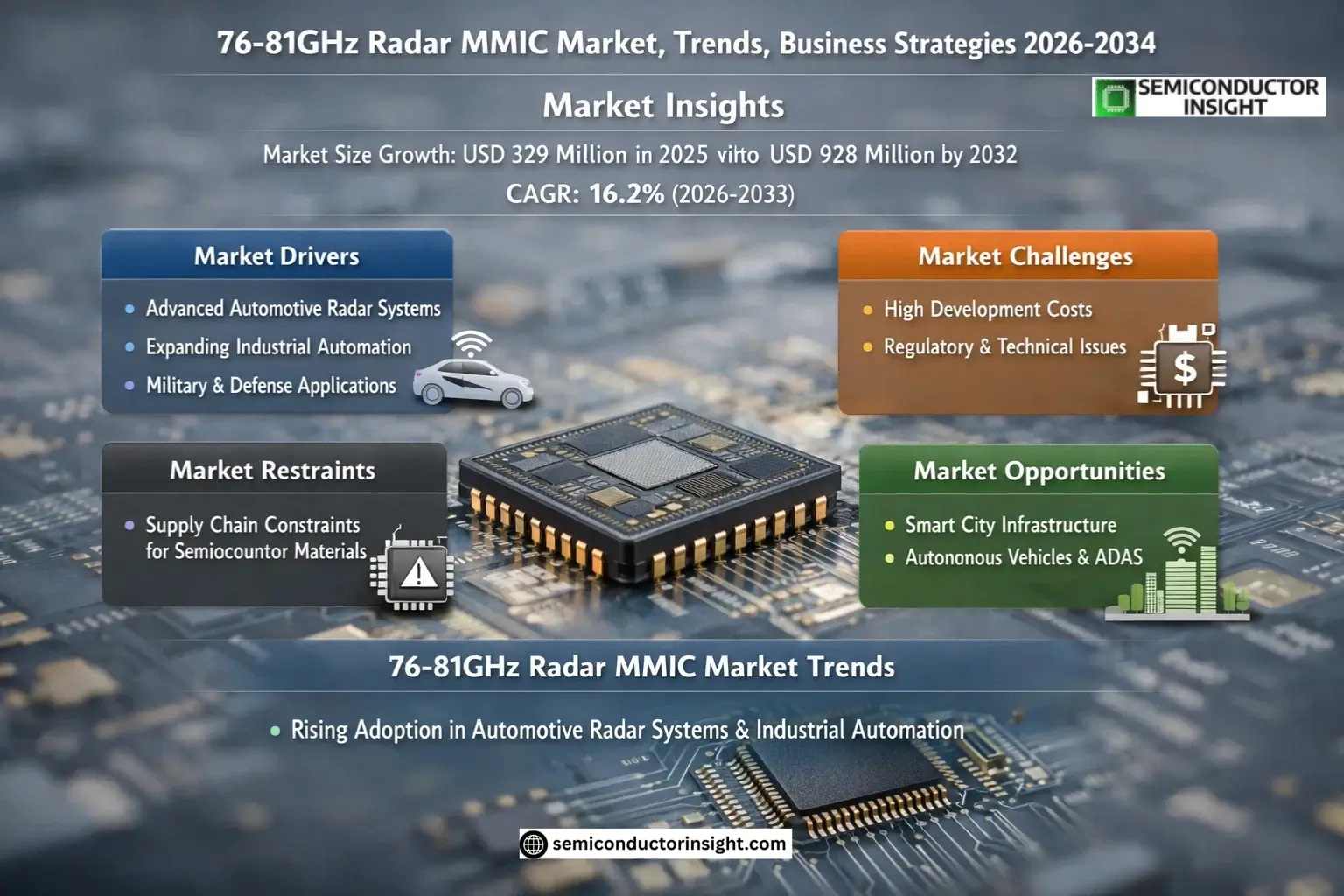
Global 76-81GHz Radar MMIC Market size was valued at USD 329 million in 2025. The market is projected to grow from USD 382 million in 2026 to USD 928 million by 2032, exhibiting a CAGR of 16.2% during the forecast period.
76-81GHz Radar MMICs are highly integrated millimeter-wave monolithic circuits operating in the 76–81GHz frequency band, designed for automotive and industrial radar applications. These components enable precise object detection with high linearity, low phase noise, and stable power performance. Key configurations include 2Tx/3Rx and 3Tx/4Rx architectures, manufactured using advanced semiconductor processes like 28nm and 45nm nodes.
The market growth is driven by increasing adoption of advanced driver-assistance systems (ADAS) and autonomous vehicles, where radar sensors require superior resolution and reliability. While automotive applications dominate demand, industrial uses such as drone navigation and security systems are emerging as significant growth areas. Leading semiconductor manufacturers continue to innovate in packaging technologies like FOWLP and FCBGA to enhance integration and performance.
MARKET DRIVERS
Growing Demand for Advanced Automotive Radar Systems
76-81GHz Radar MMIC Market is experiencing significant growth due to the rising adoption of advanced driver-assistance systems (ADAS) in vehicles. Automotive manufacturers are increasingly integrating high-frequency radar chips to enable features like adaptive cruise control and collision avoidance, driving demand for 76-81GHz solutions.
Expanding Industrial Automation Applications
Beyond automotive, 76-81GHz Radar MMICs are finding new applications in industrial automation, particularly in material handling and robotics. The superior resolution and accuracy of these high-frequency components make them ideal for precision sensing in harsh environments.
Military and defense sectors are also contributing to market growth, utilizing 76-81GHz radar technology for surveillance and threat detection systems that require high precision and minimal interference.
MARKET CHALLENGES
High Development and Production Costs
The complex design and manufacturing processes for 76-81GHz Radar MMICs result in higher costs compared to lower frequency alternatives. This presents a barrier to widespread adoption, particularly in cost-sensitive consumer applications.
Other Challenges
Regulatory Compliance Issues
Different countries have varying spectrum allocation policies for the 76-81GHz band, creating complexity for manufacturers developing global products.
Technical Limitations in Extreme Conditions
While 76-81GHz Radar MMICs perform well in most environments, their performance can degrade in heavy rain or fog, requiring complementary sensor technologies in some applications.
MARKET RESTRAINTS
Supply Chain Constraints for Advanced Semiconductor Materials
The production of 76-81GHz Radar MMICs requires specialized semiconductor materials that have faced supply chain disruptions in recent years. This has limited the ability of manufacturers to scale production to meet growing demand.
MARKET OPPORTUNITIES
Emerging Smart City Infrastructure Applications
76-81GHz Radar MMIC Market stands to benefit from smart city initiatives, where high-frequency radar can be used for traffic monitoring, pedestrian detection, and intelligent transportation systems with greater accuracy than current solutions.
76-81GHz Radar MMIC Market Trends
Increasing Adoption in Automotive Radar Systems
76-81GHz Radar MMIC Market is experiencing substantial growth due to rising demand from automotive radar applications. Advanced driver-assistance systems (ADAS) and autonomous vehicles require high-precision millimeter-wave radar components for functions like adaptive cruise control and collision avoidance. Manufacturers are developing compact, low-power MMIC solutions with improved linearity and phase noise performance for next-generation automotive systems.
Other Trends
Advancements in Packaging Technologies
FOWLP (Fan-Out Wafer Level Packaging) and FCBGA (Flip Chip Ball Grid Array) packaging solutions are gaining traction in the 76-81GHz Radar MMIC Market due to their superior thermal performance and miniaturization capabilities. These packaging methods enable better integration of RF front-end components while maintaining signal integrity at high frequencies.
Shift Toward Higher Integration MMIC Solutions
Market leaders are focusing on developing highly integrated 76-81GHz Radar MMICs that combine multiple functions such as power amplifiers, low-noise amplifiers, and mixers on a single chip. This integration trend helps reduce system complexity while improving reliability and reducing overall solution costs for both automotive and industrial radar applications.
Growing Demand for Industrial Radar Applications
Beyond automotive uses, 76-81GHz Radar MMICs are seeing expanded adoption in industrial applications including drone navigation, traffic monitoring, and security systems. The high-resolution capabilities of these components make them particularly suitable for industrial sensing applications requiring millimeter-level accuracy.
Regional Market Developments
The Asia-Pacific region is emerging as a significant growth market for 76-81GHz Radar MMIC technology, driven by increasing automotive production and government mandates for vehicle safety systems. European and North American markets continue to lead in technology innovation, with major semiconductor companies investing heavily in next-generation MMIC development.
COMPETITIVE LANDSCAPE
Key Industry Players
Global 76-81GHz Radar MMIC Market Dominated by Semiconductor Leaders
76-81GHz Radar MMIC Market is highly concentrated with the top five players – NXP Semiconductors, Texas Instruments, and Infineon Technologies collectively holding significant market share. These semiconductor giants leverage their advanced RF technology portfolios and automotive industry partnerships to dominate radar MMIC production. NXP leads with its SAF4000 platform, while Texas Instruments focuses on highly integrated single-chip solutions. The market exhibits moderate competition with established players controlling R&D capabilities and manufacturing scale.
Several emerging Asian manufacturers are gaining traction in niche segments, particularly for cost-sensitive applications. Companies like Huawei HiSilicon and STMicroelectronics are expanding their 76-81GHz offerings through strategic partnerships with automotive Tier 1 suppliers. The competitive landscape also features specialized RF semiconductor firms such as Analog Devices and Qorvo, which bring unique system expertise in millimeter-wave technologies.
List of Key 76-81GHz Radar MMIC Companies Profiled
- NXP Semiconductors
- Texas Instruments
- Infineon Technologies
- STMicroelectronics
- Analog Devices
- Qorvo
- Renesas Electronics
- ON Semiconductor
- Bosch Sensortec
- Huawei HiSilicon
- Vayyar Imaging
- Arbe Robotics
- Uhnder
- Metawave
- Smart Radar Systems
Segment Analysis:
| Segment Category | Sub-Segments | Key Insights |
| By Type |
|
2Tx/3Rx dominates due to:
|
| By Application |
|
Automotive Radar leads owing to:
|
| By End User |
|
Tier 1 Suppliers are key due to:
|
| By Package Type |
|
FOWLP is preferred because:
|
| By Process Node |
|
28nm leads due to:
|
Regional Analysis: 76-81GHz Radar MMIC Market
The North American 76-81GHz Radar MMIC Market is primarily fueled by advanced driver assistance systems (ADAS) adoption. Automakers are standardizing high-frequency radar across vehicle segments to meet NHTSA safety requirements, with premium brands implementing multi-radar configurations.
Silicon Valley remains the global center for 76-81GHz MMIC development, with fabless chip companies working closely with foundries to push performance boundaries. Recent breakthroughs in GaAs and SiGe technologies are enabling cost-effective high-volume production.
FCC’s favorable spectrum allocation for 76-81GHz applications gives North American developers first-mover advantage. The regulatory environment encourages innovation while maintaining strict interference control standards critical for radar reliability.
Military applications account for significant 76-81GHz Radar MMIC procurement, particularly for unmanned systems and perimeter surveillance. DoD contracts continue to drive specialized MMIC development with enhanced security and ruggedization features.
Europe
Europe represents the second largest market for 76-81GHz Radar MMICs, propelled by EU-mandated vehicle safety standards and premium automotive brand concentration. German automakers lead in implementing sophisticated radar-based safety systems, while the region’s strong industrial base supports specialized radar applications. The 79GHz band allocation for short-range radar creates unique market dynamics distinct from other regions. European semiconductor firms focus on high-performance MMICs optimized for challenging weather conditions. Collaborative research initiatives between automotive OEMs and component suppliers accelerate technology maturation.
Asia-Pacific
The Asia-Pacific 76-81GHz Radar MMIC Market is experiencing rapid growth, driven by Chinese automotive production and Japanese technological leadership. Local manufacturers are developing cost-optimized solutions for emerging market vehicles while maintaining strict performance benchmarks. South Korea’s electronics giants are investing heavily in integrated radar systems. India’s automotive sector presents new opportunities, though adoption trails more developed markets. Regional semiconductor foundries are scaling production to meet anticipated demand growth from both domestic and international customers.
Middle East & Africa
The MEA region shows emerging potential for 76-81GHz Radar MMICs, primarily in luxury vehicle segments and specialized industrial applications. Infrastructure development projects are creating demand for traffic monitoring and security systems. The market remains constrained by limited local manufacturing capabilities, relying on imports from established suppliers. Gulf countries demonstrate the highest adoption rates, with growing interest in smart city applications that leverage high-frequency radar technology.
South America
South America represents a developing market for 76-81GHz Radar MMICs, with Brazil as the primary adopter in automotive applications. Economic volatility impacts market growth, though regional trade agreements facilitate technology transfer. Local content requirements are prompting some foreign automakers to establish limited radar system assembly operations. The aftermarket shows promise as vehicle owners retrofit older models with advanced safety features.
Report Scope
This market research report provides a comprehensive analysis of the 76-81GHz Radar MMIC Market , covering the forecast period 2025–2032. It offers detailed insights into market dynamics, technological advancements, competitive landscape, and key trends shaping the industry.
Key focus areas of the report include:
- Market Overview: The report begins with an overview outlining its current market scenario, key growth indicators, and industry transformation drivers. It discusses macroeconomic factors, demand–supply balance, regulatory landscape, and the strategic role of semiconductors in powering advancements across industries such as automotive, telecommunications, consumer electronics, and industrial automation.
- Market Size & Forecast: Historical data and future projections for revenue, unit shipments, and market value across major regions and segments.
- Segmentation Analysis: Detailed breakdown by product type, technology, application, and end-user industry to identify high-growth segments and investment opportunities.
- Regional Insights: Insights into market performance across North America, Europe, Asia-Pacific, Latin America, and the Middle East & Africa, including country-level analysis where relevant.
- Competitive Landscape: Profiles of leading market participants, including their product offerings, R&D focus, manufacturing capacity, pricing strategies, and recent developments such as mergers, acquisitions, and partnerships.
- Technology Trends & Innovation: Assessment of emerging technologies, integration of AI/IoT, semiconductor design trends, fabrication techniques, and evolving industry standards.
- Market Drivers & Restraints: Evaluation of factors driving market growth along with challenges, supply chain constraints, regulatory issues, and market-entry barriers.
- Stakeholder Insights: Insights for component suppliers, OEMs, system integrators, investors, and policymakers regarding the evolving ecosystem and strategic opportunities.
Primary and secondary research methods are employed, including interviews with industry experts, data from verified sources, and real-time market intelligence to ensure the accuracy and reliability of the insights presented.
FREQUENTLY ASKED QUESTIONS:
What is the current market size of 76-81GHz Radar MMIC Market?
-> 76-81GHz Radar MMIC Market size was valued at USD 329 million in 2025. The market is projected to grow from USD 382 million in 2026 to USD 928 million by 2032, exhibiting a CAGR of 16.2% during the forecast period.
What is the growth rate of 76-81GHz Radar MMIC Market?
-> The market is expected to grow at a CAGR of 16.2% during the forecast period (2025-2032).
Which key companies operate in 76-81GHz Radar MMIC Market?
-> Key players include NXP Semiconductors, Texas Instruments, Infineon Technologies, Bosch, Continental, Aptiv, Valeo, Denso, ZF, and Huawei.
What are the key applications of 76-81GHz Radar MMIC?
-> Primary applications include automotive radar (angle radar, forward radar) and industrial radar.
What was the production volume in 2025?
-> Global production was approximately 30 million units in 2025 with an average price of USD 12 per unit.
Get Sample Report PDF for Exclusive Insights
Report Sample Includes
- Table of Contents
- List of Tables & Figures
- Charts, Research Methodology, and more...
 Download Sample Report PDF