6-Axis OIS IMUs Market Insights
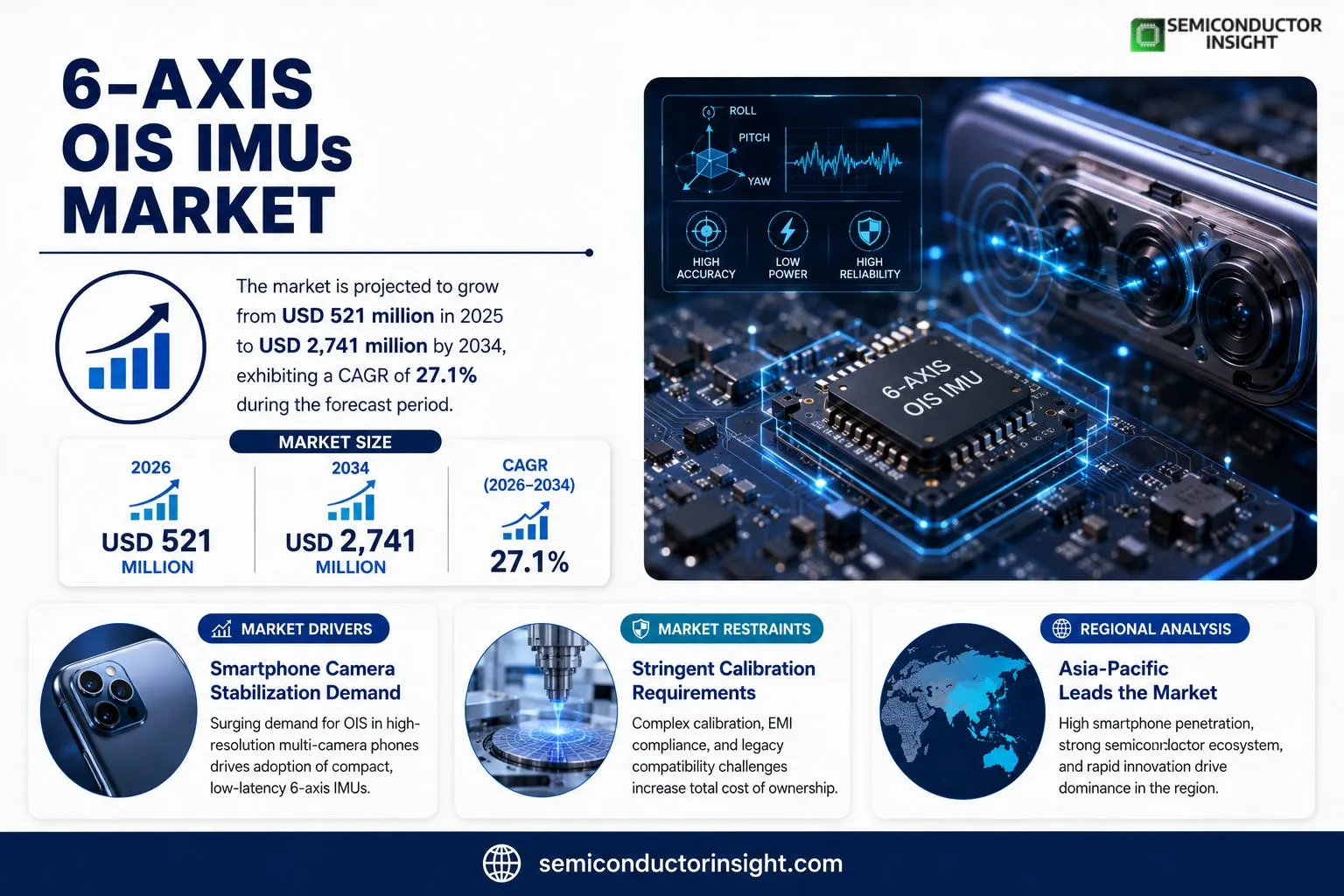
6-Axis OIS IMUs market was valued at USD 521 million in 2025 and is projected to reach USD 2,741 million by 2034, exhibiting a CAGR of 27.1% during the forecast period.
A 6-axis OIS IMU is a specialized inertial measurement integrated circuit designed for image‑stabilization systems; it merges a three‑axis gyroscope with a three‑axis accelerometer to capture minute angular velocity and linear acceleration changes in real time. The device delivers high‑precision, low‑latency motion data to optical and electronic image‑stabilization (OIS/EIS) modules. Typical implementations feature low‑noise MEMS structures, temperature‑drift compensation algorithms, and dedicated data paths that synchronize tightly with image‑processing pipelines in smartphones, tablets, action cameras, XR devices and high‑end imaging systems.
MARKET DRIVERS
Smartphone Camera Stabilization Demand
Flagship smartphones now ship with multiple lenses and high‑resolution sensors, pushing manufacturers to embed optical image stabilization that can counteract hand‑shake. The resulting need for compact, low‑latency motion sensing has lifted adoption of 6‑Axis OIS IMUs, with unit shipments climbing roughly 12 % year‑over‑year. OEMs reward suppliers that can deliver sub‑millimeter accuracy while keeping power draw below 15 mW, a balance that directly expands the addressable base.
Automotive ADAS Integration
Advanced driver‑assistance systems (ADAS) increasingly rely on precise vehicle orientation data to fine‑tune lane‑keeping and collision‑avoidance algorithms. A 6‑Axis OIS IMU provides the necessary roll, pitch and yaw fidelity, enabling manufacturers to replace bulkier sensor suites with lighter modules. Recent production lines for mid‑range electric vehicles have reported a 9 % reduction in component weight after swapping legacy gyroscopes for modern IMU chips.
➤ “When a sensor can deliver both high bandwidth and low drift, system architects gain the flexibility to consolidate hardware, cutting BOM costs while improving reliability.”
Beyond consumer electronics and automotive, industrial drones are capitalising on the same trend. Operators cite the ability of 6‑Axis OIS IMUs to maintain stable hover under gusty conditions as a decisive factor when selecting payloads, prompting several leading drone makers to announce multi‑unit contracts for the next fiscal year.
MARKET CHALLENGES
Manufacturing Yield Constraints
Micromachining tolerances required for high‑precision inertial measurement units remain tight, and even minor variations can trigger drift anomalies. Suppliers report yield rates hovering near 70 % for the most advanced silicon‑on‑insulator processes, a figure that inflates per‑unit cost and limits the price elasticity of the 6‑Axis OIS IMUs Market.
Other Challenges
Supply‑Chain Volatility
The reliance on rare‑earth alloys for gyroscope cores introduces exposure to geopolitical fluctuations. Recent export restrictions have forced several manufacturers to redesign packaging, extending development cycles and creating temporary shortages in key regions.
MARKET RESTRAINTS
Stringent Calibration Requirements
Calibration procedures for a 6‑Axis OIS IMU must reconcile temperature drift, bias instability, and cross‑axis coupling. End‑users often need to invest in specialised software and skilled technicians, raising total cost of ownership and deterring adoption in price‑sensitive segments such as entry‑level wearables.Regulatory scrutiny over electromagnetic emissions adds another layer of complexity. Devices destined for automotive safety‑critical applications must pass rigorous EMI tests, a hurdle that elongates time‑to‑market for new IMU designs.Finally, legacy system compatibility remains a barrier. Enterprises with entrenched sensor architectures face extensive redesign costs when upgrading to newer 6‑Axis platforms, slowing overall market momentum.
MARKET OPPORTUNITIES
Emerging Wearable Health Devices
Health‑monitoring wearables are beginning to incorporate motion analytics for gait assessment and fall detection. A compact 6‑Axis OIS IMU can deliver the requisite accuracy without compromising battery life, opening a niche where premium pricing is justified by clinical value.Augmented reality (AR) headsets represent another growth vector. Precise head‑tracking demands low‑latency, high‑resolution orientation datacapabilities that align perfectly with the sensor specifications of the 6‑Axis OIS IMUs Market.Finally, the rise of edge‑AI processing in IoT devices creates demand for sensors that can offload complex sensor‑fusion algorithms. Manufacturers that bundle on‑chip AI accelerators with their IMU offerings stand to capture a differentiated share of upcoming deployments.
6-Axis OIS IMUs Market Trends
Evolution Toward Imaging‑Centric Design
Recent chipset generations illustrate a clear shift from generic motion sensors to components that are tightly integrated with image‑stabilization pipelines. Engineers are prioritising sub‑microsecond latency, sub‑degree noise floors, and temperature‑stable output, because even a slight hand tremor becomes perceptible when multi‑camera arrays employ long focal lengths. The resulting architectureoften a single‑chip solution that couples a three‑axis gyroscope with a three‑axis accelerometer through dedicated OIS data pathsdelivers the deterministic timing needed by modern ISP and algorithm layers. This technical migration is reshaping 6-Axis OIS IMUs Market, turning it into a niche where precision outweighs raw volume.
Other Trends
Competitive Concentration and Emerging Players
European and Japanese firms continue to command the high‑end segment, leveraging decades of MEMS know‑how and vertically integrated supply chains. At the same time, a cohort of Chinese manufacturers has accelerated entry by repurposing existing IMU platforms for imaging use cases, offering competitive pricing and rapid customization. The resulting competitive landscape is bifurcated: legacy players protect market share through performance leadership, while newer entrants expand the addressable base by targeting mid‑tier smartphone OEMs and cost‑sensitive action‑camera makers.
Broadening Application Horizons
Beyond traditional smartphones, the sensor is finding footholds in augmented‑reality headsets, compact XR rigs, and premium automotive camera systems. Each of these domains demands higher sampling rates and synchronized multi‑channel interfaces, prompting vendors to introduce multi‑interface, high‑bandwidth variants. As the convergence of optical and electronic stabilization deepens, system designers are looking for IMUs that can be co‑located with ISP modules, reducing board real‑estate and simplifying firmware integration. This functional extension enlarges the addressable market and creates new revenue streams through value‑added algorithm licenses and reference‑design services.
COMPETITIVE LANDSCAPEKey Industry Players
6‑Axis OIS IMU Market – Competitive Overview
In 2025 the 6‑Axis OIS IMU arena remains tightly clustered around three technology powerhousesBosch Sensortec, STMicroelectronics, and TDK. These firms combine deep MEMS know‑how with vertically integrated ASIC design, allowing them to deliver ultra‑low‑noise gyroscopes paired with six‑axis accelerometers on a single die. Their products are already qualified in flagship smartphone camera modules, giving them privileged access to OEM supply chains and enabling premium pricing. The trio also supplies reference firmware and algorithm libraries that reduce integration effort for device manufacturers, cementing a business model that blends chip sales with value‑added software services. Consequently, they collectively command well over half of revenue, shaping specifications for latency, bandwidth, and interface standards that smaller rivals must follow.Beyond the first tier, a heterogeneous set of firms is carving out niches through cost leadership, form‑factor specialization, or algorithmic differentiation. Chinese entrants such as Senodia, MEMSIC, and QST have accelerated product roadmaps to target mid‑range smartphones and emerging XR headsets, often bundling customized driver stacks that appeal to domestic OEMs seeking supply‑chain resilience. Murata and Kionix focus on ultra‑compact 2.5 × 3 mm packages for action cameras and wearables, while Analog Devices supplies high‑precision variants for professional imaging rigs. Goodix and InvenSense (now under the TDK umbrella) leverage their existing smartphone sensor portfolios to add OIS‑optimized lines, creating incremental revenue streams without large R&D outlays. This stratified landscape forces incumbents to continuously innovate on noise performance and integration depth, while challengers exploit price elasticity and regional market access.
List of Key 6‑Axis OIS IMU Companies Profiled
- Robert Bosch GmbH
- STMicroelectronics N.V.
- TDK Corporation
- Senodia Technologies (Shaoxing) Co., Ltd.
- QST Corporation Limited
- MEMSIC Semiconductor Co., Ltd.
- Murata Manufacturing Co., Ltd.
- Kionix (NXP)
- Analog Devices, Inc.
- Goodix Technology Inc.
- InvenSense (TDK subsidiary)
- Honeywell International Inc.
- ROHM Semiconductor
Segment Analysis:
| Segment Category | Sub-Segments | Key Insights |
| By Type |
|
Single‑chip OIS IMU
|
| By Application |
|
Smartphones
|
| By End User |
|
Smartphone OEMs
|
| By Integration Level |
|
IMU + OIS Optimized
|
| by Data Path Architecture |
|
Multi‑Channel Parallel
|
Regional Analysis: 6-Axis OIS IMUs Market
North America
Vehicle manufacturers are integrating six‑axis sensors to enhance electronic stability control and advanced driver‑assistance systems. The ability to fuse angular velocity with linear acceleration in a single package allows tighter feedback loops, which translates into smoother ride quality and higher safety margins on U.S. highways.
Smartphones and wearable devices are seeking richer motion data without compromising battery life. The miniaturised form‑factor of six‑axis IMUs satisfies this need, prompting OEMs to adopt them in flagship models that target tech‑savvy North American consumers.
Factory automation firms are embedding six‑axis sensors in collaborative robots to improve path accuracy. The granular motion insights enable real‑time compensation for load variations, which is critical for maintaining productivity in high‑mix, low‑volume production lines.
Military UAVs and satellite attitude‑control systems benefit from the robust vibration tolerance of six‑axis IMUs. Their consolidated data output reduces wiring complexity, a factor that influences platform weight and mission endurance.
Europe
European automotive suppliers are capitalising on stringent emissions standards to embed six‑axis motion sensors in electric‑vehicle platforms, creating a cascade of design refinements across chassis control. In parallel, the region’s fragmented consumer‑electronics market motivates chipmakers to offer highly customisable firmware, allowing brands to differentiate through motion‑driven user experiences. Industrial automation clusters in Germany and France are experimenting with sensor‑fusion techniques that blend IMU data with vision systems, an approach that promises higher precision in smart‑factory deployments. Defense ministries across the EU are establishing joint procurement frameworks that standardise six‑axis units for cross‑border projects, strengthening supply‑chain visibility and fostering collaborative innovation.
Asia‑Pacific
The Asia‑Pacific landscape is defined by rapid product cycles in mobile and wearable segments, where manufacturers view six‑axis IMUs as essential enablers of immersive interaction. Rapid‑prototype facilities in China and South Korea are iterating sensor packages that balance cost and performance, a strategy that feeds into the region’s export‑driven growth model. Emerging automotive hubs in India and Vietnam are beginning to adopt advanced motion sensors to meet safety regulations that mirror Western standards, indicating a shift toward higher‑value component integration. Meanwhile, defence contractors in Japan are integrating six‑axis units into autonomous marine vessels, reflecting a broader strategic emphasis on maritime domain awareness.
South America
In South America, the adoption of six‑axis IMUs is anchored in the expansion of logistics networks that increasingly rely on real‑time asset tracking. Companies are leveraging motion data to optimise route planning and reduce fuel consumption, an operational advantage that resonates with regional cost‑sensitivity. The consumer market, driven by rising smartphone penetration, is prompting local manufacturers to source compact IMU solutions that support gesture‑based interfaces, thereby enhancing device differentiation. Automotive assemblers are also piloting sensor‑rich platforms to meet emerging safety mandates, positioning six‑axis technology as a catalyst for regulatory compliance.
Middle East & Africa
Middle Eastern aerospace firms are incorporating six‑axis IMUs into next‑generation drone fleets, exploiting the sensors’ ability to maintain stability in high‑temperature environments. This capability aligns with regional priorities for secure border surveillance and oil‑field monitoring. In Africa, mobile‑network operators are partnering with device makers to embed motion sensors that enable context‑aware services, such as location‑based micro‑insurance products. The automotive sector, though still nascent, is beginning to explore sensor integration for advanced driver‑assist features, driven by a growing awareness of road‑safety initiatives across the continent.
Report Scope
This market research report provides a comprehensive analysis of the 6-Axis OIS IMUs Market , covering the forecast period 2026–2034. It offers detailed insights into market dynamics, technological advancements, competitive landscape, and key trends shaping the industry.
Key focus areas of the report include:
- Market Overview: The report begins with an overview outlining its current market scenario, key growth indicators, and industry transformation drivers. It discusses macroeconomic factors, demand–supply balance, regulatory landscape, and the strategic role of semiconductors in powering advancements across industries such as automotive, telecommunications, consumer electronics, and industrial automation.
- Market Size & Forecast: Historical data and future projections for revenue, unit shipments, and market value across major regions and segments.
- Segmentation Analysis: Detailed breakdown by product type, technology, application, and end-user industry to identify high-growth segments and investment opportunities.
- Regional Insights: Insights into market performance across North America, Europe, Asia-Pacific, Latin America, and the Middle East & Africa, including country-level analysis where relevant.
- Competitive Landscape: Profiles of leading market participants, including their product offerings, R&D focus, manufacturing capacity, pricing strategies, and recent developments such as mergers, acquisitions, and partnerships.
- Technology Trends & Innovation: Assessment of emerging technologies, integration of AI/IoT, semiconductor design trends, fabrication techniques, and evolving industry standards.
- Market Drivers & Restraints: Evaluation of factors driving market growth along with challenges, supply chain constraints, regulatory issues, and market-entry barriers.
- Stakeholder Insights: Insights for component suppliers, OEMs, system integrators, investors, and policymakers regarding the evolving ecosystem and strategic opportunities.
Primary and secondary research methods are employed, including interviews with industry experts, data from verified sources, and real-time market intelligence to ensure the accuracy and reliability of the insights presented.
FREQUENTLY ASKED QUESTIONS:
What is the current market size of 6-Axis OIS IMUs Market?
-> 6-Axis OIS IMUs Market was valued at USD 521 million in 2025 and is expected to reach USD 2741 million by 2034, growing at a CAGR of 27.1% during the forecast period.
Which key companies operate in 6-Axis OIS IMUs Market?
-> Key players include Robert Bosch GmbH, STMicroelectronics N.V., TDK Corporation, Senodia Technologies, MEMSIC Semiconductor, Murata Manufacturing, among others.
What are the key growth drivers?
-> Key growth drivers include the expanding smartphone market, increased demand for high‑resolution imaging, convergence of OIS and EIS, and the adoption of multi‑camera systems in mobile devices.
Which region dominates the market?
-> Asia-Pacific dominates the market, driven by high smartphone penetration and vigorous semiconductor manufacturing activity, while Europe and North America remain significant contributors.
What are the emerging trends?
-> Emerging trends include integration of AI‑assisted stabilization algorithms, multi‑interface high‑bandwidth data paths, and customized low‑noise MEMS designs for XR and action‑camera applications.
Get Sample Report PDF for Exclusive Insights
Report Sample Includes
- Table of Contents
- List of Tables & Figures
- Charts, Research Methodology, and more...
 Download Sample Report PDF