
5G Signal Processing Market Insights
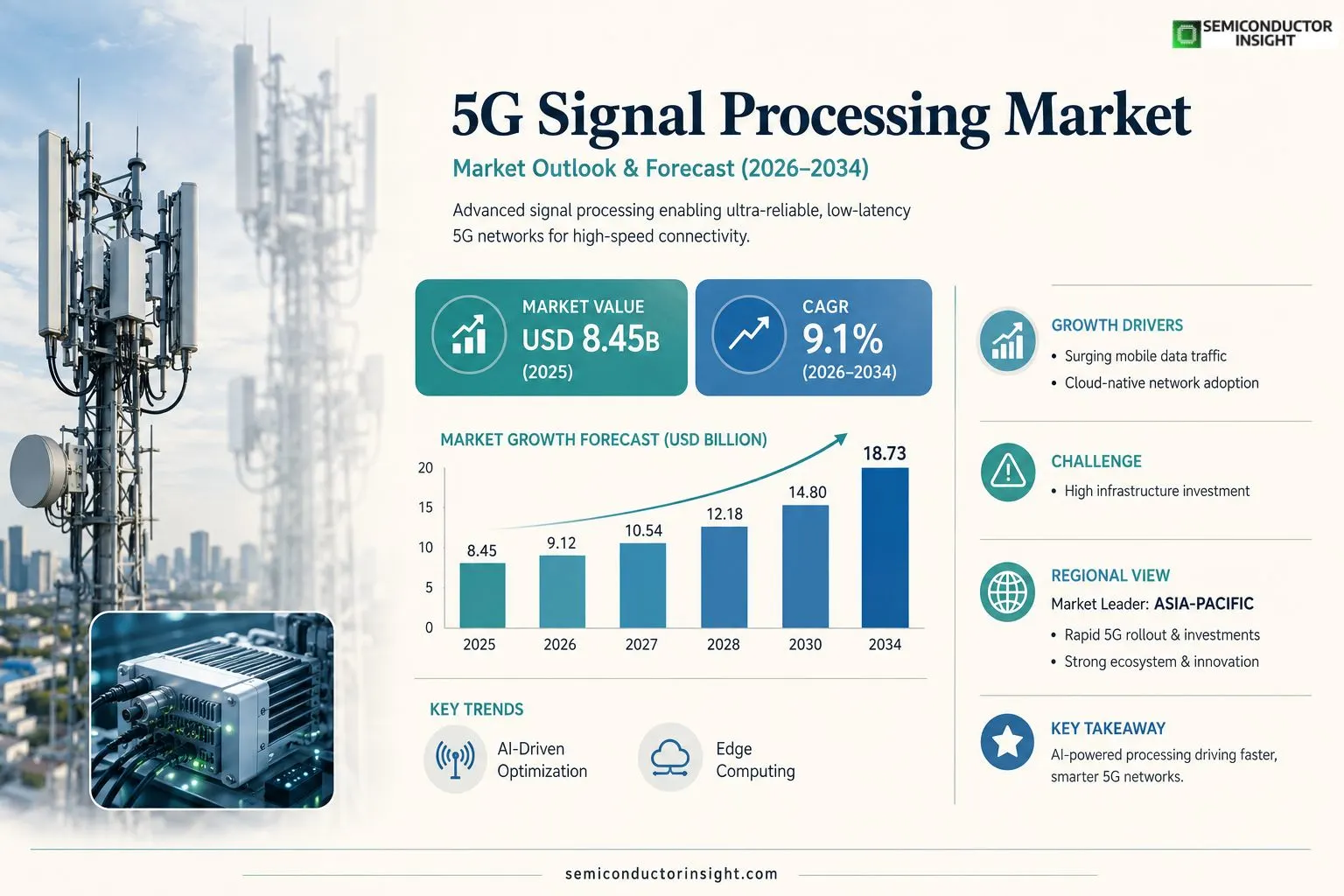
Global 5G Signal Processing Market size was valued at USD 8.45 billion in 2025. The market is projected to grow from USD 9.12 billion in 2026 to USD 18.73 billion by 2034, exhibiting a CAGR of 9.1% during the forecast period.
5G signal processing encompasses advanced algorithms and hardware that enable high‑frequency modulation, beamforming, massive MIMO (multiple‑input multiple‑output), and low‑latency waveform manipulation essential for delivering ultra‑reliable broadband services.The market is accelerating because mobile data traffic is surging beyond 10 exabytes per month, while operators invest heavily in edge‑computing infrastructure and AI‑driven network optimization. Furthermore, collaborations such as Qualcomm’s partnership with Samsung on integrated RF front‑ends and Nokia’s rollout of cloud‑native base stations are fueling adoption across telecom ecosystems.
MARKET DRIVERS
Rising Data Traffic and Bandwidth Demands
The exponential growth of mobile video streaming, augmented reality, and mission‑critical communications is driving unprecedented data traffic. As consumers expect seamless experiences, operators are compelled to deploy advanced 5G Signal Processing Market solutions that can handle higher bandwidth while maintaining low latency.
Adoption of Cloud‑Native Architectures
Enterprises are migrating core network functions to cloud environments, demanding flexible and scalable signal processing platforms. Cloud‑native designs enable rapid service rollout and cost efficiencies, positioning the market for strong upward momentum.
➤ “Integrated AI algorithms within 5G signal processors are projected to shave processing latency by up to 30%,”
These drivers collectively create a fertile landscape for vendors that can deliver high‑performance, software‑defined processing engines tailored for next‑generation connectivity.
MARKET CHALLENGES
Technical Complexity and Integration Issues
Implementing sophisticated signal processing chains across heterogeneous radio access networks introduces integration challenges. Compatibility with legacy equipment and the need for real‑time firmware updates can delay deployments.
Other Challenges
Regulatory and Standardization Gaps
The ongoing evolution of 5G standards leaves some frequency bands and waveform specifications unsettled, creating uncertainty for manufacturers planning long‑term product roadmaps.
MARKET RESTRAINTS
High Capital Expenditure for Infrastructure Upgrade
Deploying state‑of‑the‑art signal processing hardware requires substantial upfront investment, which can constrain rollout speed, especially in emerging markets with limited financing options.Limited Availability of Skilled WorkforceDesigning, optimizing, and maintaining complex 5G processing solutions demand specialized talent, a resource that remains scarce relative to rapid market growth.Power Consumption ConstraintsEnergy efficiency is a critical metric; high‑performance processors must balance processing capability with power draw to meet sustainability goals and operational cost targets.
MARKET OPPORTUNITIES
Edge Computing and AI‑Driven Processing
Bringing signal processing closer to the user through edge nodes reduces latency and enables real‑time analytics. Integrating AI for adaptive beamforming and interference mitigation presents a lucrative growth avenue.Expansion into IoT and Automotive SectorsThe proliferation of massive IoT devices and connected vehicles creates new demand for low‑power, high‑precision processing modules, opening diversified revenue streams for market participants.Emerging Spectrum Bands for 5GUtilization of millimeter‑wave and sub‑THz frequencies expands capacity, requiring next‑generation processing architectures that can handle wider bandwidths and more complex modulation schemes.
5G Signal Processing Market Trends
Surge in Data Traffic Drives Innovation
The exponential rise of mobile data traffic, now exceeding 10 exabytes per month, is compelling network operators to upgrade core processing capabilities. Advanced modulation techniques, high‑frequency beamforming, and massive MIMO architectures are becoming mandatory to sustain ultra‑reliable broadband services. In response, 5G signal processing market is witnessing accelerated adoption of hardware‑accelerated DSPs and software‑defined radio platforms that can handle the increased waveform complexity while maintaining low latency. This shift is supported by substantial capital expenditure on edge‑computing nodes, which offload intensive signal‑processing tasks from centralized data centers, thereby enhancing network resiliency and reducing end‑user latency.
Other Trends
Edge Computing Integration
Edge‑centric deployments are reshaping the ecosystem. Operators are embedding signal‑processing engines directly into distributed units, enabling real‑time beam steering and dynamic spectrum allocation at the network edge. Strategic collaborations, such as the partnership between Qualcomm and Samsung on integrated RF front‑ends, and Nokia’s rollout of cloud‑native base stations, illustrate how ecosystem players are co‑creating solutions that blend hardware efficiency with software flexibility. These initiatives shorten the time‑to‑market for new features, improve energy efficiency, and provide a scalable path for expanding capacity as traffic continues to grow.
AI‑Driven Network Optimization
Artificial‑intelligence algorithms are increasingly embedded within signal‑processing pipelines to automate link adaptation, interference mitigation, and resource scheduling. By analyzing real‑time radio‑frequency conditions, AI models can predict optimal beam patterns and adjust power levels autonomously, reducing manual engineering effort and improving overall spectral efficiency. This trend is reinforcing 5G signal processing market’s movement toward intelligent, self‑optimizing networks that can dynamically respond to fluctuating demand patterns while preserving quality‑of‑service guarantees for mission‑critical applications.
COMPETITIVE LANDSCAPEKey Industry Players
Competitive Overview of the Global 5G Signal Processing Market
5G signal processing market is anchored by a handful of technology powerhouses that dominate algorithmic design, RF front‑end integration, and baseband silicon. Qualcomm remains the clear market leader, leveraging its Snapdragon X series to deliver high‑efficiency beamforming and massive‑MIMO capabilities that are adopted by most Tier‑1 operators. Samsung complements Qualcomm through joint RF‑front‑end projects that accelerate time‑to‑market for carrier‑grade modules. Nokia and Ericsson, as legacy network equipment vendors, have embedded their own DSP and AI‑enhanced processing stacks into cloud‑native base stations, reinforcing a vertically integrated supply chain. Huawei, despite geopolitical constraints, continues to supply end‑to‑end solutions that combine custom ASICs with proprietary software pipelines. MediaTek, Intel, and Marvell provide competitive alternatives in mid‑tier equipment, focusing on cost‑effective implementations for private 5G networks and enterprise deployments. This concentration creates a hierarchical market structure where a few innovators set performance benchmarks while a broader set of OEMs license or adapt these core technologies.Beyond the dominant tier, a diverse cohort of niche players enriches the ecosystem with specialized IP, test‑equipment expertise, and emerging silicon solutions. Qorvo and Skyworks excel in power‑amplifier and antenna‑tuning modules that enhance link‑budget efficiency for dense‑urban deployments. Analog Devices and Rohde & Schwarz supply precision measurement and calibration tools essential for validating high‑frequency waveforms. Xilinx (now part of AMD) offers reconfigurable FPGA platforms that enable rapid prototyping of novel wave‑shape algorithms. Mavenir and Parallel Wireless focus on software‑defined radio stacks that decouple hardware from service logic, fostering agile network evolution. These companies, while smaller in revenue, drive innovation in low‑latency waveform manipulation, AI‑assisted beam management, and edge‑compute integration, ensuring sustained competitive pressure across the value chain.
List of Key 5G Signal Processing Companies Profiled
- Qualcomm
- Samsung
- Nokia
- Ericsson
- Huawei
- MediaTek
- Intel
- Marvell Technology Group
- Qorvo
- Skyworks Solutions
- Analog Devices
- Rohde & Schwarz
- Xilinx (AMD)
- Mavenir
- Parallel Wireless
Segment Analysis:
| Segment Category | Sub-Segments | Key Insights |
| By Type |
|
Baseband Processors
|
| By Application |
|
Mobile Broadband
|
| By End User |
|
Telecom Operators
|
| By Technology |
|
Massive MIMO Architectures
|
| By Deployment Mode |
|
Cloud‑Native Base Stations
|
Regional Analysis: North America
United States
Focuses on the deployment of advanced base stations and core network elements to support the increased bandwidth and lower latency of 5G. Investment in fiber optic networks is crucial for backhaul connectivity.
The adoption of Massive MIMO and beamforming technologies is enhancing the capacity and efficiency of 5G networks. This drives demand for sophisticated signal processing algorithms.
The shift towards cloud-native 5G core architectures is enabling greater flexibility, scalability, and cost-efficiency in network operations.
With increasing reliance on 5G for critical infrastructure and data transmission, robust security solutions are becoming paramount.
Europe
European nations are strategically positioning themselves as leaders in 5G innovation and deployment. The European Union’s commitment to 5G infrastructure development, coupled with supportive government policies, is fostering a strong market. Key trends include the integration of 5G with other technologies like IoT and edge computing. Business strategies often involve collaborations between telecom operators, equipment vendors, and research institutions. The focus on energy efficiency and sustainability is also influencing the development of 5G signal processing solutions. The European market’s emphasis on data privacy and security is creating demand for advanced encryption and authentication mechanisms. The diverse regulatory landscape across European countries presents both opportunities and challenges for market participants. The ongoing efforts to expand 5G coverage and improve network performance are expected to drive sustained growth in 5G signal processing market throughout the forecast period.
Asia-Pacific
The Asia-Pacific region presents the largest and fastest-growing 5G signal processing market globally. Countries like China, Japan, South Korea, and India are investing heavily in 5G infrastructure and applications. China is leading the charge in 5G deployment, with significant government support and a strong domestic telecommunications industry. South Korea is a technology leader, driving innovation in 5G signal processing and related technologies. India’s burgeoning mobile subscriber base and increasing demand for data are fueling market growth. Business strategies in the Asia-Pacific region often involve partnerships with local players and adaptation to specific market needs. The focus on low-cost 5G solutions is particularly prominent in emerging markets. The region’s rapid technological advancements and increasing adoption of 5G-enabled applications are expected to propel 5G signal processing market to new heights.
South America
South America is witnessing increasing adoption of 5G technology, driven by the growing demand for high-speed mobile internet and data-intensive applications. Brazil, Argentina, and Chile are among the leading countries in the region regarding 5G deployment. Key trends include the expansion of 5G coverage in urban areas and the development of 5G-enabled industrial applications. Business strategies often focus on providing affordable 5G services and catering to the needs of businesses and consumers. The region’s reliance on mobile technology and increasing internet penetration are creating strong growth potential for 5G signal processing market. However, challenges related to infrastructure development and regulatory hurdles need to be addressed to unlock the full potential of 5G in South America.
Middle East & Africa
The Middle East and Africa represent a rapidly expanding market for 5G signal processing, with significant investments in infrastructure development and digital transformation initiatives. Countries like Saudi Arabia, the UAE, and South Africa are at the forefront of 5G deployment in the region. The focus is on supporting smart city initiatives, industrial automation, and enhanced mobile broadband services. Business strategies involve partnerships with global technology providers and local telecommunication operators. The region’s growing mobile subscriber base and increasing adoption of 5G-enabled applications are expected to drive significant growth in 5G signal processing market in the coming years. Challenges related to infrastructure costs and regulatory frameworks need to be addressed to ensure widespread 5G adoption across the region.
Report Scope
This market research report provides a comprehensive analysis of the 5G Signal Processing Market , covering the forecast period 2026–2034. It offers detailed insights into market dynamics, technological advancements, competitive landscape, and key trends shaping the industry.
Key focus areas of the report include:
- Market Overview: The report begins with an overview outlining its current market scenario, key growth indicators, and industry transformation drivers. It discusses macroeconomic factors, demand–supply balance, regulatory landscape, and the strategic role of semiconductors in powering advancements across industries such as automotive, telecommunications, consumer electronics, and industrial automation.
- Market Size & Forecast: Historical data and future projections for revenue, unit shipments, and market value across major regions and segments.
- Segmentation Analysis: Detailed breakdown by product type, technology, application, and end-user industry to identify high-growth segments and investment opportunities.
- Regional Insights: Insights into market performance across North America, Europe, Asia-Pacific, Latin America, and the Middle East & Africa, including country-level analysis where relevant.
- Competitive Landscape: Profiles of leading market participants, including their product offerings, R&D focus, manufacturing capacity, pricing strategies, and recent developments such as mergers, acquisitions, and partnerships.
- Technology Trends & Innovation: Assessment of emerging technologies, integration of AI/IoT, semiconductor design trends, fabrication techniques, and evolving industry standards.
- Market Drivers & Restraints: Evaluation of factors driving market growth along with challenges, supply chain constraints, regulatory issues, and market-entry barriers.
- Stakeholder Insights: Insights for component suppliers, OEMs, system integrators, investors, and policymakers regarding the evolving ecosystem and strategic opportunities.
Primary and secondary research methods are employed, including interviews with industry experts, data from verified sources, and real-time market intelligence to ensure the accuracy and reliability of the insights presented.
FREQUENTLY ASKED QUESTIONS:
What is the current market size of 5G Signal Processing Market?
-> 5G signal processing market was valued at USD 8.45 billion in 2025 and is expected to reach USD 18.73 billion by 2034.
Which key companies operate in 5G Signal Processing Market?
-> Key players include Qualcomm, Samsung, Nokia, Ericsson, Huawei, Intel, and MediaTek, among others.
What are the key growth drivers?
-> Key growth drivers include surging mobile data traffic exceeding 10 exabytes per month, heavy operator investment in edge‑computing infrastructure, AI‑driven network optimization, and strategic collaborations such as Qualcomm‑Samsung and Nokia’s cloud‑native deployments.
Which region dominates the market?
-> Asia‑Pacific is the fastest‑growing region, while Europe remains a dominant market due to extensive 5G rollout programs.
What are the emerging trends?
-> Emerging trends include advanced beamforming algorithms, massive MIMO implementations, low‑latency waveform manipulation, and integration of AI/IoT for real‑time network optimization.
Get Sample Report PDF for Exclusive Insights
Report Sample Includes
- Table of Contents
- List of Tables & Figures
- Charts, Research Methodology, and more...
 Download Sample Report PDF


