5G AI-Integrated Baseband Processor Market Insights
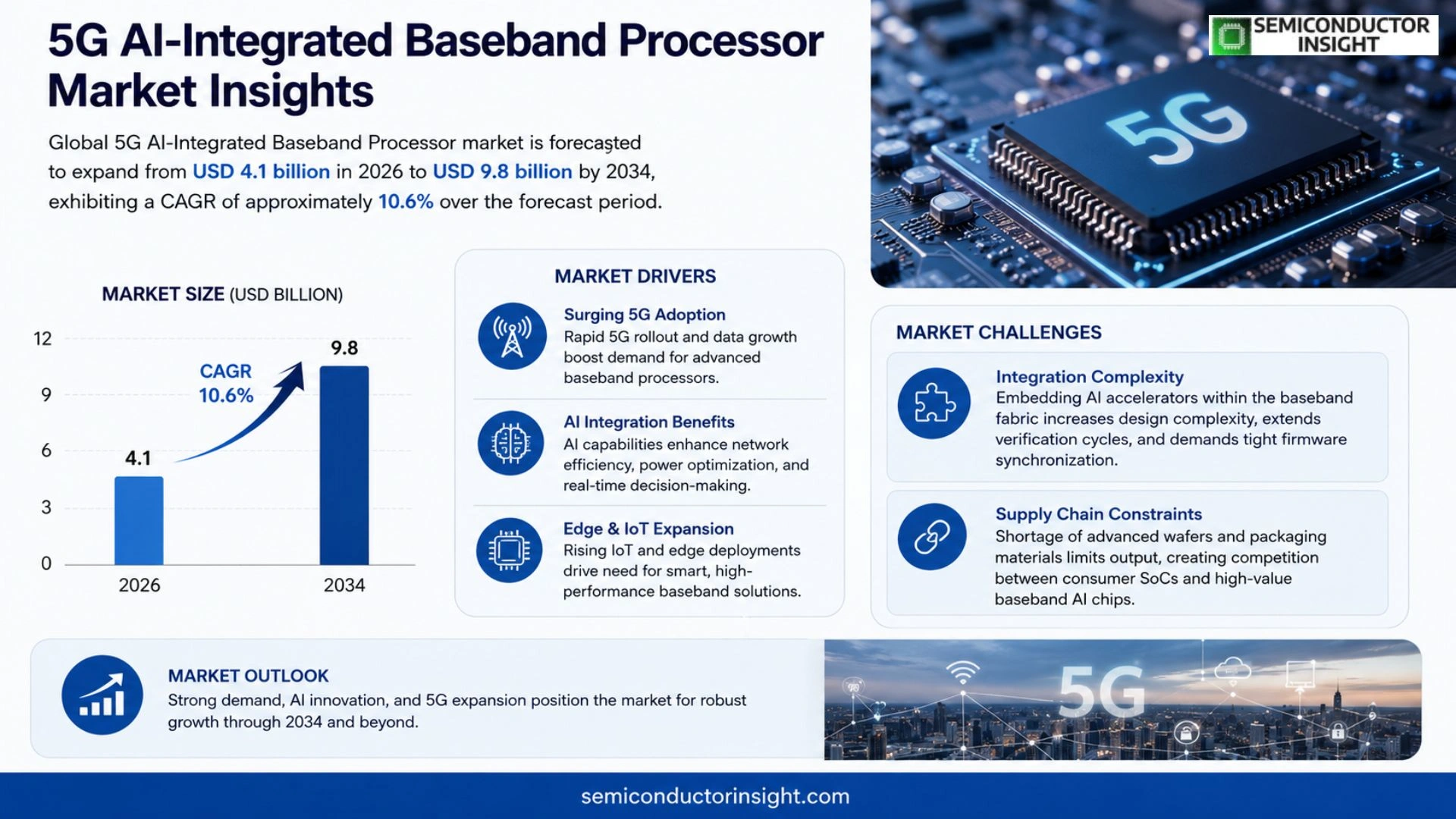
Global 5G AI‑Integrated Baseband Processor market size was valued at USD 3.7 billion in 2025. The market is forecasted to expand from USD 4.1 billion in 2026 to USD 9.8 billion by 2034, exhibiting a CAGR of approximately 10.6 % over the forecast period.
These processors merge conventional baseband functions with on‑chip artificial‑intelligence accelerators, delivering real‑time signal optimization, dynamic spectrum sharing, and edge inference for mobile devices and network gear. Embedding neural‑network engines directly into the radio access layer reduces latency, improves energy efficiency, and supports advanced applications such as autonomous driving, immersive XR, and massive IoT.
The surge stems from telecom operators modernizing core networks toward open‑RAN while demanding higher throughput per watt. Chipmakers also benefit from economies of scale linked to smartphone rollouts that require AI‑enhanced connectivity features. A notable development occurred in March 2024 when Qualcomm partnered with Samsung on a joint AI‑enabled baseband silicon platform, illustrating coordinated effort across the ecosystem.
MARKET DRIVERS
AI‑enabled low‑latency services
The proliferation of immersive gaming, real‑time translation, and autonomous‑vehicle communication is forcing operators to seek baseband solutions that can process AI workloads at the edge. Latency ceilings that once limited cloud‑based inference are being erased by tightly coupled AI processors, making 5G AI‑Integrated Baseband Processor Market a focal point for carriers eager to monetize new services.
Edge‑centric network architectures
Network slicing and micro‑data‑center deployments are reshaping infrastructure design. Vendors that embed AI accelerators directly into the baseband chip can deliver slice‑specific optimization without additional hardware layers, giving them a competitive edge in contracts where resource efficiency is a decisive factor.
➤ “When AI inference resides in the baseband, operators can cut round‑trip time by up to 40 %, unlocking revenue streams that were previously infeasible.”
Investments from chipset manufacturers into heterogeneous integration,combining digital pre‑distortion, RF front‑end, and AI cores on a single die,are accelerating time‑to‑market, reinforcing the upward momentum of 5G AI‑Integrated Baseband Processor Market.
MARKET CHALLENGES
Integration complexity
Embedding AI accelerators within the baseband fabric introduces design trade‑offs around thermal headroom, verification cycles, and firmware synchronization. Companies that lack deep AI‑hardware expertise often face longer development timelines, which can erode first‑mover advantages.
Other Challenges
Supply chain constraints
The shortage of advanced silicon wafers and specialty packaging materials has tightened margins. Even when demand spikes, manufacturers must juggle allocation between consumer‑grade SoCs and the higher‑value baseband AI chips, creating a bottleneck that slows scaling.
MARKET RESTRAINTS
Power‑consumption limits
Base stations operate under strict energy budgets, especially in remote or off‑grid sites. AI‑heavy workloads increase draw, and without breakthroughs in low‑power AI cores, operators risk escalating OPEX. This constraint nudges some carriers toward cloud‑centric AI models, tempering the immediate upside for on‑premise baseband processors.
MARKET OPPORTUNITIES
Emerging verticals
Industries such as smart manufacturing, tele‑medicine, and public‑safety networks are beginning to adopt private 5G slices that demand on‑device AI inference. Early partnerships between chipset firms and vertical solution providers can capture high‑margin contracts, positioning 5G AI‑Integrated Baseband Processor Market as a cornerstone of next‑generation enterprise connectivity.
5G AI-Integrated Baseband Processor Market Trends
AI‑enhanced baseband as a latency reducer
The fusion of neural‑network engines inside the baseband silicon is reshaping how mobile traffic is handled. By moving inference to the radio layer, devices can react to channel fluctuations in microseconds, a capability that directly benefits latency‑sensitive services such as autonomous vehicle communication and immersive mixed reality. This architectural shift reduces the reliance on cloud‑side processing, lowers power draw per transmitted bit, and creates a more predictable quality‑of‑service envelope for operators seeking to differentiate their offerings.
Other Trends
Open‑RAN adoption amplifies demand for programmable AI basebands
Telecom operators pursuing open‑RAN architectures are favoring chips that expose programmable AI blocks. The openness of the radio access network permits third‑party software to tap the on‑chip accelerators for tasks like dynamic spectrum sharing and adaptive beamforming. As operators replace legacy monolithic radios, the market sees a surge in reference designs that embed AI capabilities, allowing rapid rollout of new features without a full hardware refresh.
Strategic partnerships accelerate ecosystem readiness
March 2024 marked a turning point when a leading chipset manufacturer aligned with a premier handset maker to deliver a joint AI‑enabled baseband platform. This collaboration illustrates a broader industry rhythm where silicon vendors, device OEMs, and network operators co‑develop solutions that meet both performance and cost targets. The partnership leverages the volume of smartphone shipments to spread development expenses, while simultaneously delivering the processing horsepower required for next‑generation 5G services. The resulting ecosystem readiness lowers barriers for smaller players to adopt AI‑integrated basebands, fostering a more competitive landscape.
COMPETITIVE LANDSCAPE
Key Industry Players
Competitive dynamics of AI‑enabled 5G baseband processors
5G AI‑Integrated Baseband segment is currently dominated by a handful of large silicon designers that combine mature 5G RF front‑end expertise with on‑chip AI inference engines. Qualcomm, leveraging its Snapdragon X series, has cemented a leadership position by delivering a tightly coupled AI accelerator that supports dynamic spectrum sharing and edge‑AI workloads. The March 2024 collaboration with Samsung to co‑develop a unified AI‑enabled baseband platform illustrates how tier‑1 vendors are consolidating design cycles and sharing silicon IP to meet operator demand for higher throughput per watt. Moreover, the integration of AI accelerators at the silicon level mitigates the need for separate edge servers, aligning with operators’ cost‑efficiency objectives. The resulting ecosystem pressure has prompted several network equipment vendors to qualify multiple sources to avoid single‑supplier lock‑in. Qualcomm’s extensive handset portfolio and its relationships with network equipment manufacturers allow it to capture a sizable share of both mobile and infrastructure deployments, creating a de‑facto reference architecture for the emerging open‑RAN ecosystem.
Beyond the flagship players, a cohort of midsize and specialist firms is expanding the functional breadth of AI‑infused baseband silicon. MediaTek’s Dimensity line introduced a programmable AI engine that targets cost‑sensitive smartphones, while Huawei’s HiSilicon Kirin 9000 series embeds a dedicated NPU for 5G baseband processing despite geopolitical constraints. Intel has entered the market through its acquisition of Habana Labs, offering a heterogeneous compute fabric that can be paired with legacy Xeon‑based RAN units. Companies such as Renesas, STMicroelectronics and Unisoc contribute niche IP blocks,ranging from low‑power DSP cores to integrated antenna‑tuning modules,that enable OEMs to differentiate products without re‑architecting the entire baseband stack. Analog Devices’ recent launch of a mixed‑signal AI‑ready baseband reference design demonstrates the trend toward modular plug‑and‑play solutions. Xilinx’s FPGA‑based AI cores, now under AMD, provide a reconfigurable path for carriers that anticipate rapid standard revisions. The diversification of contributors lowers entry barriers for new entrants, accelerates innovation cycles, and forces the dominant players to continuously enhance performance‑per‑watt metrics.
List of Key 5G AI‑Integrated Baseband Processor Companies Profiled
- Qualcomm
- MediaTek
- Samsung Electronics
- Huawei (HiSilicon)
- Intel
- Nvidia
- Renesas
- STMicroelectronics
- Marvell Technology Group
- Unisoc
- Apple
- Broadcom
- Xilinx (AMD)
- Analog Devices
- Texas Instruments
Segment Analysis:
| Segment Category | Sub-Segments | Key Insights |
| By Type |
|
Monolithic Integration
|
| By Application |
|
Smartphones
|
| By End User |
|
Telecom Operators
|
| By Technology |
|
AI Accelerator
|
| By Market Driver |
|
Open‑RAN Adoption
|
Regional Analysis: 5G AI-Integrated Baseband Processor Market
Leading chipset vendors have forged joint ventures with cloud providers to embed AI inference engines directly onto baseband silicon. This partnership model shortens time‑to‑market for AI‑enabled features, allowing carriers to test adaptive beamforming algorithms without extensive firmware overhauls. The collaborative framework also spreads development risk, fostering a more resilient supply chain for next‑generation connectivity.
Recent geopolitical shifts prompted manufacturers to diversify fabrication sites across the continent. By leveraging multiple foundry partners, firms mitigate the impact of localized disruptions and maintain steady capacity for high‑performance AI cores, a critical factor for maintaining service quality during rapid network densification.
The Federal Communications Commission’s emphasis on spectrum sharing has encouraged the integration of AI decision layers within baseband processors. This regulatory nudge aligns technical capabilities with policy goals, creating a feedback loop where smarter chips enable more efficient spectrum use, satisfying both industry and regulator expectations.
Regional tech clusters in Austin, Boston, and Toronto serve as incubators for AI‑centric silicon design. Their proximity to academic research centers accelerates talent pipelines and facilitates rapid prototyping, ensuring that novel AI algorithms transition swiftly from theory to silicon implementation.
Europe
European operators are concentrating on energy‑efficient AI workloads as they expand 5G coverage across dense urban cores. Countries such as Germany and France have introduced incentives for green networking, prompting chipset designers to prioritize low‑power AI inference. This focus aligns with broader sustainability targets and opens opportunities for specialized processors that balance performance with carbon‑footprint considerations. Moreover, cross‑border standardization efforts within the EU streamline deployment timelines, allowing vendors to offer region‑wide solutions that respect differing spectrum allocations while maintaining consistent AI capabilities.
Asia‑Pacific
The Asia‑Pacific region showcases a blend of massive subscriber growth and aggressive spectrum auctions, particularly in China, South Korea, and Japan. Telecom giants there are experimenting with AI‑augmented baseband architectures to manage traffic surges during major events, such as sports tournaments and cultural festivals. The competitive landscape is further intensified by domestic semiconductor champions who leverage government‑backed R&D programs to embed AI directly into radio units. This approach not only shortens latency but also equips networks with the agility needed to support emerging services like holographic communication and real‑time translation.
South America
In South America, the rollout of 5G is still in its early phases, yet operators recognize the strategic advantage of integrating AI at the baseband level to offset limited infrastructure budgets. By deploying AI‑enabled processors, carriers can extract higher spectral efficiency from existing sites, delaying the need for costly densification. Local partnerships with multinational equipment suppliers are fostering knowledge transfer, ensuring that regional teams acquire the expertise required to fine‑tune AI models for diverse terrain and variable user density.
Middle East & Africa
The Middle East & Africa market is characterized by a mix of high‑value urban deployments and expansive rural coverage challenges. Gulf states are investing heavily in smart‑city initiatives, where AI‑integrated baseband processors become pivotal for real‑time analytics in transportation and public safety. In contrast, African operators are leveraging the flexibility of AI to dynamically allocate resources across vast distances, improving service reliability without extensive capital outlay. Collaborative pilots with global chipset firms are laying the groundwork for a more adaptable network architecture that can evolve alongside economic development trajectories.
Report Scope
This market research report provides a comprehensive analysis of the 5G AI-Integrated Baseband Processor Market , covering the forecast period 2026–2034. It offers detailed insights into market dynamics, technological advancements, competitive landscape, and key trends shaping the industry.
Key focus areas of the report include:
- Market Overview: The report begins with an overview outlining its current market scenario, key growth indicators, and industry transformation drivers. It discusses macroeconomic factors, demand–supply balance, regulatory landscape, and the strategic role of semiconductors in powering advancements across industries such as automotive, telecommunications, consumer electronics, and industrial automation.
- Market Size & Forecast: Historical data and future projections for revenue, unit shipments, and market value across major regions and segments.
- Segmentation Analysis: Detailed breakdown by product type, technology, application, and end-user industry to identify high-growth segments and investment opportunities.
- Regional Insights: Insights into market performance across North America, Europe, Asia-Pacific, Latin America, and the Middle East & Africa, including country-level analysis where relevant.
- Competitive Landscape: Profiles of leading market participants, including their product offerings, R&D focus, manufacturing capacity, pricing strategies, and recent developments such as mergers, acquisitions, and partnerships.
- Technology Trends & Innovation: Assessment of emerging technologies, integration of AI/IoT, semiconductor design trends, fabrication techniques, and evolving industry standards.
- Market Drivers & Restraints: Evaluation of factors driving market growth along with challenges, supply chain constraints, regulatory issues, and market-entry barriers.
- Stakeholder Insights: Insights for component suppliers, OEMs, system integrators, investors, and policymakers regarding the evolving ecosystem and strategic opportunities.
Primary and secondary research methods are employed, including interviews with industry experts, data from verified sources, and real-time market intelligence to ensure the accuracy and reliability of the insights presented.
FREQUENTLY ASKED QUESTIONS:
What is the current market size of 5G AI-Integrated Baseband Processor Market?
-> 5G AI‑Integrated Baseband Processor market is forecasted to expand from USD 4.1 billion in 2026 to USD 9.8 billion by 2034.
Which key companies operate in 5G AI-Integrated Baseband Processor Market?
-> Key players include Qualcomm and Samsung, which announced a joint AI‑enabled baseband silicon platform in March 2024, along with other leading chipset manufacturers actively developing AI‑integrated baseband solutions.
What are the key growth drivers?
-> Key growth drivers include modernization of core networks toward open‑RAN, the need for higher throughput per watt, and economies of scale from widespread smartphone rollouts that demand AI‑enhanced connectivity.
Which region dominates the market?
-> The reference highlights a Global market perspective without specifying a single dominant region; growth is driven by worldwide telecom operators and chipset suppliers.
What are the emerging trends?
-> Emerging trends include integration of on‑chip AI accelerators for real‑time signal optimization, dynamic spectrum sharing, edge inference capabilities, and the broader adoption of open‑RAN architectures.
Get Sample Report PDF for Exclusive Insights
Report Sample Includes
- Table of Contents
- List of Tables & Figures
- Charts, Research Methodology, and more...
 Download Sample Report PDF