3-Axis Force Sensor Market, Trends, Business Strategies 2025-2032

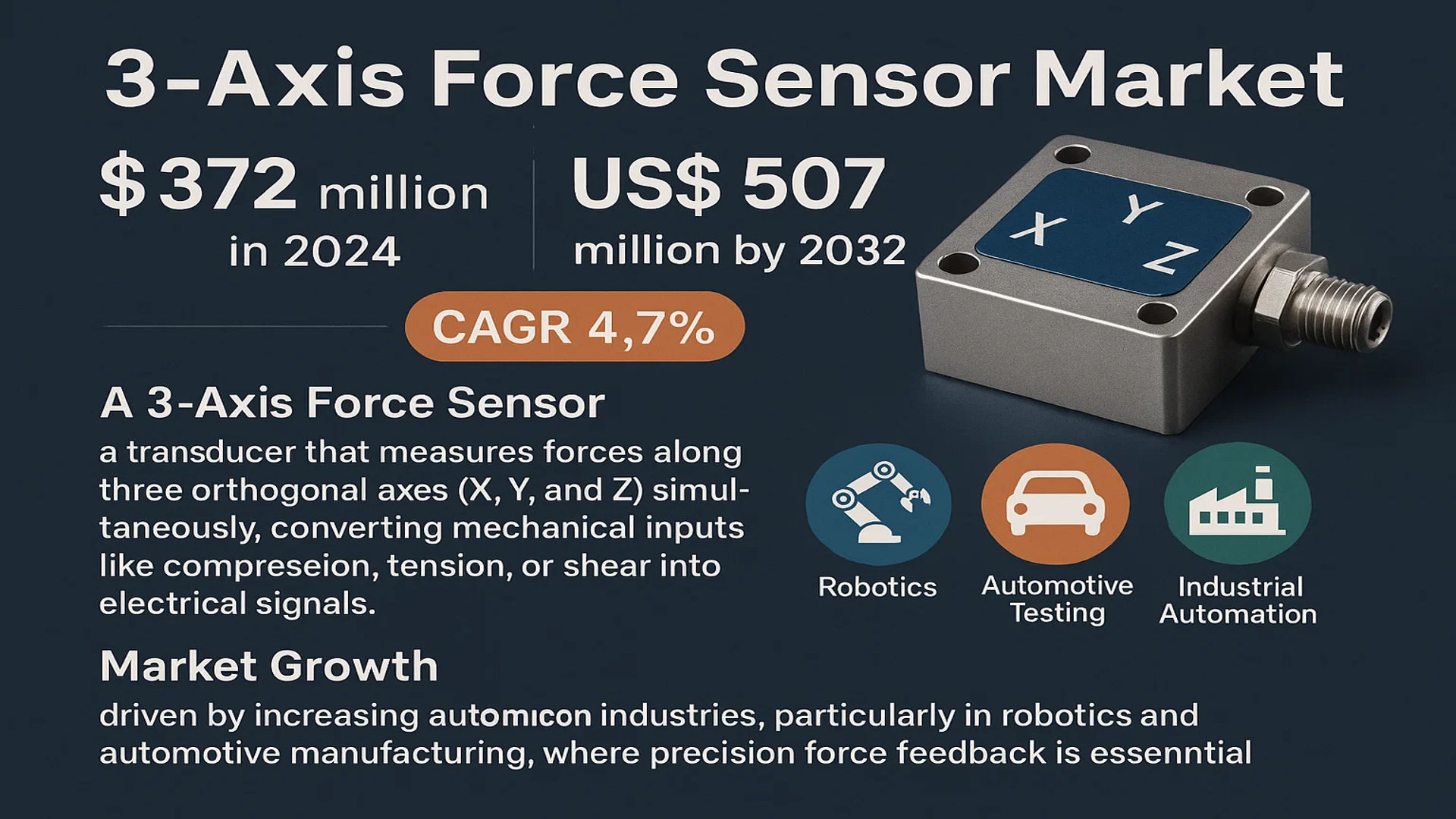
3-Axis Force Sensor Market was valued at 372 million in 2024 and is projected to reach US$ 507 million by 2032, at a CAGR of 4.7% during the forecast period

PDF Icon Download Sample Report PDF
  • Quick Dispatch

    All Orders

  • Secure Payment

    100% Secure Payment

Price range: $1,500.00 through $4,250.00

Clear

MARKET INSIGHTS

The global 3-Axis Force Sensor Market was valued at 372 million in 2024 and is projected to reach US$ 507 million by 2032, at a CAGR of 4.7% during the forecast period.

A 3-Axis Force Sensor is defined as a transducer that measures forces along three orthogonal axes (X, Y, and Z) simultaneously, converting mechanical inputs like compression, tension, or shear into electrical signals. These sensors are critical components in applications requiring precise multi-directional force measurement, such as robotics, automotive testing, and industrial automation. Unlike single-axis sensors, 3-axis variants provide comprehensive spatial force data, enabling advanced control systems and performance analytics.

The market growth is driven by increasing automation across industries, particularly in robotics and automotive manufacturing, where precision force feedback is essential. However, challenges like high costs and calibration complexities may temper adoption rates. Leading players such as FUTEK, ATI Industrial Automation, and Kistler dominate the market with innovations in MEMS-based sensors and compact designs. Recent advancements include IoT integration for real-time force monitoring, further expanding applications in smart factories and wearable technologies.
3-Axis Force Sensor Market

MARKET DYNAMICS

MARKET DRIVERS

Expanding Automation in Manufacturing and Robotics to Fuel Demand for 3-Axis Force Sensors

The global push towards industrial automation is creating unprecedented demand for precision measurement tools like 3-axis force sensors. As factories adopt more robotic systems for assembly, packaging, and quality control, the need for multi-directional force feedback has become critical. Manufacturers report 65% of new robotic installations now incorporate force sensing capabilities, with 3-axis variants preferred for their comprehensive measurement range. The automotive sector alone accounts for 38% of industrial sensor deployments, driven by stringent quality requirements in electric vehicle battery assembly and precision welding applications.

Growth of Medical Robotics and Minimally Invasive Surgery Creating New Applications

Surgical robotics represents one of the fastest-growing segments for 3-axis force sensor adoption, projected to maintain 21% annual growth through 2030. These sensors enable critical haptic feedback in robotic-assisted surgery systems, allowing surgeons to precisely control instrument pressure during delicate procedures. Recent technological breakthroughs have reduced sensor sizes to sub-millimeter scales while maintaining measurement accuracies within ±0.5% of full scale, making them ideal for integration into endoscopic tools and microsurgical instruments.

MARKET CHALLENGES

Complex Calibration Requirements and Environmental Sensitivity Pose Operational Challenges

While 3-axis force sensors offer superior measurement capabilities, their multi-directional nature introduces complex calibration requirements that can challenge end-users. Many industrial applications require regular recalibration—often as frequently as every 500 operating hours—to maintain specified accuracy levels. Environmental factors like temperature fluctuations and electromagnetic interference can cause measurement drift exceeding 2-3% in uncontrolled conditions, requiring additional compensation hardware and sophisticated signal processing algorithms.

Other Challenges

High Initial Implementation Costs
The sophisticated electronics and precision mechanics in 3-axis sensors result in unit costs 40-60% higher than single-axis alternatives. For applications requiring multiple sensing points, these costs multiply quickly—a typical robotic work cell with six force measurement stations can exceed $25,000 just in sensor hardware.

Specialized Installation Requirements
Proper integration of 3-axis sensors often requires customized mounting solutions and specialized cabling to prevent signal degradation. Studies show 35% of premature sensor failures can be traced to improper installation practices, particularly in high-vibration industrial environments.

MARKET RESTRAINTS

Limited Standardization Across Sensor Interfaces Restraining Adoption

The lack of universal communication standards for multi-axis force sensors creates significant integration challenges. While single-axis sensors typically use standardized analog outputs, 3-axis variants employ diverse digital protocols including CANbus, EtherCAT, and proprietary interfaces—with no single standard commanding more than 32% market share. This fragmentation forces system integrators to develop custom interfacing solutions for different sensor models, adding 15-20% to total project costs in many cases.

MARKET OPPORTUNITIES

Emerging IoT and AI Applications Creating New Use Cases in Predictive Maintenance

The integration of 3-axis force sensors with industrial IoT platforms represents a major growth frontier. When combined with machine learning algorithms, these sensors enable predictive maintenance systems that can detect equipment wear patterns with 92% accuracy according to recent studies. Major manufacturers are now embedding force sensing directly into machinery components, with some bearing manufacturers reporting 45% reductions in unplanned downtime through continuous force monitoring implementations.

Advancements in MEMS Technology Enabling Miniaturized Solutions

Recent breakthroughs in micro-electromechanical systems (MEMS) have produced 3-axis force sensors measuring under 5mm x 5mm while maintaining industrial-grade accuracy. These tiny sensors are finding applications in consumer electronics—particularly in next-generation input devices and wearables—with projected market penetration exceeding 18 million units annually by 2028. The medical device sector shows particular promise, with MEMS force sensors enabling new classes of smart surgical tools and rehabilitation devices.

3-AXIS FORCE SENSOR MARKET TRENDS

Increasing Automation in Industrial and Robotics Applications Drives Market Growth

The rapid adoption of automation across industries has significantly increased demand for 3-axis force sensors, particularly in robotics and automotive manufacturing. These sensors enable precise force measurement in multiple directions, enhancing the accuracy of robotic assembly lines and quality control systems. The global robotics market is projected to grow at a CAGR of 12% from 2024-2032, directly fueling demand for force sensing solutions. In automotive applications, 3-axis sensors play a critical role in crash testing and component durability analysis. Furthermore, the integration of Artificial Intelligence (AI) with force sensing technologies has led to smarter predictive maintenance systems, reducing equipment downtime by up to 30% in manufacturing environments.

Other Trends

Miniaturization and Higher Precision Requirements

The electronics industry’s push toward miniaturization has created demand for smaller, more precise 3-axis force sensors. Semiconductor manufacturers increasingly rely on micro-force measurement for delicate component assembly, where typical requirements range from 50mN to 10N force ranges with micrometer-level precision. This trend aligns with the growing semiconductor market, projected to reach $790 billion by 2032. Additionally, medical device manufacturers are incorporating ultra-sensitive force sensors into surgical robotics, where tactile feedback systems require sub-Newton measurement accuracy while maintaining compact form factors.

Emerging Applications in Healthcare and Consumer Electronics

Advanced healthcare applications are adopting 3-axis force sensors for rehabilitation equipment and surgical robotics. In prosthetic limb development, these sensors provide crucial feedback for natural movement simulation, with the assistive technology market growing at 7% annually. Consumer electronics manufacturers are also implementing force sensors in next-generation input devices. The shift toward haptic feedback systems in gaming controllers and touchscreens has created opportunities for compact force sensing solutions, particularly in the Asia-Pacific region where electronics manufacturing is concentrated. Over 40% of new premium smartphones now incorporate some form of advanced force detection for enhanced user interaction.

COMPETITIVE LANDSCAPE

Key Industry Players

Innovation and Expansion Drive Market Leadership in 3-Axis Force Sensor Industry

The global 3-Axis Force Sensor market demonstrates a dynamic competitive landscape characterized by both established market leaders and emerging innovators. FUTEK Advanced Sensor Technology, Inc. dominates the market with its comprehensive range of high-precision force measurement solutions, supported by a robust presence across North America, Europe, and Asia-Pacific regions. The company’s leadership is reinforced by continuous R&D investments, resulting in advanced sensor technologies catering to diverse industrial applications.

ATI Industrial Automation and Kistler Group maintain significant market positions, leveraging their specialized expertise in robotic force measurement and industrial automation sectors. These companies have demonstrated consistent growth through strategic collaborations with automotive and manufacturing leaders. Their focus on developing compact, high-performance sensors for collaborative robotics applications positions them favorably in the rapidly evolving Industry 4.0 landscape.

Market competition intensifies as key players expand their geographic footprints and enhance product capabilities. Tekscan, Inc. has gained notable traction through its innovative FlexiForce tactile sensors, particularly in medical and research applications. The company’s recent partnerships with healthcare technology providers exemplify the growing convergence between sensor technology and digital health solutions.

Meanwhile, Asian manufacturers like Shenzhen Ligent Sensor Tech are disrupting traditional market dynamics with cost-competitive offerings, capturing increased market share in price-sensitive segments. Their growth reflects the broader trend of manufacturing decentralization and supply chain diversification across the sensor industry.

List of Key 3-Axis Force Sensor Companies Profiled

Segment Analysis:

By Type

Commercial Grade Segment Leads Due to Increased Industrial Automation Demand

The market is segmented based on type into:

  • Commercial Grade
  • Military Grade

By Application

Automotive Segment Dominates Due to Integration in Smart Manufacturing Systems

The market is segmented based on application into:

  • Automotive
  • Robots
  • Others

By Technology

Strain Gauge Technology Holds Largest Share Owing to Precision Measurement Capabilities

The market is segmented based on technology into:

  • Strain Gauge
  • Piezoelectric
  • Capacitive
  • Optical

By End-User Industry

Manufacturing Sector Accounts for Significant Adoption Due to Quality Control Needs

The market is segmented based on end-user industry into:

  • Manufacturing
  • Healthcare
  • Aerospace & Defense
  • Research & Development
  • Others

Regional Analysis: 3-Axis Force Sensor Market

Asia-Pacific
The Asia-Pacific region dominates the global 3-Axis Force Sensor market, accounting for over 38% of the total revenue in 2024. This leadership position stems from robust manufacturing ecosystems in China, Japan, and South Korea, coupled with rapid industrialization across Southeast Asia. China’s “Made in China 2025” initiative actively promotes advanced sensor technologies, creating significant demand for precision force measurement in robotics and automotive applications. Japan’s longstanding expertise in mechatronics and industrial automation drives innovation, while India’s expanding electronics manufacturing sector presents new growth opportunities. However, intense price competition among local manufacturers creates margin pressures for global players entering this high-volume market.

North America
North America represents the second-largest market for 3-Axis Force Sensors, with the U.S. contributing approximately 28% of global sales. The region benefits from advanced R&D capabilities and strong adoption across aerospace, defense, and medical device industries. Stringent quality requirements in these sectors fuel demand for high-precision military-grade sensors, with manufacturers like FUTEK and ATI Industrial Automation leading innovation. Recent investments in autonomous vehicles and collaborative robotics, particularly in Silicon Valley and Boston’s tech hubs, are creating new application frontiers. The Canadian market shows growing potential, especially in industrial automation and renewable energy applications.

Europe
Europe maintains a strong position in the 3-Axis Force Sensor market, characterized by premium-priced, high-accuracy products from German and Swiss manufacturers. The region excels in specialized applications such as pharmaceutical manufacturing equipment and precision engineering tools, where measurement accuracy below 0.1% is often required. EU-funded research projects under Horizon Europe are accelerating development of smart sensors with integrated AI capabilities. While Western European markets show steady growth, Eastern Europe emerges as a cost-competitive manufacturing base for sensor components. The automotive sector remains a key driver, particularly for testing equipment and advanced driver assistance systems.

South America
South America’s 3-Axis Force Sensor market is nascent but shows promising growth in Brazil and Argentina. The region’s focus on agricultural automation and mining equipment modernization creates niche opportunities for ruggedized sensors. However, reliance on imports for high-end sensors and limited local manufacturing capabilities constrain market expansion. Economic instability in key markets like Venezuela and fluctuating exchange rates present challenges for international suppliers. Recent trade agreements within Mercosur are gradually improving technology transfer, particularly in Brazil’s growing automotive sector where sensor demand increases by approximately 7% annually.

Middle East & Africa
This region represents the smallest but fastest-growing market for 3-Axis Force Sensors, with projected CAGR of 6.2% through 2032. Oil and gas applications dominate demand, particularly for hazardous environment-rated sensors in GCC countries. Israel’s thriving medical technology sector drives innovation in miniature force sensors, while South Africa’s industrial sector shows increasing adoption. Infrastructure limitations and lack of technical expertise remain barriers, though smart city initiatives in the UAE and Saudi Vision 2030 projects are stimulating investments in sensor technologies. The market remains highly dependent on imports, with local assembly only emerging in select free trade zones.

Report Scope

This market research report provides a comprehensive analysis of the global and regional 3-Axis Force Sensor markets, covering the forecast period 2024–2032. It offers detailed insights into market dynamics, technological advancements, competitive landscape, and key trends shaping the industry.

Key focus areas of the report include:

  • Market Size & Forecast: Historical data and future projections for revenue, unit shipments, and market value across major regions and segments. The global 3-Axis Force Sensor market was valued at USD 372 million in 2024 and is projected to reach USD 507 million by 2032, at a CAGR of 4.7% during the forecast period.
  • Segmentation Analysis: Detailed breakdown by product type (Commercial Grade, Military Grade), application (Automotive, Robots, Others), and end-user industry to identify high-growth segments and investment opportunities.
  • Regional Outlook: Insights into market performance across North America, Europe, Asia-Pacific, Latin America, and the Middle East & Africa, including country-level analysis where relevant.
  • Competitive Landscape: Profiles of leading market participants, including their product offerings, R&D focus, manufacturing capacity, pricing strategies, and recent developments such as mergers, acquisitions, and partnerships.
  • Technology Trends & Innovation: Assessment of emerging technologies, integration of IoT, semiconductor design trends, and evolving industry standards in force sensing technology.
  • Market Drivers & Restraints: Evaluation of factors driving market growth along with challenges, supply chain constraints, regulatory issues, and market-entry barriers.
  • Stakeholder Analysis: Insights for component suppliers, OEMs, system integrators, investors, and policymakers regarding the evolving ecosystem and strategic opportunities.

Primary and secondary research methods are employed, including interviews with industry experts, data from verified sources, and real-time market intelligence to ensure the accuracy and reliability of the insights presented.

FREQUENTLY ASKED QUESTIONS:

What is the current market size of Global 3-Axis Force Sensor Market?

-> 3-Axis Force Sensor Market was valued at 372 million in 2024 and is projected to reach US$ 507 million by 2032, at a CAGR of 4.7% during the forecast period.

Which key companies operate in Global 3-Axis Force Sensor Market?

-> Key players include FUTEK, Freescale, ATI, GE, Innovative Sensor Technology, Tekscan, Kistler, Forsentek, Nos Sensor, Shenzhen Ligent Sensor Tech, Juli Sensor, and Sunrise Instruments, among others.

What are the key growth drivers?

-> Key growth drivers include increasing automation in manufacturing, rising demand for robotics, and technological advancements in force sensing applications.

Which region dominates the market?

-> Asia-Pacific is the fastest-growing region, while North America remains a technologically advanced market leader.

What are the emerging trends?

-> Emerging trends include miniaturization of sensors, integration with IoT systems, and development of smart force sensing solutions.

3-Axis Force Sensor Market, Trends, Business Strategies 2025-2032

Get Sample Report PDF for Exclusive Insights

Report Sample Includes

  • Table of Contents
  • List of Tables & Figures
  • Charts, Research Methodology, and more...

PDF Icon Download Sample Report PDF
SKU: 177ef6263a07
Category:

Download Sample Report

Table of Content

1 Introduction to Research & Analysis Reports
1.1 3-Axis Force Sensor Market Definition
1.2 Market Segments
1.2.1 Segment by Type
1.2.2 Segment by Application
1.3 Global 3-Axis Force Sensor Market Overview
1.4 Features & Benefits of This Report
1.5 Methodology & Sources of Information
1.5.1 Research Methodology
1.5.2 Research Process
1.5.3 Base Year
1.5.4 Report Assumptions & Caveats
2 Global 3-Axis Force Sensor Overall Market Size
2.1 Global 3-Axis Force Sensor Market Size: 2024 VS 2032
2.2 Global 3-Axis Force Sensor Market Size, Prospects & Forecasts: 2020-2032
2.3 Global 3-Axis Force Sensor Sales: 2020-2032
3 Company Landscape
3.1 Top 3-Axis Force Sensor Players in Global Market
3.2 Top Global 3-Axis Force Sensor Companies Ranked by Revenue
3.3 Global 3-Axis Force Sensor Revenue by Companies
3.4 Global 3-Axis Force Sensor Sales by Companies
3.5 Global 3-Axis Force Sensor Price by Manufacturer (2020-2025)
3.6 Top 3 and Top 5 3-Axis Force Sensor Companies in Global Market, by Revenue in 2024
3.7 Global Manufacturers 3-Axis Force Sensor Product Type
3.8 Tier 1, Tier 2, and Tier 3 3-Axis Force Sensor Players in Global Market
3.8.1 List of Global Tier 1 3-Axis Force Sensor Companies
3.8.2 List of Global Tier 2 and Tier 3 3-Axis Force Sensor Companies
4 Sights by Product
4.1 Overview
4.1.1 Segment by Type – Global 3-Axis Force Sensor Market Size Markets, 2024 & 2032
4.1.2 Commercial Grade
4.1.3 Military Grade
4.2 Segment by Type – Global 3-Axis Force Sensor Revenue & Forecasts
4.2.1 Segment by Type – Global 3-Axis Force Sensor Revenue, 2020-2025
4.2.2 Segment by Type – Global 3-Axis Force Sensor Revenue, 2026-2032
4.2.3 Segment by Type – Global 3-Axis Force Sensor Revenue Market Share, 2020-2032
4.3 Segment by Type – Global 3-Axis Force Sensor Sales & Forecasts
4.3.1 Segment by Type – Global 3-Axis Force Sensor Sales, 2020-2025
4.3.2 Segment by Type – Global 3-Axis Force Sensor Sales, 2026-2032
4.3.3 Segment by Type – Global 3-Axis Force Sensor Sales Market Share, 2020-2032
4.4 Segment by Type – Global 3-Axis Force Sensor Price (Manufacturers Selling Prices), 2020-2032
5 Sights by Application
5.1 Overview
5.1.1 Segment by Application – Global 3-Axis Force Sensor Market Size, 2024 & 2032
5.1.2 Automotive
5.1.3 Robots
5.1.4 Others
5.2 Segment by Application – Global 3-Axis Force Sensor Revenue & Forecasts
5.2.1 Segment by Application – Global 3-Axis Force Sensor Revenue, 2020-2025
5.2.2 Segment by Application – Global 3-Axis Force Sensor Revenue, 2026-2032
5.2.3 Segment by Application – Global 3-Axis Force Sensor Revenue Market Share, 2020-2032
5.3 Segment by Application – Global 3-Axis Force Sensor Sales & Forecasts
5.3.1 Segment by Application – Global 3-Axis Force Sensor Sales, 2020-2025
5.3.2 Segment by Application – Global 3-Axis Force Sensor Sales, 2026-2032
5.3.3 Segment by Application – Global 3-Axis Force Sensor Sales Market Share, 2020-2032
5.4 Segment by Application – Global 3-Axis Force Sensor Price (Manufacturers Selling Prices), 2020-2032
6 Sights by Region
6.1 By Region – Global 3-Axis Force Sensor Market Size, 2024 & 2032
6.2 By Region – Global 3-Axis Force Sensor Revenue & Forecasts
6.2.1 By Region – Global 3-Axis Force Sensor Revenue, 2020-2025
6.2.2 By Region – Global 3-Axis Force Sensor Revenue, 2026-2032
6.2.3 By Region – Global 3-Axis Force Sensor Revenue Market Share, 2020-2032
6.3 By Region – Global 3-Axis Force Sensor Sales & Forecasts
6.3.1 By Region – Global 3-Axis Force Sensor Sales, 2020-2025
6.3.2 By Region – Global 3-Axis Force Sensor Sales, 2026-2032
6.3.3 By Region – Global 3-Axis Force Sensor Sales Market Share, 2020-2032
6.4 North America
6.4.1 By Country – North America 3-Axis Force Sensor Revenue, 2020-2032
6.4.2 By Country – North America 3-Axis Force Sensor Sales, 2020-2032
6.4.3 United States 3-Axis Force Sensor Market Size, 2020-2032
6.4.4 Canada 3-Axis Force Sensor Market Size, 2020-2032
6.4.5 Mexico 3-Axis Force Sensor Market Size, 2020-2032
6.5 Europe
6.5.1 By Country – Europe 3-Axis Force Sensor Revenue, 2020-2032
6.5.2 By Country – Europe 3-Axis Force Sensor Sales, 2020-2032
6.5.3 Germany 3-Axis Force Sensor Market Size, 2020-2032
6.5.4 France 3-Axis Force Sensor Market Size, 2020-2032
6.5.5 U.K. 3-Axis Force Sensor Market Size, 2020-2032
6.5.6 Italy 3-Axis Force Sensor Market Size, 2020-2032
6.5.7 Russia 3-Axis Force Sensor Market Size, 2020-2032
6.5.8 Nordic Countries 3-Axis Force Sensor Market Size, 2020-2032
6.5.9 Benelux 3-Axis Force Sensor Market Size, 2020-2032
6.6 Asia
6.6.1 By Region – Asia 3-Axis Force Sensor Revenue, 2020-2032
6.6.2 By Region – Asia 3-Axis Force Sensor Sales, 2020-2032
6.6.3 China 3-Axis Force Sensor Market Size, 2020-2032
6.6.4 Japan 3-Axis Force Sensor Market Size, 2020-2032
6.6.5 South Korea 3-Axis Force Sensor Market Size, 2020-2032
6.6.6 Southeast Asia 3-Axis Force Sensor Market Size, 2020-2032
6.6.7 India 3-Axis Force Sensor Market Size, 2020-2032
6.7 South America
6.7.1 By Country – South America 3-Axis Force Sensor Revenue, 2020-2032
6.7.2 By Country – South America 3-Axis Force Sensor Sales, 2020-2032
6.7.3 Brazil 3-Axis Force Sensor Market Size, 2020-2032
6.7.4 Argentina 3-Axis Force Sensor Market Size, 2020-2032
6.8 Middle East & Africa
6.8.1 By Country – Middle East & Africa 3-Axis Force Sensor Revenue, 2020-2032
6.8.2 By Country – Middle East & Africa 3-Axis Force Sensor Sales, 2020-2032
6.8.3 Turkey 3-Axis Force Sensor Market Size, 2020-2032
6.8.4 Israel 3-Axis Force Sensor Market Size, 2020-2032
6.8.5 Saudi Arabia 3-Axis Force Sensor Market Size, 2020-2032
6.8.6 UAE 3-Axis Force Sensor Market Size, 2020-2032
7 Manufacturers & Brands Profiles
7.1 FUTEK
7.1.1 FUTEK Company Summary
7.1.2 FUTEK Business Overview
7.1.3 FUTEK 3-Axis Force Sensor Major Product Offerings
7.1.4 FUTEK 3-Axis Force Sensor Sales and Revenue in Global (2020-2025)
7.1.5 FUTEK Key News & Latest Developments
7.2 Freescale
7.2.1 Freescale Company Summary
7.2.2 Freescale Business Overview
7.2.3 Freescale 3-Axis Force Sensor Major Product Offerings
7.2.4 Freescale 3-Axis Force Sensor Sales and Revenue in Global (2020-2025)
7.2.5 Freescale Key News & Latest Developments
7.3 ATI
7.3.1 ATI Company Summary
7.3.2 ATI Business Overview
7.3.3 ATI 3-Axis Force Sensor Major Product Offerings
7.3.4 ATI 3-Axis Force Sensor Sales and Revenue in Global (2020-2025)
7.3.5 ATI Key News & Latest Developments
7.4 GE
7.4.1 GE Company Summary
7.4.2 GE Business Overview
7.4.3 GE 3-Axis Force Sensor Major Product Offerings
7.4.4 GE 3-Axis Force Sensor Sales and Revenue in Global (2020-2025)
7.4.5 GE Key News & Latest Developments
7.5 Innovative Sensor Technology
7.5.1 Innovative Sensor Technology Company Summary
7.5.2 Innovative Sensor Technology Business Overview
7.5.3 Innovative Sensor Technology 3-Axis Force Sensor Major Product Offerings
7.5.4 Innovative Sensor Technology 3-Axis Force Sensor Sales and Revenue in Global (2020-2025)
7.5.5 Innovative Sensor Technology Key News & Latest Developments
7.6 Tekscan
7.6.1 Tekscan Company Summary
7.6.2 Tekscan Business Overview
7.6.3 Tekscan 3-Axis Force Sensor Major Product Offerings
7.6.4 Tekscan 3-Axis Force Sensor Sales and Revenue in Global (2020-2025)
7.6.5 Tekscan Key News & Latest Developments
7.7 Kistler
7.7.1 Kistler Company Summary
7.7.2 Kistler Business Overview
7.7.3 Kistler 3-Axis Force Sensor Major Product Offerings
7.7.4 Kistler 3-Axis Force Sensor Sales and Revenue in Global (2020-2025)
7.7.5 Kistler Key News & Latest Developments
7.8 Forsentek
7.8.1 Forsentek Company Summary
7.8.2 Forsentek Business Overview
7.8.3 Forsentek 3-Axis Force Sensor Major Product Offerings
7.8.4 Forsentek 3-Axis Force Sensor Sales and Revenue in Global (2020-2025)
7.8.5 Forsentek Key News & Latest Developments
7.9 Nos Sensor
7.9.1 Nos Sensor Company Summary
7.9.2 Nos Sensor Business Overview
7.9.3 Nos Sensor 3-Axis Force Sensor Major Product Offerings
7.9.4 Nos Sensor 3-Axis Force Sensor Sales and Revenue in Global (2020-2025)
7.9.5 Nos Sensor Key News & Latest Developments
7.10 Shenzhen Ligent Sensor Tech
7.10.1 Shenzhen Ligent Sensor Tech Company Summary
7.10.2 Shenzhen Ligent Sensor Tech Business Overview
7.10.3 Shenzhen Ligent Sensor Tech 3-Axis Force Sensor Major Product Offerings
7.10.4 Shenzhen Ligent Sensor Tech 3-Axis Force Sensor Sales and Revenue in Global (2020-2025)
7.10.5 Shenzhen Ligent Sensor Tech Key News & Latest Developments
7.11 Juli Sensor
7.11.1 Juli Sensor Company Summary
7.11.2 Juli Sensor Business Overview
7.11.3 Juli Sensor 3-Axis Force Sensor Major Product Offerings
7.11.4 Juli Sensor 3-Axis Force Sensor Sales and Revenue in Global (2020-2025)
7.11.5 Juli Sensor Key News & Latest Developments
7.12 Sunrise Instruments
7.12.1 Sunrise Instruments Company Summary
7.12.2 Sunrise Instruments Business Overview
7.12.3 Sunrise Instruments 3-Axis Force Sensor Major Product Offerings
7.12.4 Sunrise Instruments 3-Axis Force Sensor Sales and Revenue in Global (2020-2025)
7.12.5 Sunrise Instruments Key News & Latest Developments
8 Global 3-Axis Force Sensor Production Capacity, Analysis
8.1 Global 3-Axis Force Sensor Production Capacity, 2020-2032
8.2 3-Axis Force Sensor Production Capacity of Key Manufacturers in Global Market
8.3 Global 3-Axis Force Sensor Production by Region
9 Key Market Trends, Opportunity, Drivers and Restraints
9.1 Market Opportunities & Trends
9.2 Market Drivers
9.3 Market Restraints
10 3-Axis Force Sensor Supply Chain Analysis
10.1 3-Axis Force Sensor Industry Value Chain
10.2 3-Axis Force Sensor Upstream Market
10.3 3-Axis Force Sensor Downstream and Clients
10.4 Marketing Channels Analysis
10.4.1 Marketing Channels
10.4.2 3-Axis Force Sensor Distributors and Sales Agents in Global
11 Conclusion
12 Appendix
12.1 Note
12.2 Examples of Clients
12.3 DisclaimerList of Tables
Table 1. Key Players of 3-Axis Force Sensor in Global Market
Table 2. Top 3-Axis Force Sensor Players in Global Market, Ranking by Revenue (2024)
Table 3. Global 3-Axis Force Sensor Revenue by Companies, (US$, Mn), 2020-2025
Table 4. Global 3-Axis Force Sensor Revenue Share by Companies, 2020-2025
Table 5. Global 3-Axis Force Sensor Sales by Companies, (K Units), 2020-2025
Table 6. Global 3-Axis Force Sensor Sales Share by Companies, 2020-2025
Table 7. Key Manufacturers 3-Axis Force Sensor Price (2020-2025) & (US$/Unit)
Table 8. Global Manufacturers 3-Axis Force Sensor Product Type
Table 9. List of Global Tier 1 3-Axis Force Sensor Companies, Revenue (US$, Mn) in 2024 and Market Share
Table 10. List of Global Tier 2 and Tier 3 3-Axis Force Sensor Companies, Revenue (US$, Mn) in 2024 and Market Share
Table 11. Segment by Type – Global 3-Axis Force Sensor Revenue, (US$, Mn), 2024 & 2032
Table 12. Segment by Type – Global 3-Axis Force Sensor Revenue (US$, Mn), 2020-2025
Table 13. Segment by Type – Global 3-Axis Force Sensor Revenue (US$, Mn), 2026-2032
Table 14. Segment by Type – Global 3-Axis Force Sensor Sales (K Units), 2020-2025
Table 15. Segment by Type – Global 3-Axis Force Sensor Sales (K Units), 2026-2032
Table 16. Segment by Application – Global 3-Axis Force Sensor Revenue, (US$, Mn), 2024 & 2032
Table 17. Segment by Application – Global 3-Axis Force Sensor Revenue, (US$, Mn), 2020-2025
Table 18. Segment by Application – Global 3-Axis Force Sensor Revenue, (US$, Mn), 2026-2032
Table 19. Segment by Application – Global 3-Axis Force Sensor Sales, (K Units), 2020-2025
Table 20. Segment by Application – Global 3-Axis Force Sensor Sales, (K Units), 2026-2032
Table 21. By Region – Global 3-Axis Force Sensor Revenue, (US$, Mn), 2025-2032
Table 22. By Region – Global 3-Axis Force Sensor Revenue, (US$, Mn), 2020-2025
Table 23. By Region – Global 3-Axis Force Sensor Revenue, (US$, Mn), 2026-2032
Table 24. By Region – Global 3-Axis Force Sensor Sales, (K Units), 2020-2025
Table 25. By Region – Global 3-Axis Force Sensor Sales, (K Units), 2026-2032
Table 26. By Country – North America 3-Axis Force Sensor Revenue, (US$, Mn), 2020-2025
Table 27. By Country – North America 3-Axis Force Sensor Revenue, (US$, Mn), 2026-2032
Table 28. By Country – North America 3-Axis Force Sensor Sales, (K Units), 2020-2025
Table 29. By Country – North America 3-Axis Force Sensor Sales, (K Units), 2026-2032
Table 30. By Country – Europe 3-Axis Force Sensor Revenue, (US$, Mn), 2020-2025
Table 31. By Country – Europe 3-Axis Force Sensor Revenue, (US$, Mn), 2026-2032
Table 32. By Country – Europe 3-Axis Force Sensor Sales, (K Units), 2020-2025
Table 33. By Country – Europe 3-Axis Force Sensor Sales, (K Units), 2026-2032
Table 34. By Region – Asia 3-Axis Force Sensor Revenue, (US$, Mn), 2020-2025
Table 35. By Region – Asia 3-Axis Force Sensor Revenue, (US$, Mn), 2026-2032
Table 36. By Region – Asia 3-Axis Force Sensor Sales, (K Units), 2020-2025
Table 37. By Region – Asia 3-Axis Force Sensor Sales, (K Units), 2026-2032
Table 38. By Country – South America 3-Axis Force Sensor Revenue, (US$, Mn), 2020-2025
Table 39. By Country – South America 3-Axis Force Sensor Revenue, (US$, Mn), 2026-2032
Table 40. By Country – South America 3-Axis Force Sensor Sales, (K Units), 2020-2025
Table 41. By Country – South America 3-Axis Force Sensor Sales, (K Units), 2026-2032
Table 42. By Country – Middle East & Africa 3-Axis Force Sensor Revenue, (US$, Mn), 2020-2025
Table 43. By Country – Middle East & Africa 3-Axis Force Sensor Revenue, (US$, Mn), 2026-2032
Table 44. By Country – Middle East & Africa 3-Axis Force Sensor Sales, (K Units), 2020-2025
Table 45. By Country – Middle East & Africa 3-Axis Force Sensor Sales, (K Units), 2026-2032
Table 46. FUTEK Company Summary
Table 47. FUTEK 3-Axis Force Sensor Product Offerings
Table 48. FUTEK 3-Axis Force Sensor Sales (K Units), Revenue (US$, Mn) and Average Price (US$/Unit) & (2020-2025)
Table 49. FUTEK Key News & Latest Developments
Table 50. Freescale Company Summary
Table 51. Freescale 3-Axis Force Sensor Product Offerings
Table 52. Freescale 3-Axis Force Sensor Sales (K Units), Revenue (US$, Mn) and Average Price (US$/Unit) & (2020-2025)
Table 53. Freescale Key News & Latest Developments
Table 54. ATI Company Summary
Table 55. ATI 3-Axis Force Sensor Product Offerings
Table 56. ATI 3-Axis Force Sensor Sales (K Units), Revenue (US$, Mn) and Average Price (US$/Unit) & (2020-2025)
Table 57. ATI Key News & Latest Developments
Table 58. GE Company Summary
Table 59. GE 3-Axis Force Sensor Product Offerings
Table 60. GE 3-Axis Force Sensor Sales (K Units), Revenue (US$, Mn) and Average Price (US$/Unit) & (2020-2025)
Table 61. GE Key News & Latest Developments
Table 62. Innovative Sensor Technology Company Summary
Table 63. Innovative Sensor Technology 3-Axis Force Sensor Product Offerings
Table 64. Innovative Sensor Technology 3-Axis Force Sensor Sales (K Units), Revenue (US$, Mn) and Average Price (US$/Unit) & (2020-2025)
Table 65. Innovative Sensor Technology Key News & Latest Developments
Table 66. Tekscan Company Summary
Table 67. Tekscan 3-Axis Force Sensor Product Offerings
Table 68. Tekscan 3-Axis Force Sensor Sales (K Units), Revenue (US$, Mn) and Average Price (US$/Unit) & (2020-2025)
Table 69. Tekscan Key News & Latest Developments
Table 70. Kistler Company Summary
Table 71. Kistler 3-Axis Force Sensor Product Offerings
Table 72. Kistler 3-Axis Force Sensor Sales (K Units), Revenue (US$, Mn) and Average Price (US$/Unit) & (2020-2025)
Table 73. Kistler Key News & Latest Developments
Table 74. Forsentek Company Summary
Table 75. Forsentek 3-Axis Force Sensor Product Offerings
Table 76. Forsentek 3-Axis Force Sensor Sales (K Units), Revenue (US$, Mn) and Average Price (US$/Unit) & (2020-2025)
Table 77. Forsentek Key News & Latest Developments
Table 78. Nos Sensor Company Summary
Table 79. Nos Sensor 3-Axis Force Sensor Product Offerings
Table 80. Nos Sensor 3-Axis Force Sensor Sales (K Units), Revenue (US$, Mn) and Average Price (US$/Unit) & (2020-2025)
Table 81. Nos Sensor Key News & Latest Developments
Table 82. Shenzhen Ligent Sensor Tech Company Summary
Table 83. Shenzhen Ligent Sensor Tech 3-Axis Force Sensor Product Offerings
Table 84. Shenzhen Ligent Sensor Tech 3-Axis Force Sensor Sales (K Units), Revenue (US$, Mn) and Average Price (US$/Unit) & (2020-2025)
Table 85. Shenzhen Ligent Sensor Tech Key News & Latest Developments
Table 86. Juli Sensor Company Summary
Table 87. Juli Sensor 3-Axis Force Sensor Product Offerings
Table 88. Juli Sensor 3-Axis Force Sensor Sales (K Units), Revenue (US$, Mn) and Average Price (US$/Unit) & (2020-2025)
Table 89. Juli Sensor Key News & Latest Developments
Table 90. Sunrise Instruments Company Summary
Table 91. Sunrise Instruments 3-Axis Force Sensor Product Offerings
Table 92. Sunrise Instruments 3-Axis Force Sensor Sales (K Units), Revenue (US$, Mn) and Average Price (US$/Unit) & (2020-2025)
Table 93. Sunrise Instruments Key News & Latest Developments
Table 94. 3-Axis Force Sensor Capacity of Key Manufacturers in Global Market, 2023-2025 (K Units)
Table 95. Global 3-Axis Force Sensor Capacity Market Share of Key Manufacturers, 2023-2025
Table 96. Global 3-Axis Force Sensor Production by Region, 2020-2025 (K Units)
Table 97. Global 3-Axis Force Sensor Production by Region, 2026-2032 (K Units)
Table 98. 3-Axis Force Sensor Market Opportunities & Trends in Global Market
Table 99. 3-Axis Force Sensor Market Drivers in Global Market
Table 100. 3-Axis Force Sensor Market Restraints in Global Market
Table 101. 3-Axis Force Sensor Raw Materials
Table 102. 3-Axis Force Sensor Raw Materials Suppliers in Global Market
Table 103. Typical 3-Axis Force Sensor Downstream
Table 104. 3-Axis Force Sensor Downstream Clients in Global Market
Table 105. 3-Axis Force Sensor Distributors and Sales Agents in Global Market

List of Figures
Figure 1. 3-Axis Force Sensor Product Picture
Figure 2. 3-Axis Force Sensor Segment by Type in 2024
Figure 3. 3-Axis Force Sensor Segment by Application in 2024
Figure 4. Global 3-Axis Force Sensor Market Overview: 2024
Figure 5. Key Caveats
Figure 6. Global 3-Axis Force Sensor Market Size: 2024 VS 2032 (US$, Mn)
Figure 7. Global 3-Axis Force Sensor Revenue: 2020-2032 (US$, Mn)
Figure 8. 3-Axis Force Sensor Sales in Global Market: 2020-2032 (K Units)
Figure 9. The Top 3 and 5 Players Market Share by 3-Axis Force Sensor Revenue in 2024
Figure 10. Segment by Type – Global 3-Axis Force Sensor Revenue, (US$, Mn), 2024 & 2032
Figure 11. Segment by Type – Global 3-Axis Force Sensor Revenue Market Share, 2020-2032
Figure 12. Segment by Type – Global 3-Axis Force Sensor Sales Market Share, 2020-2032
Figure 13. Segment by Type – Global 3-Axis Force Sensor Price (US$/Unit), 2020-2032
Figure 14. Segment by Application – Global 3-Axis Force Sensor Revenue, (US$, Mn), 2024 & 2032
Figure 15. Segment by Application – Global 3-Axis Force Sensor Revenue Market Share, 2020-2032
Figure 16. Segment by Application – Global 3-Axis Force Sensor Sales Market Share, 2020-2032
Figure 17. Segment by Application -Global 3-Axis Force Sensor Price (US$/Unit), 2020-2032
Figure 18. By Region – Global 3-Axis Force Sensor Revenue, (US$, Mn), 2025 & 2032
Figure 19. By Region – Global 3-Axis Force Sensor Revenue Market Share, 2020 VS 2024 VS 2032
Figure 20. By Region – Global 3-Axis Force Sensor Revenue Market Share, 2020-2032
Figure 21. By Region – Global 3-Axis Force Sensor Sales Market Share, 2020-2032
Figure 22. By Country – North America 3-Axis Force Sensor Revenue Market Share, 2020-2032
Figure 23. By Country – North America 3-Axis Force Sensor Sales Market Share, 2020-2032
Figure 24. United States 3-Axis Force Sensor Revenue, (US$, Mn), 2020-2032
Figure 25. Canada 3-Axis Force Sensor Revenue, (US$, Mn), 2020-2032
Figure 26. Mexico 3-Axis Force Sensor Revenue, (US$, Mn), 2020-2032
Figure 27. By Country – Europe 3-Axis Force Sensor Revenue Market Share, 2020-2032
Figure 28. By Country – Europe 3-Axis Force Sensor Sales Market Share, 2020-2032
Figure 29. Germany 3-Axis Force Sensor Revenue, (US$, Mn), 2020-2032
Figure 30. France 3-Axis Force Sensor Revenue, (US$, Mn), 2020-2032
Figure 31. U.K. 3-Axis Force Sensor Revenue, (US$, Mn), 2020-2032
Figure 32. Italy 3-Axis Force Sensor Revenue, (US$, Mn), 2020-2032
Figure 33. Russia 3-Axis Force Sensor Revenue, (US$, Mn), 2020-2032
Figure 34. Nordic Countries 3-Axis Force Sensor Revenue, (US$, Mn), 2020-2032
Figure 35. Benelux 3-Axis Force Sensor Revenue, (US$, Mn), 2020-2032
Figure 36. By Region – Asia 3-Axis Force Sensor Revenue Market Share, 2020-2032
Figure 37. By Region – Asia 3-Axis Force Sensor Sales Market Share, 2020-2032
Figure 38. China 3-Axis Force Sensor Revenue, (US$, Mn), 2020-2032
Figure 39. Japan 3-Axis Force Sensor Revenue, (US$, Mn), 2020-2032
Figure 40. South Korea 3-Axis Force Sensor Revenue, (US$, Mn), 2020-2032
Figure 41. Southeast Asia 3-Axis Force Sensor Revenue, (US$, Mn), 2020-2032
Figure 42. India 3-Axis Force Sensor Revenue, (US$, Mn), 2020-2032
Figure 43. By Country – South America 3-Axis Force Sensor Revenue Market Share, 2020-2032
Figure 44. By Country – South America 3-Axis Force Sensor Sales, Market Share, 2020-2032
Figure 45. Brazil 3-Axis Force Sensor Revenue, (US$, Mn), 2020-2032
Figure 46. Argentina 3-Axis Force Sensor Revenue, (US$, Mn), 2020-2032
Figure 47. By Country – Middle East & Africa 3-Axis Force Sensor Revenue, Market Share, 2020-2032
Figure 48. By Country – Middle East & Africa 3-Axis Force Sensor Sales, Market Share, 2020-2032
Figure 49. Turkey 3-Axis Force Sensor Revenue, (US$, Mn), 2020-2032
Figure 50. Israel 3-Axis Force Sensor Revenue, (US$, Mn), 2020-2032
Figure 51. Saudi Arabia 3-Axis Force Sensor Revenue, (US$, Mn), 2020-2032
Figure 52. UAE 3-Axis Force Sensor Revenue, (US$, Mn), 2020-2032
Figure 53. Global 3-Axis Force Sensor Production Capacity (K Units), 2020-2032
Figure 54. The Percentage of Production 3-Axis Force Sensor by Region, 2024 VS 2032
Figure 55. 3-Axis Force Sensor Industry Value Chain
Figure 56. Marketing Channels