Two Color Detector Market Insights
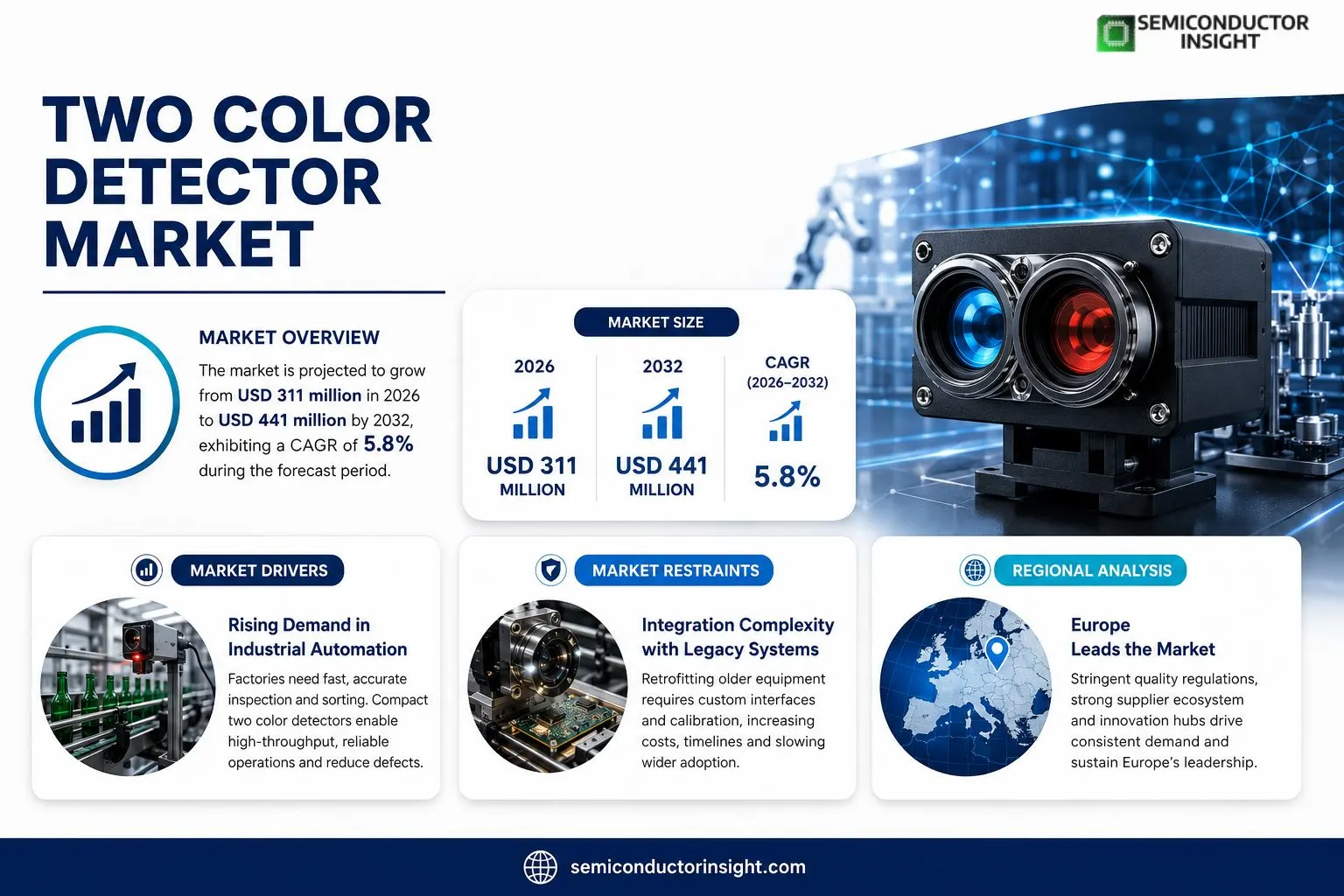
Two Color Detector market size was valued at USD 311 million in 2026 to USD 441 million by 2032, exhibiting a CAGR of 5.8% during the forecast period.
A Two Color Detector is an advanced optoelectronic device that simultaneously captures light signals in two distinct wavelength ranges. It typically integrates two semiconductor materials, delivering separate output signals that enhance detection accuracy, mitigate background interference, and maintain stable operation under harsh conditions.The market gains momentum because defense systems increasingly rely on dual‑color technology for stealth target discrimination and infrared decoy identification, while Industry 4.0 drives demand for precise non‑contact temperature measurement in semiconductor fabrication and metallurgy. Additionally, satellite remote‑sensing applications and AI‑driven image processing create further opportunities for multi‑channel data acquisition.
MARKET DRIVERS
Rising Demand in Industrial Automation
Manufacturers are scaling up production lines that rely on rapid visual verification. Two Color Detector Market benefits from factories that need to separate products based on binary color cues, such as distinguishing clear from tinted bottles or routing printed parts with specific markings. This operational pressure translates into higher unit shipments for compact detectors that can sustain high‑throughput environments.
Advancements in Sensor Miniaturization
Recent breakthroughs in semiconductor processes have trimmed the footprint of color‑sensing chips by nearly 40 % over the past three years. Smaller devices lower material cost and enable integration into portable equipment, expanding the addressable customer base beyond traditional factory floors.
➤ “Compact, low‑power detectors are now viable for edge‑computing nodes, unlocking real‑time sorting in remote facilities.”
When these technical gains converge with tighter regulatory scrutiny on product traceability, buyers accelerate procurement cycles, driving a noticeable uptick in order volumes across the sector.
MARKET CHALLENGES
Integration Complexity with Legacy Systems
Older production equipment often communicates through analog signaling, whereas modern detectors output digital protocols. Retrofitting a plant demands custom interface modules, inflating project timelines and raising engineering overhead.
Other Challenges
Cost Sensitivity
End‑users in low‑margin consumer goods arenas evaluate detector purchases against incremental yield gains. If the price premium exceeds the realized savings, adoption stalls.Furthermore, the absence of industry‑wide calibration standards forces each supplier to offer bespoke validation kits, adding another layer of expense for customers seeking consistency across multiple lines.
MARKET RESTRAINTS
Limited Supply of High‑Performance Optics
Accurate color discrimination hinges on precision optics that are sourced from a narrow pool of manufacturers. Recent capacity constraints have led to longer lead times, which dampens the ability of system integrators to meet aggressive rollout schedules.
MARKET OPPORTUNITIES
Emerging Applications in Consumer Electronics
Smartphone assemblers are beginning to embed two‑color detection modules to verify component placement during final testing. This niche, still in its infancy, promises a steady stream of orders as manufacturers chase higher defect‑free yields without adding complex vision systems.
Two Color Detector Market Trends
Defense Procurement Accelerates Two Color Detector Market
National security programs across Europe and Asia have intensified specifications for infrared counter‑measure systems, prompting a measurable uptick in orders for dual‑color sensors. The ability to separate stealth signatures from background clutter translates into higher detection confidence, a capability that modern combat platforms now treat as a baseline requirement. Consequently, manufacturers are reallocating R&D budgets toward ruggedized, high‑quantum‑efficiency designs that can survive extreme temperature swings without performance loss. This shift not only lifts unit price margins—currently ranging between $20,000 and $100,000—but also tightens the supply chain around specialized semiconductor substrates, reinforcing barriers to entry for new entrants.
Other Trends
Industrial Automation Adoption
Industry 4.0 initiatives have introduced stringent non‑contact temperature monitoring across semiconductor fabs and metallurgical furnaces. Dual‑color detectors, by virtue of their simultaneous multi‑wavelength readout, deliver the precision needed to calibrate process control loops in real time. Plant managers report a reduction in false alarms by up to 35 % compared with single‑band solutions, which directly improves overall equipment effectiveness. The net effect is a measurable expansion of the industrial segment, driving manufacturers to offer modular detector packages that integrate seamlessly with existing PLC ecosystems. Pricing pressure remains moderate because the cost premium is justified by downstream savings on scrap reduction and energy efficiency.
Expansion in Remote Sensing Applications
Satellite operators are capitalizing on the surge in high‑resolution Earth observation data demanded by AI‑powered analytics platforms. Dual‑color infrared arrays enable the extraction of richer spectral signatures, supporting more accurate cloud classification, vegetation health assessment, and maritime surveillance. As private‑sector constellations proliferate, the market for space‑qualified detectors is expected to broaden beyond traditional defense contracts, creating a diversified revenue stream. Suppliers are therefore investing in radiation‑hardening processes and adopting standardized form factors to meet launch‑vehicle constraints while preserving the high signal‑to‑noise ratios critical for downstream algorithmic processing.
COMPETITIVE LANDSCAPEKey Industry Players
Two Color Detector Market – Competitive Overview
The market is anchored by a handful of firms that command the majority of high‑performance, dual‑material detector shipments. Hamamatsu, with its deep expertise in epitaxial growth and a portfolio that spans non‑cooled to TE‑cooled modules, retains a pricing premium thanks to superior quantum efficiency and low defect density. OSI Optoelectronics follows closely, leveraging a vertically integrated supply chain that includes proprietary substrate processing, allowing it to maintain margins above 35 %. Both companies have accelerated R&D pipelines aimed at expanding resolution tiers from 320×256 up to 1280×1024, a move that directly addresses defense‑driven demands for finer target discrimination and industrial needs for precise temperature mapping. Their dominance is reinforced by strategic partnerships with semiconductor fabs, which mitigate the steep entry barriers posed by the complex layered growth technology that underpins dual‑color performance.Beyond the tier‑one giants, a diverse set of niche operators exploits specialized market segments. Irnova and Dexterals focus on compact, cost‑effective units for remote sensing and meteorological platforms, often customizing Si‑InGaAs hybrid structures to balance sensitivity and price. Leonardo and Sensor Technology have carved out defense‑specific niches, delivering hardened detectors that survive extreme thermal shocks and radiation, thereby supporting stealth‑target interception programs. AIM IR and Teledyne capture the high‑precision industrial automation space, where non‑cooled detectors calibrated for 640×512 arrays enable real‑time monitoring of semiconductor wafer processing. Emerging players such as Xenics, FLIR Systems, and Bosch Sensortec are investing in AI‑ready data pipelines, positioning themselves to supply multi‑channel raw data for next‑generation image‑analysis algorithms. This layered competitive fabric creates a dynamic where large incumbents guard core technology while smaller firms accelerate innovation through application‑focused engineering.
List of Key Two Color Detector Companies Profiled
- Hamamatsu
- OSI Optoelectronics
- Irnova
- Leonardo
- Dexerials
- Sensor Technology
- AIM IR
- Teledyne
- Xenics
- FLIR Systems
- Bosch Sensortec
- Panasonic
- Olympus
- Raytheon
Segment Analysis:
| Segment Category | Sub-Segments | Key Insights |
| By Type |
|
Non-cooled
|
| By Application |
|
Defense and Military
|
| By End User |
|
Defense agencies
|
| By Material |
|
Si‑InGaAs
|
| By Deployment Environment |
|
Harsh industrial
|
Regional Analysis: Two Color Detector Market
EU directives on product safety demand real‑time verification of color integrity, prompting manufacturers to embed dual‑color detection at line speed. Compliance audits now reference detector performance as a key metric, converting regulatory scrutiny into a market catalyst for vendors offering certified solutions.
Automotive paint verification, pharmaceutical blister packaging, and high‑resolution printing dominate usage patterns. Each segment leverages the technology to prevent costly rework, reinforcing the detectors’ role as an indispensable quality gate.
Proximity of silicon wafer fabs in the Netherlands to assembly plants in Eastern Europe compresses lead times. This geographical advantage supports a responsive inventory model that aligns closely with just‑in‑time manufacturing philosophies.
Munich and Paris host clusters of startups focused on AI‑enhanced color discrimination. Their breakthroughs in machine‑learning calibration are spilling over to legacy vendors, accelerating feature upgrades across the market.
North America
In North America, Two Color Detector Market is shaped by a strong appetite for high‑throughput inspection in semiconductor and aerospace manufacturing. Consumers there prioritize speed and integration flexibility, prompting vendors to offer modular platforms that can be retrofitted into existing lines. The region’s fragmented supplier base fuels competitive pricing, yet the absence of a unified regulatory push means adoption rates are more reliant on individual corporate quality programs than on statutory mandates.
Asia‑Pacific
Asia‑Pacific experiences rapid adoption driven by expanding electronics assembly capacity in China, Vietnam, and South Korea. Manufacturers are scaling production volumes, and the cost pressures inherent in mass markets make dual‑color detection an attractive means to reduce waste. While labor costs remain low, the push toward automation amplifies the need for reliable sensors that can operate continuously without frequent recalibration, positioning the technology as a cornerstone of future smart factories.
South America
South America’s growth trajectory is modest but notable, anchored by burgeoning food‑processing and beverage labeling operations in Brazil and Argentina. Companies are increasingly aware of brand‑image risks associated with color inconsistencies, leading to incremental upgrades of inspection equipment. However, limited access to high‑precision components and reliance on imported technology temper the speed of market maturation.
Middle East & Africa
In the Middle East & Africa, the market is still nascent, with demand concentrated in petrochemical packaging and emerging automotive assembly facilities in the Gulf states. Investments in industrial diversification under national visions have opened doors for advanced inspection technologies, yet the scarcity of local expertise pushes firms to partner with established European suppliers, creating a dependency that could shape future purchasing patterns.
Report Scope
This market research report provides a comprehensive analysis of Two Color Detector Market, covering the forecast period 2026–2034. It offers detailed insights into market dynamics, technological advancements, competitive landscape, and key trends shaping the industry.
Key focus areas of the report include:
- Market Overview: The report begins with an overview outlining its current market scenario, key growth indicators, and industry transformation drivers. It discusses macroeconomic factors, demand–supply balance, regulatory landscape, and the strategic role of semiconductors in powering advancements across industries such as automotive, telecommunications, consumer electronics, and industrial automation.
- Market Size & Forecast: Historical data and future projections for revenue, unit shipments, and market value across major regions and segments.
- Segmentation Analysis: Detailed breakdown by product type, technology, application, and end-user industry to identify high-growth segments and investment opportunities.
- Regional Insights: Insights into market performance across North America, Europe, Asia-Pacific, Latin America, and the Middle East & Africa, including country-level analysis where relevant.
- Competitive Landscape: Profiles of leading market participants, including their product offerings, R&D focus, manufacturing capacity, pricing strategies, and recent developments such as mergers, acquisitions, and partnerships.
- Technology Trends & Innovation: Assessment of emerging technologies, integration of AI/IoT, semiconductor design trends, fabrication techniques, and evolving industry standards.
- Market Drivers & Restraints: Evaluation of factors driving market growth along with challenges, supply chain constraints, regulatory issues, and market-entry barriers.
- Stakeholder Insights: Insights for component suppliers, OEMs, system integrators, investors, and policymakers regarding the evolving ecosystem and strategic opportunities.
Primary and secondary research methods are employed, including interviews with industry experts, data from verified sources, and real-time market intelligence to ensure the accuracy and reliability of the insights presented.
FREQUENTLY ASKED QUESTIONS:
What is the current market size of Two Color Detector Market?
-> Two Color Detector Market was valued at USD 301 million in 2025 and is expected to reach USD 441 million by 2032, at a CAGR of 5.8% during the forecast period.
Which key companies operate in Two Color Detector Market?
-> Key players include Hamamatsu, OSI Optoelectronics, Irnova, Leonardo, Dexerials, Sensor Technology, AIM IR, among others.
What are the key growth drivers?
-> Key growth drivers include refined identification of defense equipment (stealth target interception and infrared decoy detection), high‑precision non‑contact temperature measurement for Industry 4.0 automation, expanding satellite remote‑sensing applications, and increasing demand for multi‑channel raw data by AI image algorithms.
Which region dominates the market?
-> Asia‑Pacific shows the strongest demand, driven by semiconductor manufacturing, advanced industrial automation, and defense spending, making it the leading region for Two Color Detector adoption.
What are the emerging trends?
-> Emerging trends include integration of dual‑color detectors with AI/IoT platforms for smart sensing, development of rugged detectors for extreme industrial environments, and expanded use in multi‑spectral remote‑sensing and autonomous systems.
Get Sample Report PDF for Exclusive Insights
Report Sample Includes
- Table of Contents
- List of Tables & Figures
- Charts, Research Methodology, and more...