Thin Clients in Hardware Market Trends, Business Strategies 2026-2036

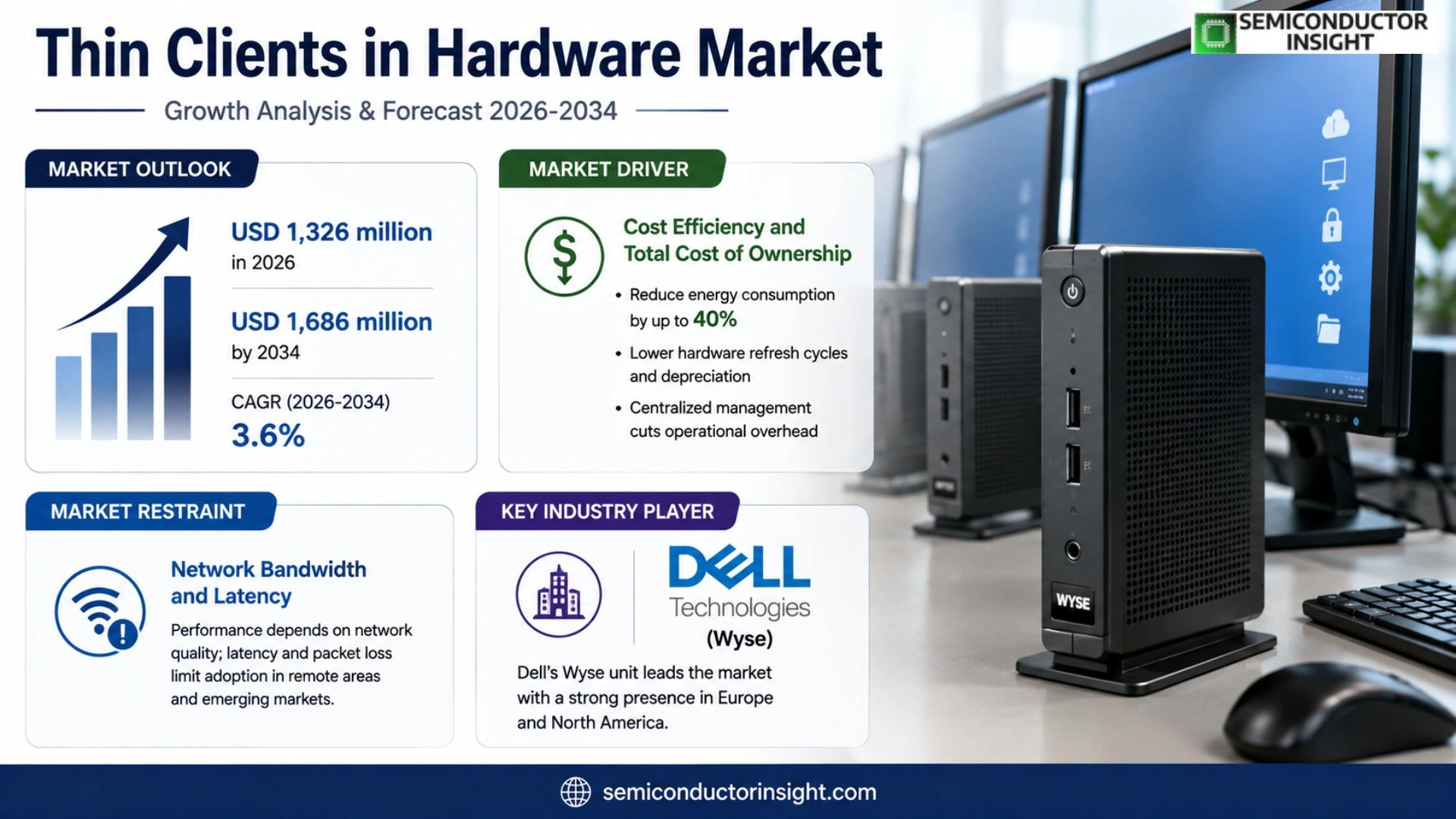
Thin Clients in Hardware market is projected to grow from USD 1,326 million in 2026 to USD 1,686 million by 2034, exhibiting a CAGR of 3.6% during the forecast period.

PDF Icon Download Sample Report PDF
  • Quick Dispatch

    All Orders

  • Secure Payment

    100% Secure Payment

Price range: $1,500.00 through $4,250.00

Clear

Thin Clients in Hardware Market Insights

Thin Clients in Hardware market is projected to grow from USD 1,326 million in 2026 to USD 1,686 million by 2034, exhibiting a CAGR of 3.6% during the forecast period.

A thin client, sometimes called a lean client, is a low‑cost, centrally‑managed computer devoid of CD‑ROM players, diskette drives, and expansion slots. All features typically found on the desktop PC,including applications, sensitive data and memory,are stored back in the data centre when using a thin client. Thin clients belong to server‑based IT where data is processed on central servers; consequently only minimal operations run locally and specially designed hardware can replace conventional PCs across an enterprise network.

The market is gaining momentum because enterprises seek cost‑efficient endpoints that simplify security administration while supporting cloud workspaces. Recent product launches such as Dell’s ARM‑based Wyse line and HP’s AI‑enhanced endpoint analytics demonstrate vendor focus on performance differentiation. Key players,Dell (Wyse), HP, NComputing, Centerm and Igel,collectively hold roughly 70 % of global shipments; Europe contributes over 30 % of revenue while China and North America each account for about 45 % of unit sales.
Thin Clients in Hardware Market Outlook

MARKET DRIVERS

Cost Efficiency and Total Cost of Ownership

Enterprises are replacing legacy PCs with Thin Clients in Hardware Market to cut energy consumption by up to 40% and reduce hardware refresh cycles. The shift translates into measurable savings on electricity bills and lower depreciation, allowing IT budgets to be reallocated toward strategic initiatives. Moreover, centralized management eliminates the need for on‑site software updates, trimming operational overhead.

Security‑Centric Deployments

Thin clients keep data within the data centre, reducing the attack surface linked to endpoint devices. Recent incidents involving ransomware have spurred CIOs to favor architectures where encryption and access controls are enforced centrally, thereby strengthening compliance with GDPR‑like regulations. This security advantage becomes a compelling argument for sectors such as finance and healthcare.

➤ “Organizations that migrated 30% of their workforce to thin clients reported a 25% drop in security incidents within the first year.”

Finally, the rise of hybrid work models forces companies to adopt solutions that can be provisioned quickly across dispersed locations. Thin clients, with their plug‑and‑play nature, enable uniform user experiences regardless of geography, reinforcing the strategic relevance of Thin Clients in Hardware market for agile workforces.

MARKET CHALLENGES

Integration with Legacy Applications

Many large organisations still rely on custom line‑of‑business software that was built for Windows‑based PCs. Porting these applications to a thin‑client environment often requires additional middleware or virtualisation layers, inflating project timelines and budgets. The added complexity can deter firms that lack in‑house expertise.

Other Challenges

Performance Constraints for Graphics‑Intensive Tasks

Creative studios, CAD users, and video editors report that thin‑client graphics pipelines lag behind traditional workstations, especially when network latency exceeds 20 ms. This performance gap limits adoption in design‑heavy industries, keeping a segment of the market tethered to conventional PCs.

MARKET RESTRAINTS

Network Bandwidth and Latency

Thin‑client performance is tightly coupled to the underlying network. Companies operating in regions with sub‑optimal broadband infrastructure encounter jitter and packet loss, which degrade user experience. This technical limitation discourages deployment in remote offices and emerging economies.

Another restraint stems from upfront licensing costs for virtualization platforms that enable thin‑client operation. While operational spend drops, the initial outlay can be prohibitive for small‑ to medium‑size enterprises, prompting them to postpone migration plans.

Lastly, a lingering perception that thin clients are “less powerful” continues to influence procurement decisions. Decision‑makers who equate device potency with a traditional desktop may overlook the mature capabilities of modern thin‑client solutions, slowing market penetration.

MARKET OPPORTUNITIES

AI‑Enabled Edge Computing

Embedding AI inference engines at the edge opens new use cases for thin clients, such as real‑time video analytics and predictive maintenance on the shop floor. Vendors that integrate lightweight neural‑network accelerators into thin‑client chassis can capture a niche segment that values both security and on‑device intelligence.

Geographically, the rapid digitalisation of public services in Southeast Asia and Africa presents a sizable, untapped market. Governments seeking to modernise citizen portals are evaluating thin‑client deployments to centralise data handling while limiting device management costs, creating a fertile ground for growth.

Thin Clients in Hardware Market Trends

ARM Architecture Overtakes x86 in Volume

Thin Clients in Hardware market is seeing a decisive shift toward ARM‑based silicon. Forecasts indicate that ARM shipments will exceed 65 % of total units by 2030, trimming power consumption and lowering bill‑of‑materials costs. This transition forces traditional x86 vendors to re‑engineer firmware stacks and to bundle security enclaves that meet emerging compliance regimes. For end users, the move translates into longer device lifecycles and reduced total cost of ownership, especially in data‑center‑backed deployments where centralized management already offsets local processing. The architecture change also opens the door for OEMs to embed AI inferencing at the edge without inflating price points, thereby creating differentiated product lines that can command premium margins.

Other Trends

Edge‑Enabled Thin Clients for Industrial Workflows

Convergence with edge computing and 5G connectivity is redefining how thin clients are positioned in factory and hybrid work environments. By offloading latency‑sensitive analytics to a nearby edge node, these devices deliver real‑time monitoring for sectors such as finance, telecom, and manufacturing while preserving the centralized data‑security model. The result is a more resilient workstation that can survive intermittent network disruptions yet still enforce corporate policy through a cloud‑managed console. Vendors that bundle ruggedized chassis with built‑in LTE/5G modules are gaining traction among logistics operators seeking to digitize last‑mile processes without overhauling legacy IT infrastructure.

Regional Polarization and Sustainability as Core Differentiators

Geographically, Europe and North America remain high‑margin territories where customers prioritize hardened security and AI‑ready hardware. In contrast, Asian manufacturers dominate the entry‑level segment, leveraging localized supply chains to undercut price and quickly tailor firmware for regional standards. Sustainability considerations have become decisive purchase criteria; devices that demonstrate recyclable materials and low‑energy profiles are now favored in compliance‑driven procurement cycles. This divergence compels global players to adopt a dual‑track strategy: premium, secure models for mature markets and cost‑effective, environmentally certified units for growth regions. The resulting portfolio balance positions Thin Clients in Hardware market to react swiftly to regulatory shifts while capturing emerging demand across disparate economic landscapes.

COMPETITIVE LANDSCAPE

Key Industry Players

Competitive Overview of Thin Client Hardware Manufacturers

Among the global thin‑client hardware arena, Dell’s Wyse unit retains the most visible footprint, commanding a sizable share of enterprise deployments in Europe and North America. The brand’s extensive portfolio,ranging from entry‑level ARM‑based boxes to high‑performance x86 workstations,lets it serve both cost‑sensitive and security‑critical users. Dell’s ability to bundle device management software with its hardware creates a recurring revenue stream that deepens customer lock‑in, especially in finance and government sectors where centralized control is non‑negotiable. Meanwhile, the top five manufacturers collectively own roughly 70 % of market volume, a concentration that intensifies pricing pressure while rewarding firms that can differentiate through firmware updates, AI‑edge integration, or compliance certifications.

Beyond the giants, a cluster of specialized vendors injects diversity into the thin‑client supply chain. IGEL, for example, has built a reputation on its Linux‑centric OS, attracting enterprises looking to reduce licensing costs. NComputing leverages a low‑price, high‑density model that appeals to education and small‑business environments in emerging markets. Asian players such as Huawei and Atrust dominate the entry‑level segment in China and Southeast Asia, capitalising on localized production and aggressive pricing. European boutique firms like Centerm and Barco focus on mission‑critical display solutions for control‑room and broadcasting applications, while Advantech and VXL Technology pursue industrial‑grade ruggedisation for manufacturing and logistics use‑cases. This mosaic of capabilities ensures that buyers can align hardware choice with specific performance, security, and total‑cost considerations.

List of Key Thin Clients in Hardware Companies Profiled

Segment Analysis:

Segment Category Sub-Segments Key Insights
By Type
  • Industrial Thin Clients
  • Enterprise Thin Clients
Industrial Thin Clients

  • Preferred for rugged environments where durability and low power consumption are critical.
  • Benefit from centralized management, reducing IT overhead in manufacturing and logistics sites.
  • Align with sustainability goals through longer device lifecycles and minimal e‑waste.
By Application
  • Finance and Insurance
  • Manufacturing
  • Logistics
  • Government
  • Education
  • Telecom
  • Others
Finance and Insurance

  • Demand strict data security and compliance, which thin clients deliver through centralized control.
  • Enable rapid workstation provisioning for high‑turnover staff while keeping TCO low.
  • Facilitate integration with legacy mainframe systems via secure remote desktop protocols.
By End User
  • Corporate Offices
  • Call Centers
  • Educational Institutions
Corporate Offices

  • Value the streamlined IT management that thin clients provide across large workforces.
  • Seek flexible peripheral support to accommodate varied productivity tools.
  • Appreciate the security posture enabled by eliminating local storage of sensitive files.
By Architecture
  • x86 Architecture
  • ARM Architecture
  • Custom SoCs
ARM Architecture

  • Offers superior power efficiency, extending device longevity in edge deployments.
  • Aligns with emerging 5G and edge‑computing workloads, enabling lightweight processing.
  • Gains preference among vendors targeting cost‑sensitive and environmentally conscious buyers.
By Form Factor
  • Standalone Thin Clients
  • All‑in‑One (With Monitor)
  • Other Integrated Designs
All‑in‑One (With Monitor)

  • Reduces desk clutter and simplifies cable management for space‑constrained offices.
  • Provides a ready‑to‑deploy solution that accelerates rollout timelines.
  • Enhances user experience by integrating high‑resolution displays with secure compute.

Regional Analysis: Thin Clients in Hardware Market

Europe

Europe’s mature corporate IT landscape has turned the continent into the primary growth engine for Thin Clients in Hardware Market. Organizations across Germany, the United Kingdom, and the Nordics have embraced centralized computing to curb operating expenses while strengthening data governance. The regulatory environment, particularly GDPR, compels enterprises to limit endpoint exposure, making stateless devices an attractive alternative to traditional PCs. Simultaneously, public‑sector procurement policies reward solutions that simplify lifecycle management, prompting ministries and universities to replace legacy workstations with low‑maintenance terminals. Vendor ecosystems in the region, anchored by strong OEM partnerships, enable rapid customization for sector‑specific use cases such as finance trading floors and healthcare diagnostics. These dynamics collectively reinforce Europe’s leadership within Thin Clients in Hardware market.

Enterprise Adoption
Large‑scale corporates prioritize thin‑client rollouts to unify desktop environments across multiple sites. By consolidating processing in data centers, they achieve consistent security policies and lower total cost of ownership. The shift also supports remote‑work frameworks, as centralized workloads can be accessed via secure VPNs without sacrificing performance.
Public‑Sector Momentum
Government agencies and educational institutions view thin‑client deployments as a pragmatic route to extend the lifespan of aging infrastructure. Procurement guidelines emphasize energy efficiency and ease of refurbishment, aligning with thin‑client characteristics. Consequently, budget‑constrained municipalities are allocating funds toward bulk purchases, driving volume growth and fostering local integration services.
Software‑Defined Workspace Integration
Vendors are bundling thin‑client hardware with virtual desktop infrastructure (VDI) and desktop‑as‑a‑service platforms, creating end‑to‑end solutions. This synergy reduces the need for on‑premise server upgrades, as workloads migrate to cloud‑based back‑ends. Enterprises benefit from scalable licensing models that match user counts, reinforcing thin‑client relevance in multi‑cloud strategies.
Emerging Vertical Applications
Beyond traditional office settings, thin‑client form factors are finding traction in manufacturing control rooms and point‑of‑sale environments. Their ruggedized designs withstand harsh conditions, while centralized management ensures rapid firmware updates across dispersed devices. Such vertical expansion diversifies the addressable market and encourages OEMs to develop industry‑specific accessories.

North America
North America remains a significant consumer of thin‑client technology, yet its market momentum is moderated by a strong entrenched PC culture. Companies leveraging high‑performance workstations for design and engineering often view thin clients as complementary rather than primary endpoints. However, rising cybersecurity concerns and a push toward green IT have stimulated incremental adoption, especially within finance and healthcare sectors where data protection and device hygiene are paramount. The presence of major cloud service providers accelerates integration with VDI solutions, allowing U.S. firms to experiment with hybrid deployments that balance legacy assets with newer thin‑client layers. This trend adds to the broader Thin Clients in Hardware Market narrative.

Asia‑Pacific
The Asia‑Pacific arena showcases divergent adoption patterns: Japan and South Korea exhibit disciplined rollouts underpinned by governmental green‑IT directives, while India and Southeast Asia experience organic growth fueled by cost‑sensitive small‑and‑medium enterprises. Rapid urbanization and expanding broadband connectivity enable centralized desktop services, making thin‑client models attractive for call‑centers and education networks. Local OEMs are customizing chassis to accommodate regional power standards and ergonomic preferences, fostering a nascent supply chain that reduces reliance on imports. Though the market is still fragmented, cross‑border initiatives for regional data centers hint at a future consolidation of thin‑client deployments.

South America
South America’s thin‑client uptake is shaped by fiscal austerity and volatile currency environments. Enterprises in Brazil and Argentina prioritize hardware that offers predictable maintenance budgets and can be procured in bulk to mitigate price fluctuations. Public‑sector projects, particularly in education, leverage donor‑funded programs that stipulate energy‑efficient endpoints, positioning thin clients as a compliant choice. Moreover, the increasing penetration of edge‑computing nodes to support remote mining operations creates niche demand for ruggedized, low‑power terminals. While the overall market remains modest, these pressures drive a gradual shift toward centralized compute architectures.

Middle East & Africa
In the Middle East & Africa, thin‑client adoption reflects a blend of strategic modernization and infrastructural challenges. Oil‑rich Gulf states invest heavily in secure, centralized workspaces for financial and governmental bodies, aligning with national digital transformation agendas. Meanwhile, sub‑Saharan nations confront electricity constraints, making the low‑power consumption of thin terminals an appealing solution for schools and clinics. Partnerships between global OEMs and regional system integrators facilitate localized firmware support and compliance with telecom regulations. As sovereign wealth funds allocate capital toward smart‑city initiatives, the demand for scalable, manageable endpoints is set to expand, positioning thin‑client technology as a cornerstone of emerging digital ecosystems.

Report Scope

This market research report provides a comprehensive analysis of the Thin Clients in Hardware Market , covering the forecast period 2026–2034. It offers detailed insights into market dynamics, technological advancements, competitive landscape, and key trends shaping the industry.

Key focus areas of the report include:

  • Market Overview: The report begins with an overview outlining its current market scenario, key growth indicators, and industry transformation drivers. It discusses macroeconomic factors, demand–supply balance, regulatory landscape, and the strategic role of semiconductors in powering advancements across industries such as automotive, telecommunications, consumer electronics, and industrial automation.
  • Market Size & Forecast: Historical data and future projections for revenue, unit shipments, and market value across major regions and segments.
  • Segmentation Analysis: Detailed breakdown by product type, technology, application, and end-user industry to identify high-growth segments and investment opportunities.
  • Regional Insights: Insights into market performance across North America, Europe, Asia-Pacific, Latin America, and the Middle East & Africa, including country-level analysis where relevant.
  • Competitive Landscape: Profiles of leading market participants, including their product offerings, R&D focus, manufacturing capacity, pricing strategies, and recent developments such as mergers, acquisitions, and partnerships.
  • Technology Trends & Innovation: Assessment of emerging technologies, integration of AI/IoT, semiconductor design trends, fabrication techniques, and evolving industry standards.
  • Market Drivers & Restraints: Evaluation of factors driving market growth along with challenges, supply chain constraints, regulatory issues, and market-entry barriers.
  • Stakeholder Insights: Insights for component suppliers, OEMs, system integrators, investors, and policymakers regarding the evolving ecosystem and strategic opportunities.

Primary and secondary research methods are employed, including interviews with industry experts, data from verified sources, and real-time market intelligence to ensure the accuracy and reliability of the insights presented.

FREQUENTLY ASKED QUESTIONS:

What is the current market size of Thin Clients in Hardware Market?

-> Thin Clients in Hardware market is projected to grow from USD 1,326 million in 2026 to USD 1,686 million by 2034, exhibiting a CAGR of 3.6%

Which key companies operate in Thin Clients in Hardware Market?

-> Key players include Dell (Wyse), HP, NComputing, Centerm, Igel, Fujitsu, Oracle (Sun Microsystems), VXL Technology.

What are the key growth drivers?

-> Key growth drivers include steady moderate demand, the shift toward ARM architecture, convergence with edge computing and 5G, and heightened focus on sustainability and security.

Which region dominates the market?

-> Europe is the largest market by share, while Asia‑Pacific serves as the primary growth engine.

What are the emerging trends?

-> Emerging trends include ARM architecture overtaking x86, integration of thin clients with edge computing and 5G, and increasing emphasis on security and sustainability as differentiators.

Thin Clients in Hardware Market Trends, Business Strategies 2026-2036

Get Sample Report PDF for Exclusive Insights

Report Sample Includes

  • Table of Contents
  • List of Tables & Figures
  • Charts, Research Methodology, and more...

PDF Icon Download Sample Report PDF
SKU: 46f19b62ff63
Category:
License Type

Corporate License, Excel License, PDF and Excel Databook License

Download Sample Report

Table of Content

1 Introduction to Research & Analysis Reports
1.1 Thin Clients in Hardware Market Definition
1.2 Market Segments
1.2.1 Segment by Type
1.2.2 Segment by Application
1.3 Global Thin Clients in Hardware Market Overview
1.4 Features & Benefits of This Report
1.5 Methodology & Sources of Information
1.5.1 Research Methodology
1.5.2 Research Process
1.5.3 Base Year
1.5.4 Report Assumptions & Caveats
2 Global Thin Clients in Hardware Overall Market Size
2.1 Global Thin Clients in Hardware Market Size: 2024 VS 2032
2.2 Global Thin Clients in Hardware Market Size, Prospects & Forecasts: 2020-2032
2.3 Global Thin Clients in Hardware Sales: 2020-2032
3 Company Landscape
3.1 Top Thin Clients in Hardware Players in Global Market
3.2 Top Global Thin Clients in Hardware Companies Ranked by Revenue
3.3 Global Thin Clients in Hardware Revenue by Companies
3.4 Global Thin Clients in Hardware Sales by Companies
3.5 Global Thin Clients in Hardware Price by Manufacturer (2020-2025)
3.6 Top 3 and Top 5 Thin Clients in Hardware Companies in Global Market, by Revenue in 2024
3.7 Global Manufacturers Thin Clients in Hardware Product Type
3.8 Tier 1, Tier 2, and Tier 3 Thin Clients in Hardware Players in Global Market
3.8.1 List of Global Tier 1 Thin Clients in Hardware Companies
3.8.2 List of Global Tier 2 and Tier 3 Thin Clients in Hardware Companies
4 Sights by Product
4.1 Overview
4.1.1 Segment by Type – Global Thin Clients in Hardware Market Size Markets, 2024 & 2032
4.1.2 Industrial Thin Clients
4.1.3 Enterprise Thin Clients
4.2 Segment by Type – Global Thin Clients in Hardware Revenue & Forecasts
4.2.1 Segment by Type – Global Thin Clients in Hardware Revenue, 2020-2025
4.2.2 Segment by Type – Global Thin Clients in Hardware Revenue, 2026-2032
4.2.3 Segment by Type – Global Thin Clients in Hardware Revenue Market Share, 2020-2032
4.3 Segment by Type – Global Thin Clients in Hardware Sales & Forecasts
4.3.1 Segment by Type – Global Thin Clients in Hardware Sales, 2020-2025
4.3.2 Segment by Type – Global Thin Clients in Hardware Sales, 2026-2032
4.3.3 Segment by Type – Global Thin Clients in Hardware Sales Market Share, 2020-2032
4.4 Segment by Type – Global Thin Clients in Hardware Price (Manufacturers Selling Prices), 2020-2032
5 Sights by Application
5.1 Overview
5.1.1 Segment by Application – Global Thin Clients in Hardware Market Size, 2024 & 2032
5.1.2 Finance and Insurance
5.1.3 Manufacturing
5.1.4 Logistics
5.1.5 Government
5.1.6 Education
5.1.7 Telecom
5.1.8 Others
5.2 Segment by Application – Global Thin Clients in Hardware Revenue & Forecasts
5.2.1 Segment by Application – Global Thin Clients in Hardware Revenue, 2020-2025
5.2.2 Segment by Application – Global Thin Clients in Hardware Revenue, 2026-2032
5.2.3 Segment by Application – Global Thin Clients in Hardware Revenue Market Share, 2020-2032
5.3 Segment by Application – Global Thin Clients in Hardware Sales & Forecasts
5.3.1 Segment by Application – Global Thin Clients in Hardware Sales, 2020-2025
5.3.2 Segment by Application – Global Thin Clients in Hardware Sales, 2026-2032
5.3.3 Segment by Application – Global Thin Clients in Hardware Sales Market Share, 2020-2032
5.4 Segment by Application – Global Thin Clients in Hardware Price (Manufacturers Selling Prices), 2020-2032
6 Sights by Region
6.1 By Region – Global Thin Clients in Hardware Market Size, 2024 & 2032
6.2 By Region – Global Thin Clients in Hardware Revenue & Forecasts
6.2.1 By Region – Global Thin Clients in Hardware Revenue, 2020-2025
6.2.2 By Region – Global Thin Clients in Hardware Revenue, 2026-2032
6.2.3 By Region – Global Thin Clients in Hardware Revenue Market Share, 2020-2032
6.3 By Region – Global Thin Clients in Hardware Sales & Forecasts
6.3.1 By Region – Global Thin Clients in Hardware Sales, 2020-2025
6.3.2 By Region – Global Thin Clients in Hardware Sales, 2026-2032
6.3.3 By Region – Global Thin Clients in Hardware Sales Market Share, 2020-2032
6.4 North America
6.4.1 By Country – North America Thin Clients in Hardware Revenue, 2020-2032
6.4.2 By Country – North America Thin Clients in Hardware Sales, 2020-2032
6.4.3 United States Thin Clients in Hardware Market Size, 2020-2032
6.4.4 Canada Thin Clients in Hardware Market Size, 2020-2032
6.4.5 Mexico Thin Clients in Hardware Market Size, 2020-2032
6.5 Europe
6.5.1 By Country – Europe Thin Clients in Hardware Revenue, 2020-2032
6.5.2 By Country – Europe Thin Clients in Hardware Sales, 2020-2032
6.5.3 Germany Thin Clients in Hardware Market Size, 2020-2032
6.5.4 France Thin Clients in Hardware Market Size, 2020-2032
6.5.5 U.K. Thin Clients in Hardware Market Size, 2020-2032
6.5.6 Italy Thin Clients in Hardware Market Size, 2020-2032
6.5.7 Russia Thin Clients in Hardware Market Size, 2020-2032
6.5.8 Nordic Countries Thin Clients in Hardware Market Size, 2020-2032
6.5.9 Benelux Thin Clients in Hardware Market Size, 2020-2032
6.6 Asia
6.6.1 By Region – Asia Thin Clients in Hardware Revenue, 2020-2032
6.6.2 By Region – Asia Thin Clients in Hardware Sales, 2020-2032
6.6.3 China Thin Clients in Hardware Market Size, 2020-2032
6.6.4 Japan Thin Clients in Hardware Market Size, 2020-2032
6.6.5 South Korea Thin Clients in Hardware Market Size, 2020-2032
6.6.6 Southeast Asia Thin Clients in Hardware Market Size, 2020-2032
6.6.7 India Thin Clients in Hardware Market Size, 2020-2032
6.7 South America
6.7.1 By Country – South America Thin Clients in Hardware Revenue, 2020-2032
6.7.2 By Country – South America Thin Clients in Hardware Sales, 2020-2032
6.7.3 Brazil Thin Clients in Hardware Market Size, 2020-2032
6.7.4 Argentina Thin Clients in Hardware Market Size, 2020-2032
6.8 Middle East & Africa
6.8.1 By Country – Middle East & Africa Thin Clients in Hardware Revenue, 2020-2032
6.8.2 By Country – Middle East & Africa Thin Clients in Hardware Sales, 2020-2032
6.8.3 Turkey Thin Clients in Hardware Market Size, 2020-2032
6.8.4 Israel Thin Clients in Hardware Market Size, 2020-2032
6.8.5 Saudi Arabia Thin Clients in Hardware Market Size, 2020-2032
6.8.6 UAE Thin Clients in Hardware Market Size, 2020-2032
7 Manufacturers & Brands Profiles
7.1 Dell(Wyse)
7.1.1 Dell(Wyse) Company Summary
7.1.2 Dell(Wyse) Business Overview
7.1.3 Dell(Wyse) Thin Clients in Hardware Major Product Offerings
7.1.4 Dell(Wyse) Thin Clients in Hardware Sales and Revenue in Global (2020-2025)
7.1.5 Dell(Wyse) Key News & Latest Developments
7.2 HP
7.2.1 HP Company Summary
7.2.2 HP Business Overview
7.2.3 HP Thin Clients in Hardware Major Product Offerings
7.2.4 HP Thin Clients in Hardware Sales and Revenue in Global (2020-2025)
7.2.5 HP Key News & Latest Developments
7.3 NComputing
7.3.1 NComputing Company Summary
7.3.2 NComputing Business Overview
7.3.3 NComputing Thin Clients in Hardware Major Product Offerings
7.3.4 NComputing Thin Clients in Hardware Sales and Revenue in Global (2020-2025)
7.3.5 NComputing Key News & Latest Developments
7.4 Centerm
7.4.1 Centerm Company Summary
7.4.2 Centerm Business Overview
7.4.3 Centerm Thin Clients in Hardware Major Product Offerings
7.4.4 Centerm Thin Clients in Hardware Sales and Revenue in Global (2020-2025)
7.4.5 Centerm Key News & Latest Developments
7.5 Igel
7.5.1 Igel Company Summary
7.5.2 Igel Business Overview
7.5.3 Igel Thin Clients in Hardware Major Product Offerings
7.5.4 Igel Thin Clients in Hardware Sales and Revenue in Global (2020-2025)
7.5.5 Igel Key News & Latest Developments
7.6 Fujitsu
7.6.1 Fujitsu Company Summary
7.6.2 Fujitsu Business Overview
7.6.3 Fujitsu Thin Clients in Hardware Major Product Offerings
7.6.4 Fujitsu Thin Clients in Hardware Sales and Revenue in Global (2020-2025)
7.6.5 Fujitsu Key News & Latest Developments
7.7 Sun Microsy
7.7.1 Sun Microsy Company Summary
7.7.2 Sun Microsy Business Overview
7.7.3 Sun Microsy Thin Clients in Hardware Major Product Offerings
7.7.4 Sun Microsy Thin Clients in Hardware Sales and Revenue in Global (2020-2025)
7.7.5 Sun Microsy Key News & Latest Developments
7.8 VXL Technology
7.8.1 VXL Technology Company Summary
7.8.2 VXL Technology Business Overview
7.8.3 VXL Technology Thin Clients in Hardware Major Product Offerings
7.8.4 VXL Technology Thin Clients in Hardware Sales and Revenue in Global (2020-2025)
7.8.5 VXL Technology Key News & Latest Developments
7.9 Start
7.9.1 Start Company Summary
7.9.2 Start Business Overview
7.9.3 Start Thin Clients in Hardware Major Product Offerings
7.9.4 Start Thin Clients in Hardware Sales and Revenue in Global (2020-2025)
7.9.5 Start Key News & Latest Developments
7.10 GWI
7.10.1 GWI Company Summary
7.10.2 GWI Business Overview
7.10.3 GWI Thin Clients in Hardware Major Product Offerings
7.10.4 GWI Thin Clients in Hardware Sales and Revenue in Global (2020-2025)
7.10.5 GWI Key News & Latest Developments
7.11 Guoguang
7.11.1 Guoguang Company Summary
7.11.2 Guoguang Business Overview
7.11.3 Guoguang Thin Clients in Hardware Major Product Offerings
7.11.4 Guoguang Thin Clients in Hardware Sales and Revenue in Global (2020-2025)
7.11.5 Guoguang Key News & Latest Developments
8 Global Thin Clients in Hardware Production Capacity, Analysis
8.1 Global Thin Clients in Hardware Production Capacity, 2020-2032
8.2 Thin Clients in Hardware Production Capacity of Key Manufacturers in Global Market
8.3 Global Thin Clients in Hardware Production by Region
9 Key Market Trends, Opportunity, Drivers and Restraints
9.1 Market Opportunities & Trends
9.2 Market Drivers
9.3 Market Restraints
10 Thin Clients in Hardware Supply Chain Analysis
10.1 Thin Clients in Hardware Industry Value Chain
10.2 Thin Clients in Hardware Upstream Market
10.3 Thin Clients in Hardware Downstream and Clients
10.4 Marketing Channels Analysis
10.4.1 Marketing Channels
10.4.2 Thin Clients in Hardware Distributors and Sales Agents in Global
11 Conclusion
12 Appendix
12.1 Note
12.2 Examples of Clients
12.3 DisclaimerList of Tables
Table 1. Key Players of Thin Clients in Hardware in Global Market
Table 2. Top Thin Clients in Hardware Players in Global Market, Ranking by Revenue (2024)
Table 3. Global Thin Clients in Hardware Revenue by Companies, (US$, Mn), 2020-2025
Table 4. Global Thin Clients in Hardware Revenue Share by Companies, 2020-2025
Table 5. Global Thin Clients in Hardware Sales by Companies, (K Units), 2020-2025
Table 6. Global Thin Clients in Hardware Sales Share by Companies, 2020-2025
Table 7. Key Manufacturers Thin Clients in Hardware Price (2020-2025) & (USD/Unit)
Table 8. Global Manufacturers Thin Clients in Hardware Product Type
Table 9. List of Global Tier 1 Thin Clients in Hardware Companies, Revenue (US$, Mn) in 2024 and Market Share
Table 10. List of Global Tier 2 and Tier 3 Thin Clients in Hardware Companies, Revenue (US$, Mn) in 2024 and Market Share
Table 11. Segment by Type – Global Thin Clients in Hardware Revenue, (US$, Mn), 2024 & 2032
Table 12. Segment by Type – Global Thin Clients in Hardware Revenue (US$, Mn), 2020-2025
Table 13. Segment by Type – Global Thin Clients in Hardware Revenue (US$, Mn), 2026-2032
Table 14. Segment by Type – Global Thin Clients in Hardware Sales (K Units), 2020-2025
Table 15. Segment by Type – Global Thin Clients in Hardware Sales (K Units), 2026-2032
Table 16. Segment by Application – Global Thin Clients in Hardware Revenue, (US$, Mn), 2024 & 2032
Table 17. Segment by Application – Global Thin Clients in Hardware Revenue, (US$, Mn), 2020-2025
Table 18. Segment by Application – Global Thin Clients in Hardware Revenue, (US$, Mn), 2026-2032
Table 19. Segment by Application – Global Thin Clients in Hardware Sales, (K Units), 2020-2025
Table 20. Segment by Application – Global Thin Clients in Hardware Sales, (K Units), 2026-2032
Table 21. By Region – Global Thin Clients in Hardware Revenue, (US$, Mn), 2025-2032
Table 22. By Region – Global Thin Clients in Hardware Revenue, (US$, Mn), 2020-2025
Table 23. By Region – Global Thin Clients in Hardware Revenue, (US$, Mn), 2026-2032
Table 24. By Region – Global Thin Clients in Hardware Sales, (K Units), 2020-2025
Table 25. By Region – Global Thin Clients in Hardware Sales, (K Units), 2026-2032
Table 26. By Country – North America Thin Clients in Hardware Revenue, (US$, Mn), 2020-2025
Table 27. By Country – North America Thin Clients in Hardware Revenue, (US$, Mn), 2026-2032
Table 28. By Country – North America Thin Clients in Hardware Sales, (K Units), 2020-2025
Table 29. By Country – North America Thin Clients in Hardware Sales, (K Units), 2026-2032
Table 30. By Country – Europe Thin Clients in Hardware Revenue, (US$, Mn), 2020-2025
Table 31. By Country – Europe Thin Clients in Hardware Revenue, (US$, Mn), 2026-2032
Table 32. By Country – Europe Thin Clients in Hardware Sales, (K Units), 2020-2025
Table 33. By Country – Europe Thin Clients in Hardware Sales, (K Units), 2026-2032
Table 34. By Region – Asia Thin Clients in Hardware Revenue, (US$, Mn), 2020-2025
Table 35. By Region – Asia Thin Clients in Hardware Revenue, (US$, Mn), 2026-2032
Table 36. By Region – Asia Thin Clients in Hardware Sales, (K Units), 2020-2025
Table 37. By Region – Asia Thin Clients in Hardware Sales, (K Units), 2026-2032
Table 38. By Country – South America Thin Clients in Hardware Revenue, (US$, Mn), 2020-2025
Table 39. By Country – South America Thin Clients in Hardware Revenue, (US$, Mn), 2026-2032
Table 40. By Country – South America Thin Clients in Hardware Sales, (K Units), 2020-2025
Table 41. By Country – South America Thin Clients in Hardware Sales, (K Units), 2026-2032
Table 42. By Country – Middle East & Africa Thin Clients in Hardware Revenue, (US$, Mn), 2020-2025
Table 43. By Country – Middle East & Africa Thin Clients in Hardware Revenue, (US$, Mn), 2026-2032
Table 44. By Country – Middle East & Africa Thin Clients in Hardware Sales, (K Units), 2020-2025
Table 45. By Country – Middle East & Africa Thin Clients in Hardware Sales, (K Units), 2026-2032
Table 46. Dell(Wyse) Company Summary
Table 47. Dell(Wyse) Thin Clients in Hardware Product Offerings
Table 48. Dell(Wyse) Thin Clients in Hardware Sales (K Units), Revenue (US$, Mn) and Average Price (USD/Unit) & (2020-2025)
Table 49. Dell(Wyse) Key News & Latest Developments
Table 50. HP Company Summary
Table 51. HP Thin Clients in Hardware Product Offerings
Table 52. HP Thin Clients in Hardware Sales (K Units), Revenue (US$, Mn) and Average Price (USD/Unit) & (2020-2025)
Table 53. HP Key News & Latest Developments
Table 54. NComputing Company Summary
Table 55. NComputing Thin Clients in Hardware Product Offerings
Table 56. NComputing Thin Clients in Hardware Sales (K Units), Revenue (US$, Mn) and Average Price (USD/Unit) & (2020-2025)
Table 57. NComputing Key News & Latest Developments
Table 58. Centerm Company Summary
Table 59. Centerm Thin Clients in Hardware Product Offerings
Table 60. Centerm Thin Clients in Hardware Sales (K Units), Revenue (US$, Mn) and Average Price (USD/Unit) & (2020-2025)
Table 61. Centerm Key News & Latest Developments
Table 62. Igel Company Summary
Table 63. Igel Thin Clients in Hardware Product Offerings
Table 64. Igel Thin Clients in Hardware Sales (K Units), Revenue (US$, Mn) and Average Price (USD/Unit) & (2020-2025)
Table 65. Igel Key News & Latest Developments
Table 66. Fujitsu Company Summary
Table 67. Fujitsu Thin Clients in Hardware Product Offerings
Table 68. Fujitsu Thin Clients in Hardware Sales (K Units), Revenue (US$, Mn) and Average Price (USD/Unit) & (2020-2025)
Table 69. Fujitsu Key News & Latest Developments
Table 70. Sun Microsy Company Summary
Table 71. Sun Microsy Thin Clients in Hardware Product Offerings
Table 72. Sun Microsy Thin Clients in Hardware Sales (K Units), Revenue (US$, Mn) and Average Price (USD/Unit) & (2020-2025)
Table 73. Sun Microsy Key News & Latest Developments
Table 74. VXL Technology Company Summary
Table 75. VXL Technology Thin Clients in Hardware Product Offerings
Table 76. VXL Technology Thin Clients in Hardware Sales (K Units), Revenue (US$, Mn) and Average Price (USD/Unit) & (2020-2025)
Table 77. VXL Technology Key News & Latest Developments
Table 78. Start Company Summary
Table 79. Start Thin Clients in Hardware Product Offerings
Table 80. Start Thin Clients in Hardware Sales (K Units), Revenue (US$, Mn) and Average Price (USD/Unit) & (2020-2025)
Table 81. Start Key News & Latest Developments
Table 82. GWI Company Summary
Table 83. GWI Thin Clients in Hardware Product Offerings
Table 84. GWI Thin Clients in Hardware Sales (K Units), Revenue (US$, Mn) and Average Price (USD/Unit) & (2020-2025)
Table 85. GWI Key News & Latest Developments
Table 86. Guoguang Company Summary
Table 87. Guoguang Thin Clients in Hardware Product Offerings
Table 88. Guoguang Thin Clients in Hardware Sales (K Units), Revenue (US$, Mn) and Average Price (USD/Unit) & (2020-2025)
Table 89. Guoguang Key News & Latest Developments
Table 90. Thin Clients in Hardware Capacity of Key Manufacturers in Global Market, 2023-2025 (K Units)
Table 91. Global Thin Clients in Hardware Capacity Market Share of Key Manufacturers, 2023-2025
Table 92. Global Thin Clients in Hardware Production by Region, 2020-2025 (K Units)
Table 93. Global Thin Clients in Hardware Production by Region, 2026-2032 (K Units)
Table 94. Thin Clients in Hardware Market Opportunities & Trends in Global Market
Table 95. Thin Clients in Hardware Market Drivers in Global Market
Table 96. Thin Clients in Hardware Market Restraints in Global Market
Table 97. Thin Clients in Hardware Raw Materials
Table 98. Thin Clients in Hardware Raw Materials Suppliers in Global Market
Table 99. Typical Thin Clients in Hardware Downstream
Table 100. Thin Clients in Hardware Downstream Clients in Global Market
Table 101. Thin Clients in Hardware Distributors and Sales Agents in Global Market

List of Figures
Figure 1. Thin Clients in Hardware Product Picture
Figure 2. Thin Clients in Hardware Segment by Type in 2024
Figure 3. Thin Clients in Hardware Segment by Application in 2024
Figure 4. Global Thin Clients in Hardware Market Overview: 2024
Figure 5. Key Caveats
Figure 6. Global Thin Clients in Hardware Market Size: 2024 VS 2032 (US$, Mn)
Figure 7. Global Thin Clients in Hardware Revenue: 2020-2032 (US$, Mn)
Figure 8. Thin Clients in Hardware Sales in Global Market: 2020-2032 (K Units)
Figure 9. The Top 3 and 5 Players Market Share by Thin Clients in Hardware Revenue in 2024
Figure 10. Segment by Type – Global Thin Clients in Hardware Revenue, (US$, Mn), 2024 & 2032
Figure 11. Segment by Type – Global Thin Clients in Hardware Revenue Market Share, 2020-2032
Figure 12. Segment by Type – Global Thin Clients in Hardware Sales Market Share, 2020-2032
Figure 13. Segment by Type – Global Thin Clients in Hardware Price (USD/Unit), 2020-2032
Figure 14. Segment by Application – Global Thin Clients in Hardware Revenue, (US$, Mn), 2024 & 2032
Figure 15. Segment by Application – Global Thin Clients in Hardware Revenue Market Share, 2020-2032
Figure 16. Segment by Application – Global Thin Clients in Hardware Sales Market Share, 2020-2032
Figure 17. Segment by Application -Global Thin Clients in Hardware Price (USD/Unit), 2020-2032
Figure 18. By Region – Global Thin Clients in Hardware Revenue, (US$, Mn), 2025 & 2032
Figure 19. By Region – Global Thin Clients in Hardware Revenue Market Share, 2020 VS 2024 VS 2032
Figure 20. By Region – Global Thin Clients in Hardware Revenue Market Share, 2020-2032
Figure 21. By Region – Global Thin Clients in Hardware Sales Market Share, 2020-2032
Figure 22. By Country – North America Thin Clients in Hardware Revenue Market Share, 2020-2032
Figure 23. By Country – North America Thin Clients in Hardware Sales Market Share, 2020-2032
Figure 24. United States Thin Clients in Hardware Revenue, (US$, Mn), 2020-2032
Figure 25. Canada Thin Clients in Hardware Revenue, (US$, Mn), 2020-2032
Figure 26. Mexico Thin Clients in Hardware Revenue, (US$, Mn), 2020-2032
Figure 27. By Country – Europe Thin Clients in Hardware Revenue Market Share, 2020-2032
Figure 28. By Country – Europe Thin Clients in Hardware Sales Market Share, 2020-2032
Figure 29. Germany Thin Clients in Hardware Revenue, (US$, Mn), 2020-2032
Figure 30. France Thin Clients in Hardware Revenue, (US$, Mn), 2020-2032
Figure 31. U.K. Thin Clients in Hardware Revenue, (US$, Mn), 2020-2032
Figure 32. Italy Thin Clients in Hardware Revenue, (US$, Mn), 2020-2032
Figure 33. Russia Thin Clients in Hardware Revenue, (US$, Mn), 2020-2032
Figure 34. Nordic Countries Thin Clients in Hardware Revenue, (US$, Mn), 2020-2032
Figure 35. Benelux Thin Clients in Hardware Revenue, (US$, Mn), 2020-2032
Figure 36. By Region – Asia Thin Clients in Hardware Revenue Market Share, 2020-2032
Figure 37. By Region – Asia Thin Clients in Hardware Sales Market Share, 2020-2032
Figure 38. China Thin Clients in Hardware Revenue, (US$, Mn), 2020-2032
Figure 39. Japan Thin Clients in Hardware Revenue, (US$, Mn), 2020-2032
Figure 40. South Korea Thin Clients in Hardware Revenue, (US$, Mn), 2020-2032
Figure 41. Southeast Asia Thin Clients in Hardware Revenue, (US$, Mn), 2020-2032
Figure 42. India Thin Clients in Hardware Revenue, (US$, Mn), 2020-2032
Figure 43. By Country – South America Thin Clients in Hardware Revenue Market Share, 2020-2032
Figure 44. By Country – South America Thin Clients in Hardware Sales, Market Share, 2020-2032
Figure 45. Brazil Thin Clients in Hardware Revenue, (US$, Mn), 2020-2032
Figure 46. Argentina Thin Clients in Hardware Revenue, (US$, Mn), 2020-2032
Figure 47. By Country – Middle East & Africa Thin Clients in Hardware Revenue, Market Share, 2020-2032
Figure 48. By Country – Middle East & Africa Thin Clients in Hardware Sales, Market Share, 2020-2032
Figure 49. Turkey Thin Clients in Hardware Revenue, (US$, Mn), 2020-2032
Figure 50. Israel Thin Clients in Hardware Revenue, (US$, Mn), 2020-2032
Figure 51. Saudi Arabia Thin Clients in Hardware Revenue, (US$, Mn), 2020-2032
Figure 52. UAE Thin Clients in Hardware Revenue, (US$, Mn), 2020-2032
Figure 53. Global Thin Clients in Hardware Production Capacity (K Units), 2020-2032
Figure 54. The Percentage of Production Thin Clients in Hardware by Region, 2024 VS 2032
Figure 55. Thin Clients in Hardware Industry Value Chain
Figure 56. Marketing Channels