Reinforced Digital Isolators Market Insights
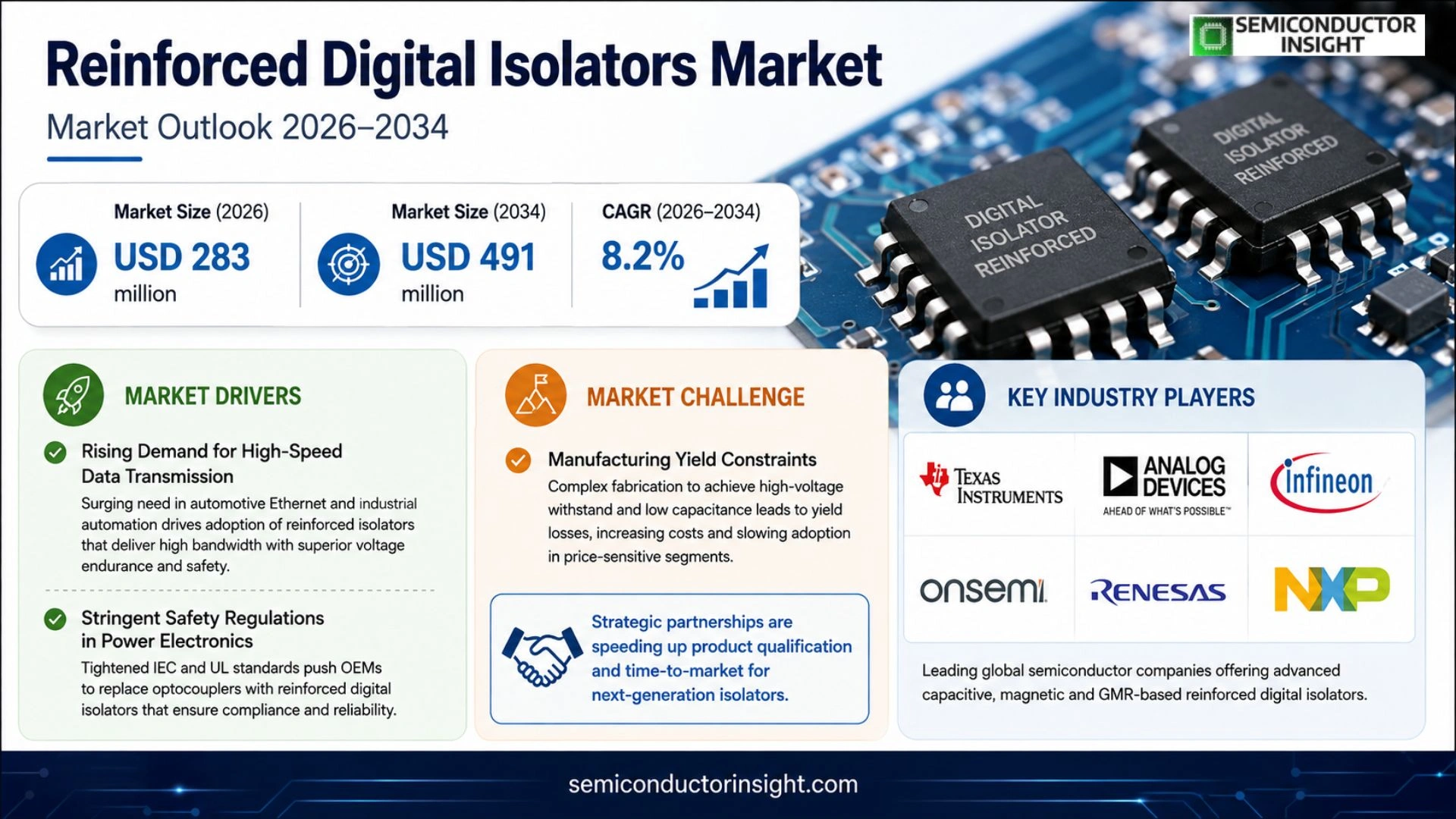
Reinforced Digital Isolators market is projected to grow from USD 283 million in 2026 to USD 491 million by 2034, exhibiting a CAGR of 8.2% during the forecast period.
Reinforced digital isolators are devices that convey digital signals across an isolation barrier while providing reinforced (double or equivalent) electrical insulation between input and output terminals. They safeguard low‑voltage control and signal circuits against high voltages, noise and transient surges, complying with IEC, UL and VDE safety standards. Typical applications span industrial automation, power supplies, electric vehicles, renewable‑energy systems and data‑center power infrastructure where signal integrity and human safety are paramount.
The expansion of the sector reflects increasing demand for high‑voltage isolation and functional safety across electrified platforms, alongside stricter regulatory requirements for insulated equipment. Adoption of wide‑bandgap power devices further amplifies the need for robust isolators that maintain high data rates with low latency. Recent industry activity includes several manufacturers announcing new product lines that meet reinforced insulation grades of up to 6 kVrms, underscoring the competitive push toward higher performance specifications.
MARKET DRIVERS
Rising Demand for High‑Speed Data Transmission
Reinforced Digital Isolators Market is being propelled by a surge in applications that require ultra‑fast signal integrity, such as automotive Ethernet and industrial automation. Engineers are opting for reinforced designs because they endure higher voltages while preserving bandwidth, allowing system architects to reduce latency without compromising safety.
Stringent Safety Regulations in Power Electronics
Regulatory bodies across Europe and North America have tightened isolation standards for power converters, prompting OEMs to integrate reinforced digital isolators that meet the latest IEC and UL thresholds. This compliance pressure translates into tangible orders, as manufacturers replace legacy optocouplers with more reliable solid‑state solutions.
➤ Strategic partnerships between silicon foundries and device manufacturers are accelerating product qualification cycles, shortening time‑to‑market for next‑generation isolators.
Collectively, these forces are reshaping purchasing strategies; buyers now prioritize lifecycle cost savings and design flexibility, which reinforced digital isolators uniquely deliver.
MARKET CHALLENGES
Manufacturing Yield Constraints
Fabricating reinforced structures that combine high‑voltage withstand with low‑capacitance performance remains a complex process. Yield losses during wafer testing inflate unit costs, making price‑sensitive segments hesitant to adopt the technology at scale.
Other Challenges
Thermal Management
The dense packaging of reinforced isolators generates localized heat, requiring advanced board‑level thermal solutions. Companies that cannot integrate effective heat‑dissipation methods risk reliability setbacks, which can stall market adoption.
MARKET RESTRAINTS
Cost Sensitivity in Emerging Economies
While high‑end automotive and industrial customers are willing to absorb premium pricing, many emerging‑market manufacturers operate under tight budgetary constraints. The higher bill‑of‑materials for reinforced digital isolators can deter these players from switching away from established low‑cost alternatives.
Limited Design Expertise
Design teams accustomed to traditional isolation components often lack the nuanced simulation tools required for reinforced architectures. This skill gap slows integration cycles and can lead to sub‑optimal circuit implementations, further restraining market momentum.
MARKET OPPORTUNITIES
Expansion into 5G Infrastructure
5G base stations demand isolation solutions that can handle both high data rates and elevated voltage swings. Reinforced digital isolators, with their superior bandwidth and robustness, present a compelling option for network equipment vendors seeking to meet the next wave of connectivity standards.
Customization for Renewable Energy Converters
Solar inverters and wind turbine converters are evolving toward higher power densities, creating a niche where tailored reinforced isolators can provide the necessary isolation without inflating board real‑estate. OEMs that offer application‑specific variants stand to capture a growing slice of the renewable‑energy segment.
Reinforced Digital Isolators Market Trends
Rising Demand for High‑Voltage Isolation in Industrial Automation
Industrial automation plants are upgrading legacy signal paths with reinforced digital isolators to meet stricter safety standards while preserving high‑speed data exchange. The shift reflects a broader move toward equipment that can tolerate transient surges and maintain signal fidelity in harsh environments. Suppliers report that the average gross profit margin on these devices now sits between 20 % and 40 %, illustrating the premium placed on reliability and compliance. Manufacturers have expanded capacity to roughly 280 million units annually, a response to the steady influx of orders from motor‑drive and inverter producers seeking double‑insulation solutions that satisfy IEC and UL requirements.
Other Trends
Regulatory Pressure Accelerates Adoption
Recent revisions to international safety codes have tightened the insulation criteria for low‑voltage control circuits adjacent to high‑voltage power stages. Companies that can certify their products against reinforced insulation grades are gaining a competitive edge, especially in regions where data‑center power infrastructure must demonstrate both human safety and equipment protection. This regulatory environment is prompting original equipment manufacturers to embed reinforced digital isolators early in the design cycle, reducing redesign costs and accelerating time‑to‑market for new power‑conversion platforms.
Electrification of Transport Expands Application Base
The rollout of electric vehicles and accompanying battery‑management systems is creating a pronounced need for isolation devices that can operate across wide voltage spans without compromising latency. Reinforced digital isolators satisfy the dual mandate of safeguarding high‑voltage traction circuits while delivering data rates that support real‑time monitoring and fault detection. As vehicle architectures become more modular, the isolators’ ability to provide consistent performance across temperature extremes positions them as a cornerstone component in next‑generation electric drivetrains. This trend not only broadens the addressable market but also pushes suppliers to innovate in magnetic coupling and giant‑magnetoresistive technologies to meet emerging data‑rate classifications above 25 Mbps.
COMPETITIVE LANDSCAPE
Key Industry Players
Reinforced Digital Isolators Competitive Overview
The market is anchored by a handful of global semiconductor giants whose product portfolios span capacitive, magnetic and GMR coupling technologies. Texas Instruments leverages its deep analog expertise and extensive automotive design‑win ecosystem to command a sizable share of high‑voltage isolation sales, especially in electric‑vehicle power‑train applications. Analog Devices complements this position with a focus on ultra‑low latency isolators for data‑center power modules, where the combination of high data rates and reinforced safety ratings is a decisive factor. Infineon and ON Semiconductor round out the top tier, each pursuing aggressive integration strategies that embed isolation functions within power‑management ICs, thereby simplifying board design for industrial automation customers. The concentration of R&D resources and scale‑driven cost advantages among these firms creates a barrier to entry that shapes the overall market structure.
Beyond the tier‑one set, several niche operators have carved out credible positions by targeting specialized segments or by offering differentiated coupling techniques. NXP’s recent emphasis on automotive‑grade reinforced isolators reflects its broader push into vehicle‑level safety architectures. Maxim Integrated (now part of Analog Devices) continues to nurture legacy product lines that serve legacy equipment retrofits. Smaller but technically agile players such as Renesas, Microchip, Rohm, and Lattice provide modular solutions for motor‑drive and battery‑management systems, often emphasizing compact form factors and high pressure‑resistance grades. Their ability to respond quickly to emerging standards and to customize insulation levels gives them a foothold in markets where design flexibility outweighs pure cost considerations.
List of Key Reinforced Digital Isolators Companies Profiled
- Texas Instruments
- Analog Devices
- Infineon Technologies
- ON Semiconductor
- NXP Semiconductors
- Maxim Integrated
- Renesas Electronics
- Microchip Technology
- Rohm Semiconductor
- Lattice Semiconductor
- STMicroelectronics
- Texas Instruments (again for emphasis)
- Fairchild Semiconductor
- Broadcom Inc.
- Marvell Technology Group
Segment Analysis:
| Segment Category | Sub-Segments | Key Insights |
| By Type |
|
Capacitive Coupling
|
| By Application |
|
Industrial Automation
|
| By End User |
|
Power Supplies
|
| By Data Rate |
|
1‑25 Mbps
|
| By Pressure Resistance Grade |
|
3‑6 kVrms
|
Regional Analysis: Reinforced Digital Isolators Market
North America
OEMs are embedding reinforced digital isolators early in platform design, treating them as enablers for high‑speed communication across power‑train modules. This early adoption reduces redesign cycles and aligns component selection with long‑term vehicle architectures.
Partnerships between semiconductor fabs and niche isolator specialists have shortened lead times, while joint testing programs validate performance under extreme automotive conditions, reinforcing confidence among system integrators.
Emerging functional‑safety directives encourage designers to replace traditional optocouplers with digitally reinforced alternatives, citing superior EMI resilience and deterministic behavior as compliance benefits.
Silicon Valley and Detroit host innovation labs where cross‑disciplinary teams experiment with integrated isolator‑gate drivers, positioning North America as a testing ground for concepts that later diffuse globally.
Europe
European manufacturers are capitalising on stricter emissions legislation to retrofit existing platforms with reinforced digital isolators, which enable higher‑efficiency power conversion. The region’s strong presence of automotive engineering schools feeds a pipeline of talent adept at designing mixed‑signal solutions, fostering a climate where niche suppliers can thrive alongside established silicon giants. Collaborative standards bodies in Germany and France are harmonising testing protocols, reducing entry barriers for newcomers and encouraging a diversified supplier base that can respond swiftly to OEM specifications.
Asia‑Pacific
In Asia‑Pacific, rapid adoption of electric mobility in China and India creates a fertile backdrop for reinforced digital isolators. Local manufacturers are scaling production capacities to meet volume requirements, while also investing in advanced packaging to improve thermal performance. The convergence of high‑density power electronics and cost‑sensitive design philosophies drives a pragmatic approach: firms seek isolators that balance ruggedness with affordability, prompting a wave of region‑specific product variants that address divergent market segments.
South America
South American markets, though smaller in absolute terms, are witnessing a maturation of automotive supply chains that increasingly mirror North American and European practices. Nations such as Brazil are introducing incentives for high‑efficiency vehicle platforms, indirectly steering designers toward reinforced digital isolators that can reduce losses in power‑train sub‑systems. The growing presence of multinational OEMs establishing local assembly lines contributes to a gradual up‑skilling of engineering talent, laying groundwork for more sophisticated component selection.
Middle East & Africa
The Middle East & Africa region is shaped by a blend of luxury automotive demand and emerging industrial automation projects. Reinforced digital isolators are gaining traction in high‑temperature environments typical of the Middle East, where robust isolation can mitigate thermal drift. In Africa, nascent automotive assembly hubs are adopting modular designs that rely on digital isolators to simplify system integration, offering a pathway to accelerate market entry for global suppliers willing to navigate localized distribution networks.
Report Scope
This market research report provides a comprehensive analysis of the Reinforced Digital Isolators Market , covering the forecast period 2026–2034. It offers detailed insights into market dynamics, technological advancements, competitive landscape, and key trends shaping the industry.
Key focus areas of the report include:
- Market Overview: The report begins with an overview outlining its current market scenario, key growth indicators, and industry transformation drivers. It discusses macroeconomic factors, demand–supply balance, regulatory landscape, and the strategic role of semiconductors in powering advancements across industries such as automotive, telecommunications, consumer electronics, and industrial automation.
- Market Size & Forecast: Historical data and future projections for revenue, unit shipments, and market value across major regions and segments.
- Segmentation Analysis: Detailed breakdown by product type, technology, application, and end-user industry to identify high-growth segments and investment opportunities.
- Regional Insights: Insights into market performance across North America, Europe, Asia-Pacific, Latin America, and the Middle East & Africa, including country-level analysis where relevant.
- Competitive Landscape: Profiles of leading market participants, including their product offerings, R&D focus, manufacturing capacity, pricing strategies, and recent developments such as mergers, acquisitions, and partnerships.
- Technology Trends & Innovation: Assessment of emerging technologies, integration of AI/IoT, semiconductor design trends, fabrication techniques, and evolving industry standards.
- Market Drivers & Restraints: Evaluation of factors driving market growth along with challenges, supply chain constraints, regulatory issues, and market-entry barriers.
- Stakeholder Insights: Insights for component suppliers, OEMs, system integrators, investors, and policymakers regarding the evolving ecosystem and strategic opportunities.
Primary and secondary research methods are employed, including interviews with industry experts, data from verified sources, and real-time market intelligence to ensure the accuracy and reliability of the insights presented.
FREQUENTLY ASKED QUESTIONS:
What is the current market size of Reinforced Digital Isolators Market?
-> Reinforced Digital Isolators market is projected to grow from USD 283 million in 2026 to USD 491 million by 2034, exhibiting a CAGR of 8.2%
Which key companies operate in Reinforced Digital Isolators Market?
-> Key players include major semiconductor and isolation device manufacturers such as Texas Instruments, Analog Devices, Infineon Technologies, NXP Semiconductors, and ON Semiconductor, as identified in industry surveys.
What are the key growth drivers?
-> Key growth drivers include the rising demand for high‑voltage isolation, functional safety requirements, stricter safety regulations, increasing electrification of transport and industry, and the adoption of wide‑bandgap power devices.
Which region dominates the market?
-> The reference does not specify a single dominant region; the market is globally distributed with strong demand across industrial automation hubs in North America, Europe, and Asia‑Pacific.
What are the emerging trends?
-> Emerging trends include higher data‑rate isolators, integration with electric‑vehicle powertrains, renewable‑energy interfacing, and the development of isolation solutions that support wide‑bandgap semiconductor technologies.
Get Sample Report PDF for Exclusive Insights
Report Sample Includes
- Table of Contents
- List of Tables & Figures
- Charts, Research Methodology, and more...
 Download Sample Report PDF