
RGB CMOS Image Sensors Market Insights
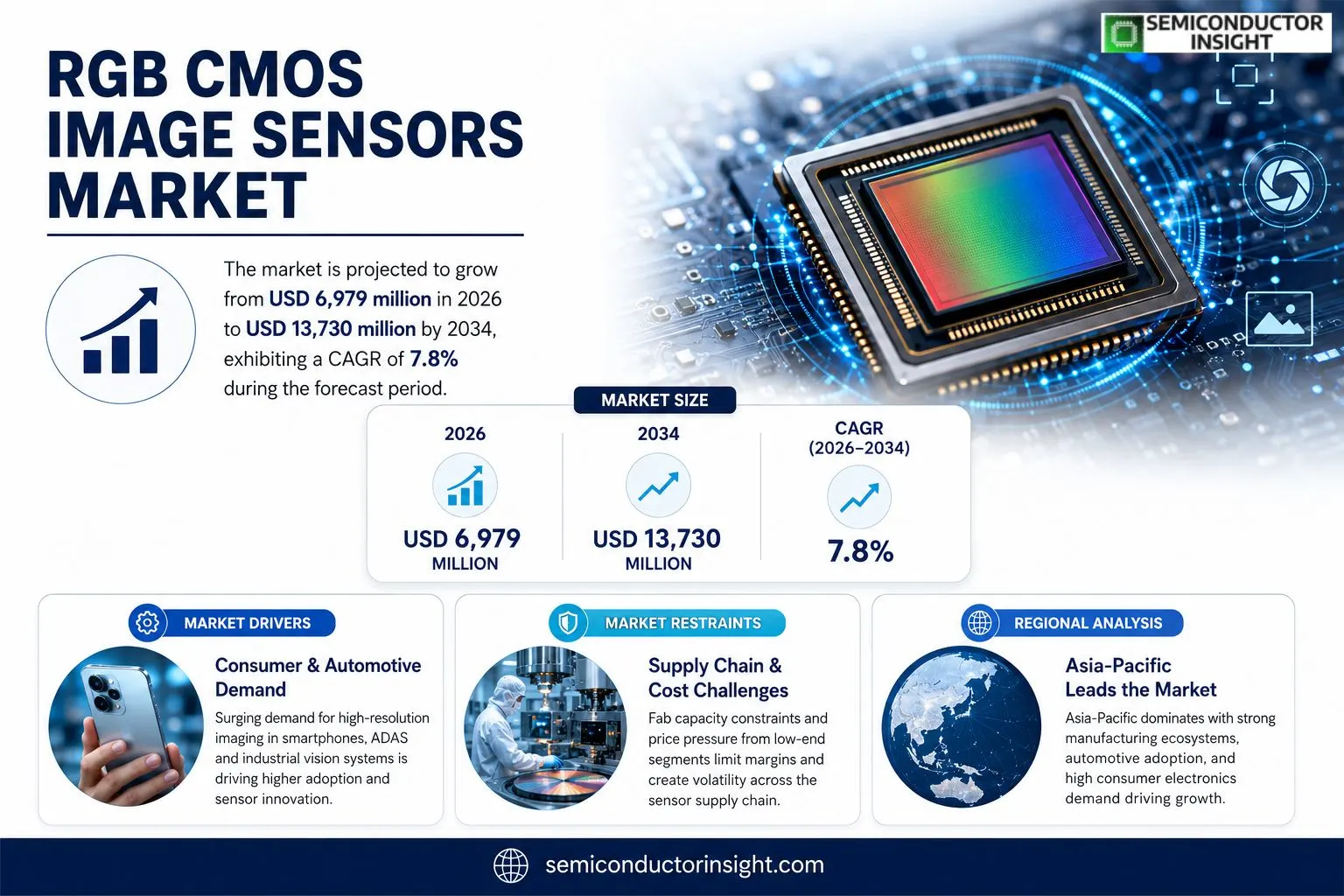
RGB CMOS Image Sensors Market size was valued at USD 6,979 million in 2026. The market is expected to increase from USD 6,979 million in 2026 to approximately USD 13,730 million by 2034, exhibiting a CAGR of 7.8 % during the forecast period.
An RGB CMOS image sensor is a color‑sensitive semiconductor device that captures visible light through a Bayer‑pattern filter array separating red (R), green (G) and blue (B) wavelengths. By converting photons into digital signals it delivers high‑quality color imaging and has become the preferred choice for consumer electronics, automotive systems, industrial inspection and security surveillance because it offers superior power efficiency, integration density and cost compared with traditional CCD technology.
MARKET DRIVERS
Consumer Device Integration
The surge in high‑resolution smartphones and wearables has forced OEMs to adopt RGB CMOS Image Sensors that deliver superior color fidelity while keeping power consumption low. Manufacturers are able to differentiate flagship models by bundling richer imaging capabilities, a move that translates into higher average selling prices and recurring upgrade cycles.
Automotive Imaging Demand
Advanced driver‑assistance systems (ADAS) now require real‑time scene perception, a function where RGB CMOS Image Sensors excel due to their fast readout and robust performance under varying lighting. As vehicle electrification accelerates, the proportion of electronic content per car climbs, creating a steady pipeline of sensor orders for safety‑critical applications.
➤ “The convergence of consumer and automotive imaging needs is reshaping supply chain priorities for sensor fabs.” – Industry Analyst, 2024
Beyond end‑user products, industrial automation is integrating vision modules that rely on precise color discrimination; this trend pushes the RGB CMOS Image Sensors Market toward higher volume production runs, lowering unit costs and encouraging new entrants to explore niche verticals.
In parallel, the rollout of 5G networks shortens latency for cloud‑based image processing, making it feasible for remote visual analytics to depend on on‑device sensors rather than bulkier optics, thereby expanding the addressable market base.
MARKET CHALLENGES
Supply Chain Volatility
Recent disruptions in semiconductor fabs have exposed the fragility of the sensor pipeline. Allocation of lithography slots to higher‑margin logic chips forces RGB CMOS Image Sensors producers to operate with reduced capacity buffers, resulting in lead‑time extensions that cascade to downstream OEMs.
Other Challenges
Cost‑Pressure from Low‑End Segments
Mass‑market smartphones and budget wearables demand aggressive price points, compelling sensor designers to trim functionalities or accept lower yields, which erodes profitability for many players.
MARKET RESTRAINTS
Technological Saturation in Mature Segments
In categories such as basic security cameras, the achievable resolution and color depth have plateaued, leaving little room for incremental revenue from sensor upgrades. This ceiling discourages heavy investment in R&D for these segments, limiting overall market expansion.Furthermore, the emergence of alternative imaging technologiessuch as event‑based sensors for specific industrial use casescreates a substitution risk that tempers enthusiasm for continued growth in traditional RGB CMOS lines.
MARKET OPPORTUNITIES
Emerging Edge‑AI Vision Platforms
Edge‑AI devices that process visual data locally require sensors with on‑chip image preprocessing capabilities. By integrating AI accelerators directly with RGB CMOS Image Sensors, manufacturers can offer turnkey solutions for smart retail, robotics, and augmented reality, opening high‑margin revenue streams.In addition, the rollout of next‑generation satellite constellations for Earth observation presents an untapped niche; lightweight, radiation‑hardened RGB sensors could enable cost‑effective multispectral data capture, positioning suppliers at the forefront of a new commercial frontier.
RGB CMOS Image Sensors Market Trends
Automotive and Consumer Demand Driving Sensor Adoption
Demand for color‑sensitive imaging modules is tightening across several high‑value segments, and the RGB CMOS Image Sensors Market is feeling the pressure of that shift. Automotive manufacturers are integrating larger‑area sensors to support advanced driver‑assist systems, where high dynamic range and fast frame rates are essential for reliable perception under varied lighting. At the same time, smartphone and wearable makers are pushing pixel counts upward while insisting on lower power draw, a combination that only the CMOS architecture can satisfy effectively. The convergence of these forces is prompting tier‑1 suppliers to renegotiate pricing structures and to secure long‑term wafer capacity, while smaller assemblers are scrambling for access to qualified foundries. Companies that can align design roadmaps with the timing of vehicle model releases or flagship phone launches stand to capture a larger share of the addressing spend. Moreover, the push for 8K video capture in professional cameras is accelerating the push for larger sensor formats, reinforcing the upward pressure on component demand.
Other Trends
Supply Chain Consolidation
The industry chain surrounding the RGB CMOS Image Sensors Market is increasingly dominated by a handful of vertically integrated players, a trend that reshapes bargaining dynamics for downstream OEMs. Upstream providers of high‑purity silicon, lithography equipment, and proprietary IP have consolidated through strategic alliances, limiting the number of viable entry points for newcomers. Midstream operations now split between integrated device manufacturers that own wafer fabs and a growing cohort of fabless designers that rely on dedicated foundries and OSAT partners. This bifurcation raises the cost of switching suppliers, incentivizing long‑term contracts and joint development programs. For investors, the concentration implies that market share gains are more likely to come from acquisitions or technology licensing rather than organic volume expansion.
Pixel Architecture Innovation Fuels New Applications
Pixel‑level engineering is now the primary lever for differentiation in the RGB CMOS Image Sensors Market, as applications demand higher resolution without sacrificing sensitivity. Back‑side illuminated and stacked‑die technologies have moved from niche automotive modules to mainstream consumer products, delivering smaller pixel pitches while preserving quantum efficiency. Meanwhile, global‑shutter implementations are seeing increased adoption in industrial robotics and high‑speed inspection lines, where motion blur must be eliminated. The shift toward heterogeneous integration forces manufacturers to co‑invest in advanced packaging and R&D collaborations with optical lens producers. Companies that master these complex stacks can command premium pricing and open new revenue streams in sectors such as autonomous navigation and medical imaging, where image fidelity directly influences system safety and diagnostic accuracy.
COMPETITIVE LANDSCAPE
Key Industry Players
RGB CMOS Image Sensors: Competitive Overview 2026‑2034
Sony remains the dominant force in the RGB CMOS image sensor arena, leveraging its integrated‑device‑manufacturer (IDM) model to control the full value chain from wafer fabrication to final packaging. The company’s early adoption of back‑side‑illuminated (BSI) and stacked sensor architectures has entrenched its leadership in premium automotive and flagship mobile applications. Sony’s deep IP portfolio and high‑volume production capabilities create a steep barrier for new entrants, while its strategic partnerships with tier‑one automotive OEMs translate into recurring design wins that reinforce market concentration. The firm’s pricing power, combined with a steady pipeline of higher‑resolution, low‑noise sensors, allows it to capture a disproportionate share of total revenue despite a relatively modest number of product families.Beyond Sony, the field comprises a mix of large conglomerates and specialist firms pursuing differentiated routes. Samsung’s fab‑plus‑foundry approach enables rapid scaling of high‑pixel‑count sensors for both consumer and automotive segments, while OmniVision focuses on ultra‑compact solutions for IoT and automotive cameras, exploiting its strong design expertise. STMicroelectronics and ON Semiconductor occupy the mid‑tier, offering a blend of global‑shutter and rolling‑shutter products that serve industrial and security markets. GalaxyCore, Panasonic, SmartSens, and Canon each target niche verticalssuch as wearable devices, medical imaging, and surveillancewhere form‑factor or power‑efficiency constraints dominate design decisions. Emerging players like SOI, Himax, Sharp, Visionox and Evervision have secured foundry capacity through alliances with TSMC or GlobalFoundries, allowing them to introduce stacked or multi‑spectral sensors that address automotive‑grade dynamic‑range demands. The competitive intensity is reflected in frequent joint‑development agreements and selective acquisitions aimed at bolstering sensor‑IP libraries and expanding geographic reach.
List of Key RGB CMOS Image Sensors Companies Profiled
- Sony Corporation
- Samsung Electronics
- OmniVision Technologies
- STMicroelectronics
- ON Semiconductor
- GalaxyCore Semiconductor
- Panasonic Corporation
- SmartSens Technology
- Canon Inc.
- SOI (Taiwan)
- Himax Technologies
- Sharp Corporation
- Visionox
- Evervision
Segment Analysis:
| Segment Category | Sub-Segments | Key Insights |
| By Type |
|
Global Shutter drives premium applications where motion distortion must be eliminated.
|
| By Application |
|
Automotive is the anchor of the market, pushing sensor evolution toward higher reliability and extreme environmental tolerance.
|
| By End User |
|
OEMs shape product roadmaps by specifying sensor performance targets early in the design cycle.
|
| By Pixel Structure |
|
Stacked CMOS Image Sensor provides the most strategic advantage for next‑generation devices.
|
| By Shutter Technology |
|
Global Shutter continues to dominate high‑precision segments where distortion‑free capture is non‑negotiable.
|
Regional Analysis: RGB CMOS Image Sensors Market
Vehicle manufacturers are embedding RGB CMOS sensors into advanced driver‑assistance systems, drawn by the chips’ low power draw and robust performance under varied lighting. The shift toward autonomous prototypes heightens the need for reliable color imaging, prompting tier‑one suppliers to secure long‑term contracts with Asian OEMs.
Mobile handset makers in the region are prioritizing sensor miniaturization to meet consumer expectations for vivid, true‑color photography. Design houses are iterating on pixel architecture, enabling slimmer modules that still deliver excellent low‑light fidelity.
Factories adopting visual inspection rigs favor RGB CMOS units for their durability and consistent output across harsh environments. The push toward smart‑factory standards amplifies the appeal of sensors that integrate seamlessly with edge‑processing platforms.
Wearables and home‑automation gadgets are increasingly featuring color sensors to enhance user interaction. The demand for compact, energy‑efficient modules drives regional design teams to explore novel back‑illuminated structures.
North America
North America remains a hub for high‑end sensor engineering, where research institutions collaborate with leading chip manufacturers to push the envelope of resolution and processing speed. The market leans heavily on defense and aerospace contracts that require rugged imaging solutions, while consumer‑device firms focus on differentiating premium products through advanced color reproduction. Strategic acquisitions by U.S. firms aim to capture niche capabilities, prompting a subtle reshuffling of supplier hierarchies.
Europe
European players emphasize sustainability and regulatory compliance, influencing sensor design toward lower material usage and recyclable packaging. Automotive clusters in Germany and France integrate RGB CMOS sensors into next‑generation infotainment and safety platforms, balancing performance with stringent emissions standards. Additionally, the region’s strong intellectual‑property framework encourages startups to commercialize innovative pixel‑fusion techniques, adding depth to the competitive landscape.
South America
Growth in South America is anchored by expanding telecom infrastructure and rising demand for surveillance solutions in urban centers. Local assemblers are sourcing sensors from regional distributors, creating a modest but steady pipeline of projects. Government initiatives aimed at enhancing digital connectivity stimulate modest upgrades in public‑service imaging equipment, offering incremental opportunities for market participants.
Middle East & Africa
The Middle East & Africa segment is driven by large‑scale smart‑city programs and a burgeoning interest in premium security installations. Oil‑field monitoring and remote‑inspection applications benefit from the reliability of RGB CMOS sensors under extreme temperature swings. While penetration remains limited, strategic partnerships with Asian manufacturers are laying the groundwork for a more pronounced market presence in the coming years.
Report Scope
This market research report provides a comprehensive analysis of the RGB CMOS Image Sensors Market , covering the forecast period 2026–2034. It offers detailed insights into market dynamics, technological advancements, competitive landscape, and key trends shaping the industry.
Key focus areas of the report include:
- Market Overview: The report begins with an overview outlining its current market scenario, key growth indicators, and industry transformation drivers. It discusses macroeconomic factors, demand–supply balance, regulatory landscape, and the strategic role of semiconductors in powering advancements across industries such as automotive, telecommunications, consumer electronics, and industrial automation.
- Market Size & Forecast: Historical data and future projections for revenue, unit shipments, and market value across major regions and segments.
- Segmentation Analysis: Detailed breakdown by product type, technology, application, and end-user industry to identify high-growth segments and investment opportunities.
- Regional Insights: Insights into market performance across North America, Europe, Asia-Pacific, Latin America, and the Middle East & Africa, including country-level analysis where relevant.
- Competitive Landscape: Profiles of leading market participants, including their product offerings, R&D focus, manufacturing capacity, pricing strategies, and recent developments such as mergers, acquisitions, and partnerships.
- Technology Trends & Innovation: Assessment of emerging technologies, integration of AI/IoT, semiconductor design trends, fabrication techniques, and evolving industry standards.
- Market Drivers & Restraints: Evaluation of factors driving market growth along with challenges, supply chain constraints, regulatory issues, and market-entry barriers.
- Stakeholder Insights: Insights for component suppliers, OEMs, system integrators, investors, and policymakers regarding the evolving ecosystem and strategic opportunities.
Primary and secondary research methods are employed, including interviews with industry experts, data from verified sources, and real-time market intelligence to ensure the accuracy and reliability of the insights presented.
FREQUENTLY ASKED QUESTIONS:
What is the current market size of RGB CMOS Image Sensors Market?
-> RGB CMOS Image Sensors Market was valued at USD 6,979 million in 2026 and is expected to reach USD 11,773 million by 2034, growing at a CAGR of 7.8% during the forecast period.
Which key companies operate in RGB CMOS Image Sensors Market?
-> Key players include Sony, Samsung, OmniVision, STMicroelectronics, ON Semiconductor, GalaxyCore, Panasonic, Smartsens Technology, Canon, SOI.
What are the key growth drivers for the market?
-> Key growth drivers include rising demand for high‑resolution imaging in consumer electronics, automotive advanced driver‑assistance systems, industrial inspection, security surveillance, and the integration of AI/IoT technologies.
Which region holds the largest market share?
-> The market is highly globalized, with significant contributions from Asia, Europe and North America; no single region is explicitly dominant in the provided data.
What emerging trends are shaping the market?
-> Emerging trends include high dynamic range (HDR) sensors for automotive, global‑shutter designs for industrial applications, stacked CMOS architectures, and increased B2B adoption driven by AI‑enabled imaging solutions.
Get Sample Report PDF for Exclusive Insights
Report Sample Includes
- Table of Contents
- List of Tables & Figures
- Charts, Research Methodology, and more...





