Parallel Converter Market Insights
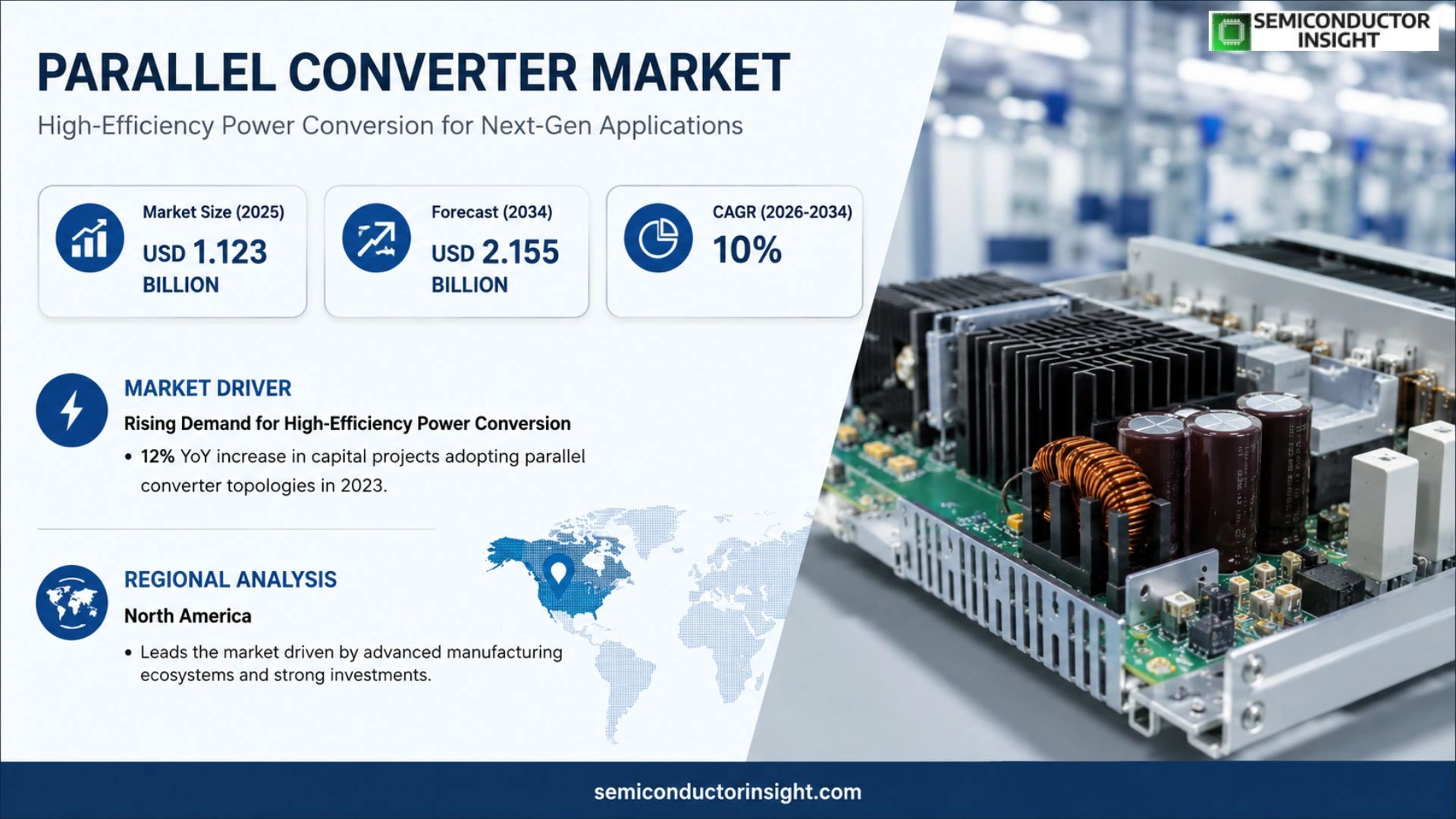
Parallel Converter market was valued at USD 1.123 billion in 2025 and is expected to reach USD 2.155 billion by 2034, reflecting a compound annual growth rate of roughly 10 % over the forecast horizon.
Parallel Converter refers to a power‑electronic system or supply architecture that enables multiple conversion modules to operate side‑by‑side on a common AC or DC bus. By sharing current and employing unified control, the design delivers linear power scaling, redundancy backup and high reliability while allowing modules to be added or removed without interrupting operation.
The expansion of AI‑driven data centers, the rollout of 5G edge infrastructure and increasing industrial digitalization are pushing demand for modular, hot‑swappable power solutions that guarantee uninterrupted service, thereby fueling adoption of parallel converter technology.
MARKET DRIVERS
Rising Demand for High‑Efficiency Power Conversion
Enterprises that operate large‑scale data centers are rewriting their power architectures to accommodate rapid workloads. 2023 data shows a 12 % year‑over‑year uptick in capital projects that specify parallel‑converter topologies because they cut losses at peak loads. This shift is not confined to cloud providers; electric‑vehicle charging networks are also embedding these converters to balance grid draw while preserving battery health.
Regulatory Incentives and Energy‑Efficiency Standards
Governments across North America and Europe have tightened efficiency thresholds for commercial power equipment. Firms that fail to meet the new 80 % efficiency floor face higher tariffs, prompting OEMs to prioritize parallel‑converter designs that can comfortably exceed the mandate. The regulatory pressure is translating into a measurable rise in procurement budgets dedicated to compliant hardware.
➤ “Adoption spikes whenever a jurisdiction adds a performance clause to its energy code; manufacturers respond within 12–18 months.”
Strategically, the confluence of workload intensity, tighter standards, and cost‑of‑ownership calculations is reshaping supplier conversations. Companies that can demonstrate lower total‑life‑cycle costs while delivering the required power density are securing the majority of new contracts in Parallel Converter Market.
MARKET CHALLENGES
Technical Complexity and Integration Costs
Parallel converters rely on sophisticated control algorithms and precise thermal management. For many mid‑size manufacturers, engineering those subsystems adds 15–20 % to bill‑of‑materials, eroding margin expectations. End‑users also face longer deployment cycles because system integrators must validate synchronisation across multiple converter modules.
Other Challenges
Supply Chain Vulnerabilities
The semiconductor shortage that began in 2020 still constrains the availability of high‑speed MOSFETs essential for parallel operation. Lead times of 8–10 weeks are commonplace, forcing OEMs to hold larger safety stocks and increase working capital.
Talent Gap
Design engineers with expertise in multi‑phase power architectures remain scarce. Companies are investing in up‑skilling programs, but the learning curve extends project timelines and can delay market entry for new product families.
MARKET RESTRAINTS
Capital Intensity of Scaling Production
Establishing a dedicated production line for parallel converters demands multi‑million‑dollar investments in specialised test equipment and clean‑room facilities. Smaller players often lack the financial bandwidth to reach economies of scale, limiting the overall supplier pool.
Limited Awareness in Emerging Regions
In many developing markets, the benefits of parallel conversion are not yet part of the standard engineering curriculum. Consequently, procurement decisions default to simpler, lower‑cost alternatives, constraining market penetration outside mature economies.
Competition from Alternative Conversion Technologies
Hybrid silicon‑carbide (SiC) modules and wide‑bandgap devices are attracting attention for their compact form factor. While they do not replicate the redundancy of parallel converters, their higher power density makes them attractive for space‑constrained applications, siphoning potential demand.
MARKET OPPORTUNITIES
Growth of Renewable Energy Integration
Solar farms and wind parks increasingly pair with energy‑storage systems that must handle fluctuating output. Parallel converters enable seamless power sharing between storage units, smoothing intermittency and protecting inverter lifespan. Analysts estimate that over 30 % of new renewable installations will incorporate parallel conversion by 2027.
Expansion into Edge Computing
Edge data nodes operate in remote locations with limited cooling capacity. The modular nature of parallel converters allows operators to add capacity incrementally without over‑hauling the entire power infrastructure, presenting a clear value proposition for telecom providers.
Customization for Industrial Automation
Manufacturers of high‑speed assembly lines are seeking converters that can be tuned to specific torque and speed profiles. Offering software‑defined control interfaces alongside hardware creates a differentiated service that can capture premium pricing in the industrial segment.
Parallel Converter Market Trends
Scaling Demand from Data Centers and Edge Compute
Parallel Converter Market is reacting to a pronounced increase in power‑intensive workloads. AI‑driven training clusters and high‑performance computing platforms now consume several hundred kilowatts per rack, pressuring designers to adopt modular power architectures that grow in parallel rather than replace existing buses. Parallel conversion units enable seamless capacity addition, reducing rollout time and limiting upfront capital risk. Since any interruption translates into lost service‑level agreement revenue, operators favor hot‑swappable modules and active current‑sharing control loops. Shipment volumes reflected this shift, reaching approximately 91.97 million units in 2025, while unit pricing remains anchored between $10 and $25.
Other Trends
Margin Dynamics Across Application Segments
Gross‑margin profiles reveal a dual structure. Solutions targeting data‑center back‑ends, core communications and mission‑critical industrial loads command premiums for N+1 redundancy, remote monitoring (PMBus, CAN, Ethernet) and high power density. These high‑value platforms routinely record margins of 30 %‑45 %, with elite high‑density designs pushing towards 55 %. Conversely, more commoditized segments,such as standard communication equipment and OEM power cabinets,experience tighter bidding environments, compressing margins into the 18 %‑30 % band. The ability to differentiate through energy‑efficiency metrics, power‑density ratios and intelligent management increasingly shields manufacturers from price erosion.
Architectural Evolution and Voltage Scaling
At the device level, the industry is standardizing on 48 – 50 V rack‑level DC distribution, a move driven by the need for higher power density and reduced conversion loss. The emergence of high‑voltage DC architectures dovetails with the parallel expansion philosophy, allowing each module to contribute a larger share of total output while still maintaining tight current‑sharing tolerances. This transition is amplified by 5G edge deployments and industrial digitalization initiatives that demand stringent SLAs and instantaneous load‑balancing. As manufacturers integrate smarter diagnostics and cloud‑connected monitoring, the overall system becomes not only more reliable but also more attractive to end‑users who can quantify uptime savings against equipment cost.
COMPETITIVE LANDSCAPE
Key Industry Players
Parallel Converter Market – Competitive Overview
The upper tier of the parallel‑converter arena is firmly anchored by a handful of global power‑electronics groups whose portfolios blend high‑efficiency platforms with extensive service ecosystems. Delta Electronics, Schneider Electric, ABB and Siemens command the premium segment that serves hyperscale data centres, AI‑driven HPC racks and mission‑critical telecom back‑bones. Their modules routinely embed hot‑swappable hot‑plug capability, active current‑sharing on 48‑50 V DC buses, and integrated PMBus/CAN/Ethernet monitoring, allowing customers to avoid costly downtime. Because these end‑users price reliability above component cost, the incumbents maintain gross margins in the mid‑40 % range and wield decisive influence over specification standards, shaping the overall market architecture.
Beyond the marquee names, a second tier of specialists pursues differentiated niches such as edge‑computing, industrial automation and OEM integration. Eaton, Vertiv, Huawei Digital Power, Advanced Energy, TDK‑Lambda, MEAN WELL, Vicor, Murata Power Solutions, Bel Power Solutions, XP Power and Flex Power Modules each leverage distinct strengths,whether it is aggressive pricing for large‑volume communication equipment, compact form‑factors for automotive power‑train applications, or advanced active‑sharing algorithms for medium‑speed converters. Their collective presence intensifies competition in the 18‑30 % margin band, forces continual efficiency gains, and expands the overall addressable market by catering to emerging voltage‑level trends and regional procurement policies.
List of Key Parallel Converter Companies Profiled
- Delta Electronics
- Schneider Electric
- ABB
- Siemens
- Eaton
- Vertiv
- Huawei Digital Power
- Advanced Energy
- TDK‑Lambda
- MEAN WELL
- Vicor
- Murata Power Solutions
- Bel Power Solutions
- XP Power
- Flex Power Modules
Segment Analysis:
| Segment Category | Sub-Segments | Key Insights |
| By Type |
|
Active Current Sharing emerges as the preferred architecture because it delivers seamless load distribution, enables hot‑swap capability without interruption, and supports sophisticated monitoring protocols such as PMBus and Ethernet.
|
| By Application |
|
Fiber Optic Communication drives the market due to the relentless demand for high‑bandwidth, ultra‑low‑latency connectivity in 5G back‑haul and edge‑computing nodes.
|
| By End User |
|
Data Centers represent the most demanding end‑user segment, where power reliability directly impacts service level agreements.
|
| By Power Architecture |
|
Parallel Comparison Type is favored for its inherent modularity and ability to maintain voltage regulation across multiple converters.
|
| By Feature Set |
|
High Efficiency is increasingly decisive as operators seek to lower total cost of ownership and meet sustainability targets.
|
Regional Analysis: Parallel Converter Market
North America
Manufacturers in the automotive and aerospace sectors are re‑engineering power distribution networks to embed parallel converters, enabling fault‑tolerant operation and smoother load transitions, which translates into higher equipment uptime and lower lifecycle costs.
Updated efficiency mandates across federal and state levels compel system designers to integrate converters that meet tighter harmonic limits, shaping product roadmaps and accelerating certification cycles for new entrants.
Advances in wide‑bandgap semiconductor materials and intelligent control algorithms are delivering converters with higher power density, reduced cooling requirements, and enhanced predictive maintenance capabilities.
A vertically integrated component base, supported by domestic silicon fabs and assembly plants, buffers the region against global shortages, ensuring consistent product roll‑outs and rapid response to demand spikes.
Europe
European manufacturers are leveraging Parallel Converter Market to meet stringent EU energy‑efficiency directives, which mandate higher power quality across industrial grids. Collaborative research programs funded by the Horizon Europe initiative are generating prototypes that incorporate AI‑driven load‑balancing, allowing utilities to defer expensive infrastructure upgrades. Market participants are also focusing on circular‑economy principles, designing converters for easy disassembly and component reuse, a trend that aligns with regional sustainability goals and offers a differentiated value proposition for OEMs.
Asia‑Pacific
The Asia‑Pacific arena is witnessing a rapid escalation in demand for parallel converters as renewable‑energy installations proliferate across China, India, and Southeast Asia. Grid operators prioritize resilience in regions prone to extreme weather, prompting a shift toward modular converter clusters that can be redeployed after outages. Local manufacturers benefit from cost‑effective labor and abundant raw material supplies, enabling competitive pricing while investing in next‑generation silicon‑carbide devices that promise higher efficiency in tropical climates.
South America
South American utilities are embracing Parallel Converter Market to address aging transmission infrastructure and to integrate growing solar and wind capacities. Nations such as Brazil and Chile view parallel converter solutions as a cost‑effective bridge to full grid modernization, emphasizing redundancy and scalability. Emerging private‑equity funds are backing regional startups that specialize in low‑cost, ruggedized converters designed for remote and off‑grid applications, fostering a nascent ecosystem poised for expansion.
Middle East & Africa
In the Middle East and Africa, the emphasis lies on adapting parallel converters to harsh desert environments and intermittent power supply scenarios. Oil‑rich Gulf states are piloting converter‑based micro‑grids to diversify energy portfolios, while African nations leverage the technology to strengthen off‑grid electrification projects. Partnerships between multinational vendors and local engineering firms are crucial for knowledge transfer, ensuring that solutions meet both climatic challenges and evolving regulatory expectations.
Report Scope
This market research report provides a comprehensive analysis of the Parallel Converter Market , covering the forecast period 2026–2034. It offers detailed insights into market dynamics, technological advancements, competitive landscape, and key trends shaping the industry.
Key focus areas of the report include:
- Market Overview: The report begins with an overview outlining its current market scenario, key growth indicators, and industry transformation drivers. It discusses macroeconomic factors, demand–supply balance, regulatory landscape, and the strategic role of semiconductors in powering advancements across industries such as automotive, telecommunications, consumer electronics, and industrial automation.
- Market Size & Forecast: Historical data and future projections for revenue, unit shipments, and market value across major regions and segments.
- Segmentation Analysis: Detailed breakdown by product type, technology, application, and end-user industry to identify high-growth segments and investment opportunities.
- Regional Insights: Insights into market performance across North America, Europe, Asia-Pacific, Latin America, and the Middle East & Africa, including country-level analysis where relevant.
- Competitive Landscape: Profiles of leading market participants, including their product offerings, R&D focus, manufacturing capacity, pricing strategies, and recent developments such as mergers, acquisitions, and partnerships.
- Technology Trends & Innovation: Assessment of emerging technologies, integration of AI/IoT, semiconductor design trends, fabrication techniques, and evolving industry standards.
- Market Drivers & Restraints: Evaluation of factors driving market growth along with challenges, supply chain constraints, regulatory issues, and market-entry barriers.
- Stakeholder Insights: Insights for component suppliers, OEMs, system integrators, investors, and policymakers regarding the evolving ecosystem and strategic opportunities.
Primary and secondary research methods are employed, including interviews with industry experts, data from verified sources, and real-time market intelligence to ensure the accuracy and reliability of the insights presented.
FREQUENTLY ASKED QUESTIONS:
What is the current market size of Parallel Converter Market?
-> Parallel Converter market is expected to reach USD 2.155 billion by 2034, reflecting a compound annual growth rate of roughly 10 %
Which key companies operate in Parallel Converter Market?
-> Key players include Delta Electronics, Schneider Electric, ABB, Eaton, Vertiv, Huawei Digital Power, Siemens, Socomec, Advanced Energy, TDK-Lambda, MEAN WELL, Vicor, Murata Power Solutions, Bel Power Solutions, XP Power, Flex Power Modules.
What are the key growth drivers?
-> Key growth drivers include rapid increase in load power, AI/HPC and cloud data center demand, 5G/edge computing, industrial digitalization, need for N+1 redundancy, hot‑swappable operation, and active current sharing for high‑efficiency, modular parallel architectures.
Which region dominates the market?
-> The market shows strong activity across all major regions,including North America, Europe, Asia, South America, and the Middle East & Africa,reflecting its global adoption.
What are the emerging trends?
-> Emerging trends include modular parallel expansion, high‑density platforms with 30%‑55% gross margins, advanced remote monitoring (PMBus/CAN/Ethernet), and integration of intelligent management capabilities.

Get Sample Report PDF for Exclusive Insights
Report Sample Includes
- Table of Contents
- List of Tables & Figures
- Charts, Research Methodology, and more...
 Download Sample Report PDF