Nanocrystalline Cores Market Insights
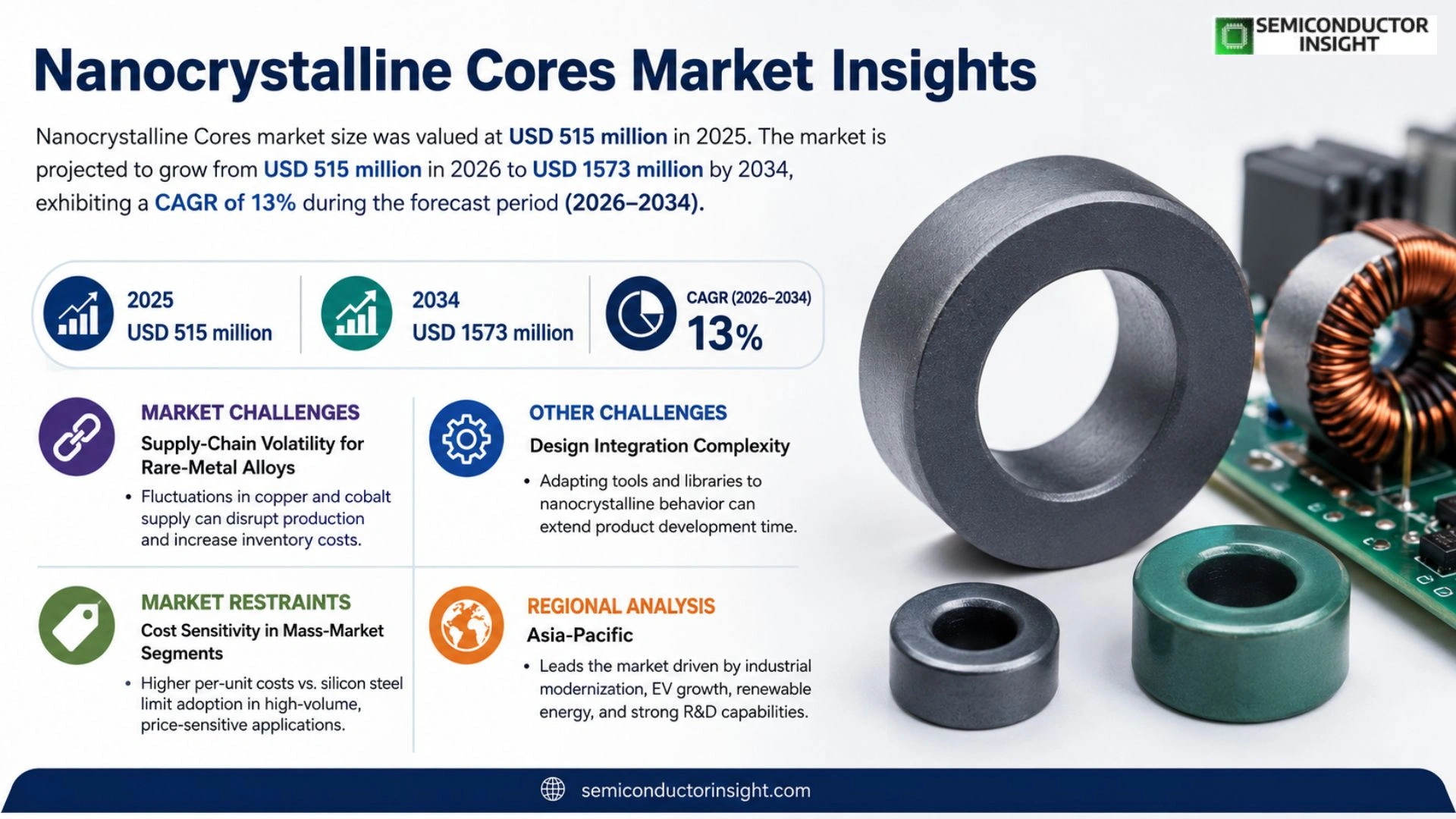
Nanocrystalline Cores market size was valued at USD 515 million in 2025. The market is projected to grow from USD 515 million in 2026 to USD 1573 million by 2034, exhibiting a CAGR of 13 % during the forecast period.
Nanocrystalline cores are soft‑magnetic components produced from iron‑based nanocrystalline alloys that contain silicon, boron, copper and niobium.
The nanoscale grains,typically tens of nanometres,are embedded within an amorphous matrix, delivering high magnetic permeability, low coercivity, minimal core loss and excellent thermal stability.
Their compact form factor and efficiency make them ideal for high‑frequency power‑electronics such as transformers, inductors, chokes and current sensors used in switch‑mode power supplies, renewable‑energy converters, electric‑vehicle charging systems and industrial drives.
MARKET DRIVERS
Rising Demand for High‑Efficiency Power Conversion
Manufacturers of renewable‑energy inverters and electric‑vehicle powertrains are seeking magnetic components that can sustain high switching frequencies while limiting core losses. Nanocrystalline Cores Market participants benefit because the material’s low coercivity translates directly into reduced heat generation, allowing designers to pack more functionality into smaller footprints.
Advances in Material Processing
Recent breakthroughs in rapid solidification and annealing have lowered the cost barrier that previously limited large‑scale adoption. As production yields improve, OEMs find it viable to replace traditional grain‑oriented silicon steel with nanocrystalline alloys, unlocking higher inductance per volume.
➤ “The shift toward compact, high‑frequency converters is reshaping component specifications, and nanocrystalline cores are emerging as the preferred solution.”
Regulatory regimes that enforce stricter efficiency standards for grid‑connected devices further amplify the incentive to adopt these cores. Companies that integrate nanocrystalline magnetic material are positioned to meet compliance without extensive redesign, thereby shortening time‑to‑market.
MARKET CHALLENGES
Supply‑Chain Volatility for Rare‑Metal Alloys
Although the alloy composition of nanocrystalline cores relies primarily on iron, trace elements such as copper and cobalt are essential for optimal grain refinement. Fluctuations in the availability of these ancillary metals can disrupt manufacturing plans, forcing some suppliers to hold larger safety stocks.
Other Challenges
Design Integration Complexity
Engineers accustomed to conventional magnetic materials must adapt simulation tools and design libraries to accurately predict nanocrystalline behavior, which can extend development cycles.
MARKET RESTRAINTS
Cost Sensitivity in Mass‑Market Segments
While performance advantages are clear, the per‑unit price of nanocrystalline cores remains higher than that of classic silicon steel, especially in high‑volume consumer‑electronics applications where margins are thin. This price differential restrains broader penetration until economies of scale materialize.
MARKET OPPORTUNITIES
Emerging Applications in 5G Infrastructure
5G base stations demand power supplies that can operate efficiently at gigahertz frequencies. The low core loss and high permeability of nanocrystalline material align perfectly with this requirement, opening a sizable avenue for growth as network operators roll out next‑generation infrastructure.
Industrial Automation and Smart Grids
Smart‑grid converters and high‑precision motor drives are increasingly reliant on compact magnetic components to meet space constraints and thermal limits. Companies that can tailor nanocrystalline core geometries for these niches are likely to capture premium market share.
Nanocrystalline Cores Market Trends
High‑Frequency Power Conversion Accelerates Adoption
The shift toward power‑electronic architectures that operate above 100 kHz has reshaped component selection across several sectors. Engineers now prioritize magnetic cores that sustain low loss at elevated frequencies while retaining thermal robustness. Nanocrystalline alloys, with grain sizes measured in tens of nanometres, deliver permeability levels that exceed conventional ferrites and a coercivity low enough to keep core loss under tight system budgets. Consequently, designers of renewable‑energy inverters, EV on‑board chargers, and advanced SMPS modules are replacing silicon‑steel and ferrite parts with nanocrystalline solutions, achieving a measurable reduction in overall I²R heating and a noticeable shrinkage in magnetic volume. This engineering shift directly translates into higher power density and longer mean‑time‑between‑failures, factors that are increasingly decisive in competitive product road‑maps.
Other Trends
Geographic Concentration in Japan
Japan commands roughly one‑third of global shipments, a share that reflects the country’s early commitment to high‑efficiency grid‑integration projects and its dense manufacturing base for automotive powertrains. Local standards that enforce stricter loss limits have compelled OEMs to source nanocrystalline cores from domestic producers, reinforcing a virtuous cycle of R&D investment and supply‑chain reliability. The result is a market where Japanese manufacturers not only capture a sizable export volume but also set performance benchmarks that influence downstream specifications worldwide.
Product Preference for Toroidal Geometry
Toroidal nanocrystalline cores dominate the product mix, accounting for about 80 % of total units sold. Their closed‑magnetic‑circuit design minimizes stray flux, which is particularly valuable in common‑mode choke applications where electromagnetic interference must be suppressed. The geometry also eases winding processes, allowing manufacturers to achieve tighter tolerances and lower material waste. As system designers demand ever‑smaller footprints without compromising isolation performance, the toroidal form factor continues to be the default choice, reinforcing its market dominance.
COMPETITIVE LANDSCAPE
Key Industry Players
Nanocrystalline Cores Market – Competitive Overview
Proterial, Ltd. and Advanced Technology & Materials dominate Nanocrystalline Cores arena, together accounting for roughly half of total revenue. Their grip stems from vertically integrated production lines that couple alloy development with precision forming of toroidal geometries, a segment that now represents about 80 % of core volume. By leveraging long‑term supply contracts with Japanese OEMs, they have locked in the bulk of demand from high‑frequency power supplies and electric‑vehicle chargers. This concentration creates a de‑facto market tier where pricing, lead‑time, and technical support are effectively governed by the strategic choices of these two firms. Their ability to offer low‑core‑loss variants that meet tightening energy‑efficiency standards has forced smaller suppliers to seek niche applications or differentiate through custom alloy chemistries.
Beyond the duopoly, a cluster of specialized manufacturers competes on material innovation and regional service. Qingdao Yunlu Advanced Materials, VACUUMSCHMELZE, China Amorphous Technology, and Hero Magnetic Development focus on high‑temperature amorphous‑nanocrystalline blends that appeal to renewable‑energy converters operating in harsh environments. Dayou Technology and Foshan Mingfuxing Metal have carved out market share by providing thin‑walled rectangular cores for compact power modules. Companies such as Londerful New Material and Bomatec differentiate through rapid prototyping capabilities, enabling system designers to iterate geometry and magnetic performance within weeks. This fragmented tier adds resilience to the supply chain, offering buyers alternatives when capacity constraints or customized specifications arise.
List of Key Nanocrystalline Cores Companies Profiled
- Proterial, Ltd.
- Advanced Technology & Materials
- Qingdao Yunlu Advanced Materials
- VACUUMSCHMELZE
- China Amorphous Technology
- Hero Magnetic Development
- Dayou Technology
- Foshan Mingfuxing Metal
- Londerful New Material
- Bomatec
- Zhonghe Amorphous Technology
- JoinChina Advanced Materials
- Vikarsh Nano
- Foshan Huaxin Microcrystalline Metal
- Anhui Smagnet Materials Technology
Segment Analysis:
| Segment Category | Sub-Segments | Key Insights |
| By Type |
|
Leading Segment The toroidal form dominates design discussions because its closed magnetic path minimizes stray flux and core loss, enabling tighter packaging in high‑frequency converters. Designers favour rectangular cores where board‑level integration and stackability are critical, especially in modular power modules. Emerging niche forms such as C‑shaped cores address specific magnetic field shaping requirements in sensor‑focused applications, fostering incremental innovation across the product portfolio. |
| By Application |
|
Leading Segment Common mode chokes receive sustained attention because nanocrystalline material delivers the low loss and high permeability required to suppress electromagnetic interference in dense power‑electronic assemblies. Transformer designs benefit from the material’s high saturation flux density, enabling compact high‑frequency power conversion that aligns with the push for smaller, lighter devices. Current transformers exploit the stable magnetic characteristics across temperature extremes, supporting precise measurement in renewable‑energy inverters and vehicle charging infrastructure. |
| By End User |
|
Leading Segment Power‑electronics manufacturers prioritize nanocrystalline cores for switched‑mode power supplies because the reduced core loss directly translates into higher system efficiency and lower thermal management burden. Renewable‑energy converters value the material’s thermal stability, which sustains reliable operation under fluctuating solar and wind conditions. Electric‑vehicle powertrains leverage the high frequency capability to shrink converter footprints, supporting the industry’s drive toward lighter, more integrated drivetrain architectures. |
| By Frequency Range |
|
Leading Segment In the low‑to‑mid frequency band, designers appreciate the material’s low coercivity, which eases magnetic saturation concerns in traditional power distribution equipment. Mid‑to‑high frequency applications, such as aerospace power converters, benefit from the balance of permeability and loss that enables lighter magnetic components. High‑frequency designs, especially in cutting‑edge EV chargers, exploit the ultra‑low core loss to achieve unprecedented efficiency levels, driving a clear preference for nanocrystalline solutions. |
| By Product Form |
|
Leading Segment Toroidal rings remain the preferred form due to their efficient magnetic flux containment, which reduces electromagnetic interference and supports compact layout strategies. Rectangular slabs are selected when planar integration with PCB stacks is essential, offering predictable mechanical handling. Custom‑shaped assemblies are emerging to meet specialized sensor and actuator requirements, illustrating how design flexibility is becoming a decisive factor in core selection. |
Regional Analysis: Nanocrystalline Cores Market
Advanced powder‑metallurgy techniques and automated winding lines have reduced material waste and improved magnetic‑performance consistency, allowing Asian suppliers to deliver cores that meet tighter loss specifications while maintaining competitive pricing.
Energy‑efficiency mandates in China’s “New Power” program and Japan’s Power‑Device Standard compel OEMs to source low‑loss magnetic components, directly boosting demand for nanocrystalline cores across multiple downstream sectors.
Rapid deployment of electric‑vehicle charging stations and offshore wind converters in the region creates a persistent appetite for high‑frequency, compact magnetic solutions that can operate under high thermal stress.
Joint ventures between local alloy producers and international design houses have accelerated technology transfer, intensifying competition while fostering collaborative innovation across the supply chain.
North America
North America’s position in Nanocrystalline Cores Market reflects a mature ecosystem where aerospace, defense, and industrial automation prioritize reliability and low‑temperature performance. U.S. firms are investing in additive‑manufacturing pilots that enable bespoke magnetic geometries, a move that aligns with the growing need for customizable power solutions in data‑center infrastructure. Regulatory focus on power‑efficiency for commercial buildings has nudged OEMs toward components that minimize core loss, reinforcing demand for nanocrystalline technology. Although the market size is modest compared with Asia‑Pacific, the region’s emphasis on high‑confidence supply chains and stringent quality standards sustains a steady demand trajectory.
Europe
European manufacturers are integrating nanocrystalline cores into renewable‑energy converters and rail‑transport traction systems, driven by the EU’s Green Deal targets. Countries such as Germany and Sweden lead in collaborative research programs that explore high‑frequency magnetic materials for smart‑grid applications, positioning Europe as an innovation hub despite a relatively smaller production footprint. The emphasis on circular‑economy principles encourages the use of recyclable magnetic alloys, a factor that differentiates European procurement decisions. Consequently, the market here is shaped by policy‑driven incentives and a preference for sustainably sourced components.
South America
In South America, emerging renewable‑energy projects,particularly solar farms in Brazil and wind installations in Chile,create pockets of demand for efficient magnetic cores. Local electronics assemblers are beginning to substitute conventional silicon steel with nanocrystalline alternatives to reduce transformer size and improve system efficiency. However, limited domestic raw‑material capacity and reliance on imports constrain rapid market expansion. Strategic partnerships with Asian suppliers are gradually mitigating this gap, suggesting a gradual upward trend as infrastructure investments mature.
Middle East & Africa
The Middle East & Africa region exhibits a niche but growing appetite for nanocrystalline cores, anchored by large‑scale desalination plants and expanding electric‑vehicle charging networks in the Gulf states. Government-led diversification away from hydrocarbon‑centric economies has sparked interest in high‑efficiency power‑conversion equipment, where low‑loss magnetic components are essential. In Africa, pilot projects for mini‑grids and off‑grid solar solutions are introducing the technology on a modest scale. While the overall market remains embryonic, policy shifts toward renewable integration hint at a gradual increase in demand.
Report Scope
This market research report provides a comprehensive analysis of the Nanocrystalline Cores Market , covering the forecast period 2026–2034. It offers detailed insights into market dynamics, technological advancements, competitive landscape, and key trends shaping the industry.
Key focus areas of the report include:
- Market Overview: The report begins with an overview outlining its current market scenario, key growth indicators, and industry transformation drivers. It discusses macroeconomic factors, demand–supply balance, regulatory landscape, and the strategic role of semiconductors in powering advancements across industries such as automotive, telecommunications, consumer electronics, and industrial automation.
- Market Size & Forecast: Historical data and future projections for revenue, unit shipments, and market value across major regions and segments.
- Segmentation Analysis: Detailed breakdown by product type, technology, application, and end-user industry to identify high-growth segments and investment opportunities.
- Regional Insights: Insights into market performance across North America, Europe, Asia-Pacific, Latin America, and the Middle East & Africa, including country-level analysis where relevant.
- Competitive Landscape: Profiles of leading market participants, including their product offerings, R&D focus, manufacturing capacity, pricing strategies, and recent developments such as mergers, acquisitions, and partnerships.
- Technology Trends & Innovation: Assessment of emerging technologies, integration of AI/IoT, semiconductor design trends, fabrication techniques, and evolving industry standards.
- Market Drivers & Restraints: Evaluation of factors driving market growth along with challenges, supply chain constraints, regulatory issues, and market-entry barriers.
- Stakeholder Insights: Insights for component suppliers, OEMs, system integrators, investors, and policymakers regarding the evolving ecosystem and strategic opportunities.
Primary and secondary research methods are employed, including interviews with industry experts, data from verified sources, and real-time market intelligence to ensure the accuracy and reliability of the insights presented.
FREQUENTLY ASKED QUESTIONS:
What is the current market size of Nanocrystalline Cores Market?
-> Nanocrystalline Cores market is projected to grow from USD 515 million in 2026 to USD 1573 million by 2034, exhibiting a CAGR of 13 % during the forecast period.
Which key companies operate in Nanocrystalline Cores Market?
-> Key players include Proterial, Ltd., Advanced Technology and Materials, Qingdao Yunlu Advanced Materials, VACUUMSCHMELZE, China Amorphous Technology, Hero Magnetic Development, Dayou Technology, Foshan Mingfuxing Metal, Londerful New Material, Bomatec, Zhonghe Amorphous Technology, JoinChina Advanced Materials, Vikarsh Nano, Foshan Huaxin Microcrystalline Metal, Anhui Smagnet Materials Technology, MAGNETEC, Shouke Electronic, King Magnetics, and Wuxi Lanyou.
What are the key growth drivers?
-> Key growth drivers include the shift toward higher frequency, higher efficiency, and higher power density in power electronic systems; increasing adoption in renewable energy generation, electric vehicles, energy storage, and industrial drives; stricter energy‑efficiency regulations and carbon‑reduction targets; and the need for low core loss, high permeability, and excellent thermal stability.
Which region dominates the market?
-> Asia dominates the market, with Japan holding the largest share at approximately 35% of global demand.
What are the emerging trends?
-> Emerging trends include the substitution of conventional silicon steel and ferrite materials with nanocrystalline alloys, the expansion of nanocrystalline cores in high‑frequency and high‑efficiency power supplies, and increased focus on compact, low‑loss components for electric vehicles and renewable energy power converters.
Get Sample Report PDF for Exclusive Insights
Report Sample Includes
- Table of Contents
- List of Tables & Figures
- Charts, Research Methodology, and more...
 Download Sample Report PDF