Monochrome Line Scan Cameras Market Insights
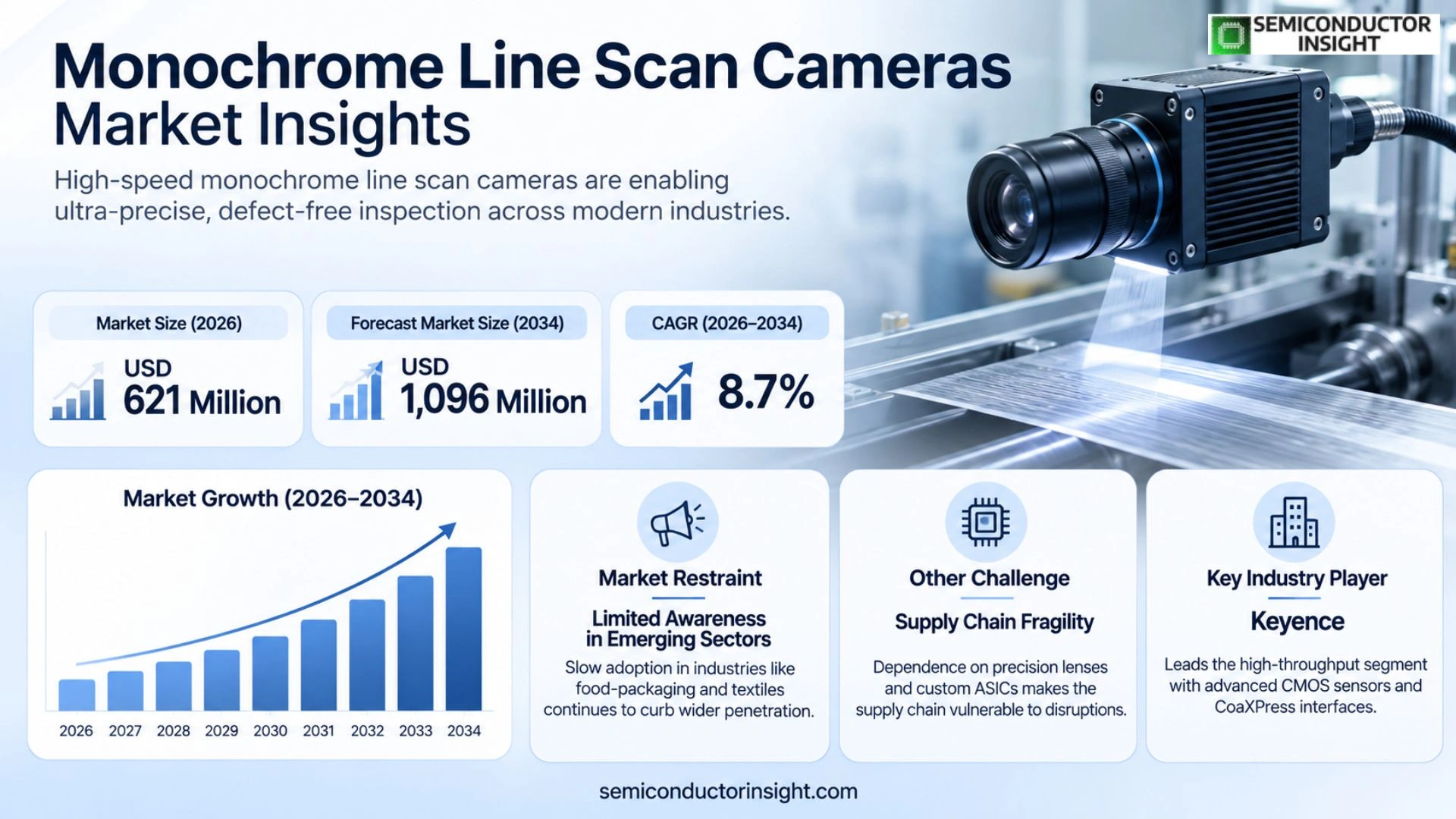
Monochrome Line Scan Cameras market size was valued at USD 621 million in 2025. The market will increase from USD 621 million in 2026 to USD 1,096 million by 2034, reflecting a compound annual growth rate of 8.7 % over the forecast horizon.
A monochrome line‑scan camera captures one‑dimensional image strips while the target moves orthogonal to the sensor array; these strips are stitched into a high‑resolution grayscale image. By omitting colour filters, the sensor maximises photon capture, delivering superior sensitivity, lower noise and finer effective resolution compared with colour counterparts,attributes essential for precision metrology and defect detection.
Growth stems from expanding semiconductor wafer inspection, printed‑circuit‑board quality control and solar‑panel screening where sub‑micron defect identification is critical. In 2024 worldwide production reached roughly 450 K units at an average price of about USD 1,400 per camera. Ongoing advances such as ultra‑high‑resolution (24K–32K pixel) sensors, line rates up to 400 kHz and integration of Time‑Delay‑Integration (TDI) technology further reinforce demand, particularly as Asian manufacturers scale high‑speed inspection lines for batteries and displays.
MARKET DRIVERS
Demand from High‑Speed Inspection Lines
The rise of automated production lines in semiconductor and printed‑circuit‑board (PCB) factories has created a sustained appetite for sensors capable of capturing rapid, high‑resolution imagery. Monochrome Line Scan Cameras excel in this niche because they deliver uninterrupted pixel rows at speeds exceeding 20 kHz, allowing manufacturers to detect sub‑micron defects without halting conveyors.
Growth of Precision Agriculture
Modern agritech platforms rely on line‑scan imaging to map crop health across expansive fields. By converting reflected light into a consistent grayscale dataset, these cameras feed algorithms that differentiate disease‑affected foliage from healthy greenery with greater reliability than conventional area sensors.
➤ “When a line‑scan sensor can operate at 30 kHz while maintaining a signal‑to‑noise ratio above 60 dB, production yield can improve by up to 8 %” – industry observation
Beyond manufacturing and agriculture, the automotive sector’s push toward higher‑resolution driver‑monitoring systems has sparked interest in compact monochrome line‑scan modules that function reliably under fluctuating illumination, reinforcing the overall market momentum.
MARKET CHALLENGES
Engineering Complexity and Integration Costs
Designing a seamless interface between line‑scan optics, high‑speed data converters, and PLC controllers demands specialized engineering talent. Small‑to‑mid‑size OEMs often incur steep integration expenses, which can deter adoption despite clear performance advantages.
Other Challenges
Supply Chain Fragility
The reliance on precision glass lenses and custom ASICs means that disruptions in semiconductor fabs or glass‑fabrication plants ripple directly to Monochrome Line Scan Cameras Market, elongating lead times and inflating unit costs.
MARKET RESTRAINTS
Limited Awareness in Emerging Sectors
Industries such as food‑packaging and textile inspection have historically favored area‑scan cameras due to entrenched supplier relationships. The learning curve associated with line‑scan technology,particularly regarding calibration and data interpretation,still curtails broader penetration.
Furthermore, the cost premium of monochrome sensors compared with color counterparts can be a deterrent for cost‑sensitive projects, especially when budget constraints outweigh the marginal gains in defect detection.
MARKET OPPORTUNITIES
Integration with AI‑Driven Quality Analytics
Coupling high‑speed line‑scan outputs with machine‑learning models unlocks predictive maintenance and real‑time anomaly detection. Companies that package a ready‑to‑deploy AI layer with their camera hardware stand to capture a sizable share of Monochrome Line Scan Cameras Market as manufacturers prioritize actionable insights over raw pixel data.
Another promising avenue lies in the rollout of 5G‑enabled edge devices. By transmitting line‑scan streams to cloud analytics platforms with minimal latency, firms can implement distributed inspection cells that reduce on‑site processing hardware, opening cost‑effective pathways for small‑scale producers.
Monochrome Line Scan Cameras Market Trends
Escalating Demand for Ultra‑High‑Resolution Inspection
Monochrome Line Scan Cameras Market is witnessing a pronounced shift toward sensors that deliver line resolutions well beyond the traditional 5K‑pixel range. Manufacturers in semiconductor fabs and advanced PCB assembly lines are opting for 24K‑ and 32K‑pixel arrays because the incremental pixel density translates directly into finer defect detection thresholds. This migration is not merely a technological fad; it reflects a strategic response to shrinking feature sizes on silicon wafers where a single sub‑micron flaw can compromise entire batches. Consequently, equipment integrators are redesigning illumination modules and data pipelines to accommodate the heightened information load, reinforcing the market’s movement toward end‑to‑end high‑speed vision solutions.
Other Trends
Integration of Time‑Delay‑Integration (TDI) in CMOS Platforms
Another noteworthy development in Monochrome Line Scan Cameras Market is the embedding of TDI technology within CMOS sensors. By effectively stacking multiple exposures as the target moves, TDI lifts the signal‑to‑noise ratio without demanding brighter illumination. This capability is especially valuable on ultra‑fast production lines where exposure time is limited. Suppliers that can certify reliable TDI‑enabled modules are gaining a competitive edge, as end users report measurable reductions in false‑reject rates during high‑throughput inspections.
Shift Toward Fiber‑Based CoaXPress Interfaces
Data‑intensive inspection tasks are forcing a transition from traditional copper Ethernet links to fiber‑optics‑based CoaXPress connections. Monochrome Line Scan Cameras Market is responding to bandwidth bottlenecks by endorsing 12‑Gb/s and 24‑Gb/s fiber standards, which preserve image fidelity at line rates approaching 400 kHz. This shift also mitigates electromagnetic interference in factory environments, aligning with broader Industry 4.0 objectives of stable, deterministic data flow. Early adopters report smoother integration with AI‑driven analytics platforms, positioning them to extract deeper quality insights from each scan.
COMPETITIVE LANDSCAPE
Key Industry Players
Monochrome Line Scan Cameras Market – Competitive Overview
Keyence dominates the high‑throughput segment, leveraging its deep integration capabilities and a portfolio that spans ultra‑high‑resolution CMOS sensors to fiber‑optic CoaXPress interfaces. Its extensive R&D pipeline, combined with a global service network, allows it to set price benchmarks while retaining a sizable share of the ultra‑fast inspection systems deployed in semiconductor fabs. Basler AG follows closely, differentiating itself through modular camera families that cater to both mid‑range production lines and niche research applications. Both firms benefit from economies of scale in sensor sourcing and have cultivated partnerships with lighting manufacturers, which reinforces their position as preferred suppliers for end‑users demanding deterministic line rates above 200 kHz.
Beyond the two market anchors, a constellation of specialized manufacturers sustains the ecosystem. Companies such as Cognex and Teledyne innovate around TDI‑enhanced CMOS chips, targeting low‑light wafer inspection where photon efficiency is paramount. Baumer Holding AG and Hikrobot focus on ruggedized designs for automotive and logistics environments, while Daheng Image and OPT Machine Vision Tech provide cost‑effective alternatives for emerging Asian manufacturers expanding battery‑cell inspection capacity. Smaller yet technically adept players,including Luca (Lucid), Schäfter+Kirchhoff, and Hefei I‑TEK OptoElectronics,contribute niche sensor formats and bespoke interface options that keep the overall market agile and responsive to rapid shifts in production speed requirements.
List of Key Monochrome Line Scan Cameras Companies Profiled
- Keyence Corporation
- Basler AG
- Teledyne DALSA
- Cognex Corporation
- Baumer Holding AG
- Hikrobot
- Daheng Image
- Omron Corporation
- Lucid Vision Labs
- Hefei I‑TEK OptoElectronics
- Schäfter+Kirchhoff
- OPT Machine Vision Tech
- TKH Group
- Dahua Technology
- Jai Imaging Systems
Segment Analysis:
| Segment Category | Sub-Segments | Key Insights |
| By Type |
|
GigE
|
| By Application |
|
Manufacturing
|
| By End User |
|
Semiconductor Wafer Inspection
|
| By Sensor Technology |
|
CMOS
|
| By Resolution |
|
Above 26MP
|
Regional Analysis: Monochrome Line Scan Cameras Market
North America
Manufacturers leverage line‑scan cameras to replace legacy point‑light sensors, gaining finer defect resolution without compromising line speed. This shift underpins tighter quality specifications across automotive and electronics assembly lines.
Universities and research institutes partner with equipment makers to refine sensor sensitivity, driving incremental performance gains that are quickly transferred to production environments.
Proximity of optical component suppliers reduces lead times, allowing OEMs to respond to short‑run orders and niche applications with customized camera modules.
Compliance frameworks for safety‑critical industries encourage adoption of line‑scan technology, ensuring traceability and auditability of inspection data.
Europe
European manufacturers value the precision that monochrome line‑scan cameras bring to sectors such as high‑speed printing and food‑processing inspection. The region’s strong emphasis on sustainability pushes suppliers toward energy‑efficient sensor designs, while fragmented market structures stimulate niche specialization. Collaborative standards bodies foster interoperability, enabling customers to integrate cameras across heterogeneous production lines without extensive re‑engineering.
Asia‑Pacific
In Asia‑Pacific, rapid diversification of high‑mix, low‑volume production drives interest in flexible line‑scan solutions. Emerging industrial hubs in Southeast Asia prioritize cost‑effective imaging platforms that can be quickly adapted to varied product geometries. Concurrently, the rise of smart‑factory pilots in China and India creates a fertile testing ground for advanced monochrome sensors, encouraging local OEMs to refine algorithms for real‑time defect classification.
South America
South American adopters focus on agricultural processing and beverage packaging, where consistent surface inspection is critical for product safety. The market benefits from regional trade agreements that simplify component importation, allowing manufacturers to trial line‑scan systems without prohibitive tariff burdens. Strategic partnerships with North American firms also facilitate technology transfer and skill development.
Middle East & Africa
The Middle East & Africa region sees modest but steady uptake of line‑scan cameras within oil‑field equipment monitoring and mineral processing. Harsh operating environments demand robust housings and high‑temperature tolerance, prompting suppliers to tailor monochrome sensors accordingly. Investment in infrastructure upgrades across several African nations further nurtures demand for reliable visual inspection tools.
Report Scope
This market research report provides a comprehensive analysis of the Monochrome Line Scan Cameras Market , covering the forecast period 2026–2034. It offers detailed insights into market dynamics, technological advancements, competitive landscape, and key trends shaping the industry.
Key focus areas of the report include:
- Market Overview: The report begins with an overview outlining its current market scenario, key growth indicators, and industry transformation drivers. It discusses macroeconomic factors, demand–supply balance, regulatory landscape, and the strategic role of semiconductors in powering advancements across industries such as automotive, telecommunications, consumer electronics, and industrial automation.
- Market Size & Forecast: Historical data and future projections for revenue, unit shipments, and market value across major regions and segments.
- Segmentation Analysis: Detailed breakdown by product type, technology, application, and end-user industry to identify high-growth segments and investment opportunities.
- Regional Insights: Insights into market performance across North America, Europe, Asia-Pacific, Latin America, and the Middle East & Africa, including country-level analysis where relevant.
- Competitive Landscape: Profiles of leading market participants, including their product offerings, R&D focus, manufacturing capacity, pricing strategies, and recent developments such as mergers, acquisitions, and partnerships.
- Technology Trends & Innovation: Assessment of emerging technologies, integration of AI/IoT, semiconductor design trends, fabrication techniques, and evolving industry standards.
- Market Drivers & Restraints: Evaluation of factors driving market growth along with challenges, supply chain constraints, regulatory issues, and market-entry barriers.
- Stakeholder Insights: Insights for component suppliers, OEMs, system integrators, investors, and policymakers regarding the evolving ecosystem and strategic opportunities.
Primary and secondary research methods are employed, including interviews with industry experts, data from verified sources, and real-time market intelligence to ensure the accuracy and reliability of the insights presented.
FREQUENTLY ASKED QUESTIONS:
What is the current market size of Monochrome Line Scan Cameras Market?
-> Monochrome Line Scan Cameras market will increase from USD 621 million in 2026 to USD 1,096 million by 2034, a compound annual growth rate of 8.7%
Which key companies operate in Monochrome Line Scan Cameras Market?
-> Key players include Keyence, Basler AG, Teledyne, TKH Group, Cognex Corporation, Baumer Holding AG, Hikrobot, Dahua Technology, Jai, Daheng Image, Omron, Lucid, Hefei I-TEK OptoElectronics, Schäfter+Kirchhoff, and OPT Machine Vision Tech, among others.
What are the key growth drivers?
-> Key growth drivers include the semiconductor and micro‑electronics fabrication sectors, solar panel inspection, advanced metrology, high‑speed sorting of complex materials, and the need for sub‑micron level defect detection.
Which region dominates the market?
-> Asia dominates the market, with China leading the expansion of advanced manufacturing capacity that fuels demand for high‑precision monochrome line scan systems.
What are the emerging trends?
-> Emerging trends include integration of Time Delay Integration (TDI) technology, ultra‑high resolution sensors (24K–32K pixels) with line rates up to 400 kHz, CoaXPress‑over‑Fiber data transmission, and AI‑driven inspection algorithms.

Get Sample Report PDF for Exclusive Insights
Report Sample Includes
- Table of Contents
- List of Tables & Figures
- Charts, Research Methodology, and more...