LED Flicker Suppression CMOS Image Sensor Market, Trends, Business Strategies 2026-2036

LED Flicker Suppression CMOS Image Sensor market is projected to reach USD 1,314 million by 2032, exhibiting a CAGR of 4.5% during the forecast period.

PDF Icon Download Sample Report PDF
  • Quick Dispatch

    All Orders

  • Secure Payment

    100% Secure Payment

Price range: $1,500.00 through $4,250.00

Clear

LED Flicker Suppression CMOS Image Sensor Market Insights

LED Flicker Suppression CMOS Image Sensor market size was valued at USD 966 million in 2026. The market is projected to reach USD 1,314 million by 2034, exhibiting a CAGR of 4.5% during the forecast period.

An LED Flicker Suppression (LFS) or LED Flicker Mitigation (LFM) CMOS image sensor is a specialized sensor engineered to eliminate image artifacts caused by high‑frequency pulse‑width‑modulation (PWM) flicker of LED light sources. Although invisible to the human eye, this flicker disrupts short‑exposure imaging systems such as automotive ADAS cameras, traffic‑signal recognition units, industrial inspection rigs, and smart‑city monitoring devices, delivering stable, artifact‑free imagery.

The market benefits from rising adoption of advanced driver‑assistance systems, increasing demand for reliable machine‑vision solutions in factories, and expanding smart‑city infrastructure that requires consistent visual data under LED illumination. In 2025, worldwide production reached approximately 441 million units at an average price of USD 2.4 per unit, underscoring both volume growth and price stability.
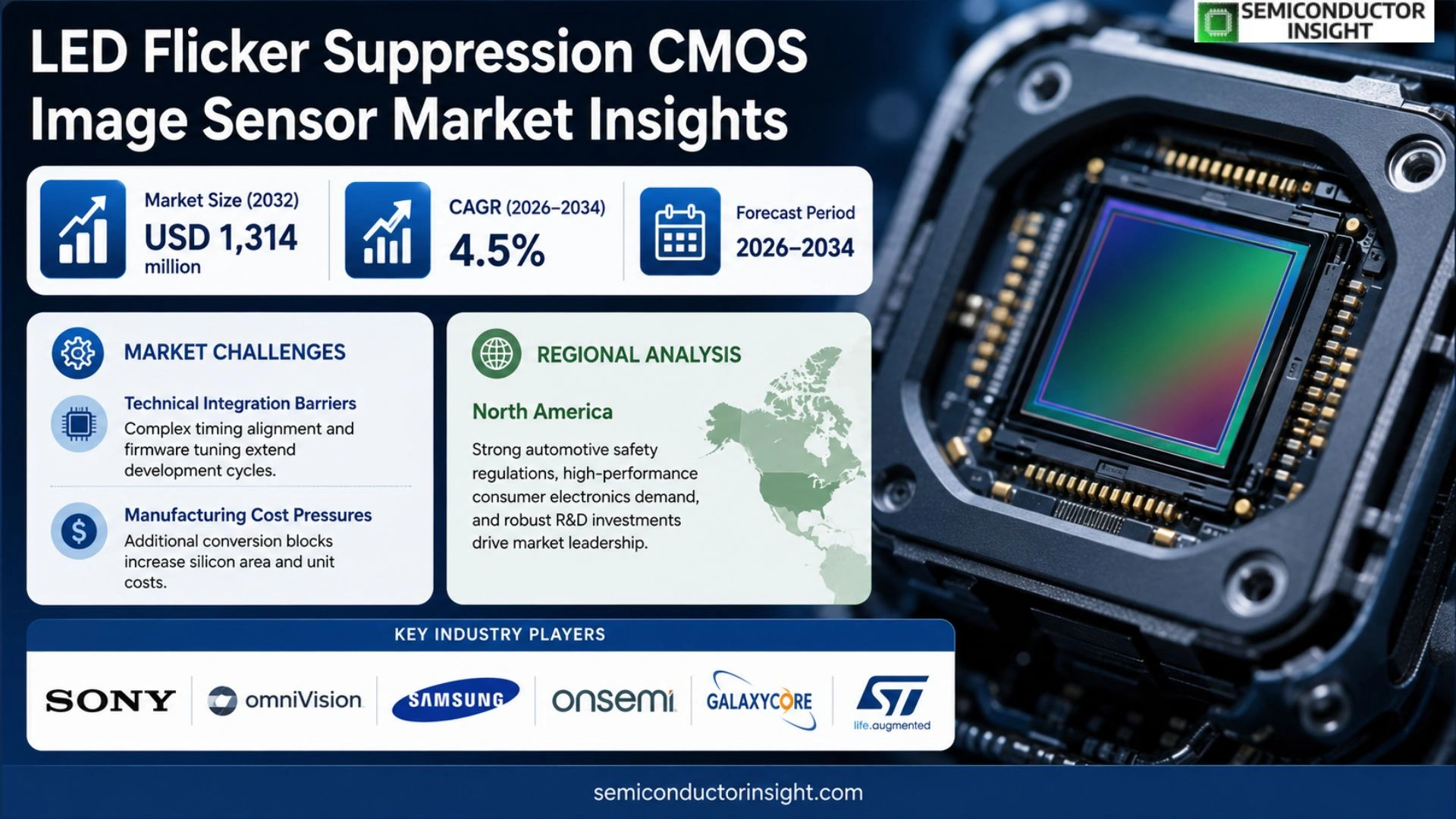
LED Flicker Suppression CMOS Image Sensor Market Prizing

MARKET DRIVERS

Increasing Adoption in Automotive Imaging

Vehicle manufacturers are integrating advanced driver‑assistance systems that rely on pristine image capture under varying lighting conditions. LED flicker suppression technology minimizes artefacts caused by rapid LED modulation, enabling reliable lane‑keeping and pedestrian detection. This functional advantage is prompting OEMs to favor sensors that embed flicker‑mitigation circuits.

Rising Demand in Consumer Electronics

Smartphones and wearables now incorporate high‑frame‑rate cameras for augmented‑reality applications. End‑users expect smooth video playback even when screens employ pulse‑width‑modulated backlights. Sensors that auto‑adjust to suppress flicker are becoming a differentiator, driving procurement volumes across global supply chains.

➤ Manufacturers that embed on‑chip flicker suppression report up to a 15% reduction in post‑production image‑correction costs.

Beyond product performance, the capability to deliver consistent color rendering across diverse illumination sources reduces warranty claims and strengthens brand reputation, a factor that accelerates investment in LED Flicker Suppression CMOS Image Sensor Market.

MARKET CHALLENGES

Technical Integration Barriers

Design teams often grapple with aligning the sensor’s timing architecture to existing image‑processing pipelines. The need to fine‑tune firmware for real‑time flicker detection can extend development cycles, especially for legacy platforms that lack flexible clock management.

Other Challenges

Manufacturing Cost Pressures

The additional analog‑digital conversion blocks required for flicker suppression increase silicon area, raising the unit cost. Small‑volume producers may find the price differential prohibitive, limiting market penetration in niche segments.

Supply‑chain volatility, particularly for high‑purity silicon wafers, compounds pricing uncertainty, prompting some OEMs to postpone large‑scale adoption until cost curves flatten.

MARKET RESTRAINTS

Regulatory Hurdles

Compliance with automotive safety standards such as ISO 26262 mandates rigorous validation of any sensor that influences vehicle control decisions. The certification process can add months to product rollout, discouraging some manufacturers from early integration of new flicker‑suppression modules.

In parallel, electromagnetic interference (EMI) regulations for consumer devices impose strict limits on the switching frequencies of LED drivers, which can conflict with the optimal operating points of on‑chip suppression circuits, creating design trade‑offs.

MARKET OPPORTUNITIES

Emergence of High‑Resolution Surveillance

Urban security networks are upgrading to 4K and higher resolution cameras that operate continuously under street‑light LED illumination. Sensors that natively eliminate flicker enable clear video feeds without costly downstream processing, opening a sizable procurement channel for vendors.

Advances in artificial‑intelligence video analytics demand error‑free frames to maintain detection accuracy. By delivering consistent illumination, flicker‑suppressed sensors directly improve algorithmic performance, making them attractive to AI‑driven surveillance providers.

Geographically, Asia‑Pacific manufacturers are scaling production of LED‑based lighting for smart‑city initiatives. Their rapid rollout creates a localized demand surge for compatible image sensors, presenting a strategic entry point for companies seeking to expand market share.

LED Flicker Suppression CMOS Image Sensor Market Trends

Automotive ADAS Adoption Fuels Sensor Demand

In 2025 the market recorded $966 million in revenue and delivered roughly 441 million units at an average price of $2.4 each. The surge in advanced driver‑assistance systems (ADAS) is the principal catalyst: short‑exposure cameras must cope with PWM‑driven LED lighting on highways and in urban corridors, making flicker‑free imaging indispensable for reliable traffic‑signal recognition and pedestrian detection. As OEMs embed higher‑resolution cameras across vehicle platforms, the need for sensors that can suppress invisible LED flicker translates directly into higher bill‑of‑materials for each vehicle, reinforcing the upward revenue trajectory for LED Flicker Suppression CMOS Image Sensor Market.

Other Trends

Vertical Integration Shapes Value Chain

The industry retains a classic vertical hierarchy: upstream firms supply high‑purity silicon wafers and precision lithography tools; midstream entities handle chip design, wafer fabrication, and packaging; downstream players integrate the sensors into automotive, industrial and security systems. A handful of international manufacturers dominate both IDM and fabless‑plus‑foundry models, creating high entry barriers. Recent collaborations between wafer fabs and packaging specialists signal a shift toward tighter coordination, allowing quicker response to specification changes driven by automotive HDR and global‑shutter requirements. This alignment shortens development cycles and improves cost predictability for end‑users.

Industrial Vision Expands Use Cases

Beyond automotive, factories are retrofitting inspection lines with high‑speed cameras that operate under LED illumination. The ability of LED Flicker Suppression CMOS Image Sensors to deliver artifact‑free frames at microsecond exposures is unlocking new quality‑control applications, from semiconductor wafer inspection to robotic pick‑and‑place verification. As manufacturers pursue higher throughput, they prioritize sensors that combine global‑shutter capability with robust pixel architectures, prompting midstream designers to invest in active‑pixel sensor (APS) innovations. The resulting product diversification not only broadens the addressable market but also pressures suppliers to maintain a steady supply of specialized materials, reinforcing the feedback loop between downstream demand and upstream technology upgrades.

COMPETITIVE LANDSCAPE

Key Industry Players

Competitive Dynamics in LED Flicker Suppression CMOS Image Sensors

The market is tightly anchored by a handful of IDM giants whose control over wafer fabrication, advanced IP libraries, and high‑volume packaging gives them a decisive edge. Sony, leveraging its proprietary Exmor R stack, commands the upper‑mid segment through aggressive integration of global‑shutter architectures that satisfy automotive ADAS specifications. Samsung follows a parallel trajectory, differentiating with its 3‑nanometer BEOL processes that enable sub‑2 µm pixel pitches while maintaining the low‑noise performance required for traffic‑signal recognition. Both firms operate vertically, reducing supply‑chain volatility and translating into stable pricing for Tier‑1 automotive OEMs. Their dominance forces mid‑stream fabless entities to specialize,either by targeting niche industrial vision modules or by offering customized firmware that fine‑tunes PWM‑flicker mitigation for smart‑city camera deployments. The result is a bifurcated competitive structure: a concentrated apex of vertically integrated powerhouses, and a peripheral ring of agile designers that thrive on rapid iteration and close collaboration with downstream system integrators.

Beyond the core quartet, a constellation of specialized players injects diversity into the ecosystem. ON Semiconductor and STMicroelectronics have embraced a hybrid IDM‑fabless model, partnering with leading foundries to deliver automotive‑grade global‑shutter sensors that meet stringent ISO‑26262 safety requirements. GalaxyCore and SmartSens Technology focus on cost‑effective rolling‑shutter solutions for consumer‑grade smart‑city installations, where price sensitivity outweighs ultimate dynamic range. Himax and Canon exploit niche domains such as medical imaging and precision industrial inspection, offering tailored pixel‑structure options (PPS vs. APS) that address unique exposure‑time constraints. Asian manufacturers like Panasonic, Sharp, and Toshiba contribute region‑specific supply chains, capitalising on local automotive clusters and government‑backed R&D subsidies. Collectively, these firms sustain a vibrant secondary tier that fuels innovation, particularly in emerging applications like drone‑borne inspection and edge‑AI vision, thereby widening the market’s opportunity set and compelling the leading IDM players to continuously refine their value propositions.

List of Key LED Flicker Suppression CMOS Image Sensor Companies Profiled

Segment Analysis:

Segment Category Sub-Segments Key Insights
By Type
  • Rolling Shutter
  • Global Shutter
Rolling Shutter dominates early adoption because it aligns well with existing automotive ADAS camera pipelines.

  • Enables seamless integration with high‑speed image capture without complex timing adjustments.
  • Offers cost‑effective implementation for mass‑market vehicles, driving broader deployment.
  • Facilitates rapid iteration of sensor algorithms focused on flicker mitigation.
By Application
  • Automotive
  • Industrial & Machine Vision
  • Others
  • Smart City Monitoring
Automotive is the leading application due to safety‑critical imaging requirements.

  • High‑dynamic‑range ADAS cameras demand reliable flicker suppression for accurate traffic‑signal recognition.
  • Regulatory pressure for robust driver‑assistance systems accelerates sensor adoption.
  • Integration with vehicle‑wide electronic architectures supports scalable deployment.
By End User
  • Automotive OEMs
  • Industrial System Integrators
  • Security & Surveillance Providers
Automotive OEMs drive the market narrative through stringent performance criteria.

  • Require consistent image quality across varying LED lighting conditions encountered on roadways.
  • Seek sensors that minimize post‑processing overhead, enhancing real‑time decision making.
  • Favor suppliers with strong IP portfolios that guarantee long‑term product stability.
By Pixel Structure
  • Passive Pixel Sensor (PPS)
  • Active Pixel Sensor (APS)
Active Pixel Sensor (APS) is preferred for high‑performance flicker mitigation.

  • Provides on‑chip amplification that improves signal‑to‑noise ratio under PWM‑driven LED illumination.
  • Enables finer control of exposure parameters, essential for short‑exposure automotive cameras.
  • Supports integration of advanced algorithms directly within the sensor die.
By Pixel Size
  • Small Pixel
  • Medium Pixel
  • Large Pixel
Medium Pixel strikes a balance between resolution and light‑collection efficiency for flicker‑free imaging.

  • Captures sufficient photons to counteract LED flicker while maintaining manageable data volumes.
  • Fits well within existing automotive module footprints, easing mechanical integration.
  • Offers flexibility for both automotive and industrial vision systems, encouraging cross‑segment adoption.

Regional Analysis: LED Flicker Suppression CMOS Image Sensor Market

North America

North America continues to shape the trajectory of LED Flicker Suppression CMOS Image Sensor Market. A confluence of high‑performance consumer electronics, aggressive automotive safety mandates, and deep R&D investment sustains its edge. Silicon Valley firms have leveraged advanced back‑side illumination techniques to mitigate flicker artifacts, creating a cascade of design wins in smartphones and driver‑monitoring systems. Meanwhile, the United States’ regulatory bodies have tightened illumination standards for medical imaging devices, compelling manufacturers to integrate more sophisticated suppression algorithms. This policy pressure, paired with the region’s extensive semiconductor ecosystem, accelerates the rollout of next‑gen sensors that combine low‑noise readout with precise temporal filtering. Canadian research institutions contribute by exploring novel pixel architectures that embed adaptive flicker detection, a move that promises to lower bill‑of‑materials for OEMs. The overall effect is a market environment where innovation cycles compress, encouraging original equipment manufacturers to favor suppliers that can deliver turnkey solutions rather than fragmented components. Investors watch the North American corridor closely because the speed of product commercialization frequently sets the benchmark for pricing and feature expectations worldwide. Supply‑chain resilience also tips the balance toward North America. Domestic wafer fabs, supported by recent federal incentives, have shortened lead times for high‑resolution sensor wafers, enabling OEMs to respond swiftly to quarterly product refresh cycles. Moreover, strategic alliances between sensor designers and camera module assemblers have yielded integrated platforms that embed flicker suppression at the silicon level, reducing downstream firmware complexity. This collaborative model not only trims development costs but also enhances product reliability, a factor that automotive tier‑one suppliers weigh heavily given the safety‑critical nature of driver monitoring. As a result, North American firms are increasingly positioned as preferred partners for multinational device manufacturers seeking to differentiate their offerings through superior image quality under variable lighting conditions. The cumulative effect of these dynamics cements North America’s role as the benchmark for both performance standards and supply‑chain agility in LED Flicker Suppression CMOS Image Sensor Market.

Technology Adoption
OEMs in the region prioritize sensors that integrate real‑time flicker detection within the pixel array, reducing reliance on post‑capture processing. This approach shortens design cycles and improves power efficiency, a key consideration for battery‑operated devices such as smartphones and wearables.
Key End‑User Segments
Automotive driver‑monitoring and advanced driver‑assistance systems dominate demand, while medical imaging and industrial vision tools follow closely. Each segment values the sensor’s ability to deliver consistent luminance under fluctuating LED sources, which directly impacts safety and diagnostic accuracy.
Regulatory Landscape
Recent updates to illumination standards for medical devices and vehicle interior lighting have intensified scrutiny on flicker artifacts. Companies that pre‑emptively align product roadmaps with these expectations gain a competitive advantage in contract negotiations.
Supply‑Chain Advantages
Proximity to leading wafer fabs and packaging facilities shortens lead times, while collaborative R&D consortia foster shared intellectual property that accelerates time‑to‑market for next‑generation sensor modules.

Europe
European manufacturers leverage a strong heritage in optical engineering to embed flicker suppression directly into lens‑sensor assemblies. The region’s emphasis on energy‑efficiency standards drives adoption of sensors that minimize LED‑induced modulation without sacrificing image fidelity. Collaborative projects funded by the EU focus on harmonizing sensor specifications across automotive and consumer sectors, thereby reducing fragmentation. As regulatory bodies tighten illumination guidelines for public transport interiors, European suppliers that can certify compliance early are poised to capture a larger share of the market.

Asia-Pacific
Asia‑Pacific’s rapid expansion of smartphone production creates robust demand for sensors that can maintain image quality under diverse lighting conditions. Local chipmakers are investing in heterogeneous integration techniques, stacking flicker‑suppression circuits beneath the photodiode layer to conserve board space. Meanwhile, emerging automotive hubs in China and India are incorporating driver‑monitoring systems that rely on these sensors to meet new safety mandates. The combination of cost‑competitiveness and growing technical expertise positions the region as a formidable challenger to established markets.

South America
In South America, growth is anchored by increasing penetration of LED‑based public‑area lighting and the subsequent need for surveillance solutions that can handle flicker. Regional system integrators are partnering with sensor vendors to develop turnkey cameras for smart‑city initiatives, prioritizing models that embed real‑time flicker correction. Although the market remains smaller than in other continents, localized production of sensor modules is gaining momentum as governments incentivize domestic electronics manufacturing.

Middle East & Africa
Middle East & Africa witness demand driven by the rollout of high‑end hospitality and aviation interiors where LED lighting is pervasive. Operators require imaging systems that deliver stable visual monitoring for security and passenger comfort. Partnerships with North American technology firms are facilitating knowledge transfer, enabling regional players to adopt advanced flicker‑suppression algorithms. As infrastructure projects mature, the region is expected to transition from import‑centric to more collaborative development models.

Report Scope

This market research report provides a comprehensive analysis of the LED Flicker Suppression CMOS Image Sensor Market , covering the forecast period 2026–2034. It offers detailed insights into market dynamics, technological advancements, competitive landscape, and key trends shaping the industry.

Key focus areas of the report include:

  • Market Overview: The report begins with an overview outlining its current market scenario, key growth indicators, and industry transformation drivers. It discusses macroeconomic factors, demand–supply balance, regulatory landscape, and the strategic role of semiconductors in powering advancements across industries such as automotive, telecommunications, consumer electronics, and industrial automation.

  • Market Size & Forecast: Historical data and future projections for revenue, unit shipments, and market value across major regions and segments.
  • Segmentation Analysis: Detailed breakdown by product type, technology, application, and end-user industry to identify high-growth segments and investment opportunities.
  • Regional Insights: Insights into market performance across North America, Europe, Asia-Pacific, Latin America, and the Middle East & Africa, including country-level analysis where relevant.
  • Competitive Landscape: Profiles of leading market participants, including their product offerings, R&D focus, manufacturing capacity, pricing strategies, and recent developments such as mergers, acquisitions, and partnerships.
  • Technology Trends & Innovation: Assessment of emerging technologies, integration of AI/IoT, semiconductor design trends, fabrication techniques, and evolving industry standards.
  • Market Drivers & Restraints: Evaluation of factors driving market growth along with challenges, supply chain constraints, regulatory issues, and market-entry barriers.
  • Stakeholder Insights: Insights for component suppliers, OEMs, system integrators, investors, and policymakers regarding the evolving ecosystem and strategic opportunities.

Primary and secondary research methods are employed, including interviews with industry experts, data from verified sources, and real-time market intelligence to ensure the accuracy and reliability of the insights presented.

FREQUENTLY ASKED QUESTIONS:

What is the current market size of LED Flicker Suppression CMOS Image Sensor Market?

-> LED Flicker Suppression CMOS Image Sensor market is projected to reach USD 1,314 million by 2032, exhibiting a CAGR of 4.5% during the forecast period.

Which key companies operate in LED Flicker Suppression CMOS Image Sensor Market?

-> Key players include Sony, Samsung, OmniVision, STMicroelectronics, ON Semiconductor, GalaxyCore, Smartsens Technology.

What are the key growth drivers?

-> Key growth drivers include rising demand for automotive ADAS cameras, industrial machine vision, smart‑city surveillance, and the need for artifact‑free imaging caused by LED PWM flicker.

Which region dominates the market?

-> Asia holds the largest market share, driven by strong automotive and industrial sensor adoption, while North America and Europe also represent significant markets.

What are the emerging trends?

-> Emerging trends include integration of AI/ML for advanced image processing, development of hybrid rolling‑shutter/global‑shutter sensors, and expansion into IoT‑enabled smart‑city applications.

LED Flicker Suppression CMOS Image Sensor Market, Trends, Business Strategies 2026-2036

Get Sample Report PDF for Exclusive Insights

Report Sample Includes

  • Table of Contents
  • List of Tables & Figures
  • Charts, Research Methodology, and more...
PDF Icon Download Sample Report PDF
SKU: 5cc044b989bf
Category:
License Type

Corporate License, Excel License, PDF and Excel Databook License

Download Sample Report

Table of Content

1 Introduction to Research & Analysis Reports
1.1 LED Flicker Suppression CMOS Image Sensor Market Definition
1.2 Market Segments
1.2.1 Segment by Type
1.2.2 Segment by Pixel Structure
1.2.3 Segment by Pixel Size
1.2.4 Segment by Application
1.3 Global LED Flicker Suppression CMOS Image Sensor Market Overview
1.4 Features & Benefits of This Report
1.5 Methodology & Sources of Information
1.5.1 Research Methodology
1.5.2 Research Process
1.5.3 Base Year
1.5.4 Report Assumptions & Caveats
2 Global LED Flicker Suppression CMOS Image Sensor Overall Market Size
2.1 Global LED Flicker Suppression CMOS Image Sensor Market Size: 2025 VS 2032
2.2 Global LED Flicker Suppression CMOS Image Sensor Market Size, Prospects & Forecasts: 2021-2032
2.3 Global LED Flicker Suppression CMOS Image Sensor Sales: 2021-2032
3 Company Landscape
3.1 Top LED Flicker Suppression CMOS Image Sensor Players in Global Market
3.2 Top Global LED Flicker Suppression CMOS Image Sensor Companies Ranked by Revenue
3.3 Global LED Flicker Suppression CMOS Image Sensor Revenue by Companies
3.4 Global LED Flicker Suppression CMOS Image Sensor Sales by Companies
3.5 Global LED Flicker Suppression CMOS Image Sensor Price by Manufacturer (2021-2026)
3.6 Top 3 and Top 5 LED Flicker Suppression CMOS Image Sensor Companies in Global Market, by Revenue in 2025
3.7 Global Manufacturers LED Flicker Suppression CMOS Image Sensor Product Type
3.8 Tier 1, Tier 2, and Tier 3 LED Flicker Suppression CMOS Image Sensor Players in Global Market
3.8.1 List of Global Tier 1 LED Flicker Suppression CMOS Image Sensor Companies
3.8.2 List of Global Tier 2 and Tier 3 LED Flicker Suppression CMOS Image Sensor Companies
4 Sights by Type
4.1 Overview
4.1.1 Segment by Type – Global LED Flicker Suppression CMOS Image Sensor Market Size Markets, 2025 & 2032
4.1.2 Exposure Method: Rolling Shutter
4.1.3 Exposure Method: Global Shutter
4.2 Segment by Type – Global LED Flicker Suppression CMOS Image Sensor Revenue & Forecasts
4.2.1 Segment by Type – Global LED Flicker Suppression CMOS Image Sensor Revenue, 2021-2026
4.2.2 Segment by Type – Global LED Flicker Suppression CMOS Image Sensor Revenue, 2027-2032
4.2.3 Segment by Type – Global LED Flicker Suppression CMOS Image Sensor Revenue Market Share, 2021-2032
4.3 Segment by Type – Global LED Flicker Suppression CMOS Image Sensor Sales & Forecasts
4.3.1 Segment by Type – Global LED Flicker Suppression CMOS Image Sensor Sales, 2021-2026
4.3.2 Segment by Type – Global LED Flicker Suppression CMOS Image Sensor Sales, 2027-2032
4.3.3 Segment by Type – Global LED Flicker Suppression CMOS Image Sensor Sales Market Share, 2021-2032
4.4 Segment by Type – Global LED Flicker Suppression CMOS Image Sensor Price (Manufacturers Selling Prices), 2021-2032
5 Sights by Pixel Structure
5.1 Overview
5.1.1 Segment by Pixel Structure – Global LED Flicker Suppression CMOS Image Sensor Market Size Markets, 2025 & 2032
5.1.2 Passive Pixel Sensor (PPS)
5.1.3 Active Pixel Sensor (APS)
5.2 Segment by Pixel Structure – Global LED Flicker Suppression CMOS Image Sensor Revenue & Forecasts
5.2.1 Segment by Pixel Structure – Global LED Flicker Suppression CMOS Image Sensor Revenue, 2021-2026
5.2.2 Segment by Pixel Structure – Global LED Flicker Suppression CMOS Image Sensor Revenue, 2027-2032
5.2.3 Segment by Pixel Structure – Global LED Flicker Suppression CMOS Image Sensor Revenue Market Share, 2021-2032
5.3 Segment by Pixel Structure – Global LED Flicker Suppression CMOS Image Sensor Sales & Forecasts
5.3.1 Segment by Pixel Structure – Global LED Flicker Suppression CMOS Image Sensor Sales, 2021-2026
5.3.2 Segment by Pixel Structure – Global LED Flicker Suppression CMOS Image Sensor Sales, 2027-2032
5.3.3 Segment by Pixel Structure – Global LED Flicker Suppression CMOS Image Sensor Sales Market Share, 2021-2032
5.4 Segment by Pixel Structure – Global LED Flicker Suppression CMOS Image Sensor Price (Manufacturers Selling Prices), 2021-2032
6 Sights by Pixel Size
6.1 Overview
6.1.1 Segment by Pixel Size – Global LED Flicker Suppression CMOS Image Sensor Market Size Markets, 2025 & 2032
6.1.2 Small Pixel
6.1.3 Medium Pixel
6.1.4 Large Pixel
6.2 Segment by Pixel Size – Global LED Flicker Suppression CMOS Image Sensor Revenue & Forecasts
6.2.1 Segment by Pixel Size – Global LED Flicker Suppression CMOS Image Sensor Revenue, 2021-2026
6.2.2 Segment by Pixel Size – Global LED Flicker Suppression CMOS Image Sensor Revenue, 2027-2032
6.2.3 Segment by Pixel Size – Global LED Flicker Suppression CMOS Image Sensor Revenue Market Share, 2021-2032
6.3 Segment by Pixel Size – Global LED Flicker Suppression CMOS Image Sensor Sales & Forecasts
6.3.1 Segment by Pixel Size – Global LED Flicker Suppression CMOS Image Sensor Sales, 2021-2026
6.3.2 Segment by Pixel Size – Global LED Flicker Suppression CMOS Image Sensor Sales, 2027-2032
6.3.3 Segment by Pixel Size – Global LED Flicker Suppression CMOS Image Sensor Sales Market Share, 2021-2032
6.4 Segment by Pixel Size – Global LED Flicker Suppression CMOS Image Sensor Price (Manufacturers Selling Prices), 2021-2032
7 Sights by Application
7.1 Overview
7.1.1 Segment by Application – Global LED Flicker Suppression CMOS Image Sensor Market Size, 2025 & 2032
7.1.2 Automotive
7.1.3 Industrial & Machine Vision
7.1.4 Others
7.2 Segment by Application – Global LED Flicker Suppression CMOS Image Sensor Revenue & Forecasts
7.2.1 Segment by Application – Global LED Flicker Suppression CMOS Image Sensor Revenue, 2021-2026
7.2.2 Segment by Application – Global LED Flicker Suppression CMOS Image Sensor Revenue, 2027-2032
7.2.3 Segment by Application – Global LED Flicker Suppression CMOS Image Sensor Revenue Market Share, 2021-2032
7.3 Segment by Application – Global LED Flicker Suppression CMOS Image Sensor Sales & Forecasts
7.3.1 Segment by Application – Global LED Flicker Suppression CMOS Image Sensor Sales, 2021-2026
7.3.2 Segment by Application – Global LED Flicker Suppression CMOS Image Sensor Sales, 2027-2032
7.3.3 Segment by Application – Global LED Flicker Suppression CMOS Image Sensor Sales Market Share, 2021-2032
7.4 Segment by Application – Global LED Flicker Suppression CMOS Image Sensor Price (Manufacturers Selling Prices), 2021-2032
8 Sights Region
8.1 By Region – Global LED Flicker Suppression CMOS Image Sensor Market Size, 2025 & 2032
8.2 By Region – Global LED Flicker Suppression CMOS Image Sensor Revenue & Forecasts
8.2.1 By Region – Global LED Flicker Suppression CMOS Image Sensor Revenue, 2021-2026
8.2.2 By Region – Global LED Flicker Suppression CMOS Image Sensor Revenue, 2027-2032
8.2.3 By Region – Global LED Flicker Suppression CMOS Image Sensor Revenue Market Share, 2021-2032
8.3 By Region – Global LED Flicker Suppression CMOS Image Sensor Sales & Forecasts
8.3.1 By Region – Global LED Flicker Suppression CMOS Image Sensor Sales, 2021-2026
8.3.2 By Region – Global LED Flicker Suppression CMOS Image Sensor Sales, 2027-2032
8.3.3 By Region – Global LED Flicker Suppression CMOS Image Sensor Sales Market Share, 2021-2032
8.4 North America
8.4.1 By Country – North America LED Flicker Suppression CMOS Image Sensor Revenue, 2021-2032
8.4.2 By Country – North America LED Flicker Suppression CMOS Image Sensor Sales, 2021-2032
8.4.3 United States LED Flicker Suppression CMOS Image Sensor Market Size, 2021-2032
8.4.4 Canada LED Flicker Suppression CMOS Image Sensor Market Size, 2021-2032
8.4.5 Mexico LED Flicker Suppression CMOS Image Sensor Market Size, 2021-2032
8.5 Europe
8.5.1 By Country – Europe LED Flicker Suppression CMOS Image Sensor Revenue, 2021-2032
8.5.2 By Country – Europe LED Flicker Suppression CMOS Image Sensor Sales, 2021-2032
8.5.3 Germany LED Flicker Suppression CMOS Image Sensor Market Size, 2021-2032
8.5.4 France LED Flicker Suppression CMOS Image Sensor Market Size, 2021-2032
8.5.5 U.K. LED Flicker Suppression CMOS Image Sensor Market Size, 2021-2032
8.5.6 Italy LED Flicker Suppression CMOS Image Sensor Market Size, 2021-2032
8.5.7 Russia LED Flicker Suppression CMOS Image Sensor Market Size, 2021-2032
8.5.8 Nordic Countries LED Flicker Suppression CMOS Image Sensor Market Size, 2021-2032
8.5.9 Benelux LED Flicker Suppression CMOS Image Sensor Market Size, 2021-2032
8.6 Asia
8.6.1 By Region – Asia LED Flicker Suppression CMOS Image Sensor Revenue, 2021-2032
8.6.2 By Region – Asia LED Flicker Suppression CMOS Image Sensor Sales, 2021-2032
8.6.3 China LED Flicker Suppression CMOS Image Sensor Market Size, 2021-2032
8.6.4 Japan LED Flicker Suppression CMOS Image Sensor Market Size, 2021-2032
8.6.5 South Korea LED Flicker Suppression CMOS Image Sensor Market Size, 2021-2032
8.6.6 Southeast Asia LED Flicker Suppression CMOS Image Sensor Market Size, 2021-2032
8.6.7 India LED Flicker Suppression CMOS Image Sensor Market Size, 2021-2032
8.7 South America
8.7.1 By Country – South America LED Flicker Suppression CMOS Image Sensor Revenue, 2021-2032
8.7.2 By Country – South America LED Flicker Suppression CMOS Image Sensor Sales, 2021-2032
8.7.3 Brazil LED Flicker Suppression CMOS Image Sensor Market Size, 2021-2032
8.7.4 Argentina LED Flicker Suppression CMOS Image Sensor Market Size, 2021-2032
8.8 Middle East & Africa
8.8.1 By Country – Middle East & Africa LED Flicker Suppression CMOS Image Sensor Revenue, 2021-2032
8.8.2 By Country – Middle East & Africa LED Flicker Suppression CMOS Image Sensor Sales, 2021-2032
8.8.3 Turkey LED Flicker Suppression CMOS Image Sensor Market Size, 2021-2032
8.8.4 Israel LED Flicker Suppression CMOS Image Sensor Market Size, 2021-2032
8.8.5 Saudi Arabia LED Flicker Suppression CMOS Image Sensor Market Size, 2021-2032
8.8.6 UAE LED Flicker Suppression CMOS Image Sensor Market Size, 2021-2032
9 Manufacturers & Brands Profiles
9.1 SONY
9.1.1 SONY Company Summary
9.1.2 SONY Business Overview
9.1.3 SONY LED Flicker Suppression CMOS Image Sensor Major Product Offerings
9.1.4 SONY LED Flicker Suppression CMOS Image Sensor Sales and Revenue in Global (2021-2026)
9.1.5 SONY Key News & Latest Developments
9.2 Samsung
9.2.1 Samsung Company Summary
9.2.2 Samsung Business Overview
9.2.3 Samsung LED Flicker Suppression CMOS Image Sensor Major Product Offerings
9.2.4 Samsung LED Flicker Suppression CMOS Image Sensor Sales and Revenue in Global (2021-2026)
9.2.5 Samsung Key News & Latest Developments
9.3 OmniVision
9.3.1 OmniVision Company Summary
9.3.2 OmniVision Business Overview
9.3.3 OmniVision LED Flicker Suppression CMOS Image Sensor Major Product Offerings
9.3.4 OmniVision LED Flicker Suppression CMOS Image Sensor Sales and Revenue in Global (2021-2026)
9.3.5 OmniVision Key News & Latest Developments
9.4 STMicroelectronics
9.4.1 STMicroelectronics Company Summary
9.4.2 STMicroelectronics Business Overview
9.4.3 STMicroelectronics LED Flicker Suppression CMOS Image Sensor Major Product Offerings
9.4.4 STMicroelectronics LED Flicker Suppression CMOS Image Sensor Sales and Revenue in Global (2021-2026)
9.4.5 STMicroelectronics Key News & Latest Developments
9.5 On Semi
9.5.1 On Semi Company Summary
9.5.2 On Semi Business Overview
9.5.3 On Semi LED Flicker Suppression CMOS Image Sensor Major Product Offerings
9.5.4 On Semi LED Flicker Suppression CMOS Image Sensor Sales and Revenue in Global (2021-2026)
9.5.5 On Semi Key News & Latest Developments
9.6 GalaxyCore
9.6.1 GalaxyCore Company Summary
9.6.2 GalaxyCore Business Overview
9.6.3 GalaxyCore LED Flicker Suppression CMOS Image Sensor Major Product Offerings
9.6.4 GalaxyCore LED Flicker Suppression CMOS Image Sensor Sales and Revenue in Global (2021-2026)
9.6.5 GalaxyCore Key News & Latest Developments
9.7 Smartsens Technology
9.7.1 Smartsens Technology Company Summary
9.7.2 Smartsens Technology Business Overview
9.7.3 Smartsens Technology LED Flicker Suppression CMOS Image Sensor Major Product Offerings
9.7.4 Smartsens Technology LED Flicker Suppression CMOS Image Sensor Sales and Revenue in Global (2021-2026)
9.7.5 Smartsens Technology Key News & Latest Developments
10 Global LED Flicker Suppression CMOS Image Sensor Production Capacity, Analysis
10.1 Global LED Flicker Suppression CMOS Image Sensor Production Capacity, 2021-2032
10.2 LED Flicker Suppression CMOS Image Sensor Production Capacity of Key Manufacturers in Global Market
10.3 Global LED Flicker Suppression CMOS Image Sensor Production by Region
11 Key Market Trends, Opportunity, Drivers and Restraints
11.1 Market Opportunities & Trends
11.2 Market Drivers
11.3 Market Restraints
12 LED Flicker Suppression CMOS Image Sensor Supply Chain Analysis
12.1 LED Flicker Suppression CMOS Image Sensor Industry Value Chain
12.2 LED Flicker Suppression CMOS Image Sensor Upstream Market
12.3 LED Flicker Suppression CMOS Image Sensor Downstream and Clients
12.4 Marketing Channels Analysis
12.4.1 Marketing Channels
12.4.2 LED Flicker Suppression CMOS Image Sensor Distributors and Sales Agents in Global
13 Conclusion
14 Appendix
14.1 Note
14.2 Examples of Clients
14.3 DisclaimerList of Tables
Table 1. Key Players of LED Flicker Suppression CMOS Image Sensor in Global Market
Table 2. Top LED Flicker Suppression CMOS Image Sensor Players in Global Market, Ranking by Revenue (2025)
Table 3. Global LED Flicker Suppression CMOS Image Sensor Revenue by Companies, (US$, Mn), 2021-2026
Table 4. Global LED Flicker Suppression CMOS Image Sensor Revenue Share by Companies, 2021-2026
Table 5. Global LED Flicker Suppression CMOS Image Sensor Sales by Companies, (Million Units), 2021-2026
Table 6. Global LED Flicker Suppression CMOS Image Sensor Sales Share by Companies, 2021-2026
Table 7. Key Manufacturers LED Flicker Suppression CMOS Image Sensor Price (2021-2026) & (US$/Unit)
Table 8. Global Manufacturers LED Flicker Suppression CMOS Image Sensor Product Type
Table 9. List of Global Tier 1 LED Flicker Suppression CMOS Image Sensor Companies, Revenue (US$, Mn) in 2025 and Market Share
Table 10. List of Global Tier 2 and Tier 3 LED Flicker Suppression CMOS Image Sensor Companies, Revenue (US$, Mn) in 2025 and Market Share
Table 11. Segment by Type – Global LED Flicker Suppression CMOS Image Sensor Revenue, (US$, Mn), 2025 & 2032
Table 12. Segment by Type – Global LED Flicker Suppression CMOS Image Sensor Revenue (US$, Mn), 2021-2026
Table 13. Segment by Type – Global LED Flicker Suppression CMOS Image Sensor Revenue (US$, Mn), 2027-2032
Table 14. Segment by Type – Global LED Flicker Suppression CMOS Image Sensor Sales (Million Units), 2021-2026
Table 15. Segment by Type – Global LED Flicker Suppression CMOS Image Sensor Sales (Million Units), 2027-2032
Table 16. Segment by Pixel Structure – Global LED Flicker Suppression CMOS Image Sensor Revenue, (US$, Mn), 2025 & 2032
Table 17. Segment by Pixel Structure – Global LED Flicker Suppression CMOS Image Sensor Revenue (US$, Mn), 2021-2026
Table 18. Segment by Pixel Structure – Global LED Flicker Suppression CMOS Image Sensor Revenue (US$, Mn), 2027-2032
Table 19. Segment by Pixel Structure – Global LED Flicker Suppression CMOS Image Sensor Sales (Million Units), 2021-2026
Table 20. Segment by Pixel Structure – Global LED Flicker Suppression CMOS Image Sensor Sales (Million Units), 2027-2032
Table 21. Segment by Pixel Size – Global LED Flicker Suppression CMOS Image Sensor Revenue, (US$, Mn), 2025 & 2032
Table 22. Segment by Pixel Size – Global LED Flicker Suppression CMOS Image Sensor Revenue (US$, Mn), 2021-2026
Table 23. Segment by Pixel Size – Global LED Flicker Suppression CMOS Image Sensor Revenue (US$, Mn), 2027-2032
Table 24. Segment by Pixel Size – Global LED Flicker Suppression CMOS Image Sensor Sales (Million Units), 2021-2026
Table 25. Segment by Pixel Size – Global LED Flicker Suppression CMOS Image Sensor Sales (Million Units), 2027-2032
Table 26. Segment by Application – Global LED Flicker Suppression CMOS Image Sensor Revenue, (US$, Mn), 2025 & 2032
Table 27. Segment by Application – Global LED Flicker Suppression CMOS Image Sensor Revenue, (US$, Mn), 2021-2026
Table 28. Segment by Application – Global LED Flicker Suppression CMOS Image Sensor Revenue, (US$, Mn), 2027-2032
Table 29. Segment by Application – Global LED Flicker Suppression CMOS Image Sensor Sales, (Million Units), 2021-2026
Table 30. Segment by Application – Global LED Flicker Suppression CMOS Image Sensor Sales, (Million Units), 2027-2032
Table 31. By Region – Global LED Flicker Suppression CMOS Image Sensor Revenue, (US$, Mn), 2025 & 2032
Table 32. By Region – Global LED Flicker Suppression CMOS Image Sensor Revenue, (US$, Mn), 2021-2026
Table 33. By Region – Global LED Flicker Suppression CMOS Image Sensor Revenue, (US$, Mn), 2027-2032
Table 34. By Region – Global LED Flicker Suppression CMOS Image Sensor Sales, (Million Units), 2021-2026
Table 35. By Region – Global LED Flicker Suppression CMOS Image Sensor Sales, (Million Units), 2027-2032
Table 36. By Country – North America LED Flicker Suppression CMOS Image Sensor Revenue, (US$, Mn), 2021-2026
Table 37. By Country – North America LED Flicker Suppression CMOS Image Sensor Revenue, (US$, Mn), 2027-2032
Table 38. By Country – North America LED Flicker Suppression CMOS Image Sensor Sales, (Million Units), 2021-2026
Table 39. By Country – North America LED Flicker Suppression CMOS Image Sensor Sales, (Million Units), 2027-2032
Table 40. By Country – Europe LED Flicker Suppression CMOS Image Sensor Revenue, (US$, Mn), 2021-2026
Table 41. By Country – Europe LED Flicker Suppression CMOS Image Sensor Revenue, (US$, Mn), 2027-2032
Table 42. By Country – Europe LED Flicker Suppression CMOS Image Sensor Sales, (Million Units), 2021-2026
Table 43. By Country – Europe LED Flicker Suppression CMOS Image Sensor Sales, (Million Units), 2027-2032
Table 44. By Region – Asia LED Flicker Suppression CMOS Image Sensor Revenue, (US$, Mn), 2021-2026
Table 45. By Region – Asia LED Flicker Suppression CMOS Image Sensor Revenue, (US$, Mn), 2027-2032
Table 46. By Region – Asia LED Flicker Suppression CMOS Image Sensor Sales, (Million Units), 2021-2026
Table 47. By Region – Asia LED Flicker Suppression CMOS Image Sensor Sales, (Million Units), 2027-2032
Table 48. By Country – South America LED Flicker Suppression CMOS Image Sensor Revenue, (US$, Mn), 2021-2026
Table 49. By Country – South America LED Flicker Suppression CMOS Image Sensor Revenue, (US$, Mn), 2027-2032
Table 50. By Country – South America LED Flicker Suppression CMOS Image Sensor Sales, (Million Units), 2021-2026
Table 51. By Country – South America LED Flicker Suppression CMOS Image Sensor Sales, (Million Units), 2027-2032
Table 52. By Country – Middle East & Africa LED Flicker Suppression CMOS Image Sensor Revenue, (US$, Mn), 2021-2026
Table 53. By Country – Middle East & Africa LED Flicker Suppression CMOS Image Sensor Revenue, (US$, Mn), 2027-2032
Table 54. By Country – Middle East & Africa LED Flicker Suppression CMOS Image Sensor Sales, (Million Units), 2021-2026
Table 55. By Country – Middle East & Africa LED Flicker Suppression CMOS Image Sensor Sales, (Million Units), 2027-2032
Table 56. SONY Company Summary
Table 57. SONY LED Flicker Suppression CMOS Image Sensor Product Offerings
Table 58. SONY LED Flicker Suppression CMOS Image Sensor Sales (Million Units), Revenue (US$, Mn) and Average Price (US$/Unit) & (2021-2026)
Table 59. SONY Key News & Latest Developments
Table 60. Samsung Company Summary
Table 61. Samsung LED Flicker Suppression CMOS Image Sensor Product Offerings
Table 62. Samsung LED Flicker Suppression CMOS Image Sensor Sales (Million Units), Revenue (US$, Mn) and Average Price (US$/Unit) & (2021-2026)
Table 63. Samsung Key News & Latest Developments
Table 64. OmniVision Company Summary
Table 65. OmniVision LED Flicker Suppression CMOS Image Sensor Product Offerings
Table 66. OmniVision LED Flicker Suppression CMOS Image Sensor Sales (Million Units), Revenue (US$, Mn) and Average Price (US$/Unit) & (2021-2026)
Table 67. OmniVision Key News & Latest Developments
Table 68. STMicroelectronics Company Summary
Table 69. STMicroelectronics LED Flicker Suppression CMOS Image Sensor Product Offerings
Table 70. STMicroelectronics LED Flicker Suppression CMOS Image Sensor Sales (Million Units), Revenue (US$, Mn) and Average Price (US$/Unit) & (2021-2026)
Table 71. STMicroelectronics Key News & Latest Developments
Table 72. On Semi Company Summary
Table 73. On Semi LED Flicker Suppression CMOS Image Sensor Product Offerings
Table 74. On Semi LED Flicker Suppression CMOS Image Sensor Sales (Million Units), Revenue (US$, Mn) and Average Price (US$/Unit) & (2021-2026)
Table 75. On Semi Key News & Latest Developments
Table 76. GalaxyCore Company Summary
Table 77. GalaxyCore LED Flicker Suppression CMOS Image Sensor Product Offerings
Table 78. GalaxyCore LED Flicker Suppression CMOS Image Sensor Sales (Million Units), Revenue (US$, Mn) and Average Price (US$/Unit) & (2021-2026)
Table 79. GalaxyCore Key News & Latest Developments
Table 80. Smartsens Technology Company Summary
Table 81. Smartsens Technology LED Flicker Suppression CMOS Image Sensor Product Offerings
Table 82. Smartsens Technology LED Flicker Suppression CMOS Image Sensor Sales (Million Units), Revenue (US$, Mn) and Average Price (US$/Unit) & (2021-2026)
Table 83. Smartsens Technology Key News & Latest Developments
Table 84. LED Flicker Suppression CMOS Image Sensor Capacity of Key Manufacturers in Global Market, 2024-2026 (Million Units)
Table 85. Global LED Flicker Suppression CMOS Image Sensor Capacity Market Share of Key Manufacturers, 2024-2026
Table 86. Global LED Flicker Suppression CMOS Image Sensor Production by Region, 2021-2026 (Million Units)
Table 87. Global LED Flicker Suppression CMOS Image Sensor Production by Region, 2027-2032 (Million Units)
Table 88. LED Flicker Suppression CMOS Image Sensor Market Opportunities & Trends in Global Market
Table 89. LED Flicker Suppression CMOS Image Sensor Market Drivers in Global Market
Table 90. LED Flicker Suppression CMOS Image Sensor Market Restraints in Global Market
Table 91. LED Flicker Suppression CMOS Image Sensor Raw Materials
Table 92. LED Flicker Suppression CMOS Image Sensor Raw Materials Suppliers in Global Market
Table 93. Typical LED Flicker Suppression CMOS Image Sensor Downstream
Table 94. LED Flicker Suppression CMOS Image Sensor Downstream Clients in Global Market
Table 95. LED Flicker Suppression CMOS Image Sensor Distributors and Sales Agents in Global Market

List of Figures
Figure 1. LED Flicker Suppression CMOS Image Sensor Product Picture
Figure 2. LED Flicker Suppression CMOS Image Sensor Segment by Type in 2025
Figure 3. LED Flicker Suppression CMOS Image Sensor Segment by Pixel Structure in 2025
Figure 4. LED Flicker Suppression CMOS Image Sensor Segment by Pixel Size in 2025
Figure 5. LED Flicker Suppression CMOS Image Sensor Segment by Application in 2025
Figure 6. Global LED Flicker Suppression CMOS Image Sensor Market Overview: 2025
Figure 7. Key Caveats
Figure 8. Global LED Flicker Suppression CMOS Image Sensor Market Size: 2025 VS 2032 (US$, Mn)
Figure 9. Global LED Flicker Suppression CMOS Image Sensor Revenue: 2021-2032 (US$, Mn)
Figure 10. LED Flicker Suppression CMOS Image Sensor Sales in Global Market: 2021-2032 (Million Units)
Figure 11. The Top 3 and 5 Players Market Share by LED Flicker Suppression CMOS Image Sensor Revenue in 2025
Figure 12. Segment by Type – Global LED Flicker Suppression CMOS Image Sensor Revenue, (US$, Mn), 2025 & 2032
Figure 13. Segment by Type – Global LED Flicker Suppression CMOS Image Sensor Revenue Market Share, 2021-2032
Figure 14. Segment by Type – Global LED Flicker Suppression CMOS Image Sensor Sales Market Share, 2021-2032
Figure 15. Segment by Type – Global LED Flicker Suppression CMOS Image Sensor Price (US$/Unit), 2021-2032
Figure 16. Segment by Pixel Structure – Global LED Flicker Suppression CMOS Image Sensor Revenue, (US$, Mn), 2025 & 2032
Figure 17. Segment by Pixel Structure – Global LED Flicker Suppression CMOS Image Sensor Revenue Market Share, 2021-2032
Figure 18. Segment by Pixel Structure – Global LED Flicker Suppression CMOS Image Sensor Sales Market Share, 2021-2032
Figure 19. Segment by Pixel Structure – Global LED Flicker Suppression CMOS Image Sensor Price (US$/Unit), 2021-2032
Figure 20. Segment by Pixel Size – Global LED Flicker Suppression CMOS Image Sensor Revenue, (US$, Mn), 2025 & 2032
Figure 21. Segment by Pixel Size – Global LED Flicker Suppression CMOS Image Sensor Revenue Market Share, 2021-2032
Figure 22. Segment by Pixel Size – Global LED Flicker Suppression CMOS Image Sensor Sales Market Share, 2021-2032
Figure 23. Segment by Pixel Size – Global LED Flicker Suppression CMOS Image Sensor Price (US$/Unit), 2021-2032
Figure 24. Segment by Application – Global LED Flicker Suppression CMOS Image Sensor Revenue, (US$, Mn), 2025 & 2032
Figure 25. Segment by Application – Global LED Flicker Suppression CMOS Image Sensor Revenue Market Share, 2021-2032
Figure 26. Segment by Application – Global LED Flicker Suppression CMOS Image Sensor Sales Market Share, 2021-2032
Figure 27. Segment by Application -Global LED Flicker Suppression CMOS Image Sensor Price (US$/Unit), 2021-2032
Figure 28. By Region – Global LED Flicker Suppression CMOS Image Sensor Revenue, (US$, Mn), 2025 & 2032
Figure 29. By Region – Global LED Flicker Suppression CMOS Image Sensor Revenue Market Share, 2021 VS 2025 VS 2032
Figure 30. By Region – Global LED Flicker Suppression CMOS Image Sensor Revenue Market Share, 2021-2032
Figure 31. By Region – Global LED Flicker Suppression CMOS Image Sensor Sales Market Share, 2021-2032
Figure 32. By Country – North America LED Flicker Suppression CMOS Image Sensor Revenue Market Share, 2021-2032
Figure 33. By Country – North America LED Flicker Suppression CMOS Image Sensor Sales Market Share, 2021-2032
Figure 34. United States LED Flicker Suppression CMOS Image Sensor Revenue, (US$, Mn), 2021-2032
Figure 35. Canada LED Flicker Suppression CMOS Image Sensor Revenue, (US$, Mn), 2021-2032
Figure 36. Mexico LED Flicker Suppression CMOS Image Sensor Revenue, (US$, Mn), 2021-2032
Figure 37. By Country – Europe LED Flicker Suppression CMOS Image Sensor Revenue Market Share, 2021-2032
Figure 38. By Country – Europe LED Flicker Suppression CMOS Image Sensor Sales Market Share, 2021-2032
Figure 39. Germany LED Flicker Suppression CMOS Image Sensor Revenue, (US$, Mn), 2021-2032
Figure 40. France LED Flicker Suppression CMOS Image Sensor Revenue, (US$, Mn), 2021-2032
Figure 41. U.K. LED Flicker Suppression CMOS Image Sensor Revenue, (US$, Mn), 2021-2032
Figure 42. Italy LED Flicker Suppression CMOS Image Sensor Revenue, (US$, Mn), 2021-2032
Figure 43. Russia LED Flicker Suppression CMOS Image Sensor Revenue, (US$, Mn), 2021-2032
Figure 44. Nordic Countries LED Flicker Suppression CMOS Image Sensor Revenue, (US$, Mn), 2021-2032
Figure 45. Benelux LED Flicker Suppression CMOS Image Sensor Revenue, (US$, Mn), 2021-2032
Figure 46. By Region – Asia LED Flicker Suppression CMOS Image Sensor Revenue Market Share, 2021-2032
Figure 47. By Region – Asia LED Flicker Suppression CMOS Image Sensor Sales Market Share, 2021-2032
Figure 48. China LED Flicker Suppression CMOS Image Sensor Revenue, (US$, Mn), 2021-2032
Figure 49. Japan LED Flicker Suppression CMOS Image Sensor Revenue, (US$, Mn), 2021-2032
Figure 50. South Korea LED Flicker Suppression CMOS Image Sensor Revenue, (US$, Mn), 2021-2032
Figure 51. Southeast Asia LED Flicker Suppression CMOS Image Sensor Revenue, (US$, Mn), 2021-2032
Figure 52. India LED Flicker Suppression CMOS Image Sensor Revenue, (US$, Mn), 2021-2032
Figure 53. By Country – South America LED Flicker Suppression CMOS Image Sensor Revenue Market Share, 2021-2032
Figure 54. By Country – South America LED Flicker Suppression CMOS Image Sensor Sales, Market Share, 2021-2032
Figure 55. Brazil LED Flicker Suppression CMOS Image Sensor Revenue, (US$, Mn), 2021-2032
Figure 56. Argentina LED Flicker Suppression CMOS Image Sensor Revenue, (US$, Mn), 2021-2032
Figure 57. By Country – Middle East & Africa LED Flicker Suppression CMOS Image Sensor Revenue, Market Share, 2021-2032
Figure 58. By Country – Middle East & Africa LED Flicker Suppression CMOS Image Sensor Sales, Market Share, 2021-2032
Figure 59. Turkey LED Flicker Suppression CMOS Image Sensor Revenue, (US$, Mn), 2021-2032
Figure 60. Israel LED Flicker Suppression CMOS Image Sensor Revenue, (US$, Mn), 2021-2032
Figure 61. Saudi Arabia LED Flicker Suppression CMOS Image Sensor Revenue, (US$, Mn), 2021-2032
Figure 62. UAE LED Flicker Suppression CMOS Image Sensor Revenue, (US$, Mn), 2021-2032
Figure 63. Global LED Flicker Suppression CMOS Image Sensor Production Capacity (Million Units), 2021-2032
Figure 64. The Percentage of Production LED Flicker Suppression CMOS Image Sensor by Region, 2025 VS 2032
Figure 65. LED Flicker Suppression CMOS Image Sensor Industry Value Chain
Figure 66. Marketing Channels