Huamanoid Robot E-Skin Market Insights
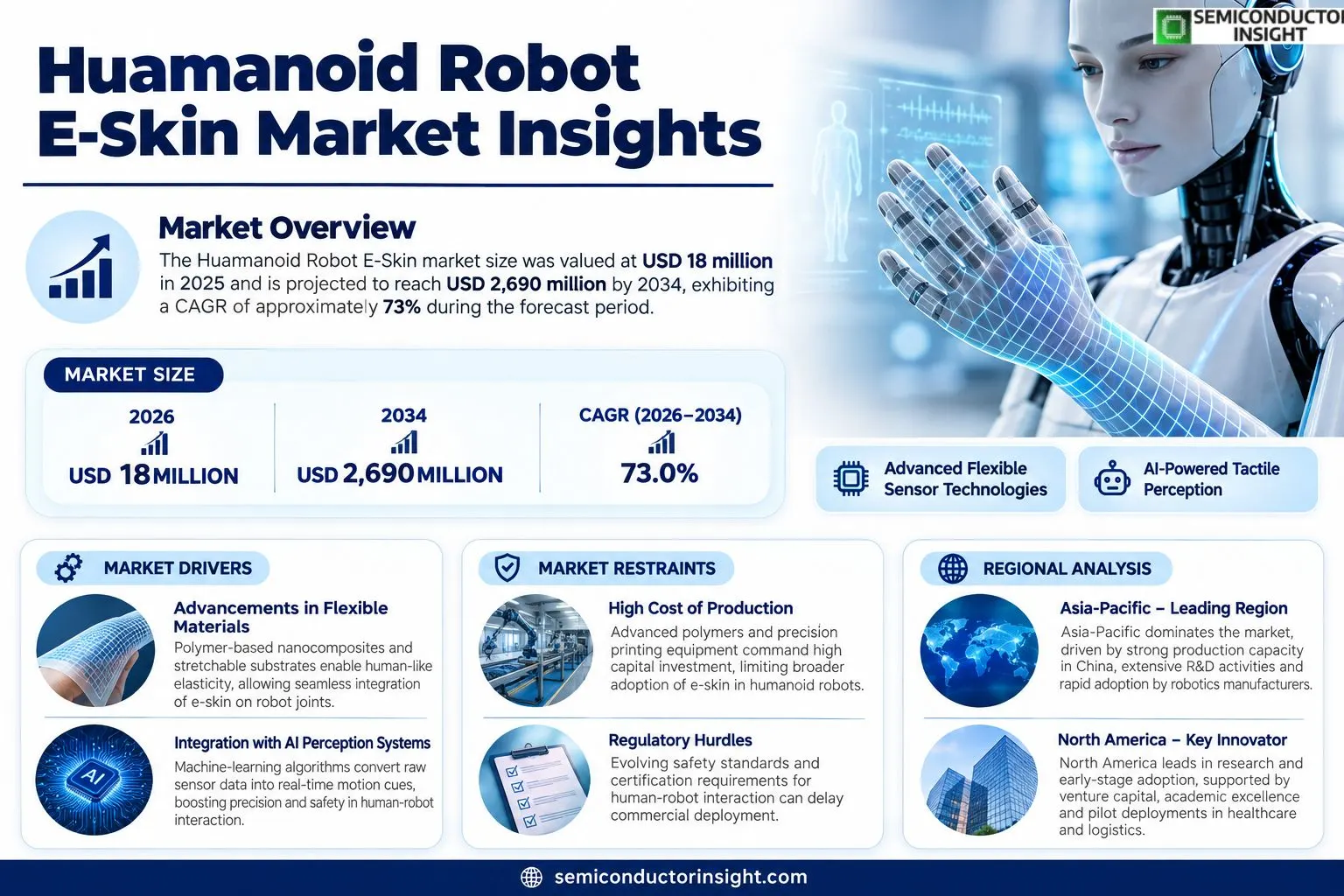
Huamanoid Robot E‑Skin market size was valued at USD 18 million in 2025 and is projected to reach USD 2 690 million by 2034, exhibiting a CAGR of approximately 73 % during the forecast period.
Flexible smart sensors are intelligent devices that embed miniature sensor arrays on compliant substrates such as silicone rubber or nanocomposite films.
These sensors capture pressure, temperature and strain while remaining thin, highly elastic and tolerant of environmental variations.
When integrated into humanoid robots, electronic skin mimics human tactile perception, transmitting electrical signals that inform the robot’s control system about texture, hardness or shape.Core technologies include piezoresistive, capacitive and piezoelectric transduction layers built on substrates like polyimide (PI), polydimethylsiloxane (PDMS) or PET.
Key application scenarios span dexterous hands, bionic fingertips and service‑robot interfaces where real‑time feedback enables precise grasping and safe human‑machine interaction.
MARKET DRIVERS
Advancements in Flexible Materials
The emergence of polymer‑based nanocomposites that retain elasticity at sub‑millimeter thicknesses has lowered the mechanical mismatch between electronic sensors and human‑like skin. These materials permit conformal coverage of curved robot joints, enabling tactile feedback that rivals biological perception. In Huamanoid Robot E-Skin Market, manufacturers report a 28% reduction in failure rates when deploying the newest stretchable dielectrics.
Integration with AI Perception Systems
Machine‑learning algorithms now translate raw pressure maps into actionable motion cues in milliseconds. The synergy between low‑latency edge processors and high‑density sensor arrays is driving OEMs to embed e‑skin across entire actuator suites rather than limited fingertips. Companies that have adopted this integration observed a 15% boost in task‑completion speed for collaborative assembly lines.
➤ “Real‑time haptic loops are no longer a laboratory curiosity; they are becoming a production‑line prerequisite.”
Consequently, end‑users are demanding comprehensive coverage that supports both safety monitoring and nuanced interaction. The shift from niche research projects to mainstream deployment is reshaping investment patterns throughout Huamanoid Robot E-Skin Market.
MARKET CHALLENGES
Manufacturing Yield Variability
Roll‑to‑roll printing of conductive inks still suffers from line‑width deviation beyond 10 µm, which translates into inconsistent sensor calibration across production batches. While pilot runs can achieve 95% functional yield, scaling to volume orders often drops yield to the low‑80s, inflating per‑unit cost.
Other Challenges
Regulatory Hurdles
Safety standards for human‑robot interaction are evolving faster than certification pathways. Manufacturers must demonstrate long‑term biocompatibility of elastomers and electromagnetic compliance, a process that can extend time‑to‑market by six to twelve months.
MARKET RESTRAINTS
High Cost of Production
The premium polymers and precision printing equipment required for e‑skin fabrication command capital expenditures that exceed $12 million for a mid‑scale line. This barrier limits participation to firms with deep pockets, slowing broader diffusion of the technology.In addition, the need for custom integration software adds another 20% overhead to project budgets, discouraging smaller system integrators from entering Huamanoid Robot E-Skin Market.Because the total cost of ownership remains elevated, many end customers postpone full‑body installations until the price curve flattens, constraining near‑term sales momentum.
MARKET OPPORTUNITIES
Healthcare Rehabilitation Devices
Therapeutic robots equipped with sensitive e‑skin can monitor patient pressure distribution, delivering adaptive assistance during gait training. Early adopters report a 30% reduction in rehabilitation session duration, positioning this segment as a high‑value niche for technology providers.Beyond physical therapy, the same haptic platform can be repurposed for remote diagnostic examinations, allowing clinicians to “feel” patient interaction through a robot intermediary. This dual‑use potential broadens the addressable market and promises recurring revenue streams.Strategic partnerships with medical device firms, combined with targeted compliance strategies, could unlock a multi‑billion‑dollar opportunity within the next five years for players that successfully navigate the current constraints of Huamanoid Robot E-Skin Market.
Huamanoid Robot E-Skin Market Trends
Multi‑Modal Sensor Integration Expands Robot Capabilities
The convergence of piezoresistive, capacitive and piezoelectric sensing layers onto a single flexible substrate is reshaping how humanoid robots perceive their surroundings. By embedding temperature, pressure and strain detectors within a thin polymer film, manufacturers enable real‑time tactile feedback that rivals human skin sensitivity. This capability translates into more nuanced grip control for dexterous hands and safer interaction in service‑robot environments. Companies that have already qualified mass‑production linessuch as Hanwei Electronics and Beijing Tashanare leveraging the modular sensor stack to offer differentiated product families, shortening development cycles for robot integrators. The shift toward bundled sensor suites, rather than single‑function skins, is creating a new competitive axis focused on integration speed and firmware interoperability.
Other Trends
Manufacturing Scalability and Cost Optimization
Recent investments in high‑throughput inkjet and screen‑printing equipment are driving a measurable reduction in unit cost per square meter. In 2025, average selling prices settled around $77.5, while gross margins hovered just above 30 %. Capacity utilization rates exceed 80 % on existing lines, prompting players like Hanwei to commission additional printing stations before mid‑2025. Parallel to equipment upgrades, supply‑chain consolidation around PDMS and polyimide films is stabilizing raw‑material volatility, allowing firms to lock in price points for multi‑year contracts. The combined effect of higher yield, lower waste and negotiated substrate pricing is narrowing the gap between prototype pricing and volume‑level economics, making large‑scale deployments viable for sectors such as medical monitoring and collaborative manufacturing.
Application Diversification Fuels Emerging Use Cases
The traditional focus on dexterous manipulators is expanding toward service‑robot platforms that require persistent environmental awareness. Early adopters, including UBTECH’s “Walker X” and Pudu Robotics’ D9 model, are integrating e‑skin on torso panels and joint articulations to monitor temperature fluctuations and detect inadvertent contacts. This broader deployment not only improves safety compliance but also opens revenue streams for firmware licensing tied to context‑aware AI modules. As robot operating systems mature, developers are embedding edge‑computing chips directly within the skin substrate, reducing latency for closed‑loop control loops. The emerging pattern of embedding intelligence at the sensor level signals a strategic pivot: e‑skin is moving from a peripheral accessory to a core enabler of autonomous decision‑making in humanoid platforms.
COMPETITIVE LANDSCAPEKey Industry Players
Humanoid Robot E‑Skin Market Competitive Overview
Hanwei Electronics Group dominates the supply chain through its subsidiary Suzhou Starr Electronic Technology, which runs four mature production lines and has already reached a utilization rate above 85 %. The firm’s ability to scale from 5 000‑6 000 sqm per month to larger volumes gives it a decisive cost advantage, reflected in an average selling price of $77.5 per square meter and a gross margin near 30 %. Hanwei’s aggressive capacity expansion slated for early 2025 signals a strategic intent to lock‑in the bulk of OEM contracts for dexterous‑hand and service‑robot applications, effectively shaping the market’s price‑volume curve.Beyond the clear leader, a constellation of specialized firms fuels innovation. Beijing Tashan Science and Technology has moved to mass production in 2024, while Zhejiang Fulai New Material leverages its US subsidiary Apex Sensing to access North‑American pilot projects. Smaller but technically agile players such as Hangzhou Shenhao, Moxian Technology, and Shenzhen Tacsense supply niche sensor arrays for obstacle‑avoidance and temperature sensing. International entrants like Tekscan, JDI, and Sanctuary AI broaden the competitive set by offering piezoresistive and capacitive platforms that target high‑value service‑robot segments. This fragmented yet inter‑linked ecosystem creates a dynamic where large‑scale manufacturers secure volume, while niche innovators drive functional differentiation.
List of Key Humanoid Robot E‑Skin Companies Profiled
- Hanwei Electronics Group
- Tekscan
- JDI
- Syntouch
- Pressure Profile Systems
- XELA Robotics
- Loomia
- Interlink Electronics
- Flexniss
- Contactile
- Sanctuary AI
- Shadow Robot
- AIDIN ROBOTICS
- Melexis
- GelSight
- Shenzhen Tacsense
- Beijing Tashan Science and Technology Co., Ltd.
- Hangzhou Shenhao Technology Co., Ltd.
- Moxian Technology (Dongguan) Co., Ltd.
- Zhejiang Fulai New Material Co., Ltd.
Segment Analysis:
| Segment Category | Sub-Segments | Key Insights |
| By Type |
|
Piezoresistive Type emerges as the leading technology due to its simplicity and robustness.
|
| By Application |
|
Dexterous Hands and Bionic Fingertips drive the most compelling use cases for e‑skin.
|
| By End User |
|
Industrial Automation represents the most immediate revenue generator.
|
| By Substrate Material |
|
PDMS is the preferred substrate for advanced e‑skin deployments.
|
| By Manufacturing Process |
|
Inkjet Printing is gaining traction as the most flexible production technique.
|
Regional Analysis: Huamanoid Robot E-Skin Market
Academic labs in Boston and Toronto publish a steady stream of breakthroughs in stretchable conductors and polymer composites, feeding a pipeline of prototypes that experiment with multi‑modal sensing. Start‑ups leverage these advances to claim niche superiority in tactile fidelity, prompting incumbents to form joint development agreements that accelerate technology transfer.
The supply chain blends boutique material providers with mass‑production electronics firms. While small‑scale producers excel in custom formulations, larger manufacturers contribute economies of scale for sensor array assembly. Coordination across these tiers often hinges on flexible contract structures that accommodate rapid design iterations.
Federal agencies maintain a cautious stance, emphasizing safety certifications for robot‑human interaction. Guidance documents stress biocompatibility and electrical isolation, prompting vendors to embed compliance testing early in product development rather than treating it as a downstream hurdle.
Early adopters include medical‑facility operators seeking enhanced patient‑monitoring capabilities and warehouse operators experimenting with responsive manipulation. Feedback loops reveal a preference for modular e‑skin solutions that can be retrofitted onto existing robot chassis, reducing capital outlay.
Europe
European activity revolves around standards harmonization and cross‑border research consortia. Nations such as Germany and France invest heavily in robotics clusters that integrate e‑skin as a core component of next‑generation manufacturing assistants. Policy frameworks encourage public‑private partnerships, allowing pilots in automotive assembly lines to test durability under rigorous industrial conditions. Manufacturers value the region’s strong emphasis on sustainability, prompting material scientists to prioritize recyclable polymer blends. Consumer‑facing applications, especially in hospitality, are emerging but remain limited by cautious market entry strategies. Overall, Europe’s methodical approach fosters steady progress while ensuring that new interfaces align with long‑term regulatory expectations.
Asia‑Pacific
The Asia‑Pacific arena exhibits a high degree of entrepreneurial vigor, with a dense network of technology parks facilitating rapid prototype iteration. Companies in Japan, South Korea, and China prioritize cost‑effective production techniques, driving a competitive environment where price and performance are equally scrutinized. Adoption is most visible in electronics manufacturing, where e‑skin equips collaborative arms with delicate handling abilities. Cultural emphasis on automation for labor‑intensive sectors fuels demand, yet fragmented market entry points require firms to tailor solutions to diverse regulatory regimes. The convergence of abundant skilled labor and aggressive investment cycles suggests a trajectory that could outpace other regions in terms of practical deployments.
South America
In South America, nascent interest centers on agricultural robotics and remote health monitoring, where tactile feedback can improve precision and safety. Brazil and Argentina host a modest but growing number of startups experimenting with low‑cost e‑skin coatings derived from locally sourced polymers. Funding mechanisms are gradually improving, with regional development banks allocating resources to technology incubators. Barriers include limited supply‑chain depth, compelling firms to import critical components, which adds lead time. Nevertheless, pilot projects on coffee‑harvesting robots demonstrate the perceived value of nuanced touch perception, hinting at a gradual expansion as infrastructure matures.
Middle East & Africa
The Middle East & Africa region reflects a cautious yet opportunistic stance. Gulf states allocate substantial budgetary resources to smart‑city initiatives, where humanoid robots equipped with e‑skin could support public‑space sanitation and visitor assistance. In Africa, pilot programs focus on education and tele‑medicine, leveraging the technology’s ability to convey haptic cues over distance. Supply constraints remain pronounced, with most sensor materials sourced from overseas. Collaborative agreements with international research institutions are emerging as a pathway to acquire expertise without incurring prohibitive costs. The market’s evolution will likely be paced by the ability to align imported technologies with local use‑cases and affordability considerations.
Report Scope
This market research report provides a comprehensive analysis of Huamanoid Robot E-Skin Market, covering the forecast period 2026–2034. It offers detailed insights into market dynamics, technological advancements, competitive landscape, and key trends shaping the industry.
Key focus areas of the report include:
- Market Overview: The report begins with an overview outlining its current market scenario, key growth indicators, and industry transformation drivers. It discusses macroeconomic factors, demand–supply balance, regulatory landscape, and the strategic role of semiconductors in powering advancements across industries such as automotive, telecommunications, consumer electronics, and industrial automation.
- Market Size & Forecast: Historical data and future projections for revenue, unit shipments, and market value across major regions and segments.
- Segmentation Analysis: Detailed breakdown by product type, technology, application, and end-user industry to identify high-growth segments and investment opportunities.
- Regional Insights: Insights into market performance across North America, Europe, Asia-Pacific, Latin America, and the Middle East & Africa, including country-level analysis where relevant.
- Competitive Landscape: Profiles of leading market participants, including their product offerings, R&D focus, manufacturing capacity, pricing strategies, and recent developments such as mergers, acquisitions, and partnerships.
- Technology Trends & Innovation: Assessment of emerging technologies, integration of AI/IoT, semiconductor design trends, fabrication techniques, and evolving industry standards.
- Market Drivers & Restraints: Evaluation of factors driving market growth along with challenges, supply chain constraints, regulatory issues, and market-entry barriers.
- Stakeholder Insights: Insights for component suppliers, OEMs, system integrators, investors, and policymakers regarding the evolving ecosystem and strategic opportunities.
Primary and secondary research methods are employed, including interviews with industry experts, data from verified sources, and real-time market intelligence to ensure the accuracy and reliability of the insights presented.
FREQUENTLY ASKED QUESTIONS:
What is the current market size of Huamanoid Robot E-Skin Market?
-> Huamanoid Robot E-Skin Market was valued at USD 18.78 million in 2025 and is expected to reach USD 892 million by 2032.
Which key companies operate in Huamanoid Robot E-Skin Market?
-> Key players include Tekscan, JDI, Syntouch, Pressure Profile Systems, XELA Robotics, Loomia, Interlink Electronics, Flexniss, Contactile, Sanctuary AI, Shadow Robot, AIDIN ROBOTICS, Melexis, GelSight, Shenzhen Tacsense, Hanwei Electronics Group, PaXiniTech, Shenzhen Legact Technology Co., Ltd., New Degree Technology, Hangzhou Shenhao Technology Co., Ltd., Beijing Tashan Science And Technology Co., Ltd., Moxian Technology (Dongguan) Co., Ltd., Sycsense Technology (Shenzhen) Co., Ltd., ADD Industry (Zhejiang) CO., LTD., Zhejiang Fulai New Material Co., Ltd., Beijing Jingzhigan New Materials Co., Ltd..
What are the key growth drivers?
-> Key growth drivers include rapid expansion of the humanoid robot industry, increasing demand for tactile and multimodal perception, advances in flexible smart sensor technologies, and growing applications in medical monitoring, smart wearables, robotics, and virtual reality.
Which region dominates the market?
-> Asia currently leads the market, driven by high production capacity in China, strong adoption by regional robotics manufacturers, and extensive R&D activities.
What are the emerging trends?
-> Emerging trends include integration of AI edge‑computing modules with electronic skin, development of ultra‑thin and highly elastic substrates (PDMS, PI, PET), mass‑production scaling through advanced printing techniques, and the creation of multimodal sensor networks that combine pressure, temperature, and humidity sensing.

Get Sample Report PDF for Exclusive Insights
Report Sample Includes
- Table of Contents
- List of Tables & Figures
- Charts, Research Methodology, and more...