Glass Encapsulated NTC Thermistor Market Insights
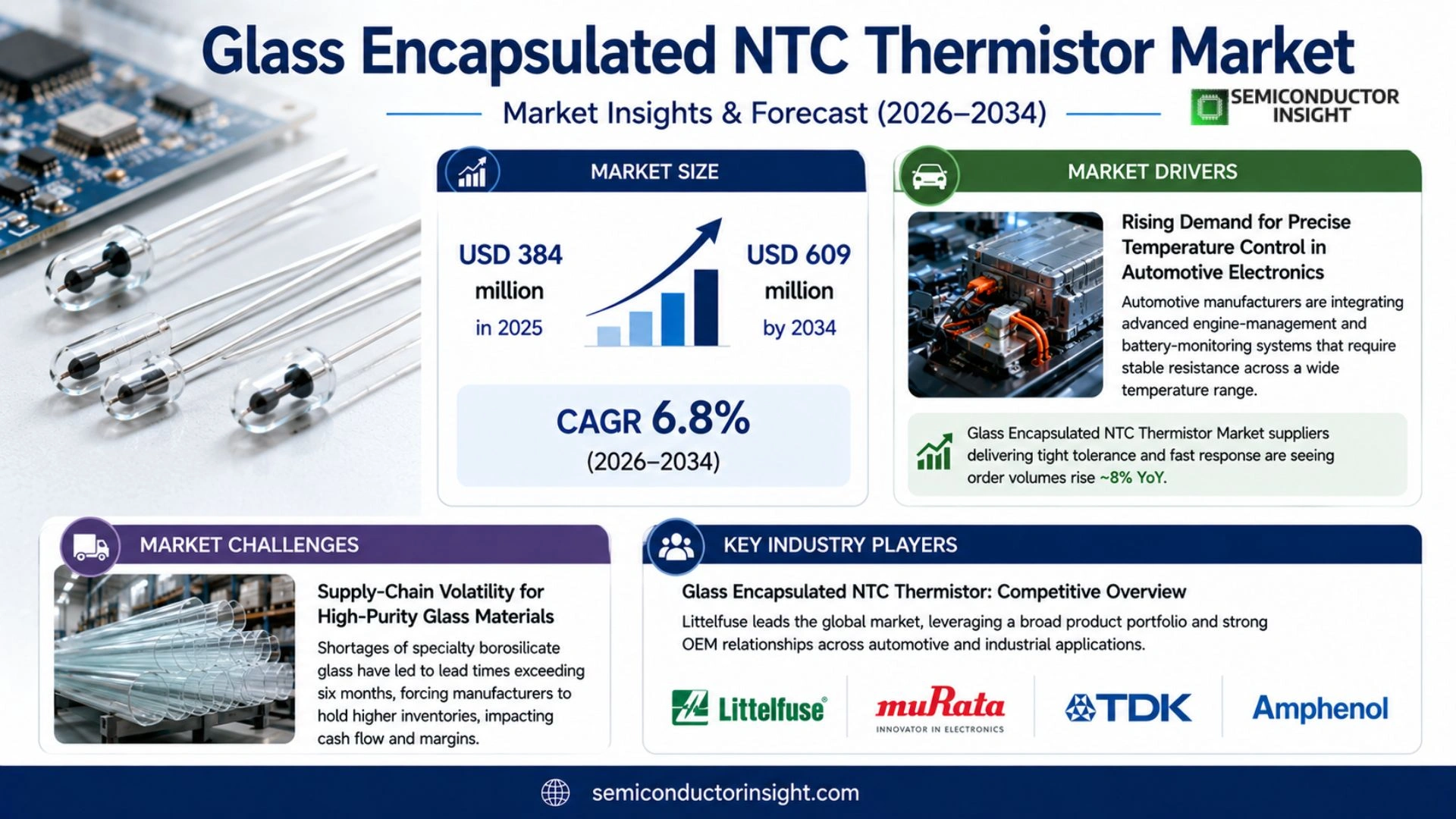
Glass Encapsulated NTC Thermistor market was valued at USD 384 million in 2025 and is expected to climb to USD 609 million by 2034, reflecting a compound annual growth rate of 6.8%.
In the same year production totaled roughly 227.3 million units, with an average price of about USD 1 850 per thousand units. Glass Encapsulated NTC Thermistor is a temperature‑sensitive resistor exhibiting a negative temperature coefficient and sealed within hermetic glass. This construction delivers high stability, moisture resistance and corrosion protection, which enables precise temperature measurement and control in harsh conditions such as high humidity, elevated temperatures or chemical exposure across automotive, industrial and consumer‑electronics applications.
The surge in automotive electronics, industrial automation, smart‑home appliances and new‑energy equipment creates strong demand for components that combine reliability with environmental robustness. Opportunities arise from miniaturised designs, higher‑temperature ratings and faster response times that meet OEM expectations while keeping cost competitive.
MARKET DRIVERS
Rising Demand for Precise Temperature Control in Automotive Electronics
Automotive manufacturers are integrating increasingly sophisticated engine‑management and battery‑monitoring systems, which require components that can deliver stable resistance over a wide temperature span. Glass Encapsulated NTC Thermistor Market suppliers that can guarantee tight tolerance and rapid response are seeing order volumes climb by roughly 8% year‑over‑year, as OEMs prioritize reliability in electric‑vehicle power‑train modules.
Expansion of Industrial Automation and IoT Sensors
Factories upgrading to Industry 4.0 architectures rely on dense sensor networks to monitor motor temperatures, compressors, and process heaters. The need for compact, hermetically sealed thermistors that survive harsh moisture and dust conditions fuels a shift toward glass‑encapsulated designs, which now capture an estimated 22% of total NTC thermistor shipments in the sector.
➤ “Manufacturers that can pair glass encapsulation with thin‑film technology are positioned to capture the premium segment of the market, where performance margins translate directly into cost savings for end‑users.”
Energy‑efficiency regulations across Europe and North America are tightening, pressuring equipment makers to adopt components that reduce standby power draw. By delivering lower leakage currents, glass‑encapsulated NTC thermistors enable compliance without redesigning core circuitry, creating a compelling value proposition for OEMs seeking to meet mandated standards.
MARKET CHALLENGES
Supply‑Chain Volatility for High‑Purity Glass Materials
Global shortages of specialty borosilicate glass have introduced lead times that can exceed six months, particularly for batches requiring ultra‑low thermal expansion coefficients. This bottleneck forces many manufacturers to hold higher inventory levels, eroding cash flow and compressing margins.
Other Challenges
Cost Sensitivity in Consumer Electronics
While performance benefits are clear, the additional material cost of glass encapsulation makes it difficult for low‑margin consumer devices to justify substitution over cheaper polymer alternatives, limiting market penetration in high‑volume, cost‑driven segments.
MARKET RESTRAINTS
Stringent Certification Requirements
Achieving compliance with automotive AEC‑Q200 and IEC 60747 standards entails extensive testing cycles that can add 3–4 months to product launch timelines. Smaller suppliers lacking dedicated certification labs often defer to larger players, narrowing the competitive field.
In addition, the rigorous environmental testing mandated for aerospace applications,such as rapid thermal cycling and vibration endurance,further raises development costs, dissuading entry from niche innovators.
MARKET OPPORTUNITIES
Integration with Smart Grid Infrastructure
Emerging smart‑grid technologies require temperature sensing at transformer stations and power‑conversion units where reliability under extreme conditions is non‑negotiable. Glass‑encapsulated NTC thermistors, with their superior moisture resistance, are uniquely suited to these installations, opening a revenue stream projected to grow at a modest double‑digit pace over the next five years.
Furthermore, collaborations between thermistor manufacturers and semiconductor firms developing System‑in‑Package (SiP) modules present a pathway to embed temperature‑compensation directly within power‑management ICs, unlocking higher integration levels and new pricing models.
Glass Encapsulated NTC Thermistor Market Trends
Automotive Electronics Accelerate Sensor Adoption
The surge in vehicle electrification and the migration toward advanced driver‑assistance systems have tightened specifications for temperature monitoring components. Manufacturers now require sensors that can survive high‑temperature zones within power‑train modules while delivering millisecond response times. Glass Encapsulated NTC Thermistor units, with their hermetic glass shells, meet these criteria by offering moisture immunity and corrosion resistance. In 2025, production topped 227 million units, reflecting OEMs’ preference for components that combine durability with cost‑effective pricing around US$1.85 per thousand units. This shift reshapes supplier negotiations, prompting a focus on volume‑based contracts and joint development programs aimed at integrating thermistors directly into power‑module designs.
Other Trends
Industrial Automation and Smart‑Home Integration
Factories modernizing with predictive maintenance platforms rely on temperature data to pre‑empt equipment failures. The glass‑sealed architecture of NTC thermistors minimizes drift in humid warehouse environments, enabling tighter control loops for robotics and conveyor systems. Simultaneously, smart‑home appliances such as connected water heaters and climate‑control units are embedding these sensors to meet consumer expectations for reliability and energy efficiency. The convergence of IoT standards and the need for components that can tolerate chemical exposure from cleaning agents has spurred manufacturers to expand their product portfolios, offering variants with faster thermal time constants and extended temperature ranges.
Miniaturization and High‑Temperature Sensing
Device engineers are increasingly tightening form‑factor constraints, especially in compact power converters and medical diagnostic equipment. The industry’s response includes the rollout of miniature glass‑encapsulated NTC thermistors capable of operating above 250 °C without degradation. These new offerings open doors to applications in aerospace power units and next‑generation renewable‑energy converters where traditional polymer‑based sensors would falter. Companies that can align production lines to deliver both ultra‑small packages and high‑temperature grades stand to capture premium market segments, leveraging Glass Encapsulated NTC Thermistor Market’s move toward performance‑first specifications.
COMPETITIVE LANDSCAPE
Key Industry Players
Glass Encapsulated NTC Thermistor: Competitive Overview
Littelfuse commands a decisive share of the global glass‑encapsulated NTC thermistor market, leveraging its extensive OEM network in automotive and industrial sectors. The company’s ability to integrate thermistor technology into broader safety‑and‑protection portfolios gives it pricing leverage and fosters long‑term contracts that shape the overall market structure. A handful of other large‑scale manufacturers such as TDK and Vishay complement Littelfuse’s dominance, creating a tiered competitive environment where the top three capture roughly half of worldwide sales volume. This concentration encourages strategic partnerships and joint‑development programs aimed at meeting emerging standards for temperature‑sensing reliability in electric‑vehicle powertrain modules and high‑temperature industrial controls.
Beyond the dominant tier, several niche but technically agile firms are expanding the market’s breadth. Companies like Semitec and EI Sensor focus on high‑temperature, fast‑response variants that address new‑energy vehicle battery management systems, while Amphenol Advanced Sensors and Honeywell specialize in miniature packages for consumer‑electronics and medical devices. Regional champions,including TE Connectivity in North America, Shibaura Electronics in Japan, and TOPOS in China,capitalize on localized supply chains and regulatory familiarity to secure contracts with domestic OEMs. These players often differentiate through proprietary glass‑seal processes or value‑added testing services, positioning themselves as essential suppliers for applications where moisture resistance and long‑term stability are non‑negotiable.
List of Key Glass Encapsulated NTC Thermistor Companies Profiled
- Littelfuse
- TDK
- Eaton
- Vishay
- Semitec
- EI Sensor
- Amphenol Advanced Sensors
- Honeywell
- TE Connectivity
- Shibaura Electronics
- Thinking Electronic Industrial
- Minjie Electronics
- TOPOS
- EXSENSE
- Huagong Gaoli Electronics
Segment Analysis:
| Segment Category | Sub-Segments | Key Insights |
| By Type |
|
Standard glass encapsulated continues to dominate because it balances reliability and cost, making it the first choice for legacy automotive and industrial designs. – Industry engineers appreciate its proven moisture resistance in harsh environments. – Suppliers are focusing on incremental improvements in glass purity to extend lifespan without raising price. – The segment benefits from broad OEM acceptance and established supply chains. |
| By Application |
|
Automotive electronics is the leading application because vehicle power‑train electrification demands highly reliable temperature sensing. – Designers value the glass encapsulation for its resistance to coolant leaks and high‑temperature zones. – Emerging functions such as battery‑management systems and autonomous sensor suites intensify the need for stable NTC performance. – Partnerships between thermistor makers and tier‑1 automotive suppliers are accelerating product co‑development. |
| By End User |
|
OEMs drive the market narrative by setting strict reliability standards for components used in safety‑critical modules. – Their long‑term sourcing strategies push suppliers toward higher glass quality and tighter process control. – OEM feedback loops encourage rapid iteration of form‑factor designs, especially for compact modules in electric vehicles. – Close collaboration on reliability testing programs distinguishes leading thermistor producers. |
| By Resistance Value |
|
Medium resistance is preferred for most automotive and industrial sensor circuits because it offers a balanced trade‑off between sensitivity and power dissipation. – Designers cite its versatility for both cold‑start protection and active thermal management. – Manufacturers are engineering glass compositions that maintain resistance stability across wide temperature swings. – The segment benefits from cross‑industry adoption, reinforcing its status as the “default” choice. |
| By Temperature Range |
|
High temperature segment gains momentum as new energy vehicles and high‑power converters expose components to extreme thermal environments. – Engineers value glass encapsulation for its superior thermal shock resistance. – Product roadmaps increasingly target operation beyond 200 °C to support next‑generation inverters. – Collaboration with material scientists is unlocking glass formulas that retain electrical characteristics at elevated temperatures. |
Regional Analysis: Glass Encapsulated NTC Thermistor Market
North America
Manufacturers of CNC machines and robotic arms are standardising on glass‑encapsulated NTC thermistors to achieve tighter process control. The inherent resistance to moisture and contaminants aligns with the clean‑room environments of high‑precision assembly lines, reducing downtime caused by sensor failure.
Electric‑vehicle power modules demand temperature sensors that survive repeated thermal cycling. Glass encapsulation offers the needed robustness, enabling vehicle manufacturers to meet warranty expectations while simplifying thermal‑management architectures.
Premium smartphones and wearables are incorporating glass‑encapsulated NTC thermistors to safeguard battery packs. Their thin form factor and high accuracy support aggressive miniaturisation trends without compromising safety.
Stringent UL and IEC certifications in North America drive early compliance initiatives. Suppliers that embed glass‑encapsulated solutions into certified designs gain a decisive market advantage and reduce time‑to‑market for their partners.
Europe
European OEMs are balancing sustainability mandates with performance goals, prompting a shift toward glass‑encapsulated NTC thermistors that can be recycled more efficiently than polymer‑based alternatives. The automotive sector, especially in Germany and France, views these sensors as essential for meeting Euro 6 emissions standards, while industrial firms in the Nordics appreciate the enhanced longevity in low‑temperature environments. Collaborative research programs funded by the EU are accelerating material‑science breakthroughs, positioning Europe as a hub for next‑generation encapsulation technologies.
Asia‑Pacific
In Asia‑Pacific, rapid electrification of transport and aggressive consumer‑device rollouts are elevating demand for reliable temperature sensing. China’s push for domestic battery production has sparked interest in glass‑encapsulated thermistors that can tolerate high‑current heat fluxes. Meanwhile, Japan’s precision‑instrument market values the ultra‑stable characteristics that glass encapsulation delivers, fostering niche applications in medical diagnostics and aerospace testing.
South America
South American manufacturers are beginning to replace legacy ceramic sensors with glass‑encapsulated NTC thermistors as they modernise production lines for renewable‑energy equipment. The region’s growing emphasis on energy‑storage projects, particularly in Brazil, creates a niche where thermal reliability directly influences system uptime and operational cost.
Middle East & Africa
The Middle East & Africa region is witnessing a nascent but decisive uptake of glass‑encapsulated thermistor technology in oil‑field instrumentation and data‑center cooling. Harsh desert temperatures and high humidity levels test sensor durability, and the glass barrier offers superior protection. Emerging smart‑city initiatives in the United Arab Emirates are also integrating these sensors into building‑management systems to optimise HVAC performance and energy consumption.
Report Scope
This market research report provides a comprehensive analysis of the Glass Encapsulated NTC Thermistor Market , covering the forecast period 2026–2034. It offers detailed insights into market dynamics, technological advancements, competitive landscape, and key trends shaping the industry.
Key focus areas of the report include:
- Market Overview: The report begins with an overview outlining its current market scenario, key growth indicators, and industry transformation drivers. It discusses macroeconomic factors, demand–supply balance, regulatory landscape, and the strategic role of semiconductors in powering advancements across industries such as automotive, telecommunications, consumer electronics, and industrial automation.
- Market Size & Forecast: Historical data and future projections for revenue, unit shipments, and market value across major regions and segments.
- Segmentation Analysis: Detailed breakdown by product type, technology, application, and end-user industry to identify high-growth segments and investment opportunities.
- Regional Insights: Insights into market performance across North America, Europe, Asia-Pacific, Latin America, and the Middle East & Africa, including country-level analysis where relevant.
- Competitive Landscape: Profiles of leading market participants, including their product offerings, R&D focus, manufacturing capacity, pricing strategies, and recent developments such as mergers, acquisitions, and partnerships.
- Technology Trends & Innovation: Assessment of emerging technologies, integration of AI/IoT, semiconductor design trends, fabrication techniques, and evolving industry standards.
- Market Drivers & Restraints: Evaluation of factors driving market growth along with challenges, supply chain constraints, regulatory issues, and market-entry barriers.
- Stakeholder Insights: Insights for component suppliers, OEMs, system integrators, investors, and policymakers regarding the evolving ecosystem and strategic opportunities.
Primary and secondary research methods are employed, including interviews with industry experts, data from verified sources, and real-time market intelligence to ensure the accuracy and reliability of the insights presented.
FREQUENTLY ASKED QUESTIONS:
What is the current market size of Glass Encapsulated NTC Thermistor Market?
-> Glass Encapsulated NTC Thermistor market is expected to climb to USD 609 million by 2034, reflecting a compound annual growth rate of 6.8%.
Which key companies operate in Glass Encapsulated NTC Thermistor Market?
-> Key players include Littelfuse, TDK, Eaton, Vishay, Semitec, EI Sensor, Amphenol Advanced Sensors, Honeywell, TE Connectivity, Shibaura Electronics, Thinking Electronic Industrial, Minjie Electronics, TOPOS, EXSENSE, Huagong Gaoli Electronics, among others.
What are the key growth drivers?
-> Key growth drivers include automotive electronics, industrial automation, smart home appliances, and new energy equipment.
Which region dominates the market?
-> Asia-Pacific holds the largest share of the market, driven by rapid adoption of automotive electronics and new‑energy solutions.
What are the emerging trends?
-> Emerging trends include development of miniaturized, high‑temperature‑resistant, fast‑response thermistors, expansion into new‑energy vehicle sensors, medical devices, and stronger OEM collaborations.

Get Sample Report PDF for Exclusive Insights
Report Sample Includes
- Table of Contents
- List of Tables & Figures
- Charts, Research Methodology, and more...
 Download Sample Report PDF