
Cylindrical Microlens Arrays Market Insights
Cylindrical Microlens Arrays market size was valued at USD 78 million in 2025. The market is projected to grow from USD 86 million in 2026 to USD 200 million by 2034, exhibiting a CAGR of 10.8% during the forecast period.
Cylindrical Microlens Arrays (CMAs) are one‑dimensional microlens arrays composed of periodically arranged cylindrical lenslets that focus light into a line rather than a spot.Upstream, CMAs are fabricated on optical glass, fused silica or polymer substrates using lithography‑derived masters, replication or wafer‑level polymer molding, which balances precision, throughput and cost.
Downstream, they are integrated into beam‑homogenizing optics, laser/LED line generators and fast‑axis collimators where a uniform non‑Gaussian line profile across UV‑IR bands is required.
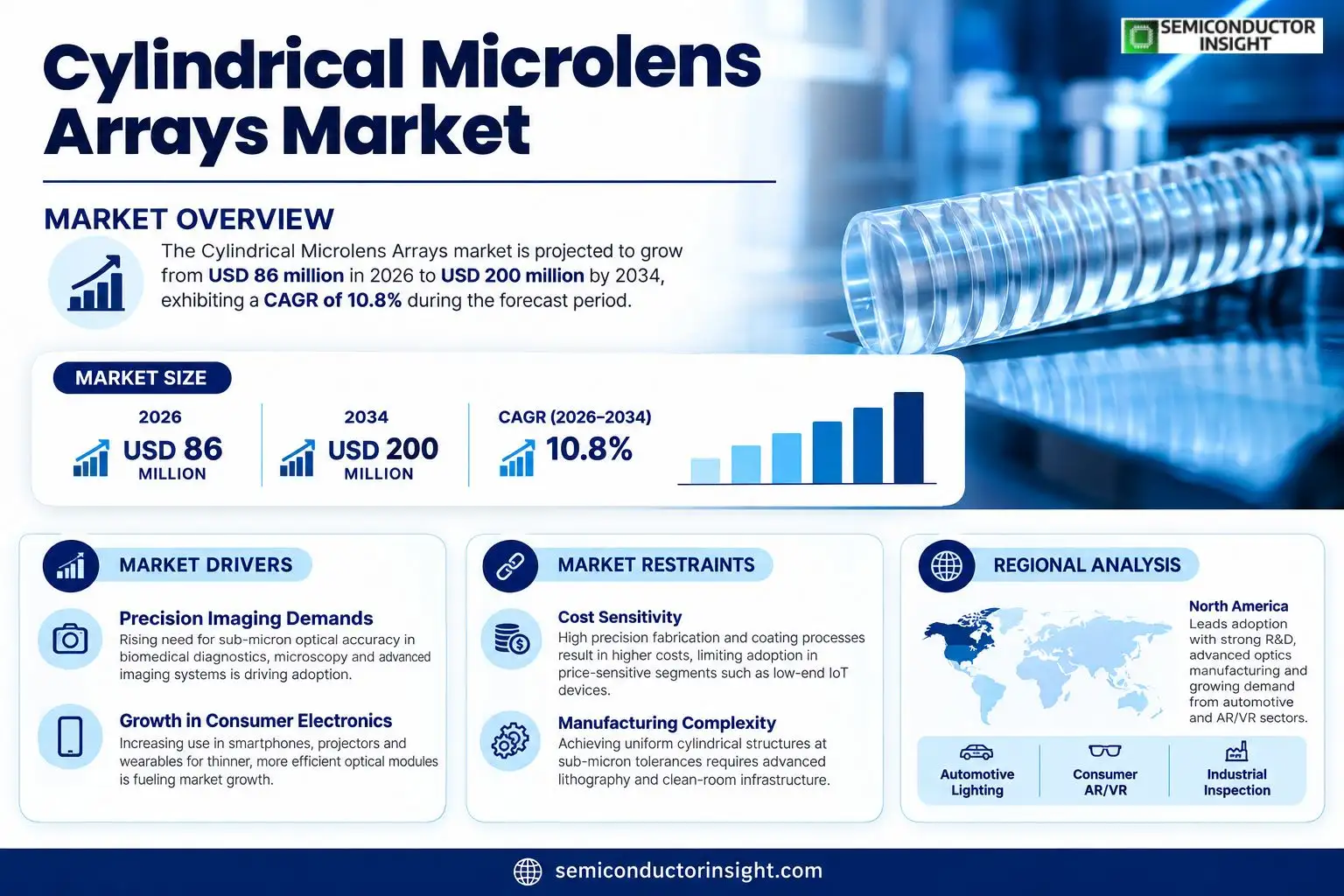
MARKET DRIVERS
Precision Imaging Demands
Advances in biomedical diagnostics and high‑resolution microscopy have elevated the need for optical components that can manipulate light with sub‑micron accuracy. Cylindrical Microlens Arrays Market benefits directly because these arrays enable uniform line‑focus illumination, reducing aberrations that would otherwise compromise image fidelity. Companies that embed these arrays into imaging rigs report measurable improvements in contrast and depth perception, compelling OEMs to prioritize their inclusion.
Growth in Consumer Electronics
Smartphone cameras, miniature projectors, and wearable displays increasingly rely on compact optical stacks. Cylindrical microlenses provide a cost‑effective route to broaden field‑of‑view without expanding device thickness. Manufacturers that have adopted these lenses note a reduction in assembly steps, translating into shorter time‑to‑market cycles and higher profit margins.
➤ “Integrating cylindrical microlens arrays delivers a distinct performance edge that competitors struggle to match,” a senior optical engineer remarks.
Beyond hardware, software algorithms that correct for lens distortion now assume the presence of high‑quality microlens arrays, creating a feedback loop where better optics drive smarter processing and vice versa. This synergy fuels sustained interest from both component suppliers and end‑product developers.
MARKET CHALLENGES
Manufacturing Complexity
Producing uniform cylindrical structures at sub‑micron tolerances demands specialized lithography and replication techniques. Small deviations can lead to focal jitter, which is unacceptable for high‑precision applications. As a result, many midsize firms hesitate to invest in the necessary clean‑room infrastructure, limiting the supplier base.
Other Challenges
Material Compatibility
Integrating the arrays with emerging substrates such as flexible polymers or glass‑ceramics introduces adhesion and thermal‑expansion issues. Suppliers that cannot guarantee reliable bonding risk losing contracts to those offering proven hybrid solutions.
MARKET RESTRAINTS
Cost Sensitivity
While the performance benefits are clear, the added expense of precision fabrication remains a hurdle for price‑constrained segments such as low‑end IoT devices. Buyers often perform strict cost‑benefit analyses, and if the perceived value does not outweigh the incremental price, adoption stalls.
MARKET OPPORTUNITIES
Integration with AR/VR Systems
Augmented‑reality headsets and virtual‑reality goggles require compact optical assemblies that can deliver wide, distortion‑free fields of view. Cylindrical microlens arrays are uniquely positioned to meet these specifications, opening a sizable revenue channel as immersive technologies transition from prototypes to mass‑market products. Early adopters that secure supply agreements stand to shape the standards for next‑generation visual experiences.
Cylindrical Microlens Arrays Market Trends
Scaling Wafer‑Level Imprint for Volume Manufacturing
Cylindrical Microlens Arrays Market is being reshaped by a decisive move toward wafer‑level imprint and polymer injection techniques. Manufacturers that have migrated from hand‑crafted lithography to high‑throughput imprint lines report unit costs dropping by roughly 30 % while maintaining sub‑micron pitch tolerances. This cost advantage aligns with the automotive sector’s demand for large‑volume, low‑price optical components, where profit margins between 25 % and 45 % remain attractive. At the same time, the shift enables tighter control over fill factor and surface form, reducing defect rates that previously eroded yields. Companies that have integrated alignment features directly into the imprint mask are seeing cycle times shrink to under two weeks, a timeline that supports rapid product‑lifecycle turnover in consumer‑electronics and projection systems.
Other Trends
Application Mix Tilting Toward High‑Power LEDs
Within Cylindrical Microlens Arrays Market, high‑power LED modules are eclipsing traditional laser users as the primary downstream segment. Line‑shaping optics for LED back‑lights and automotive headlights require uniform, non‑Gaussian profiles to avoid hot‑spots, a niche where the one‑dimensional focusing capability of cylindrical microlenses excels. Recent field data show that LED‑based implementations have lifted overall unit sales to about 28 million in 2025, up from 22 million two years earlier. The rise is driven by stricter energy‑efficiency standards and the proliferation of augmented‑reality displays that depend on thin, planar illumination sources. Suppliers that pair their arrays with anti‑reflective coatings are capturing a premium segment, as coating improves transmission across the UV‑IR spectrum without compromising the line focus.
Supply‑Chain Rigor and Automotive Qualification
Quality assurance remains the most acute challenge for Cylindrical Microlens Arrays Market, especially in automotive‑grade programs where audit trails and traceability are non‑negotiable. Variations in polymer aging, such as yellowing or outgassing, can translate into optical drift that fails customer reliability tests. To mitigate these risks, leading producers are investing in in‑line metrology that monitors surface roughness and double‑sided alignment with nanometer precision. The resulting yield improvements allow manufacturers to honor multi‑year supply contracts while keeping inventory buffers modest. However, the rigorous validation cycles required for automotive qualification can extend ramp‑up periods by several months, introducing a volatility factor that smaller players struggle to absorb.
COMPETITIVE LANDSCAPE
Key Industry Players
Cylindrical Microlens Arrays: Market Concentration and Growth Drivers
AGC dominates the high‑volume segment, leveraging its deep expertise in optical glass and fused‑silica substrates to deliver wafer‑level imprinted arrays at scale. The company’s vertically integrated supply chainfrom raw glass production to precision lithographic master generationallows it to sustain gross margins near the upper end of the industry range (40‑45%). AGC’s recent investment in a 200‑mm polymer‑mold line has expanded its capability to serve automotive projection and high‑power LED lighting, where cost‑pressure and volume are paramount. By aligning product road‑maps with OEM qualification programmes, AGC has locked in multi‑year contracts that stabilize cash flow and create entry barriers for newer entrants. The firm also differentiates through a proprietary anti‑yellowing coating that extends component lifetime under harsh thermal cycling, a decisive factor for automotive‑grade specifications.
Beyond the market leader, a constellation of specialised manufacturers fuels innovation in niche applications. Holographix and NIL Technology focus on sub‑micron pitch arrays for laser material processing, where line‑profile uniformity directly translates into yield improvements for semiconductor wafer inspection. Syntec Optics and PowerPhotonic have built reputations around custom‑coated cylindrical lenses for UV‑IR line‑scan systems, capitalising on their in‑house thin‑film facilities to meet stringent reflectance tolerances. Flexible Optical and MPNICS address the emerging demand for lightweight polymer‑based arrays in wearable optics, offering rapid prototyping through roll‑to‑roll replication. Focuslight Technologies, Shanghai Optics, and Highlight Optics cater to regional laser‑marking equipment makers, providing low‑to‑mid‑volume runs with flexible design turn‑around. This dispersed ecosystem balances the market, ensuring that large‑scale volume producers coexist with agile innovators that push the functional envelope of cylindrical microlens technology.
List of Key Cylindrical Microlens Arrays Companies Profiled
- AGC
- INGENERIC
- Holographix
- NIL Technology
- Syntec Optics
- PowerPhotonic
- Flexible Optical
- MPNICS
- Focuslight Technologies
- Shanghai Optics
- Highlight Optics
Segment Analysis:
| Segment Category | Sub-Segments | Key Insights |
| By Type |
|
Polymer Type
|
| By Application |
|
Laser line shaping
|
| By End User |
|
Automotive lighting and projection
|
| By Substrate |
|
Fused Silica
|
| By Coating |
|
Anti‑Reflective Coated
|
Regional Analysis: Cylindrical Microlens Arrays Market
The market draws strongest traction from automotive lidar, consumer AR/VR, and high‑throughput inspection equipment, each leveraging the unique line‑focusing ability of cylindrical microlenses to increase depth‑of‑field without enlarging optics footprints.
Progress in ultrafast laser writing and roll‑to‑roll polymer replication reduces unit costs, encouraging system integrators to replace conventional spherical arrays with cylindrical counterparts for finer spatial resolution.
Proximity of silicon‑wafer vendors to optical‑coating labs in the Midwest creates a resilient supply chain, allowing rapid material swaps when project specifications shift from glass to flexible substrates.
Export‑control classifications for photonic components are relatively light, but emerging safety standards for autonomous‑vehicle sensors are prompting manufacturers to certify product reliability early in development.
Europe
European activity centers on precision engineering hubs in Germany and the Netherlands, where legacy optics manufacturers are retrofitting existing lines to accommodate cylindrical designs. Strong collaborations between automotive OEMs and research institutes accelerate adoption in driver‑assistance systems, while the region’s commitment to sustainability drives interest in recyclable polymer microlenses. Market participants note that the fragmented supplier landscape can slow time‑to‑market, yet the depth of technical expertise offsets this friction, keeping Europe a credible second tier for Cylindrical Microlens Arrays Market.
Asia‑Pacific
In Asia‑Pacific, rapid industrialization and aggressive consumer‑electronics roll‑outs generate a fertile ground for cylindrical microlens integration, especially in smartphone camera modules and compact lidar units. China’s manufacturing scale provides cost advantages, while Japan’s precision‑glass expertise ensures high‑performance offerings for medical imaging. The region faces challenges in standardizing quality across disparate factories, but regional trade agreements are easing cross‑border component flow, allowing multinational players to tap local capacity without compromising design integrity.
South America
South American markets are still emerging, with Brazil and Chile leading pilot projects in agricultural drone imaging and low‑cost environmental sensing. Local universities are experimenting with additive manufacturing of microlens molds, which could democratize production if coupled with government incentives. Limited domestic sourcing forces many firms to import critical substrates, raising lead times; however, the growing focus on localized supply chains hints at a gradual reduction in dependency on overseas providers.
Middle East & Africa
The Middle East & Africa region sees modest uptake, primarily driven by defense and oil‑field inspection applications where rugged, compact optics are prized. United Arab Emirates initiatives to develop a regional photonics ecosystem have attracted a handful of niche startups focused on polymer‑based cylindrical arrays. Infrastructure constraints and a relatively small talent pool keep market penetration low, yet strategic partnerships with European technology firms are laying the groundwork for incremental growth over the next decade.
Report Scope
This market research report provides a comprehensive analysis of the Cylindrical Microlens Arrays Market , covering the forecast period 2026–2034. It offers detailed insights into market dynamics, technological advancements, competitive landscape, and key trends shaping the industry.
Key focus areas of the report include:
- Market Overview: The report begins with an overview outlining its current market scenario, key growth indicators, and industry transformation drivers. It discusses macroeconomic factors, demand–supply balance, regulatory landscape, and the strategic role of semiconductors in powering advancements across industries such as automotive, telecommunications, consumer electronics, and industrial automation.
- Market Size & Forecast: Historical data and future projections for revenue, unit shipments, and market value across major regions and segments.
- Segmentation Analysis: Detailed breakdown by product type, technology, application, and end-user industry to identify high-growth segments and investment opportunities.
- Regional Insights: Insights into market performance across North America, Europe, Asia-Pacific, Latin America, and the Middle East & Africa, including country-level analysis where relevant.
- Competitive Landscape: Profiles of leading market participants, including their product offerings, R&D focus, manufacturing capacity, pricing strategies, and recent developments such as mergers, acquisitions, and partnerships.
- Technology Trends & Innovation: Assessment of emerging technologies, integration of AI/IoT, semiconductor design trends, fabrication techniques, and evolving industry standards.
- Market Drivers & Restraints: Evaluation of factors driving market growth along with challenges, supply chain constraints, regulatory issues, and market-entry barriers.
- Stakeholder Insights: Insights for component suppliers, OEMs, system integrators, investors, and policymakers regarding the evolving ecosystem and strategic opportunities.
Primary and secondary research methods are employed, including interviews with industry experts, data from verified sources, and real-time market intelligence to ensure the accuracy and reliability of the insights presented.
FREQUENTLY ASKED QUESTIONS:
What is the current market size of Cylindrical Microlens Arrays Market?
-> Cylindrical Microlens Arrays Market was valued at USD 77.77 million in 2025 and is expected to reach USD 163 million by 2032, representing a CAGR of 11.0% during the forecast period.
Which key companies operate in Cylindrical Microlens Arrays Market?
-> Key players include AGC, INGENERIC, Holographix, NIL Technology, Syntec Optics, PowerPhotonic, Flexible Optical, MPNICS, Focuslight Technologies, Shanghai Optics, and Highlight Optics, among others.
What are the key growth drivers?
-> Key growth drivers include the demand for thinner, more efficient optical modules in automotive and consumer electronics, the need for uniform non‑Gaussian line profiles in laser and high‑power LED applications, and the scalability offered by wafer‑level and imprint manufacturing techniques.
Which region dominates the market?
-> Asia leads the market, driven by strong manufacturing bases in China, Japan, and South Korea, while Europe and North America also show significant adoption in automotive and industrial optics.
What are the emerging trends?
-> Emerging trends include wafer‑level/imprint/injection molding processes for high‑volume production, co‑design of microstructures with alignment features to improve repeatability, and the integration of cylindrical microlens arrays into automotive projection and lighting systems.

Get Sample Report PDF for Exclusive Insights
Report Sample Includes
- Table of Contents
- List of Tables & Figures
- Charts, Research Methodology, and more...
 Download Sample Report PDF


