Automotive Battery Leak Detection Sensor Market Insights
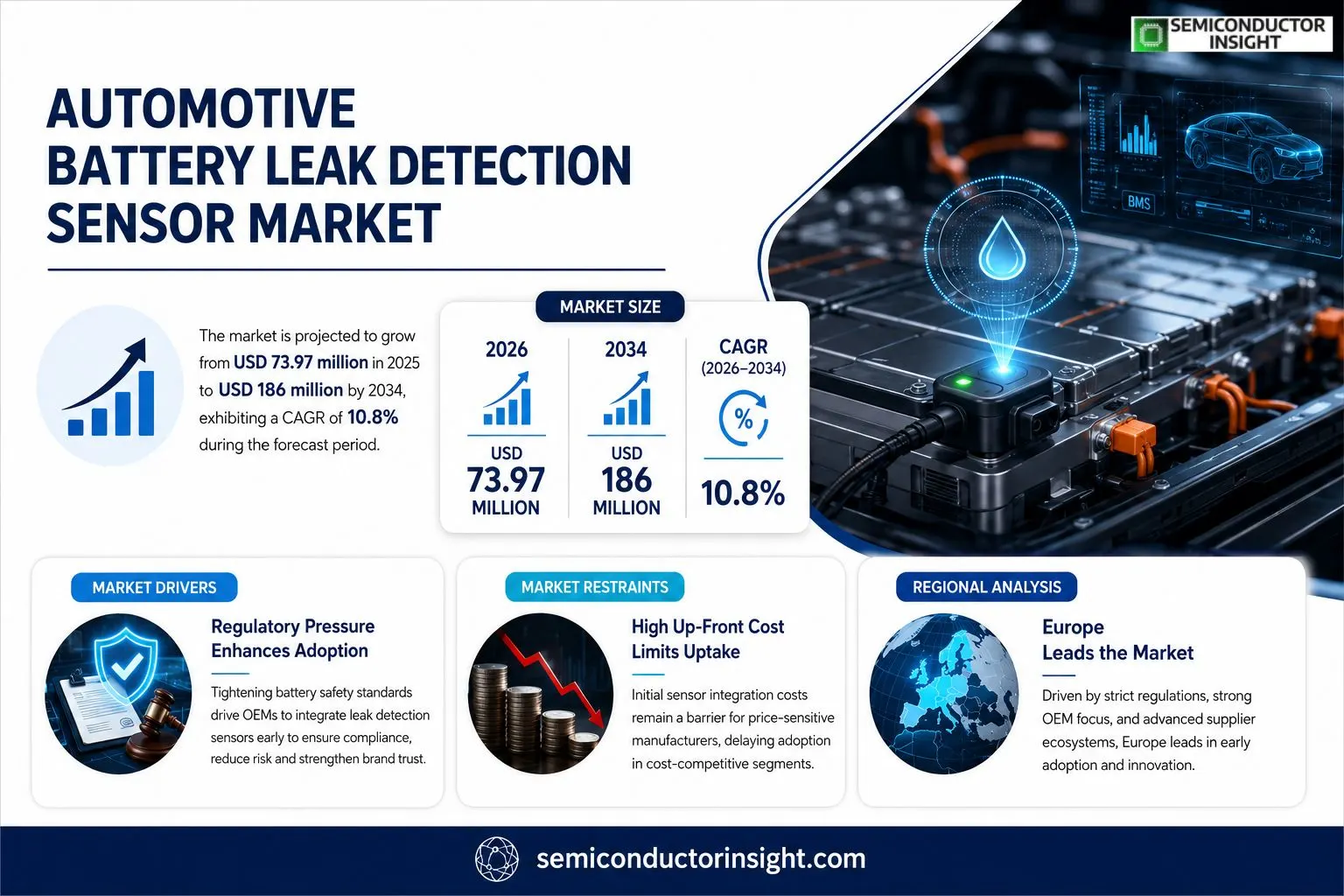
Automotive Battery Leak Detection Sensor market size was valued at USD 73.97 million in 2025 and is projected to reach USD 186 million by 2034, exhibiting a CAGR of approximately 10.8% during the forecast period.
Automotive Battery Leak Detection Sensor is a specialized device designed to monitor the safety of traction‑battery systems. It detects characteristic signals such as electrolyte‑solvent vapors, coolant vapors, or hydrogen released from sealed cells or packs under specific conditions, thereby identifying potential leakage risks with high sensitivity and repeatable accuracy.The rapid expansion of new‑energy vehicles, tightening battery‑safety regulations, and heightened public attention to battery incidents are collectively boosting demand for these sensors. Manufacturers are integrating them more closely with Battery Management Systems, expanding detection capabilities beyond electrolyte vapor to include hydrogen, coolant and ambient humidity, while pursuing lower power consumption and miniaturisation.
MARKET DRIVERS
Regulatory Pressure Enhances Adoption
Governments across North America, Europe and parts of Asia have tightened vehicle safety standards to mandate early‑stage detection of electrolyte leakage. Manufacturers that embed leak detection sensors into battery packs can demonstrate compliance, avoid fines, and protect brand reputation. This regulatory climate creates a clear incentive for OEMs to allocate budget toward Automotive Battery Leak Detection Sensor Market.
Electrified Powertrains Accelerate Sensor Demand
The surge in electric‑vehicle production expands the volume of high‑energy‑density batteries on the road. As pack capacities climb, the potential damage from a leak grows proportionally, prompting fleet operators and premium brands to prioritize preventive monitoring. Investments in sensor integration therefore mirror the broader electrification trend, reinforcing market momentum.
➤ “Detecting a leak before it compromises a pack can save millions in warranty claims.”
Beyond compliance and safety, early‑detection technology offers tangible cost avoidance. Service workshops that can pinpoint a fault without disassembly reduce labor hours, while insurers view equipped vehicles as lower‑risk assets. Consequently, Automotive Battery Leak Detection Sensor Market benefits from a convergence of regulatory, operational and financial drivers.
MARKET CHALLENGES
Technology Integration Complexity
Embedding a leak detection sensor into a compact, high‑voltage battery module demands precise placement, robust sealing and seamless communication with vehicle control units. Design engineers often grapple with electromagnetic interference and temperature extremes, which can delay series production and inflate engineering costs.
Other Challenges
Supply Chain Constraints
The specialty polymers and micro‑electromechanical components required for reliable sensing are sourced from a limited pool of suppliers. Recent logistics disruptions have strained lead times, forcing manufacturers to carry higher inventory or negotiate premium pricing, thereby shrinking profit margins.
MARKET RESTRAINTS
High Up‑Front Cost Limits Uptake
While the long‑term savings of leak detection are evident, the initial expense of sensor modulesoften a fixed cost per kilowatt‑hour of battery capacityremains a hurdle for price‑sensitive manufacturers. Budget‑conscious OEMs may defer integration to later model cycles, slowing overall market penetration.
MARKET OPPORTUNITIES
Emerging Materials Unlock New Designs
Advances in graphene‑based conductors and nano‑porous membranes are reducing sensor size while improving detection sensitivity. These material breakthroughs allow sensors to be retrofitted into existing battery architectures, opening a sizeable aftermarket segment. Companies that secure early patents on such technologies stand to capture a disproportionate share of future growth in Automotive Battery Leak Detection Sensor Market.
Automotive Battery Leak Detection Sensor Market Trends
Integration with Battery Management Systems
Automotive Battery Leak Detection Sensor Market is witnessing a shift toward tighter coupling with vehicle‑level Battery Management Systems (BMS). Manufacturers are embedding leak‑detection modules directly into BMS architectures, allowing real‑time cross‑checking of voltage, temperature, and gas‑emission data. This convergence enables predictive fault isolation before a leak escalates into a safety event, thereby reducing warranty expenses and strengthening brand reputation for safety‑conscious consumers. Moreover, the added intelligence facilitates over‑the‑air firmware updates, ensuring that detection algorithms stay current with evolving battery chemistries. As OEMs prioritize holistic safety solutions, sensor suppliers that can deliver calibrated, communication‑ready devices gain preferential access to early‑stage vehicle design programs.
Other Trends
Supply‑Chain Consolidation
Upstream providers of sensitive materials and semiconductor chips are increasingly aligning with midstream sensor manufacturers to create vertically integrated production lines. This move trims lead times and curtails variability in component quality, which is crucial for maintaining the repeatability demanded by automotive certification bodies. Concurrently, domestic substitution initiatives in key regions are nudging firms to source critical substrates locally, thereby reducing exposure to geopolitical disruptions. The downstream effect is a more resilient and cost‑predictable supply chain, giving OEMs confidence to specify leak‑detection sensors across both passenger and commercial vehicle platforms without fearing supply bottlenecks.
Cost Efficiency and Miniaturization
Economies of scale achieved through larger production batches are driving unit prices downward, while advances in MEMS technology are shrinking sensor footprints. Smaller, lower‑power devices can now be mounted directly on individual cells rather than at the pack level, opening opportunities for granular monitoring in high‑density battery packs. The financial upside for manufacturers lies in the ability to position these compact sensors as standard safety equipment rather than optional extras, thereby expanding the total addressable market. For vehicle makers, the reduced cost and weight translate into marginal improvements in range and payload capacityfactors that differentiate competitive offerings in the fast‑moving new‑energy vehicle segment.
COMPETITIVE LANDSCAPE
Key Industry Players
Automotive Battery Leak Detection Sensor Market – Competitive Overview
Amphenol Sensors commands the largest share of the market, leveraging a vertically integrated supply chain that covers component sourcing, ASIC development and high‑volume manufacturing. Its strength lies in the ability to bundle leak‑detection modules with broader connectivity solutions for electric‑vehicle manufacturers, a strategy that secures multi‑year contracts and creates a barrier to entry for newcomers. The company’s focus on miniaturisation and low‑power operation has resonated with tier‑one OEMs seeking to embed safety functions directly into battery packs without sacrificing packaging efficiency. This positioning not only drives revenue stability but also forces rivals to accelerate their own integration roadmaps, reshaping the competitive equilibrium.Beyond the dominant players, a cohort of specialised firms such as SGX Sensortech, Fuji Bridex, Yamaha Fine Technologies and Keyitec occupy niche segments by offering ultra‑sensitive conductivity‑based sensors or bespoke calibration services for niche vehicle platforms. INFICON and Cincinnati Test Systems differentiate themselves through advanced test‑equipment offerings that support OEM validation processes, while Restek and REDLINE focus on material‑level innovations that improve sensor longevity under harsh thermal cycles. Emerging contenders like Bosch Sensortec, Honeywell and Continental are expanding their portfolio to include combined BMS‑integrated modules, indicating a gradual convergence of sensor and battery‑management functions. The overall landscape reflects a blend of scale‑driven incumbents and agile specialists, each influencing pricing, technology diffusion and partnership dynamics across the value chain.
List of Key Automotive Battery Leak Detection Sensor Companies Profiled
- Amphenol Sensors
- SGX Sensortech
- Fuji Bridex
- Yamaha Fine Technologies
- Keyitec
- INFICON
- Cincinnati Test Systems
- Restek
- REDLINE
- Bosch Sensortec
- Honeywell
- Continental
- Texas Instruments
- Denso
- NXP Semiconductors
Segment Analysis:
| Segment Category | Sub-Segments | Key Insights |
| By Type |
|
Handheld Sensors are favored for diagnostic flexibility and rapid field verification.
|
| By Application |
|
Passenger Car Integration drives the most visible adoption due to stringent safety standards.
|
| By End User |
|
OEM Adoption defines market direction through design‑in strategies.
|
| By Sensing Technology |
|
Conductivity‑Based Sensors dominate early deployments owing to proven accuracy.
|
| By Output Signal |
|
Digital Switch Output is increasingly preferred for its ease of integration with vehicle electronic architectures.
|
Regional Analysis: Automotive Battery Leak Detection Sensor Market
The EU’s Battery Directive revision introduces mandatory leak detection checkpoints for new vehicle models. Compliance deadlines push manufacturers toward early sensor integration, creating a predictable demand curve for qualified component suppliers across the continent.
Recent mergers among German sensor firms have streamlined procurement processes, allowing automakers to negotiate volume contracts with clearer cost trajectories, thereby reinforcing Europe’s cost advantage in sensor production.
Service networks in the UK and Scandinavia are piloting retrofit kits that embed leak detection capability into legacy battery packs, opening a second‑life revenue stream for aftermarket players.
With electric vehicle registrations climbing steadily, battery manufacturers are demanding higher safety standards. Leak detection sensors are becoming a prerequisite for both high‑energy‑density cells and conventional lead‑acid replacements.
North America
In the United States, safety‑driven OEMs are responding to consumer expectations for reliability, especially in commercial fleets that operate in harsh climates. Canadian regulators, though less prescriptive, encourage voluntary adoption of leak detection technology, prompting early‑stage partnerships between sensor start‑ups and large automotive suppliers. Market dynamics are further shaped by the presence of an extensive service‑center network that can quickly deploy sensor‑enabled diagnostic tools, creating a feedback loop that accelerates product refinements.
Asia‑Pacific
The Asia‑Pacific region benefits from the sheer volume of battery production in China, Japan, and South Korea. While domestic regulations vary, manufacturers are motivated by the need to differentiate premium electric models through enhanced safety features. Supplier clusters in Shenzhen and Osaka are experimenting with integrated sensor‑module designs that reduce assembly steps, a tactic that could lower overall vehicle cost structures and encourage broader market acceptance across emerging economies.
South America
Brazil’s growing automotive market, coupled with rising imports of electric buses, is sparking interest in leak detection sensors as a warranty‑risk mitigation tool. Local distributors are leveraging partnerships with European sensor firms to introduce certified products, aligning with regional initiatives aimed at improving vehicle safety standards without imposing heavy legislative burdens.
Middle East & Africa
In the Middle East, high ambient temperatures heighten the risk of battery electrolyte escape, prompting fleet operators in the UAE and Saudi Arabia to adopt proactive monitoring solutions. African markets, still in nascent stages of EV adoption, see leak detection sensors as a value‑added service that can reassure investors and consumers about long‑term battery reliability, especially where service infrastructure remains limited.
Report Scope
This market research report provides a comprehensive analysis of the Automotive Battery Leak Detection Sensor Market , covering the forecast period 2026–2034. It offers detailed insights into market dynamics, technological advancements, competitive landscape, and key trends shaping the industry.
Key focus areas of the report include:
- Market Overview: The report begins with an overview outlining its current market scenario, key growth indicators, and industry transformation drivers. It discusses macroeconomic factors, demand–supply balance, regulatory landscape, and the strategic role of semiconductors in powering advancements across industries such as automotive, telecommunications, consumer electronics, and industrial automation.
- Market Size & Forecast: Historical data and future projections for revenue, unit shipments, and market value across major regions and segments.
- Segmentation Analysis: Detailed breakdown by product type, technology, application, and end-user industry to identify high-growth segments and investment opportunities.
- Regional Insights: Insights into market performance across North America, Europe, Asia-Pacific, Latin America, and the Middle East & Africa, including country-level analysis where relevant.
- Competitive Landscape: Profiles of leading market participants, including their product offerings, R&D focus, manufacturing capacity, pricing strategies, and recent developments such as mergers, acquisitions, and partnerships.
- Technology Trends & Innovation: Assessment of emerging technologies, integration of AI/IoT, semiconductor design trends, fabrication techniques, and evolving industry standards.
- Market Drivers & Restraints: Evaluation of factors driving market growth along with challenges, supply chain constraints, regulatory issues, and market-entry barriers.
- Stakeholder Insights: Insights for component suppliers, OEMs, system integrators, investors, and policymakers regarding the evolving ecosystem and strategic opportunities.
Primary and secondary research methods are employed, including interviews with industry experts, data from verified sources, and real-time market intelligence to ensure the accuracy and reliability of the insights presented.
FREQUENTLY ASKED QUESTIONS:
What is the current market size of Automotive Battery Leak Detection Sensor Market?
-> Automotive Battery Leak Detection Sensor Market was valued at USD 73.97 million in 2025 and is expected to reach USD 152 million by 2032, growing at a CAGR of 10.8% during the forecast period.
Which key companies operate in Automotive Battery Leak Detection Sensor Market?
-> Key players include Amphenol Sensors, SGX Sensortech, Fuji Bridex, Yamaha Fine Technologies, Keyitec, INFICON, Cincinnati Test Systems, Restek, and REDLINE, among others.
What are the key growth drivers?
-> Key growth drivers include rapid expansion of the new energy vehicle market, increasingly stringent battery safety standards, heightened public attention to battery safety incidents, and supportive regulatory policies that mandate the use of leak detection sensors.
Which region dominates the market?
-> Asia holds a dominant position due to its large‑scale production of new energy vehicles and extensive battery manufacturing activities, while Europe and North America also show significant adoption.
What are the emerging trends?
-> Emerging trends include integration of leak detection sensors with Battery Management Systems (BMS) for multi‑parameter intelligent detection, expansion of sensing capabilities to hydrogen, coolant, and ambient humidity, and a drive toward higher reliability, lower power consumption, miniaturization, and cost reduction through domestic substitution.

Get Sample Report PDF for Exclusive Insights
Report Sample Includes
- Table of Contents
- List of Tables & Figures
- Charts, Research Methodology, and more...
 Download Sample Report PDF