32-bit Automotive Microcontrollers (MCU) Market Insights
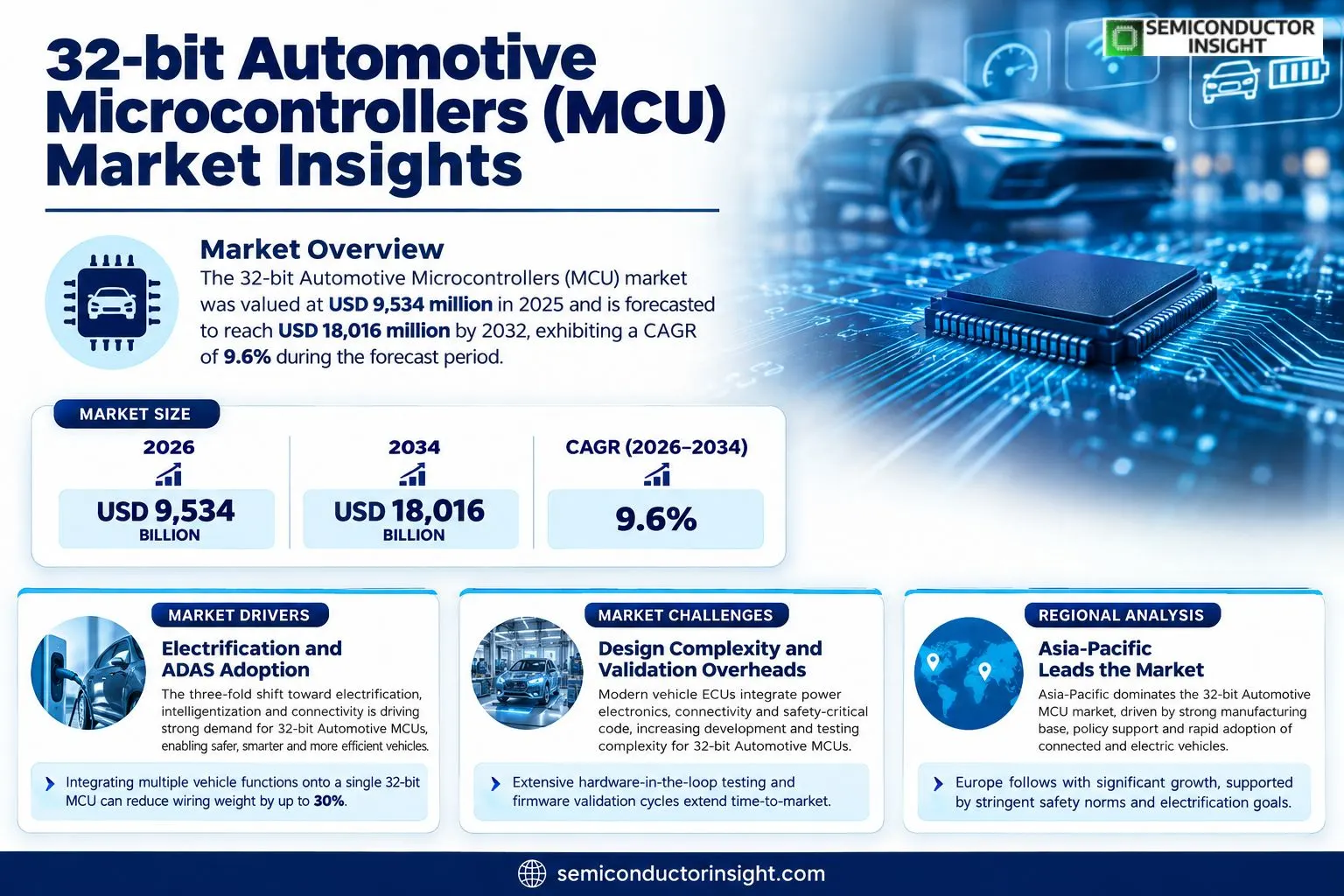
32-bit Automotive Microcontrollers (MCU) market was valued at USD 9,534 million in 2026 and is forecasted to reach USD 18,016 million by 2034, reflecting a CAGR of 9.6 % over the period.
These MCUs are high‑performance computing cores built specifically for automotive electronic systems. They combine a 32‑bit CPU with large Flash/RAM memory, precision ADC/DAC converters, multiple communication interfaces such as CAN, LIN and Ethernet, plus dedicated peripherals like motor‑control PWM and encryption engines. Supported by complex instruction sets and real‑time operating systems, they enable low‑latency control for powertrain functions, smart cockpit interactions and autonomous‑driving sensor fusion while meeting AEC‑Q100 reliability and ISO 26262 functional‑safety standards.The upward trajectory stems from the “three‑fold” shift toward electrification, intelligentization and connectivity across vehicles. Electric models require additional master‑slave MCUs for battery‑management systems; advanced cockpits rely on multi‑core units for multi‑screen displays and voice interfaces; autonomous features demand powerful processors for camera and radar data handlingLevel 3 autonomy typically integrates five to ten such MCUs per vehicle. Functional safety imperatives and low‑power designs further push technology iteration, while domestic substitution policies encourage local suppliers such as GigaDevice and BYD Semiconductor to gain market share alongside established players including Infineon Technologies, NXP Semiconductors and Renesas Electronics.
MARKET DRIVERS
Electrification and Power‑train Consolidation
The shift toward electric drivetrains has forced OEMs to reduce component count while maintaining high reliability. 32-bit Automotive Microcontrollers (MCU) Market suppliers that can integrate power‑stage control, battery‑management functions, and safety‑critical logic onto a single silicon die are capturing the attention of major manufacturers. This integration translates into lighter wiring harnesses, lower assembly time, and measurable cost efficiencies that directly improve vehicle profitability.
Advanced Driver‑Assistance Systems (ADAS) Adoption
ADAS features such as adaptive cruise control, lane‑keeping assist, and automated emergency braking demand processors with higher computational bandwidth and deterministic latency. 32-bit Automotive Microcontrollers (MCU) Market responds with multicore architectures that support real‑time image‑processing and sensor‑fusion workloads, enabling OEMs to differentiate their models without a proportional increase in hardware complexity.
➤ Integrating multiple vehicle functions onto a single 32‑bit MCU reduces wiring weight by up to 30 % and creates measurable cost savings for OEMs.
Beyond performance, the industry’s stricter functional‑safety standards (ISO 26262) compel manufacturers to select MCUs that incorporate built‑in self‑test and redundancy mechanisms. Vendors that embed these safety blocks gain a competitive edge, because system‑level certification timelines shorten dramatically.
MARKET CHALLENGES
Design Complexity and Validation Overheads
Modern vehicle ECUs now host a blend of power electronics, connectivity stacks, and safety‑critical code, which elevates firmware complexity. Engineers spend considerable effort on code‑size optimization and timing analysis, extending development cycles for 32-bit Automotive Microcontrollers (MCU) Market. The need for extensive hardware‑in‑the‑loop testing further strains resources, especially for Tier‑1 suppliers juggling multiple program launches.
Other Challenges
Supply‑Chain Fragility
The limited number of semiconductor fabs capable of producing automotive‑grade 32‑bit devices introduces bottlenecks during peak demand. Sudden shifts in wafer capacity often translate into longer lead times, forcing OEMs to hold higher inventory buffers and eroding the cost advantage of MCU consolidation.
MARKET RESTRAINTS
High Development Expenditure
Bringing a new 32-bit automotive MCU from concept to production typically requires investments exceeding $150 million, covering silicon design, qualification, and safety certification. Smaller tier‑2 suppliers often lack the capital to compete, limiting the diversity of options available to automakers.In parallel, the stringent automotive qualification processencompassing temperature cycling, electromagnetic compatibility, and long‑term reliability testsadds layers of cost that are not easily passed on to end customers without affecting price competitiveness.Moreover, the rapid evolution of vehicle software architectures forces MCUs to support over‑the‑air (OTA) update mechanisms, which in turn demands robust security features. Implementing secure boot, encrypted firmware storage, and hardware‑rooted key management inflates bill‑of‑materials, nudging some vehicle programs toward legacy 8‑ or 16‑bit solutions for cost containment.
MARKET OPPORTUNITIES
Edge‑AI and OTA Capabilities
As vehicles become platforms for data‑driven services, the demand for on‑board AI inference grows. 32‑bit MCUs equipped with dedicated neural‑network accelerators enable real‑time object detection and driver‑behavior analysis without offloading to centralized processors, opening new revenue streams for OEMs through premium safety packages.Simultaneously, the adoption of OTA update frameworks gives manufacturers the flexibility to deploy feature upgrades and security patches throughout a vehicle’s lifecycle. MCUs that provide secure key storage and fail‑safe boot paths become essential enablers, positioning vendors that have already integrated these safeguards to capture a substantial share of upcoming projects.Emerging markets in Southeast Asia and Latin America are experiencing a surge in locally assembled vehicles that meet safety standards. Suppliers that can offer cost‑effective 32‑bit MCU families with modular peripheral sets stand to benefit from the regional push toward higher‑quality, technology‑rich automobiles.
32-bit Automotive Microcontrollers (MCU) Market Trends
Electrification and Advanced Driver Assistance Fuel MCU Demand
32-bit Automotive Microcontrollers (MCU) Market has moved beyond niche applications, becoming the backbone of modern powertrains and driver‑assistance systems. In 2026 sales reached roughly 12 billion units, with an average selling price near $870 per thousand units, underpinning a revenue base of $9.5 billion. Electric vehicles now require dedicated master and slave MCUs for battery‑management and motor‑control functions, while Level 3 autonomous platforms typically embed five to ten of these devices to execute sensor‑fusion and real‑time decision algorithms. This hardware proliferation translates into higher gross margins of 45‑60 % for manufacturers that can integrate safety‑critical peripherals and low‑power techniques within a single die.
Other Trends
Safety‑Critical Integration and Power Efficiency
Functional‑safety certification (ISO 26262 ASIL‑D) and extended operating temperature ranges (‑40 °C to 150 °C) compel designers to embed hardware encryption, watchdog timers, and dynamic voltage scaling directly into the MCU architecture. The shift toward RISC‑V cores in several fabless projects illustrates an industry effort to curb R&D expenses while preserving deterministic performance. Low‑power modes now achieve sub‑milliwatt idle currents, a crucial attribute for battery‑powered modules such as smart cockpit controllers and telematics units. These technical refinements not only satisfy regulatory scrutiny but also open avenues for OEMs to consolidate multiple functions onto fewer silicon pieces, thereby reducing board‑level complexity and cost.
Localization and Supply‑Chain Resilience
Geopolitical uncertainty and recurring chip shortages have accelerated a move toward domestic substitution for 32-bit Automotive Microcontrollers (MCU) Market. While international vendors historically supplied over 90 % of automotive‑grade devices, policy incentives and R&D subsidies are enabling local firms like GigaDevice and BYD Semiconductor to secure AEC‑Q100 and ISO 26262 certifications at scale. This nascent local capacity narrows the technology gap and mitigates supply‑chain risk for Tier 1 suppliers, who increasingly favor mixed‑source strategies. As regional production ramps up, pricing pressure may intensify, prompting incumbent players to differentiate through advanced safety modules and higher‑density memory offerings.
COMPETITIVE LANDSCAPE
Key Industry Players
32‑Bit Automotive MCU Competitive Overview
Infineon Technologies, NXP Semiconductors and Renesas Electronics dominate the upper tier of the 32‑bit automotive microcontroller market. Their portfolios combine high‑performance Cortex‑M cores with integrated safety‑critical peripherals, enabling OEMs to consolidate power‑train, chassis and infotainment functions onto a reduced silicon count. The three firms control a majority of revenue share, leveraging mature IDM capabilities and extensive AEC‑Q100 certification pipelines. Their pricing power, coupled with deep relationships to Tier‑1 suppliers, creates a barrier to entry that shapes the overall market structure; most mid‑size players cluster around niche applications such as body‑domain or specialized sensor‑fusion modules.Beyond the leading trio, a diversified set of competitors is gaining traction in focused segments. STMicroelectronics and Texas Instruments offer broad‑range product families that balance cost and performance for entry‑level ADAS and electric‑vehicle battery‑management systems. Analog Devices and Silicon Laboratories specialize in high‑precision analog front‑ends and secure communication stacks, appealing to safety‑critical chassis controllers. Emerging domestic firmsGigaDevice Semiconductor, BYD Semiconductor, and Nuvoton Technologyare capitalising on localisation policies, delivering AEC‑Q100‑qualified parts at competitive unit costs. Their progress narrows the traditional reliance on foreign manufacturers and introduces a modest but growing amount of supply‑chain resilience for automakers.
List of Key Automotive MCU Companies Profiled
- Infineon Technologies
- NXP Semiconductors
- Renesas Electronics
- Microchip Technology
- STMicroelectronics
- Texas Instruments
- Analog Devices
- Silicon Laboratories
- Toshiba
- GigaDevice Semiconductor
- BYD Semiconductor
- Nuvoton Technology
- ON Semiconductor
- Cypress Semiconductor
- Renesas Electronics (Automotive Division)
Segment Analysis:
| Segment Category | Sub-Segments | Key Insights |
| By Type |
|
General Purpose Type
|
| By Application |
|
Powertrain & Battery Management
|
| By End User |
|
Tier‑1 Suppliers
|
| By Technology |
|
Functional Safety
|
| By Functional Domain |
|
Power Domain MCU
|
Regional Analysis: 32-bit Automotive Microcontrollers (MCU) Market
Asia‑Pacific
Domestic silicon fabs in Taiwan and South Korea dominate wafer capacity, while emerging Chinese foundries are rapidly scaling to meet automotive‑grade reliability demands. International players such as NXP and Renesas maintain joint ventures, ensuring that design libraries stay compatible with regional safety standards and enabling faster time‑to‑market for 32‑bit MCU‑based solutions.
Multi‑core 32‑bit MCUs are gaining traction in electric‑vehicle power‑train controllers, where real‑time torque management and battery‑management algorithms require deterministic processing. The shift toward high‑speed CAN‑FD and Ethernet‑based in‑vehicle networks further pushes manufacturers to adopt devices with larger address spaces and enhanced security modules.
Stricter functional‑safety mandates, exemplified by regional adaptations of ISO 26262, compel automakers to select MCUs that offer robust diagnostic coverage and fail‑safe mechanisms. Local safety certification bodies are increasingly requiring traceability of firmware versions, a requirement well‑served by 32‑bit architectures that support secure boot and encrypted updates.
Beyond passenger cars, commercial vans and two‑wheelers are integrating 32‑bit MCUs to manage telematics, rider‑assist functions, and predictive maintenance. The rise of shared‑mobility services in dense Asian metros amplifies demand for over‑the‑air capable controllers that can evolve feature sets without hardware retrofits.
North America
North America maintains a sophisticated demand base for 32‑bit Automotive Microcontrollers (MCU) Market due to its early adoption of advanced driver‑assist systems. OEMs in the United States and Canada prioritize safety‑critical applications, which pushes suppliers to embed redundancy and secure boot features in their silicon. The region’s strong IP landscape encourages partnerships between semiconductor firms and software houses, producing turnkey solutions for autonomous‑driving pilots. While the market size is modest compared with Asia‑Pacific, the emphasis on premium vehicle platforms creates a niche for high‑performance MCUs that can handle intensive sensor fusion workloads. Regulatory pressure from FMVSS and evolving federal guidelines on cybersecurity further shapes procurement strategies, compelling manufacturers to favor devices with proven functional‑safety track records.
Europe
Europe’s automotive sector is characterized by a dense network of legacy manufacturers transitioning toward electrification and connectivity. The 32‑bit Automotive Microcontrollers (MCU) Market benefits from the EU’s Green Deal, which accelerates the rollout of electric‑powertrains demanding precise motor‑control algorithms. European Tier‑1 suppliers are investing heavily in hardware‑in‑the‑loop simulation environments to validate MCU firmware against stringent UNECE safety norms. Simultaneously, a wave of collaborative research initiatives across Germany, France, and Sweden focuses on integrating over‑the‑air update capabilities, positioning 32‑bit architectures as the backbone for future‑proof vehicle electronics. The region’s emphasis on data privacy also drives demand for MCUs that can host secure enclaves, aligning with upcoming GDPR‑aligned automotive data regulations.
South America
In South America, market momentum for 32‑bit Automotive Microcontrollers (MCU) is linked to the gradual penetration of mid‑range vehicles equipped with advanced infotainment and telematics suites. Brazil’s emerging automotive hub is attracting foreign MCU vendors seeking to establish localized assembly lines that meet regional cost constraints while preserving performance. Automotive manufacturers are beginning to replace legacy 8‑bit controllers with 32‑bit alternatives to support predictive maintenance and fleet‑management platforms that are increasingly required by logistics operators. Although regulatory frameworks are less prescriptive than in North America or Europe, growing consumer expectations for connectivity are nudging OEMs toward more capable microcontrollers.
Middle East & Africa
The Middle East & Africa region presents a unique blend of luxury‑vehicle demand and expanding commercial‑fleet operations, both of which drive interest in 32‑bit Automotive Microcontrollers (MCU) Market solutions. Wealth‑driven markets such as the United Arab Emirates are adopting high‑end electric and hybrid models that rely on sophisticated motor‑control MCUs. Meanwhile, emerging economies in Africa are standardizing on robust, low‑cost vehicle platforms where 32‑bit MCUs provide a cost‑effective upgrade path for safety and connectivity features. Regional automotive partnerships are beginning to explore local firmware customization, ensuring that devices can tolerate extreme temperature ranges typical of desert environments while still delivering the processing headroom required for advanced driver‑assist functions.
Report Scope
This market research report provides a comprehensive analysis of the 32-bit Automotive Microcontrollers (MCU) Market , covering the forecast period 2026–2034. It offers detailed insights into market dynamics, technological advancements, competitive landscape, and key trends shaping the industry.
Key focus areas of the report include:
- Market Overview: The report begins with an overview outlining its current market scenario, key growth indicators, and industry transformation drivers. It discusses macroeconomic factors, demand–supply balance, regulatory landscape, and the strategic role of semiconductors in powering advancements across industries such as automotive, telecommunications, consumer electronics, and industrial automation.
- Market Size & Forecast: Historical data and future projections for revenue, unit shipments, and market value across major regions and segments.
- Segmentation Analysis: Detailed breakdown by product type, technology, application, and end-user industry to identify high-growth segments and investment opportunities.
- Regional Insights: Insights into market performance across North America, Europe, Asia-Pacific, Latin America, and the Middle East & Africa, including country-level analysis where relevant.
- Competitive Landscape: Profiles of leading market participants, including their product offerings, R&D focus, manufacturing capacity, pricing strategies, and recent developments such as mergers, acquisitions, and partnerships.
- Technology Trends & Innovation: Assessment of emerging technologies, integration of AI/IoT, semiconductor design trends, fabrication techniques, and evolving industry standards.
- Market Drivers & Restraints: Evaluation of factors driving market growth along with challenges, supply chain constraints, regulatory issues, and market-entry barriers.
- Stakeholder Insights: Insights for component suppliers, OEMs, system integrators, investors, and policymakers regarding the evolving ecosystem and strategic opportunities.
Primary and secondary research methods are employed, including interviews with industry experts, data from verified sources, and real-time market intelligence to ensure the accuracy and reliability of the insights presented.
FREQUENTLY ASKED QUESTIONS:
What is the current market size of 32-bit Automotive Microcontrollers (MCU) Market?
-> 32-bit Automotive Microcontrollers (MCU) Market was valued at USD 9,534 million in 2026 and is expected to reach USD 18,016 million by 2034.
Which key companies operate in 32-bit Automotive Microcontrollers (MCU) Market?
-> Key players include Infineon Technologies, NXP Semiconductors, Renesas Electronics, Microchip Technology, STMicroelectronics, Texas Instruments, Analog Devices, Silicon Laboratories, Toshiba, Giga Device Semiconductor.
What are the key growth drivers?
-> Key growth drivers include electrification, intelligentization, connectivity (the three‑fold trend), functional safety and low‑power requirements, and domestic substitution policies promoting localization.
Which region dominates the market?
-> Asia‑Pacific dominates the market, while Europe remains a significant region with strong automotive manufacturing bases.
What are the emerging trends?
-> Emerging trends include adoption of RISC‑V architecture, increased deployment of MCUs for Level 3+ autonomous driving, integration of hardware encryption modules, and higher emphasis on functional‑safety‑qualified designs.
Get Sample Report PDF for Exclusive Insights
Report Sample Includes
- Table of Contents
- List of Tables & Figures
- Charts, Research Methodology, and more...