
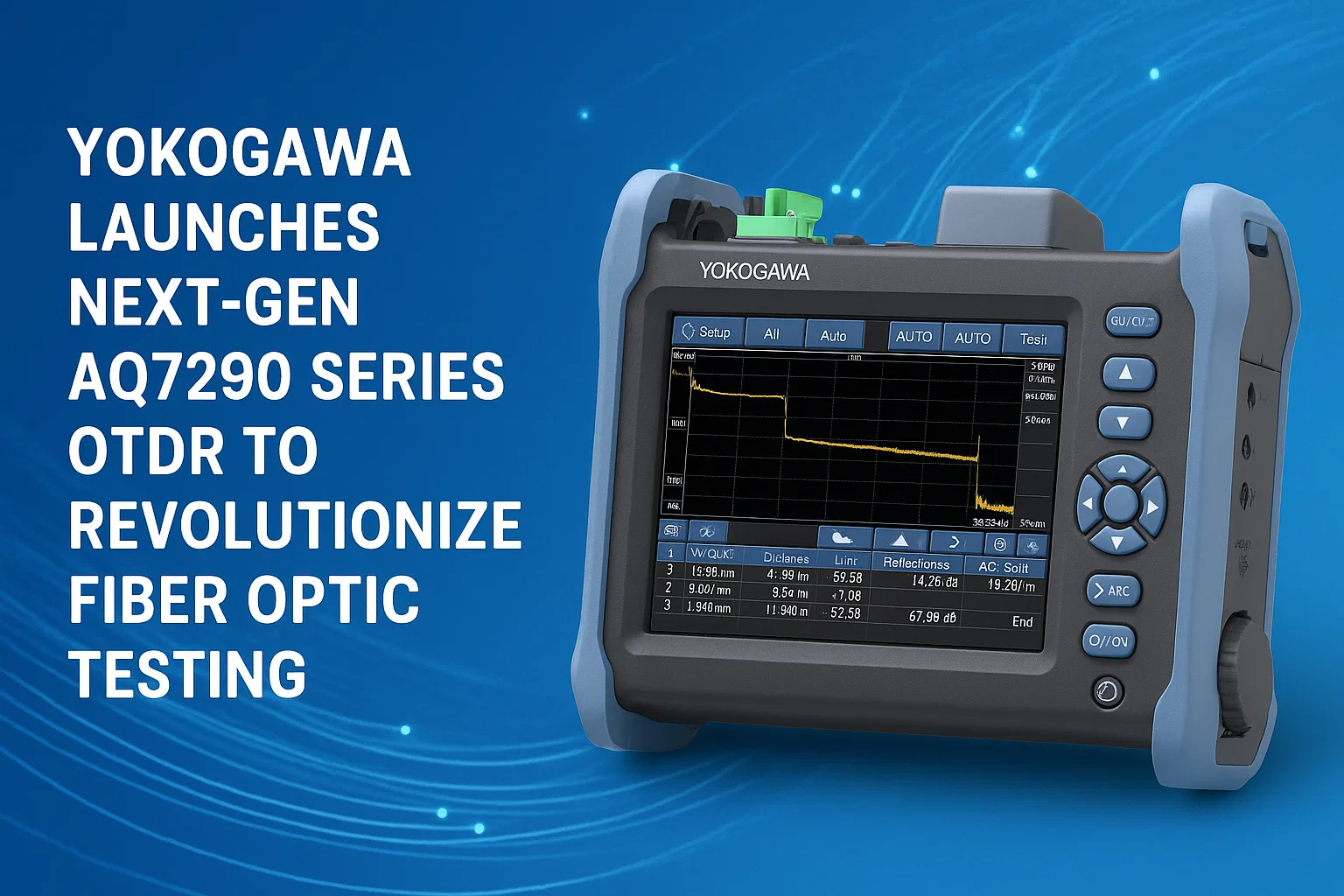
Yokogawa Launches Next-Gen AQ7290 Series OTDR to Revolutionize Fiber Optic Testing
The Time Domain Reflectometer (TDR) industry is experiencing a wave of innovation driven by rapid advancements in telecommunications, fiber optic networks, and electrical infrastructure diagnostics. As the demand for faster and more reliable network testing tools grows, manufacturers are introducing next-generation TDRs with advanced capabilities such as AI-powered diagnostics, autonomous monitoring, and enhanced portability.
According to recent data, the global TDR market was valued at USD 567 million in 2024 and is projected to reach USD 823 million by 2032, growing at a CAGR of 4.9% between 2025 and 2032. This growth reflects the vital role TDRs play in maintaining modern communication systems, smart grids, and industrial networks.
Access Your Free Sample Report- Time Domain Reflectometers Market
Understanding Time Domain Reflectometers: A Brief Overview
A Time Domain Reflectometer is a diagnostic instrument used to detect faults in cables, connectors, and fiber optic lines by sending an electrical pulse through the conductor and analyzing the reflections caused by impedance mismatches or breaks. TDRs are essential in industries such as:
- Telecommunications – for testing fiber optic and copper networks.
- Power utilities – for monitoring live electrical grids and detecting line faults.
- Aerospace and defense – for ensuring mission-critical systems remain operational.
- Manufacturing and industrial automation – to maintain process efficiency and prevent costly downtime.
The versatility of TDRs has expanded in recent years, with manufacturers integrating multi-function capabilities, wireless connectivity, and cloud-based reporting systems to meet modern diagnostic needs.
Recent Developments Shaping the TDR Industry
The past year has seen significant advancements in TDR technology, product launches, and innovative concepts. Here’s a detailed look at the most notable updates:
1. Yokogawa Unveils AQ7290 Series OTDR – Setting a New Benchmark in Performance
Yokogawa Test & Measurement has introduced its AQ7290 Series Optical Time Domain Reflectometer, a groundbreaking product line designed for faster, more precise network diagnostics. This next-generation OTDR represents a major leap forward in fiber optic testing.
Key Features of AQ7290:
- Ultra-fast start-up time: Power-on to measurement in under 10 seconds.
- User-friendly interface: Multi-touch display with one-button measurement capabilities.
- Improved dynamic range: Enhanced by +2 dB compared to the previous AQ7280 model.
- Multi-wavelength support: Available in six different models with two or three wavelength options.
- Streamlined field use: Portable design suitable for outdoor and industrial environments.
This launch aligns with the growing demand for high-speed broadband networks and 5G infrastructure expansion, where precise and reliable fiber testing is critical. Yokogawa’s innovation demonstrates how leading companies are investing in field-ready devices to support the rapid rollout of next-gen networks.
2. Platinum Tools Introduces PT-OTDR-100 Mini OTDR at BICSI 2024
Platinum Tools unveiled the PT-OTDR-100, a compact and multi-function portable OTDR tester, designed to simplify fiber network testing in both commercial and industrial applications. The launch marks a trend toward lightweight, all-in-one field devices that reduce testing complexity.
Highlights of PT-OTDR-100:
- 5-inch OLED touchscreen display for easy operation.
- Integrated OTDR, Optical Power Meter (OPM), Visual Fault Locator (VFL), and laser source.
- Copper and fiber testing support in a single device.
- Exportable test reports for compliance and documentation.
- Long battery life suitable for field technicians.
The device was particularly well-received by network installers and maintenance teams, offering a cost-effective solution for small and medium-sized enterprises. As fiber networks continue to expand globally, demand for compact OTDRs like this is expected to rise sharply.
3. Autonomous TDR Development by Savannah River National Laboratory (SRNL)
Innovative Concept in Grid Monitoring
Savannah River National Laboratory (SRNL) has conceptualized an autonomously powered, inductively coupled TDR system for real-time monitoring of electrical grids and power lines. This revolutionary approach aims to eliminate manual diagnostics by enabling TDRs to operate continuously without external power sources.
Core Features:
- Inductive power harvesting: Operates directly from live power lines.
- Battery backup: Ensures continuous operation during outages.
- GPS integration: Pinpoints fault locations with high accuracy.
- 4G cellular connectivity: Transmits data directly to control centers for rapid response.
If commercialized, this technology could transform smart grid monitoring, providing utility companies with real-time insights into line health and potential faults. It also aligns with the global push toward autonomous, IoT-enabled infrastructure.
Download Sample Report PDF- Time Domain Reflectometers Market
4. Advancements in TDR Testing Techniques
A July 2025 feature article in ECMweb emphasized the importance of proper testing techniques when using TDRs. The report provided updated guidelines on maximizing accuracy, including:
- Correct calibration for different cable types.
- Optimizing pulse width for detecting faults in long vs. short cables.
- Leveraging advanced software analytics for reflection data interpretation.
- Avoiding common mistakes like overdriving signals, which can distort readings.
As TDR technology evolves, training and best practices become critical to ensure technicians can fully utilize advanced features for network diagnostics.
Market Dynamics Driving Growth
The TDR market’s steady growth is fueled by several key factors:
1. Expansion of Global Fiber Optic Networks
The rollout of 5G and high-speed broadband infrastructure has created a surge in demand for fiber testing equipment. As countries invest in digital connectivity, network operators require reliable TDRs to verify installations and troubleshoot issues.
- Example: The U.S. government’s BEAD program (Broadband Equity, Access, and Deployment) is allocating billions toward fiber deployment, directly boosting OTDR sales.
2. Rise of Smart Grids and Renewable Energy Systems
The transition to smart grids and renewable energy sources like wind and solar requires precise monitoring of electrical transmission lines. TDRs are critical in detecting line degradation, ensuring energy reliability, and preventing outages.
- Innovations like SRNL’s autonomous TDR could become foundational in real-time grid management.
3. Growth in Aerospace and Defense Applications
Military and aerospace sectors depend on fault-free communication and control systems. TDRs are vital for pre-flight checks, satellite communication systems, and defense infrastructure.
Governments worldwide are increasing investments in aerospace technology, providing another growth avenue for TDR manufacturers.
4. Increasing Demand for Portable, Multi-Function Devices
The shift toward field-deployable diagnostic tools is driving innovation. Modern technicians prefer compact, multi-capability devices like Platinum Tools’ PT-OTDR-100, which combine several testing functions in a single unit.
This trend is particularly strong in emerging markets, where cost-effective solutions are a priority.
Challenges Facing the TDR Industry
Despite the positive outlook, the industry faces several challenges that could impact growth:
- High Initial Costs
Advanced OTDRs and specialized TDRs remain expensive, posing barriers for small-scale network operators and startups. - Need for Skilled Technicians
Operating modern TDRs requires training and expertise. A shortage of skilled professionals may limit adoption rates in some regions. - Rapid Technological Changes
As networks evolve (e.g., 5G to 6G), manufacturers must continuously innovate to stay relevant, which increases R&D costs. - Competition from Alternative Technologies
Other diagnostic tools like vector network analyzers (VNAs) may compete in certain applications, requiring TDR companies to differentiate their offerings.
Regional Insights: Where Growth is Happening
North America
- The largest market share, driven by 5G rollouts and smart grid modernization.
- The U.S. is investing heavily in fiber broadband expansion and utility infrastructure.
Asia-Pacific
- Rapid urbanization and government-backed digitalization initiatives in China, India, and Japan.
- Growing demand for portable OTDRs due to widespread fiber deployments.
Europe
- Strong focus on renewable energy integration and telecom upgrades.
- Countries like Germany and the UK are investing in grid reliability systems.
Latin America and Africa
- Emerging markets with significant opportunities for low-cost, portable TDR solutions as telecom networks expand.
Future Outlook: The Road to 2032
By 2032, the TDR market is expected to reach USD 823 million, powered by:
- Integration with IoT and AI: Next-gen TDRs will feature predictive analytics, reducing downtime through proactive fault detection.
- Cloud connectivity: Real-time data sharing and remote diagnostics will become standard.
- Miniaturization: Compact, handheld devices will dominate fieldwork applications.
- Sustainability focus: Energy-efficient designs and recycling initiatives will shape manufacturing practices.
Click Here To Download Full Sample Report- Time Domain Reflectometers Market
Key Players Leading the Market
Several companies are at the forefront of TDR innovation:
- Yokogawa Electric Corporation – Pioneering advanced OTDRs like the AQ7290 series.
- VIAVI Solutions Inc. – Offering a wide range of fiber testing solutions.
- Megger Group – Known for electrical TDRs used in utility applications.
- Keysight Technologies – Leading in high-precision diagnostic instruments.
- Platinum Tools – Innovating compact, affordable OTDR devices for field technicians.
The Time Domain Reflectometer industry is entering an exciting era of growth and transformation. With advancements like Yokogawa’s AQ7290 OTDR, Platinum Tools’ mini field devices, and SRNL’s autonomous monitoring concepts, the market is moving toward smarter, more integrated solutions. With the market projected to grow steadily from USD 567 million in 2024 to USD 823 million by 2032, industry players have a clear opportunity to innovate and capture emerging demand across diverse sectors.

Comments (0)