
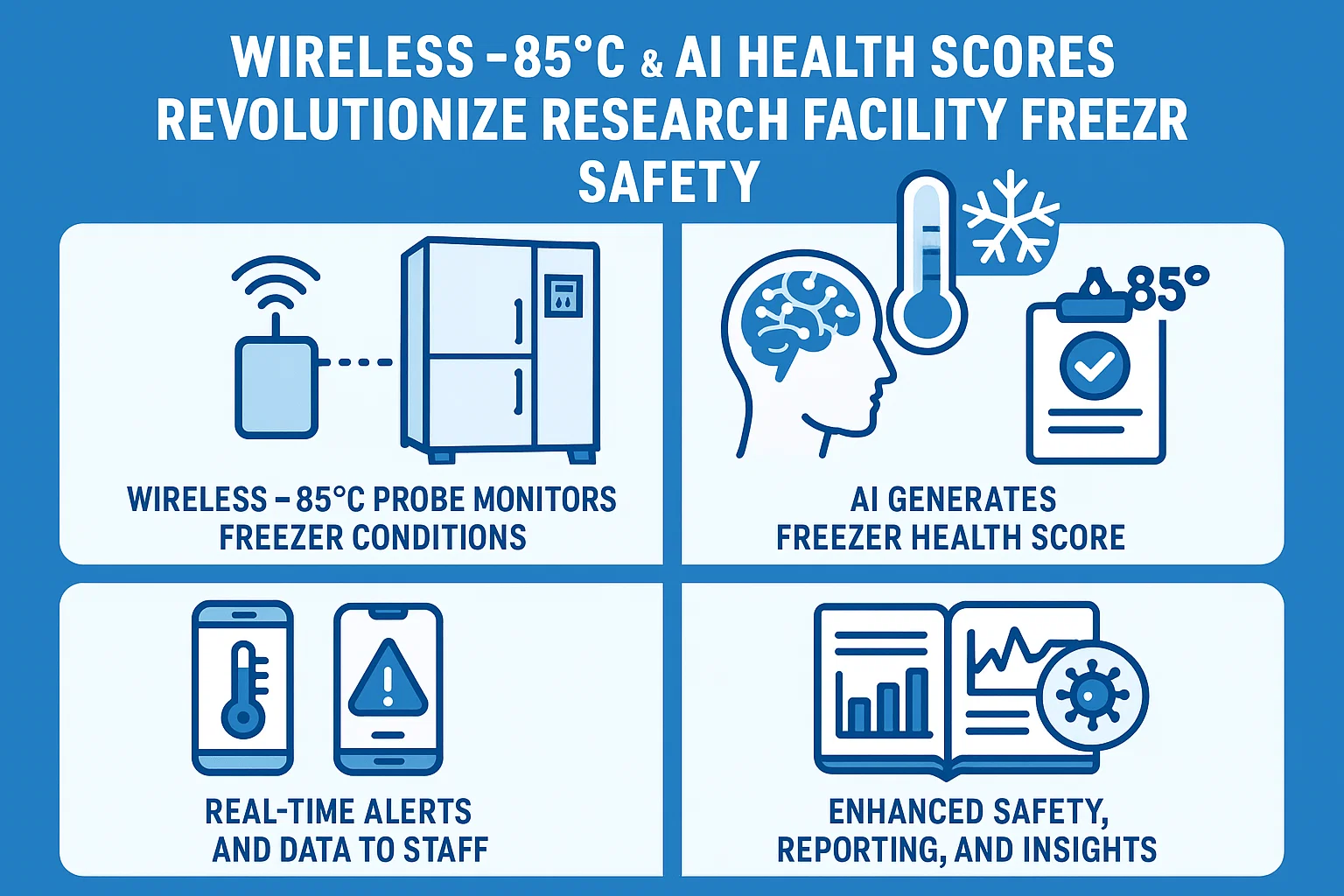
Wireless −85 °C Probes & AI Health Scores Revolutionize Research Facility Freezer Safety
In today’s data-driven and compliance-heavy industries, temperature monitoring has become more than a support function—it’s a mission-critical operation. The freezer temperature monitor market, which stood at US$ 284.7 million in 2024, is poised to reach a value of US$ 467.9 million by 2032, growing at a CAGR of 7.4% during the forecast period. This growth is not merely quantitative; it is driven by transformative developments in technology, regulation, and user expectations.
Access Your Free Sample Report- Freezer Temperature Monitor Market
The Importance of Freezer Temperature Monitoring in Critical Industries
In sectors like biopharma, clinical trials, food safety, and diagnostics, freezer reliability is non-negotiable. Temperatures must remain within strict thresholds to ensure sample integrity, drug efficacy, and food safety. Freezer temperature monitoring tools offer real-time visibility, historical data logging, alarm-based alerts, and now, predictive analytics, minimizing the risk of costly losses.
Research institutions, for instance, have reported that over 25% of their freezer assets lacked continuous monitoring until recently. At places like the Icahn School of Medicine, recent shifts toward centralized, wireless monitoring systems now protect millions of dollars in biological materials.
Market Drivers and Growth Metrics
Several factors are propelling market growth:
- Stringent Regulatory Compliance: GxP guidelines, HACCP standards, and 21 CFR Part 11 demand data integrity in temperature monitoring.
- Rise in Biopharmaceuticals: The surge in biologics and cell/gene therapies requires ultra-low temperature storage (-80°C or lower).
- Expansion of Cold Chain Logistics: Growing global trade of vaccines, perishables, and specialty foods necessitates robust monitoring systems.
- Technological Advancements: Innovations in AI, cloud computing, and wireless networking are making systems more scalable and intelligent.
Technological Advancements Redefining the Industry
AI-Powered Predictive Maintenance
Elemental Machines has introduced an AI-enhanced health score for freezer systems. These tools evaluate data from temperature fluctuations, compressor cycling, and power draw to predict unit failure before it happens. This minimizes false alarms and allows proactive maintenance, a game-changer in labs with hundreds of refrigeration units.
Wireless Edge-Based Sensors
Phase IV Engineering has released wireless monitoring tools capable of operating down to -85°C. These sensors use edge computing to locally process temperature data, reducing the load on cloud systems and preserving bandwidth. With thin-profile sensor cables, the systems also maintain the seal integrity of ULT freezers.
Cloud-Connected Compliance Logging
Providers like Vaisala (viewLinc) and Monnit ALTA offer real-time, cloud-connected temperature logs with 24/7 remote access. These systems meet FDA and ISO standards, making them ideal for regulated environments. Some can even track freezer door open/close activity, water leaks, and power interruptions—providing a holistic risk profile.
Download Sample Report PDF- Freezer Temperature Monitor Market
Notable Industry Deployments
Icahn School of Medicine, New York
Historically, many research institutions manually logged temperatures or used rudimentary sensors. The Icahn School of Medicine transformed its monitoring program by adopting battery-backed, wireless sensors with redundant connectivity. This shift ensures uninterrupted monitoring even during blackouts or network outages.
Elemental Machines in Biotech Labs
Their AI-predicted Health Score system is now standard in biotech labs and incubators. By combining multiple sensor inputs, the platform identifies deviations in cooling cycles and alerts staff about potential freezer failures days in advance, thereby saving irreplaceable biological assets.
DIY Community at Hackaday
A custom project published by Hackaday showcases a DIY approach using K-type thermocouples, microcontrollers, and Home Assistant. Although not suitable for commercial use, such solutions are empowering small labs and enthusiasts with low-cost monitoring alternatives, especially where connectivity is poor.
Freezer Monitoring in the Healthcare Sector
Hospitals and clinics increasingly use medical-grade, AI-backed temperature monitors to store vaccines, reagents, and transplant materials. The systems meet WHO PQS standards and ensure traceability. With the global push toward vaccination programs and organ transplant readiness, these systems are becoming mandatory.
Companies like Swift Sensors and DeltaTrak have embedded alert protocols to notify clinicians via text, email, or app push notifications when deviations occur.
Food & Beverage Industry Applications
Commercial kitchens, grocery stores, and food transporters are leveraging HACCP-compliant sensors to ensure food safety. Monnit’s ALTA sensors, for instance, are designed to operate in cold warehouses and shipping containers, with real-time reporting to mobile dashboards.
The systems also support historical data analysis, enabling managers to audit freezer reliability during inspections or in the event of a recall.
Regulatory Standards Shaping Adoption
- 21 CFR Part 11 (FDA): Requires secure, audit-trailed data recording and access controls.
- GxP Compliance: Demands documented evidence that freezer systems consistently operate within intended specifications.
- HACCP & ISO 22000: Food safety standards that mandate reliable monitoring of refrigeration conditions.
Meeting these regulations requires systems with validated software, user authentication, time-stamped records, and secure backups.
Challenges and Opportunities
Key Challenges
- High upfront costs for validated systems
- Integration complexity with legacy equipment
- Signal penetration issues in walk-in or metal-lined freezers
Opportunities
- Integration with building automation systems (BAS)
- Subscription-based monitoring services (Monitoring-as-a-Service)
- Growth in emerging markets for cold chain compliance
Competitive Landscape and Innovation Outlook
While the market has key players like Vaisala, Monnit, DeltaTrak, and Elemental Machines, the field is rapidly diversifying. Startups are entering with niche offerings, especially in IoT-optimized devices and low-power wireless networks like LoRaWAN and Zigbee.
The next frontier is expected to include:
- Digital twins of refrigeration assets
- Augmented reality dashboards for maintenance staff
- Quantum dot-based nanosensors for ultra-precise monitoring
Click Here To Download Full Sample Report- Freezer Temperature Monitor Market
The Future of Cold Storage Monitoring
The industry is moving toward autonomous cold storage environments. Systems will self-diagnose, self-correct (via control feedback loops), and report only when human intervention is truly needed. This will reduce maintenance costs, lower energy consumption, and improve compliance.
As freezers become smarter, integrated, and more reliable, we can expect a massive reduction in sample loss, food wastage, and compliance risks. With real-time global access to data and alarms, organizations can respond instantly to anomalies—wherever they are.
The freezer temperature monitor market is undergoing a rapid transformation driven by necessity and innovation. With applications spanning biotech, medicine, academia, and food safety, the integration of AI, wireless technology, and predictive analytics is making monitoring systems more intelligent and resilient.
Backed by a strong CAGR of 7.4% through 2032, the sector is ripe for investment and development. For stakeholders across healthcare, research, and industry, now is the time to upgrade monitoring infrastructure—not just for compliance, but for a future where prevention, precision, and automation are the norm.

Comments (0)