
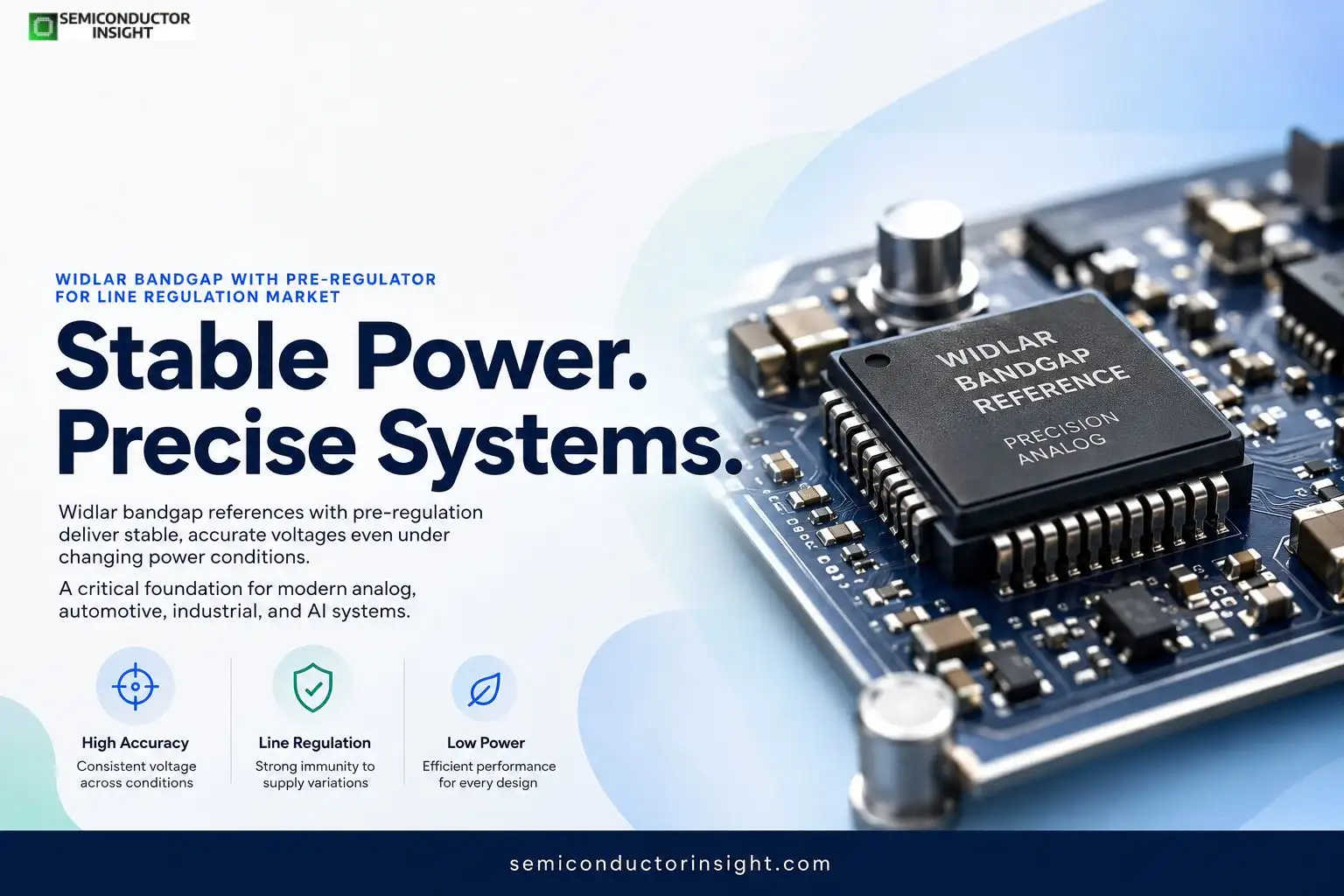
Widlar Bandgap with Pre-Regulator for Line Regulation Market 2026 Driven by Precision Voltage Reference Integration in Mixed Signal ICs
Every advanced semiconductor system depends on an accurate voltage reference, regardless of whether it powers an automotive controller, industrial sensor, AI accelerator, or medical monitoring device. Among the most established analog building blocks, the Widlar bandgap reference remains a cornerstone for generating stable voltage outputs that are largely independent of temperature variation.
When paired with a pre-regulator for line regulation, this architecture significantly improves immunity to supply voltage fluctuations, enabling higher precision across increasingly complex integrated circuits. As semiconductor manufacturers integrate more analog functionality into highly scaled process nodes, the Widlar bandgap with pre-regulator for line regulation market is gaining renewed relevance in precision power management ICs, data converters, battery management systems, and safety-critical electronics.
Why Line Regulation Has Become an Engineering Priority
- Today’s electronic systems operate under highly dynamic power conditions. AI processors, automotive ECUs, industrial automation equipment, and edge computing platforms frequently experience supply variations caused by changing workloads or battery conditions. Even small fluctuations can degrade analog performance.
- A pre-regulator minimizes these variations before they reach the Widlar bandgap reference, allowing downstream circuits to maintain stable output voltages. This is particularly valuable in analog-to-digital converters, low-dropout regulators, precision amplifiers, and sensor interfaces where reference accuracy directly influences system performance.
- As process technologies shrink below 5 nm and mixed-signal integration becomes denser, maintaining consistent reference voltages has become increasingly important for both analog and digital reliability.
Advanced Packaging Is Increasing Demand for Stable Reference Circuits
Modern semiconductor packages now combine CPUs, GPUs, memory, RF components, and analog blocks within a single package. According to industry data from SEMI, global semiconductor manufacturing continues expanding through hundreds of new fabrication projects, while advanced packaging capacity is expected to grow significantly throughout the decade.
These heterogeneous integration platforms require multiple precision voltage domains operating simultaneously. Widlar bandgap circuits with integrated pre-regulation help isolate sensitive analog references from noisy digital switching environments, improving signal integrity across the package.
This trend is particularly evident in AI accelerators, automotive SoCs, industrial controllers, and communication processors.
Precision Analog Remains Essential despite Digital Scaling
- Although digital transistors continue shrinking, analog circuits cannot simply scale in the same manner. Stable reference voltages remain fundamental to every precision mixed-signal design.
- According to the International Energy Agency, annual electric vehicle sales surpassed 17 million units in previous years, with each vehicle containing dozens of power management ICs, battery monitoring devices, voltage regulators, and sensor controllers. Many of these devices rely on highly accurate voltage references to support battery balancing, motor control, charging systems, and functional safety.
- Similarly, modern industrial automation systems incorporate thousands of sensing channels where accurate reference generation directly impacts measurement accuracy.
Take a Quick Glance at Our In-Depth Analysis Report: https://semiconductorinsight.com/report/widlar-bandgap-with-pre-regulator-for-line-regulation-market/
Design Innovations Are Moving Beyond Classical Architectures
The classical Widlar bandgap architecture is being enhanced with digital trimming, curvature compensation, startup optimization, and adaptive bias techniques. These improvements reduce temperature drift while maintaining compact silicon area.
Many integrated circuit designers now combine pre-regulation with low-noise bias generation, allowing reference circuits to maintain stability even when power rails fluctuate rapidly. Several recent IEEE research publications also explore ultra-low-power Widlar implementations for IoT devices consuming only a few microwatts during continuous operation.
Such innovations support battery-powered wearables, environmental sensors, wireless medical devices, and remote industrial monitoring equipment where every nanowatt matters.
Foundries Are Enabling Better Analog Integration
- Leading semiconductor foundries continue expanding specialized analog and mixed-signal manufacturing capabilities alongside advanced digital processes.
- Foundry platforms supporting 180 nm, 130 nm, 90 nm, 65 nm, and specialty BCD technologies remain widely used because they offer excellent analog performance, high-voltage capability, and mature reliability.
- These technologies allow engineers to integrate Widlar bandgap references, pre-regulators, EEPROM, power devices, and protection circuitry on a single die, reducing external components while improving long-term stability.
- As chiplet-based architectures become increasingly common, stable on-chip reference generation will remain an indispensable requirement across multiple dies and heterogeneous systems.
Reliability Standards Are Elevating Reference Circuit Design
Automotive electronics compliant with ISO 26262, industrial functional safety platforms following IEC 61508, and medical electronics governed by stringent quality standards all demand highly reliable analog references capable of operating continuously for many years.
This has shifted engineering priorities beyond voltage accuracy alone. Designers now evaluate long-term drift, electromagnetic immunity, startup robustness, radiation tolerance for aerospace applications, and resilience under extreme environmental conditions.
For this reason, the Widlar bandgap with pre-regulator architecture continues to evolve as a foundational element of next-generation semiconductor power management, delivering the stability required by increasingly intelligent, connected, and safety-critical electronic systems.

Comments (0)