
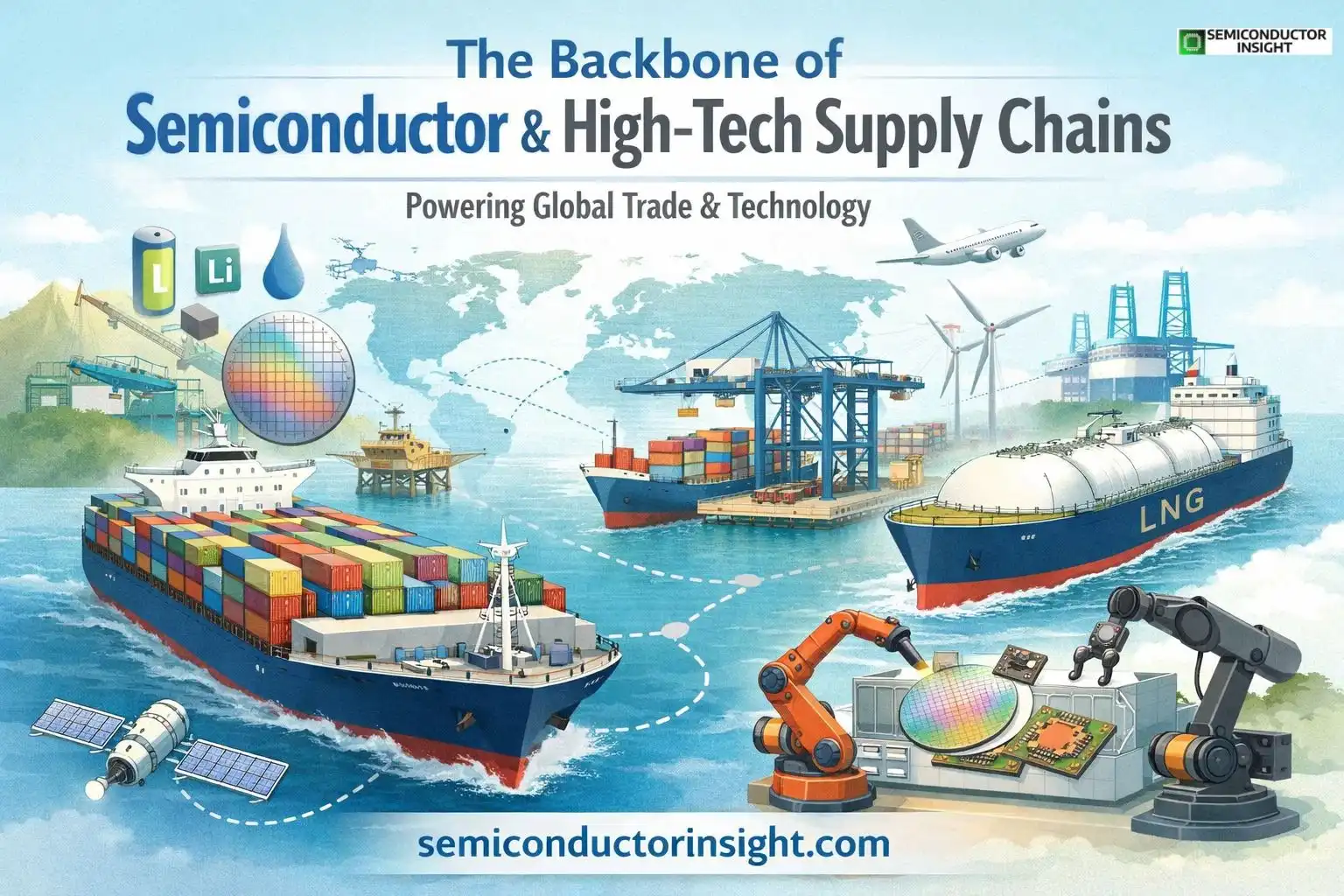
Why the Maritime Shipping Industry Is Becoming the Backbone of Semiconductor and High-Tech Supply Chains? of Semiconductor and High-Tech Supply Chains?
The Ocean Highways That Quietly Run the World More than 80% of global merchandise trade by volume moves by sea, according to data from the United Nations Conference on Trade and Development. From crude oil and iron ore to smartphones and servers, maritime shipping remains the invisible framework holding global commerce together. While aviation captures speed and headlines, it is container vessels, bulk carriers, and tankers that carry the weight of modern industrial economies.
In 2023 alone, global seaborne trade volumes crossed 12 billion tons, reflecting how deeply industries depend on maritime logistics. The rise of e-commerce, advanced electronics manufacturing, and energy transitions has only intensified this reliance. Shipping is no longer just about moving goods; it is about synchronizing production cycles across continents.
Containerization and the Modern Trade Architecture
- The standardized container remains one of the most transformative inventions in trade history.
- Today, the world’s largest container ships can carry over 24,000 TEUs (twenty-foot equivalent units), dramatically reducing per-unit transportation costs.
- Major operators like Maersk and Mediterranean Shipping Company control significant portions of global container capacity, shaping freight rates and supply flows.
- Ports have evolved into high-tech logistics ecosystems. Automated terminals in Rotterdam and Singapore operate with remote-controlled cranes and AI-assisted scheduling systems.
- According to port authority data from Singapore, vessel turnaround times have reduced by nearly 30% over the past decade due to digital coordination and predictive maintenance systems.
- This operational efficiency is critical for time-sensitive sectors such as semiconductor manufacturing, where a delay of even a few days can disrupt production lines across multiple countries.
Energy Cargoes and the Industrial Backbone
Beyond containers, bulk shipping remains fundamental. Around 40% of global seaborne trade consists of energy cargoes, including crude oil, liquefied natural gas, and coal. Tankers and LNG carriers are now being designed with dual-fuel engines to reduce emissions while maintaining efficiency.
The energy transition has also created new cargo categories. Shipments of battery raw materials such as lithium and cobalt have increased steadily over the last five years. Offshore wind components often exceeding 100 meters in length are transported by specialized heavy-lift vessels.
Maritime trade statistics published by the International Maritime Organization indicate that the global fleet surpassed 100,000 commercial vessels, highlighting the scale of ocean-based transport supporting power generation and electrification efforts worldwide.
Maritime Shipping and the Semiconductor Supply Web
- Semiconductors may be small, but their supply chain footprint is enormous. Advanced chips designed in the United States, fabricated in Taiwan, packaged in Malaysia, and assembled into devices in China or Vietnam all rely heavily on maritime freight.
- The dominance of Taiwan Semiconductor Manufacturing Company in advanced chip fabrication means that thousands of containers carrying silicon wafers, specialty chemicals, and precision equipment move through Asian sea routes every month. In 2021, when port congestion intensified during the global supply chain crisis, automotive production fell by millions of units worldwide due to chip shortages an example of how tightly shipping and semiconductor ecosystems are intertwined.
- Similarly, equipment makers such as ASML ship extreme ultraviolet lithography systems in specialized containers by sea for parts of their journey. These machines weigh over 150 tons when assembled, illustrating how maritime logistics supports even the most sophisticated layers of chip manufacturing.
- In short, maritime shipping underpins the semiconductor supply chain, ensuring advanced packaging substrates, silicon wafers, and chipmaking tools move seamlessly between innovation hubs.
Digital Shipping Lanes and Smart Vessels
The shipping industry has entered a phase of rapid digitalization. Smart vessels now use real-time weather routing systems, reducing fuel consumption by up to 10% per voyage. Satellite tracking, blockchain-based documentation, and predictive analytics are minimizing paperwork and fraud risks.
In 2024, several major carriers expanded biofuel-powered voyages, reporting emission reductions of up to 20% compared to conventional marine fuels. Meanwhile, autonomous vessel trials in Northern Europe demonstrate how crew requirements and navigation risks may shift over time.
These advancements reflect a broader transformation toward green shipping, as regulators and cargo owners push for lower carbon footprints. Maritime transport currently accounts for roughly 3% of global greenhouse gas emissions, a figure that has intensified innovation in cleaner propulsion systems.
Ports as Industrial and Technology Gateways
Modern ports are no longer simple docking points; they function as industrial clusters. Semiconductor equipment, automotive components, and consumer electronics often move through free trade zones adjacent to major ports. The Port of Shanghai, for instance, handled over 47 million TEUs in a recent year, maintaining its position as the busiest container port globally.
Data from government maritime agencies show that Asia accounts for more than 50% of global container throughput, underlining the region’s dominance in electronics and chip manufacturing exports. The integration of inland rail corridors with seaports has further reduced transit times by nearly 15% on some Asia-Europe routes.
These logistics ecosystems enable global trade integration, connecting fabrication plants, assembly units, and distribution centers across continents with remarkable precision.
Lastly before we wrap up, don’t forget to look at our most recent exclusive report for in-depth insights: https://semiconductorinsight.com/report/global-maritime-security-systems-market/
A Market Defined by Scale and Interdependence
The maritime shipping market today reflects more than transport capacity; it mirrors the structure of global industry itself. Whether moving advanced chipmaking tools, renewable energy components, or everyday consumer goods, shipping lines form the connective tissue of the world economy.
What makes the sector especially compelling is its blend of physical scale and technological refinement. Massive steel vessels cross oceans, yet their operations depend on data analytics, satellite systems, and synchronized manufacturing schedules.
As semiconductor complexity deepens and global production networks expand, maritime shipping continues to serve as the silent enabler. Without it, the rhythm of industrial growth from silicon wafer to finished smartphone would simply stall.

Comments (0)