
Which Seven Technology Trends Are Transforming the Time-of-Flight (ToF) Sensor Market in 2026?
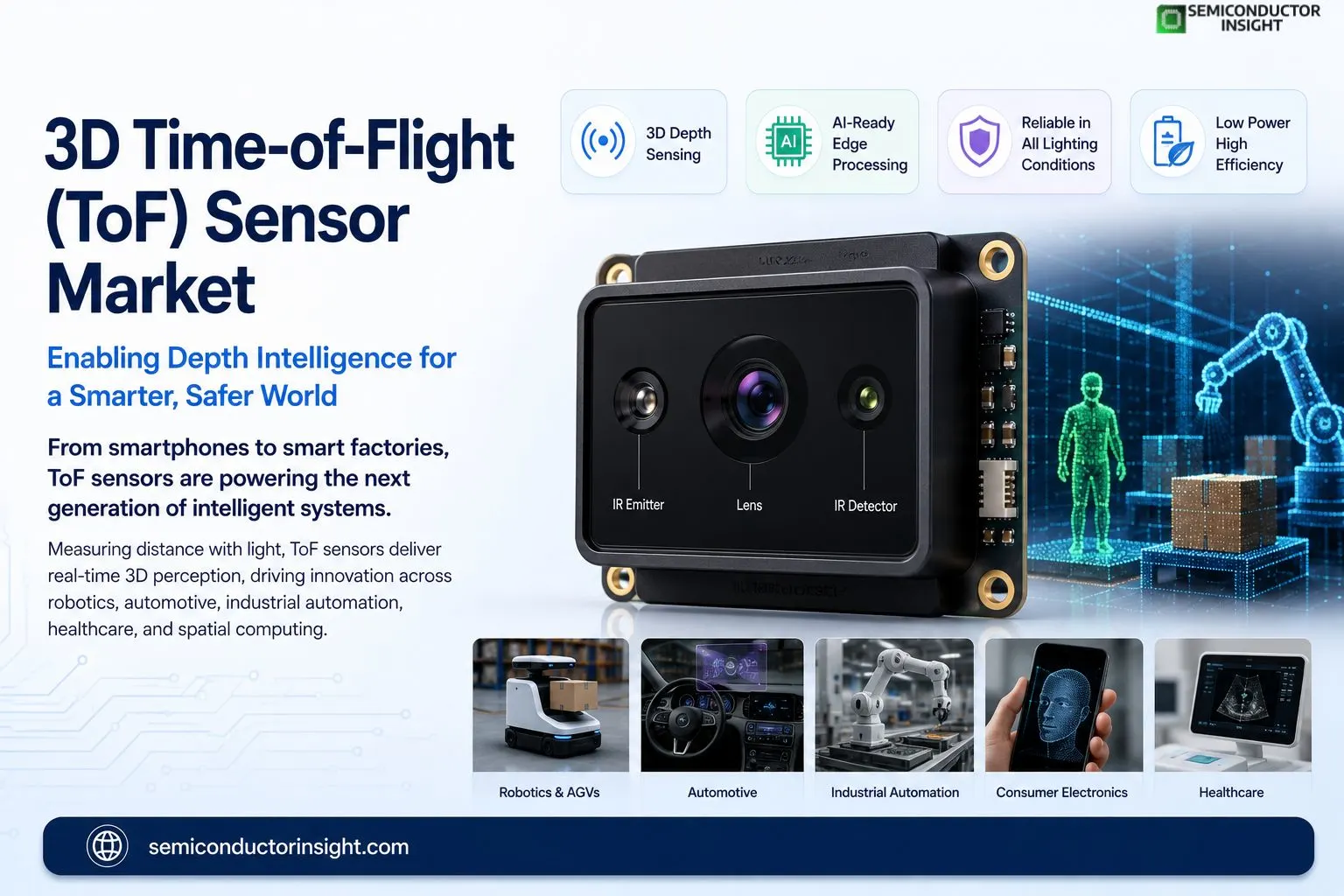
The semiconductor industry is entering a new era where machines no longer depend on images they interpret in real time, but instead interpret distance, movement and three-dimensional space. At the core of this change is Time-of-Flight (ToF) sensing, a technology that measures the time it takes for emitted light to travel to an object and back to the sensor. Turning these measurements into accurate depth maps, ToF sensors have become indispensable in smartphones, robotics, automotive systems, industrial automation, healthcare devices, and emerging spatial computing platforms.
Traditional image sensors only acquire information about color and brightness, but ToF sensors can provide accurate depth information regardless of surface texture, which makes it possible to recognize objects faster and interact with machines more safely. As artificial intelligence becomes more reliant on spatial awareness, ToF technology is moving from a niche imaging solution to a core semiconductor innovation.
Why Three-Dimensional Vision Is Becoming the New Standard?
Modern electronic systems increasingly require machines to understand physical environments with high accuracy. Whether navigating autonomous robots inside warehouses or enabling facial authentication on smartphones, depth sensing has become a critical capability.
A typical ToF sensor emits infrared light operating around 850 nm or 940 nm wavelengths, allowing measurements within milliseconds. Advanced indirect ToF sensors can capture hundreds of thousands of distance points simultaneously, supporting high-speed 3D mapping for applications where conventional cameras struggle under varying lighting conditions.
Consumer electronics remain among the largest adopters, but industrial robotics, logistics automation, and smart infrastructure are rapidly expanding deployment volumes as industries prioritize precision, efficiency, and operational safety.
Beyond Smartphones Where Semiconductor Innovation Is Creating New Demand
- Although smartphones introduced ToF technology to millions of consumers through facial recognition and camera autofocus improvements, the market has expanded far beyond mobile devices.
- Autonomous mobile robots operating inside modern distribution centers depend on depth sensing for obstacle avoidance and navigation. According to the International Federation of Robotics (IFR), more than 4.2 million industrial robots were operating in factories worldwide, creating growing demand for compact and reliable 3D sensing technologies.
- Similarly, collaborative robots increasingly integrate ToF sensors to monitor worker proximity and improve workplace safety without sacrificing operational speed.
- Automotive manufacturers are also incorporating ToF sensors into driver monitoring systems, gesture recognition interfaces, occupant detection, and intelligent cabin monitoring to support next-generation safety functions.
Semiconductor Manufacturing Is Unlocking Higher Precision
Recent semiconductor innovations have significantly improved ToF sensor performance while reducing power consumption and device size.
Manufacturers now combine backside-illuminated CMOS architectures, stacked semiconductor designs, and advanced wafer-level optics to enhance sensitivity and measurement accuracy. Improved pixel architectures allow sensors to generate denser point clouds while maintaining faster frame rates suitable for dynamic environments.
Another major advancement involves integrating AI processors directly alongside sensing hardware. Instead of transmitting raw depth information to cloud platforms, edge AI enables immediate processing inside devices, reducing latency while improving privacy and system responsiveness.
These improvements are particularly valuable for augmented reality headsets, autonomous inspection systems, and wearable electronics where compact size and real-time performance are essential.
Current Industry Momentum Is Extending ToF across Multiple Sectors
- Several recent developments demonstrate how rapidly ToF sensing is expanding beyond consumer electronics.
- Sony Semiconductor Solutions continues advancing high-resolution depth imaging technologies for industrial and automotive applications. STMicroelectronics has expanded miniature ToF sensor portfolios supporting smartphones, robotics, drones, and smart home devices.
- Infineon Technologies and ams OSRAM are introducing integrated infrared illumination solutions designed to improve ranging accuracy under challenging environmental conditions.
- Meanwhile, Apple continues utilizing sophisticated depth-sensing technology across selected product lines to enhance Face ID authentication and spatial computing experiences.
- Mixed-reality devices entering commercial markets are further increasing demand for compact depth sensors capable of continuously mapping surrounding environments with low power consumption.
Small Components Creating Large Volumes of Data
ToF sensors continuously give depth measurements to feed artificial intelligence algorithms, in contrast to conventional image sensors that primarily produce visual information.
In many commercial applications a single depth camera can capture hundreds of thousands of three dimensional measurement points in each frame, operating at frame rates exceeding 30 frames per second. These high-density depth maps are increasingly employed by industrial inspection systems which process thousands of manufactured parts per hour to detect dimensional deviations that are difficult to detect using conventional cameras.
As factories embrace Industry 4.0 initiatives, ToF-enabled systems are generating exponential amounts of spatial data, opening new opportunities for AI-powered quality control and predictive maintenance.
You can freely browse our most recent updated report to learn more about it before scrolling further: https://semiconductorinsight.com/report/3d-tof-sensor-for-robots-market/
Depth Intelligence Is Becoming a Core Semiconductor Capability
The evolution of Time-of-Flight sensing illustrates a broader shift occurring across the semiconductor industry. Modern chips are no longer designed solely to compute they increasingly perceive, interpret, and respond to real-world environments. By combining advanced photonics, CMOS image sensing, infrared illumination, and embedded AI, ToF sensors are enabling machines to understand depth with remarkable precision.
From intelligent factories and autonomous robots to healthcare imaging and immersive spatial computing, depth perception is becoming an essential feature of next-generation electronic systems. As semiconductor manufacturers continue improving sensing accuracy, energy efficiency, and integration capabilities, Time-of-Flight technology is positioned to remain one of the most influential innovations shaping the future of intelligent vision.

Comments (0)