

Where Does USB Y-cable market Fit as USB-C and High-Speed Interfaces Expand?
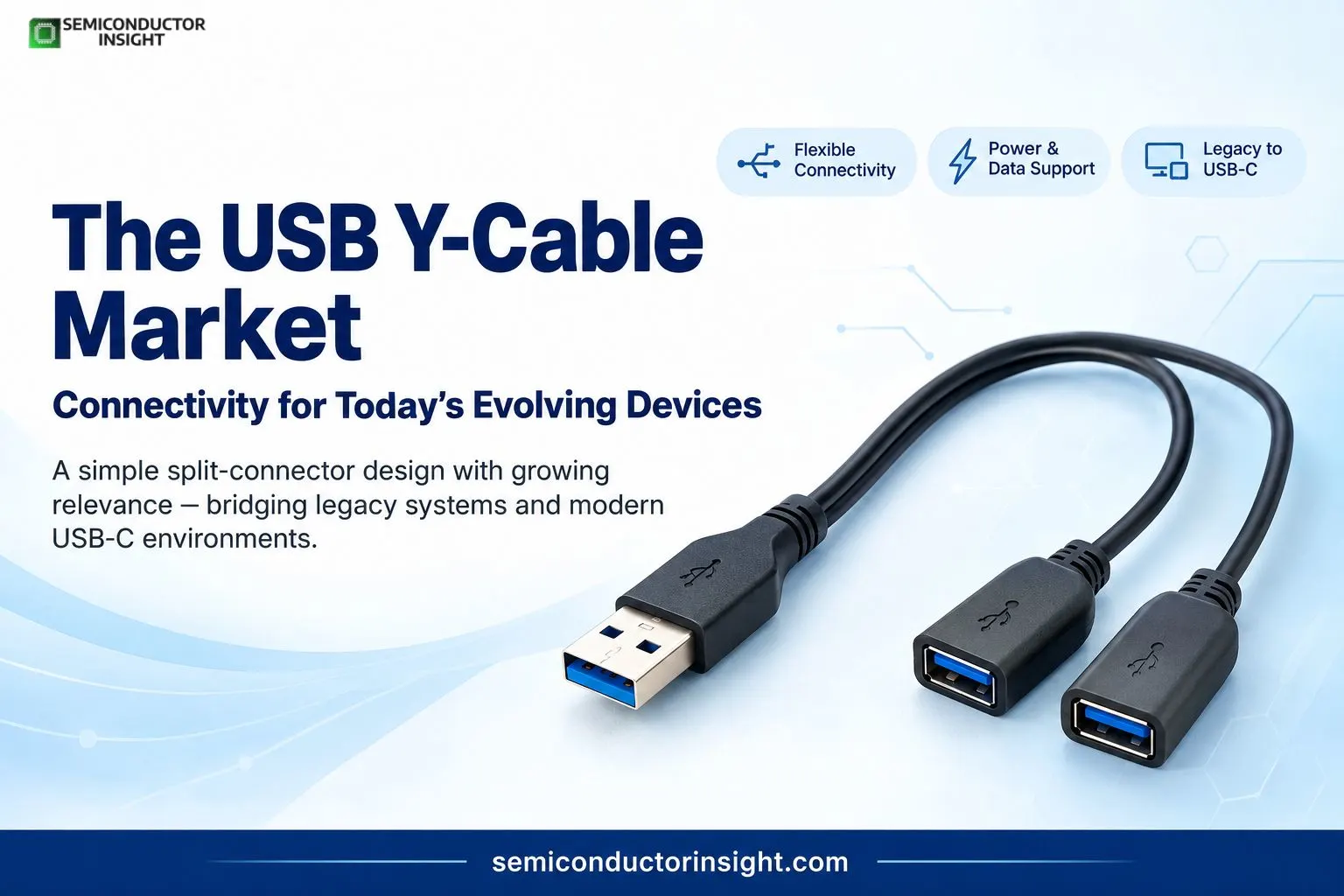
The USB Y-cable occupies an unusual position in today’s connectivity landscape. It is neither a conventional charging lead nor a full USB hub. Instead, its defining feature is a split-end architecture that allows one connection point to interface with two downstream connectors, depending on the design and intended application.
That simple geometry has kept Y-cables relevant in external storage, embedded systems, development boards, legacy computer equipment, portable peripherals and specialized electronics. In 2026, the conversation is changing as USB-C becomes increasingly common and manufacturers rethink how power, data and device interfaces are arranged.
The Y Shape Is Only the Beginning
Not every USB Y-cable performs the same task.
- Some configurations use one connector on one end and two connectors on the other to provide additional power to a peripheral.
- Others are designed for particular data or device configurations. The internal wiring determines whether the second branch carries power, data or a combination of signals.
- This makes specification more important than appearance. A cable that visually resembles a USB Y-cable may have completely different electrical behavior from another model.
- For buyers, connector type, USB generation, current capability, shielding, cable length and intended host-device configuration can matter more than the Y-shaped construction itself.
For additional report info, feel free to view our most recent edition: https://semiconductorinsight.com/report/usb-y-cable-market/
Why External Storage Keeps the Format Relevant?
External hard disk drives provide one of the clearest historical use cases for USB Y-cables.
Earlier bus-powered storage devices could encounter situations where the USB port alone did not provide sufficient power during startup or sustained operation. A second USB connection could therefore be used to draw additional power from the host system.
Modern storage has moved heavily toward USB-C and solid-state drives, but legacy USB-A equipment remains widespread. Millions of older computers, industrial terminals and peripheral systems continue operating long after newer connector standards have entered the consumer market.
That installed base creates a continuing niche for specialized cable configurations.
A Useful Accessory for Embedded Hardware
USB Y-cables also appear in development and embedded environments where engineers need to connect compact hardware to multiple USB interfaces.
Development boards, single-board computers, test equipment and specialized controllers may operate with combinations of USB-A, USB-C, Micro-USB and other connectors. During prototyping, engineers frequently rely on readily available cables and adapters before a final product receives a dedicated connector architecture.
The distinction between a Y-cable and a USB hub becomes particularly important here. A passive cable cannot automatically reproduce the functionality of an active USB hub.
USB-C Is Changing the Cable Conversation
- USB-C is pushing the industry toward reversible connectors, higher power capabilities and increasingly sophisticated USB implementations.
- The USB Implementers Forum has published USB specifications supporting data rates ranging from earlier USB generations to USB4 implementations reaching 40 Gbps and beyond, while USB Power Delivery has expanded power-management capabilities substantially compared with early USB charging arrangements.
- This does not automatically make every USB-C Y-cable capable of those speeds or power levels.
- In fact, the opposite is becoming increasingly important: connector shape no longer tells the complete technical story.
- A USB-C cable may support only certain USB data rates, power levels or alternate modes. Consequently, product labeling and electrical specifications are becoming increasingly important purchasing factors.
EU Charging Rules Add another Layer
The European Union’s common-charger framework is accelerating the standardization of USB-C on many categories of portable electronic equipment.
The European Commission states that the common charger rules apply to numerous categories of radio equipment and require USB-C charging interfaces for covered products placed on the EU market from 28 December 2024, with the laptop requirement applying from 28 April 2026.
The policy does not specifically create demand for Y-cables. However, it contributes to a broader environment in which USB-C becomes the default physical interface for an expanding range of devices.
That creates opportunities for specialized USB accessories while simultaneously reducing dependence on some legacy connector combinations.
Cable Length Is Becoming an Engineering Decision
Longer USB cables introduce considerations involving signal integrity, voltage drop and electromagnetic interference.
For high-speed USB applications, passive cable design becomes increasingly sensitive to conductor quality, shielding and construction. A cable intended for a low-speed power application cannot automatically be assumed suitable for high-speed data transmission.
For this reason, manufacturers are increasingly separating products according to application rather than selling one universal cable configuration.
The Next Opportunity Sits Between Legacy and New Interfaces
- The USB Y-cable is unlikely to become the centerpiece of mainstream connectivity. Its opportunity is more specialized.
- Its strength lies in bridging practical requirements that standard single-port cables cannot always address, particularly where older hardware, external storage, embedded equipment or unusual power arrangements remain in service.
- As USB-C becomes more dominant, the category is likely to become increasingly specification-driven.
- The winners will not necessarily be the manufacturers offering the largest number of cable variations, but those able to clearly communicate compatibility, electrical configuration and intended application.
Why This Category Deserves Attention?
USB Y-cable market illustrates a broader semiconductor and electronics trend: connectivity products often survive not because they represent the newest interface, but because they solve specific problems inside an enormous installed hardware base.
For businesses evaluating this space, our scope focuses on connector configurations, USB standards, application-specific demand, device compatibility, power requirements, data-transfer considerations and evolving interface adoption. The analysis is structured to help manufacturers, distributors, electronics brands and component suppliers identify practical product opportunities rather than treating USB Y-cables as a generic accessory category.

Comments (0)