
Weekly Digital Time Switches Market Building the Timed Backbone of Smart Systems
Weekly digital time switches market has quietly grown to be one of the most important parts of modern buildings, factories, and infrastructure that use semiconductors. A weekly digital time switch is basically a programmable electronic controller that turns on or off electrical loads like lights, HVAC, pumps, and security systems based on a schedule for each day of the week, not simply simple on-off triggers.
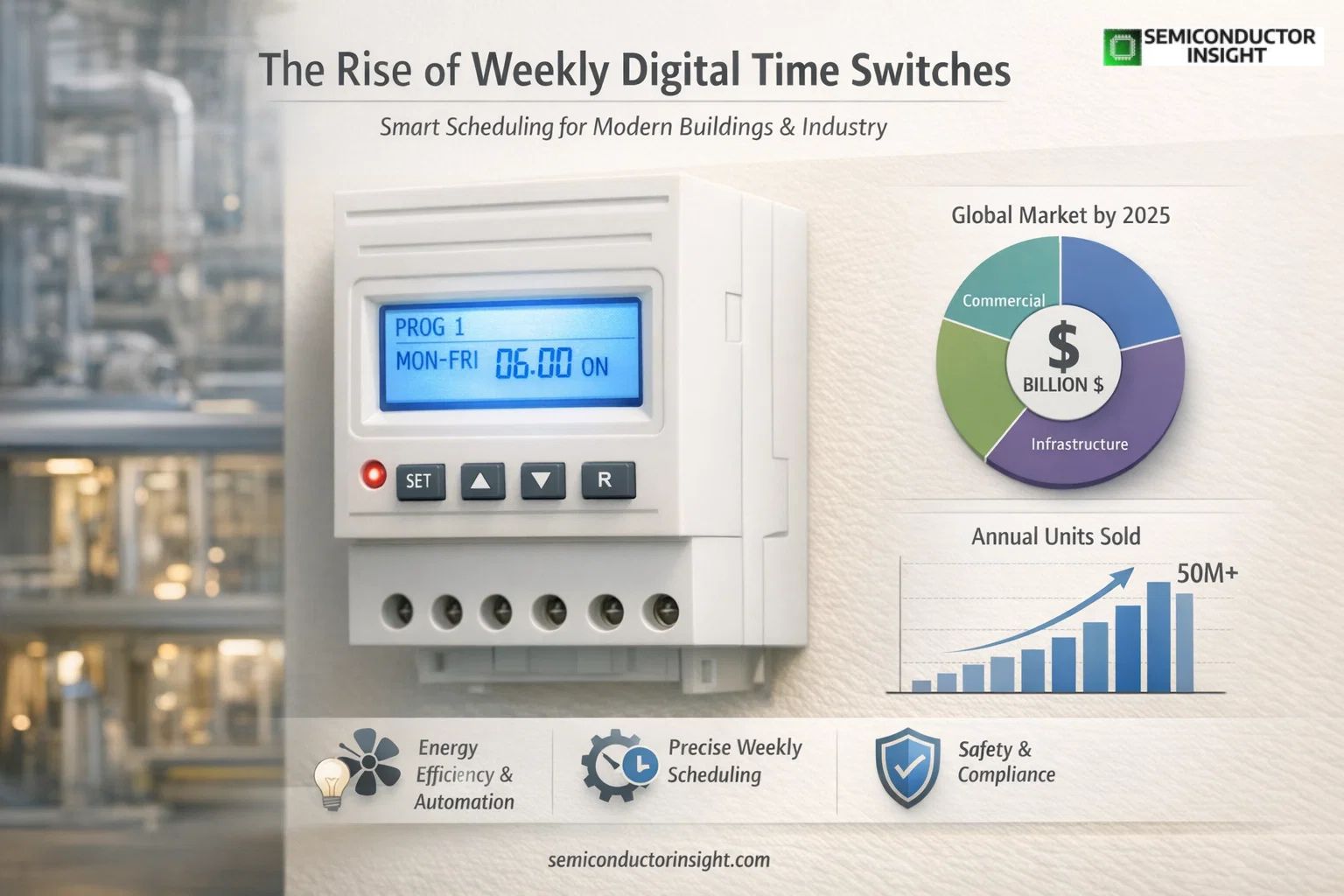
By 2025, the global market for weekly digital time switches is expected to be worth billions of dollars. Sales are already in the tens of millions of units per year, and the market is expected to grow at a compound annual growth rate of low to mid-single digits through the early 2030s.
How weekly digital time switches think like mini‑controllers?
- Inside the box, a weekly digital time switch behaves like a small embedded‑system node: a microcontroller reads an internal real‑time clock, a user‑programmed weekly schedule, and sometimes sensor inputs, then drives a relay or solid‑state switch to control the load.
- Modern devices typically support up to 30-50 programmable events per week, with 1-15‑minute time‑step resolution, allowing fine‑grained control over lighting levels, chiller cycling, or production‑line start‑up sequences.
- This level of precision turns a basic wall‑mounted timer into a semiconductor‑driven automation point, where each programmed event is effectively a time‑domain instruction in the building’s or plant’s control logic.
Growing demand hotspots beyond simple lighting
Demand for weekly digital time switches is expanding far beyond stair‑case lights and office corridors. In commercial buildings, these devices now manage escalators, ventilation fans, signage boards, and parking‑lot lighting, often synchronized to weekday, weekend, and holiday profiles.
In industrial settings, they regulate pumps, conveyors, and boiler cycles, helping plants avoid 24/7 operation and instead align energy use with production windows. For example, a typical industrial facility might schedule pumps only during three 8‑hour shifts, cutting unnecessary runtime by 30-40% and reducing motor stress and maintenance frequency.
Advantages of weekly scheduling in real‑world operations
Weekly time shifts are becoming more popular because they work better with how people actually do things, not just with general on-off regulations. A school can have various schedules for Monday through Friday and Saturday. A mall can keep the lights in common areas at full brightness during busy times and dim them late at night.
A factory can also vary the start times of shifts to avoid abrupt grid loads. Each of these options has a direct effect on energy costs, the life of equipment, and the stability of the grid. For example, a medium-sized commercial building that uses weekly time switches for HVAC and lights can cut its monthly electricity use by about 15-25%, depending on local rates and how the building is used.
A Closer Look at Our Latest Study and Key Findings: https://semiconductorinsight.com/report/weekly-digital-time-switches-market/
Key weekly digital time switches and their edge in one line
- Honeywell T6000 series: Combines weekly scheduling with temperature‑based override for smarter HVAC control.
- Schneider Electric Acti 9 Timers: Offers multi‑channel programmable relays ideal for industrial lighting and pump control.
- Legrand Praesideo Digital Time Switches: Designed for commercial buildings with easy‑to‑program weekly cycles and conflict‑free holiday logic.
- Intermatic EI series: Delivers robust, weather‑resistant scheduling for outdoor lighting and security applications.
- Siemens LoRad 7: Integrates weekly time‑based control with basic energy‑monitoring features for industrial users.
- GE/AENT V‑series: Focuses on retrofit‑friendly digital time switches for older residential and small‑commercial loads.
Smart integration and the semiconductor‑driven shift
The latest wave of weekly digital time switches is tightly embedded in the semiconductor‑enabled smart‑building ecosystem. Many models now communicate over Wi‑Fi, Zigbee, or KNX, allowing them to sync with building‑management systems, cloud dashboards, and mobile apps.
This means a facility manager can update a weekly schedule from a phone, receive alerts if a switch fails to trigger, or overlay occupancy‑sensor data to override programmed times. From a chip‑level perspective, this shift is pulling more processing into low‑power microcontrollers, real‑time‑clock modules, and wireless‑radio ICs, turning each time switch into a small IoT node rather than a standalone mechanical timer.
Safety, energy, and compliance in time‑driven circuits
- Beyond convenience, weekly digital time switches are becoming a de‑facto tool for safety and compliance.
- In emergency‑lighting systems, for instance, they can automate monthly and quarterly self‑test cycles without manual intervention, ensuring that batteries and fixtures are exercised within prescribed time windows.
- Similarly, in critical infrastructure such as hospitals or data centres, scheduled shutdowns and restarts of non‑critical loads can be tightly coordinated to avoid conflicts with backup‑power switchover events.
- Regulators in many regions are now referencing programmable time‑based control as part of energy‑efficiency standards, which indirectly pushes builders and owners toward weekly digital time switches instead of older mechanical timers.
Looking ahead, the weekly digital time switches market is likely to evolve along three semiconductor‑centric directions. Further, integration depth will increase, with more units embedding occupancy sensors, daylight‑harvesting logic, and predictive algorithms that learn from user behaviour.

Comments (0)