

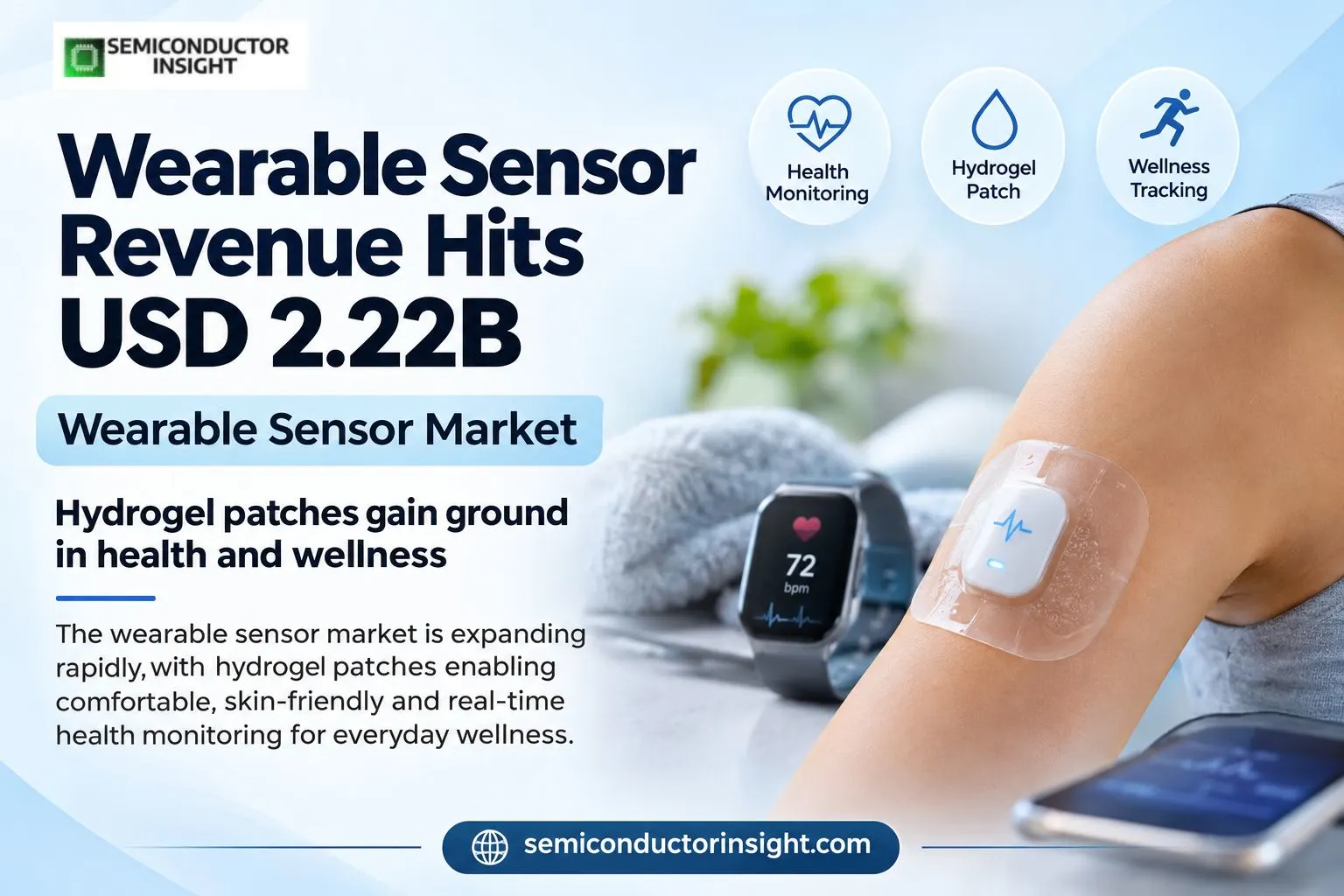
Wearable Sensor Revenue Hits USD 2.22B in Health and Wellness as Hydrogel Patches Gain Ground
The wearable industry spent the better part of a decade convincing people to strap devices to their wrists. In 2026, the more consequential shift is happening at a smaller scale: a thin, wet-feeling patch that adheres to the skin, measures what the body is actually doing at the molecular level, and then disappears from conscious awareness entirely.
Hydrogel-based epidermal sensors have moved from materials science curiosity to clinical and commercial relevance, and the reasons are as much about comfort and signal fidelity as they are about any single breakthrough.
- What separates a hydrogel epidermal sensor from a conventional wearable is the interface. Dry electrodes and rigid electronics inevitably create impedance gaps at the skin surface, especially when the wearer moves, sweats, or has body hair.
- Hydrogels address this by matching the mechanical properties of soft tissue while providing ionic conductivity that bridges the electrical divide between biology and electronics.
- The result is a signal that looks less like a noisy approximation and more like a continuous, high-fidelity recording of what the body is signaling.
The Mechanical Art of Sticking Without Irritating
- Skin adhesion is the unglamorous metric that determines whether a sensor stays useful for an hour or a week. Recent hydrogel formulations have pushed the boundaries in ways that directly translate to user experience.
- A tannic acid-iron dual-catalyst hydrogel reported in New Journal of Chemistry achieved 191.6 kPa adhesion on pig skin while maintaining 4.8 mS/cm ionic conductivity and mechanical strength of 0.95 MPa.
- Those numbers matter because they represent a rare combination: a material that grips aggressively enough to survive motion artifact while remaining soft enough to avoid the irritation that plagues acrylic adhesives.
- The hairy skin problem has been particularly stubborn. A Science Advances paper in 2026 documented an ultrasoft hydrogel integrating laser-induced graphene and reduced graphene oxide that monitors electrocardiogram, electrooculogram, and electrodermal activity through hair and under sweating conditions.
- The platform uses a dual-polymer network of polyacrylamide and polydopamine, with pH-tunable gelation times ranging from 1,204 seconds down to 72 seconds. That kind of process control is what separates a lab demonstration from a manufacturable product.
Take a Quick Glance at Our In-Depth Analysis Report: https://semiconductorinsight.com/report/wearable-hydrogel-based-epidermal-sensors-market/
Ionic Conductivity Meets Electronic Conduction
The conductive mechanism inside these sensors is where materials science gets genuinely interesting. Hydrogels are inherently ionic conductors, meaning charge moves through them via dissolved ions rather than electrons. This is actually an advantage for skin contact because the human body itself communicates electrically through ions. But it creates a challenge when the signal needs to reach conventional electronic readout circuitry.
The 2026 answer has been ion-electron dual conduction. The supramolecular PVA eutectogel-graphene platform mentioned earlier combines ionic transport through deep eutectic solvent phases with electronic conduction through wrinkled graphene layers. The graphene is deposited in overlapping films on pre-stretched eutectogel, creating a robust interface that survives deformation while maintaining low interfacial impedance. This architecture enables strain sensing, temperature detection, and biopotential recording from a single material platform.
A biomass-derived alternative takes a modular approach. Researchers constructed a cellulose-based hydrogel platform with distinct sub-platforms for optical and electrical sensing, decoupling the two functions to avoid the fluorescence attenuation that conductive fillers typically cause. The transparent version handles sweat biomarker detection, while the conductive version incorporates MXene nanosheets and PEDOT:PSS for strain and electrophysiological monitoring. It is a design philosophy built on the recognition that one material does not need to do everything well simultaneously.
Where the Clinical and Commercial Traction Is Real
The market context around epidermal sensors has shifted from speculative to measurable. The health and wellness segment of wearable sensors reached USD 2.22 billion in 2025, with remote patient monitoring advancing at a 19.35% CAGR as payers seek cost-avoidance through early detection. Biosensors specifically are posting 18.85% CAGR, a figure that reflects the migration from motion tracking toward molecular and electrophysiological sensing.
- The commercial logic is straightforward when viewed through a reimbursement lens. A hypertension remote monitoring program documented a 22.2% return on investment through reduced emergency visits, validating the economics that make hydrogel-based continuous monitoring attractive beyond the consumer wellness market.
- Corporate deployments have shown similar pragmatism: Chevron’s hydration patches reduced heat-related incidents in field operations, creating a workplace safety use case that does not depend on consumer enthusiasm.
Regulatory pathways remain uneven. The European Union’s Medical Device Regulation has created a bottleneck, with only 43 notified bodies covering roughly 500,000 devices, which slows certification for novel sensor architectures. The decentralized nature of some hydrogel fabrication methods, particularly 3D-printed and custom formulations, challenges regulatory frameworks designed for standardized mass manufacturing. These are not insurmountable barriers, but they explain why the most visible hydrogel sensor deployments in 2026 are in wellness, sports, and occupational settings rather than acute clinical care.
The Next Layer of Functionality
The trajectory of hydrogel epidermal sensors points toward integration rather than replacement. A University of Chicago technology called ABLE combines a skin-adhesive hydrogel with live Staphylococcus epidermidis composites and flexible electronic arrays, enabling both physiological recording and drug-free immunomodulation for inflammatory skin conditions like psoriasis. The system is designed for wireless control and safe biohazard disposal, addressing practical adoption barriers that pure sensing platforms ignore.
On the manufacturing side, 3D printing is emerging as the bridge between customization and scale. Next-generation epidermal patches reviewed in Bioactive Materials suggest that hydrogel-based biosensors integrated into printed patches could enable real-time monitoring of pH, glucose, and other biomarkers, setting the stage for platforms that sense and deliver therapeutics simultaneously. The short-term roadmap focuses on multifunctional capability integration; the medium-term vision is AI-assisted design enabling fully personalized patches with remotely triggered drug release.
The skin, it turns out, was never just a barrier. It was an interface waiting for materials that could speak its language. Hydrogels, with their ionic conductivity, mechanical softness, and tunable adhesion, are proving to be that language. The sensors built from them are not trying to replace the smartwatch. They are trying to make the watch, and everything like it, feel like a compromise.

Comments (0)