
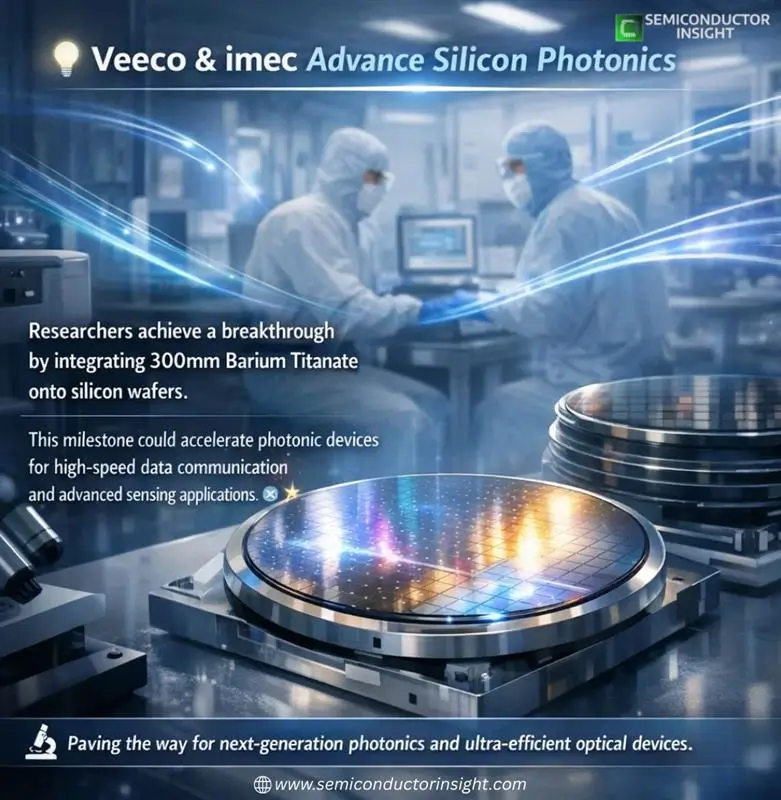
Veeco and imec Develop 300mm Manufacturing-Compatible Process for Integrating Barium Titanate on Silicon Photonics
Veeco Instruments Inc. and nanoelectronics research leader imec have announced a major breakthrough in silicon photonics manufacturing: the successful development of a 300mm high-volume production compatible process that enables the integration of barium titanate (BaTiO₃ or BTO) onto a silicon photonics platform.
This advancement marks a significant milestone toward bringing next-generation electro-optic materials into scalable semiconductor fabrication, addressing long-standing barriers related to cost, repeatability, and commercial manufacturability.
Why Barium Titanate Matters for Silicon Photonics?
Barium titanate is considered one of the most promising materials for future photonic devices due to its unique electro-optical properties. It can enable high-speed, low-power light modulation, which is critical for emerging applications such as:
- High-speed optical transceivers for datacom infrastructure
- Quantum computing and quantum photonic systems
- Light Detection and Ranging (LiDAR) technologies
- AR/VR and advanced sensing platforms
However, traditional integration approaches have struggled to meet the cost and scalability requirements needed for high-volume manufacturing.
Veeco Delivers First-of-Its-Kind 300mm MBE Cluster System
As part of the partnership, Veeco has delivered its first molecular beam epitaxy (MBE)-based 300mm cluster system, specifically designed for the epitaxial growth of single-crystalline BaTiO₃ thin films on silicon.
The new platform supports both solid-source and hybrid MBE solutions, offering improved deposition repeatability and reduced cost compared with classical MBE methods.
This development represents a key step in making BTO-on-silicon processes viable for commercial semiconductor fabs.
Meeting Industry Demand for Production-Compatible Electro-Optic Materials
The optical transceiver market is projected to grow significantly, reaching $13.1 billion by 2030, up from $2.9 billion in 2024. As demand rises, silicon photonics platforms must overcome limitations of existing modulator technologies, including:
- High power consumption
- Performance trade-offs in speed and drive voltage
- Large device footprints
The introduction of novel electro-optic materials like BaTiO₃ is expected to be crucial in enabling more compact, efficient, and sustainable photonic solutions.
Imec noted that there is currently no commercially available production-compatible process for integrating such materials at scale a gap this collaboration aims to fill.
Key Highlights of the Veeco-imec Collaboration
- Development of a 300mm fab-compatible BTO-on-silicon integration process
- Delivery of Veeco’s first advanced MBE-based cluster platform
- Improved repeatability and reduced cost for BaTiO₃ deposition
- Expansion of heterogeneous integration capabilities beyond silicon
- Potential to unlock breakthroughs in datacom and quantum photonics
Imec’s scientific director Clement Merckling emphasized that the partnership has focused on benchmarking both material quality and electro-optic performance over the past four years, helping define a roadmap toward scalable manufacturing.
Veeco executives also highlighted that new hardware innovations are shifting MBE processing into a more cost-effective domain suitable for high-volume semiconductor production.
You can review our most recent, relevant findings here:
https://semiconductorinsight.com/report/silicon-photonics-die-market/
Upcoming Prospects Towards Next-Generation Photonic Modulators
With this achievement, Veeco and imec are strengthening the foundation for integrating beyond-silicon electro-optic materials into mainstream silicon photonics, supporting future breakthroughs in quantum computing, optical networking, and greener digital infrastructure.
The collaboration is expected to accelerate the development of repeatable, high-volume BaTiO₃ production processes, paving the way for advanced photonic modulator technologies.

Comments (0)