

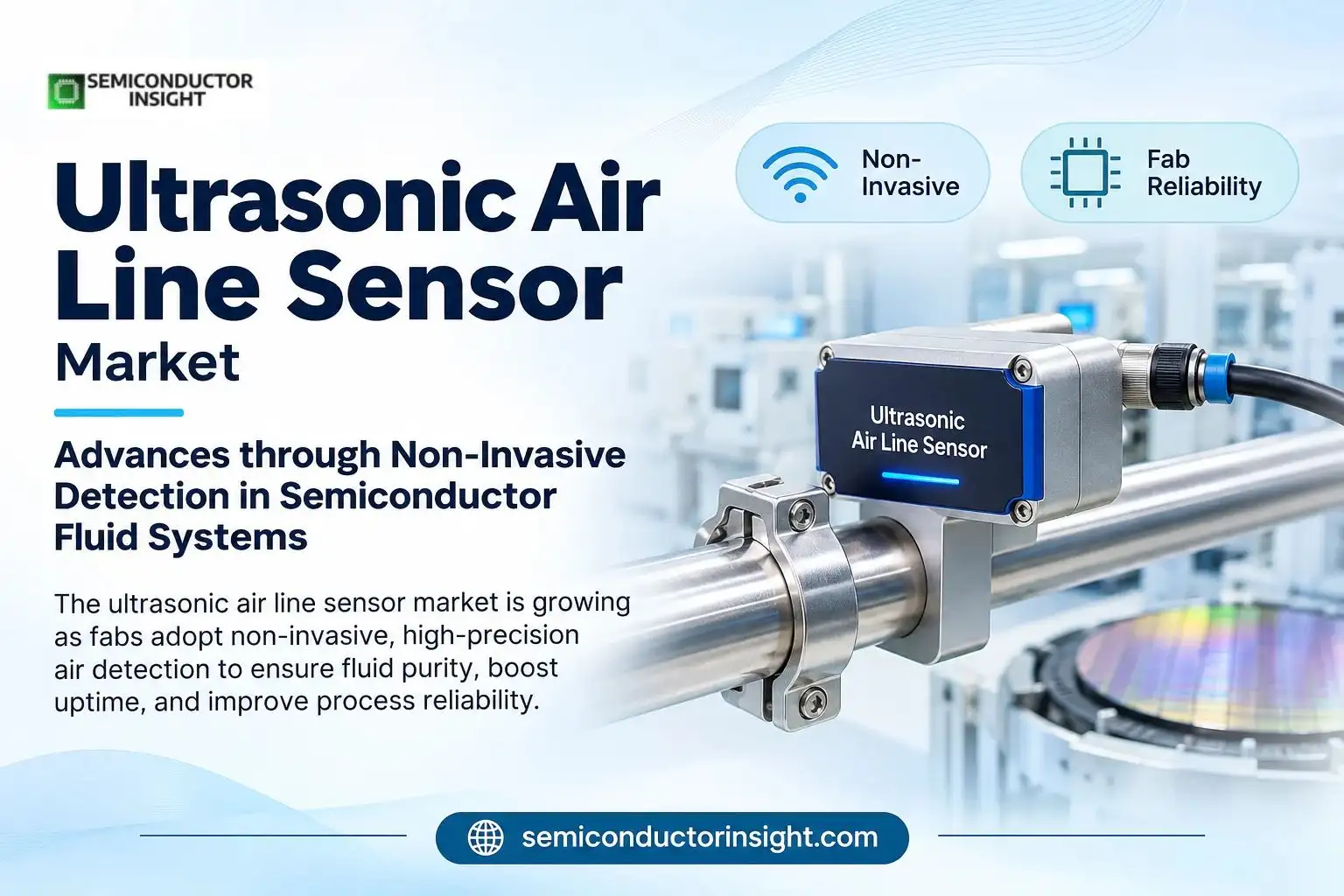
Ultrasonic Air Line Sensor Market Advances through Non-Invasive Detection in Semiconductor Fluid Systems
Ultrasonic airline sensors operate by sending high-frequency sound pulses across a fluid-filled tube or pipe and analyzing the returning signal. When liquid fills the path completely the acoustic energy travels in a predictable pattern. An air pocket or bubble interrupts that pattern, producing a measurable change in amplitude or transit time that the electronics convert into a detection event. This principle allows the sensor to remain outside the fluid path, preserving sterility and chemical purity in semiconductor process lines where even microscopic contamination can ruin a wafer batch.
- In semiconductor fabs the same ultrasonic approach serves dual purposes. On liquid chemical delivery lines it flags air bubbles that could disrupt coating, etching or CMP slurry flow.
- On compressed air and nitrogen distribution networks clamp-on transducers measure volume flow without cutting into the pipe or introducing potential leak points.
- The non-contact nature means installation can occur while the line stays under pressure, a practical advantage during continuous three-shift production.
Acoustic Path Behavior in High-Purity Tubing
Transit-time sensors place a pair of transducers so that one pulse travels with the flow and the other against it. The difference in arrival time scales directly with fluid velocity. When an air void appears the signal strength drops sharply because sound couples poorly between liquid and gas. Amplitude-monitoring designs exploit this drop and can register bubbles as small as one microliter. Response times below one millisecond are common, giving process controllers enough margin to shut a valve or divert flow before the bubble reaches a critical chamber.
Clamp-on gas meters for compressed air lines face a different acoustic environment. Air has lower acoustic impedance than water-based chemistries, so transducer frequency and coupling gel or dry-coupling pads must be chosen carefully. Modern systems still achieve usable readings down to a few bar of pressure on metal or plastic tubing, allowing plants to quantify consumption at individual tool clusters and locate small leaks that would otherwise escape notice.
A Brief Look at Our Detailed Analysis Related Report: https://semiconductorinsight.com/report/ultrasonic-air-line-sensor-market/
Practical Placement on Semiconductor Chemical and Utility Lines
- Sensors are typically mounted on rigid PFA or PTFE tubing in chemical supply systems and on stainless or polymer utility headers for nitrogen and clean dry air.
- Because the transducers never contact the media, the same hardware can move between different chemistries after a simple wipe-down.
- In one documented installation at a European mixed-signal semiconductor plant, clamp-on ultrasonic meters were added to both the compressed-air and nitrogen networks without interrupting production. The meters now supply continuous standard-volume-flow data that feed into the facility’s energy and process-control dashboards.
- Material selection remains important. Housing and transducer faces must resist the solvent vapors and occasional splash exposure found in wet benches.
- Stainless-steel versions rated for sanitary or aggressive environments appear frequently in OEM catalogs, while polymer-housed units serve lighter-duty medical and laboratory lines that share similar bubble-detection needs.
Signal Processing and Control Integration
Digital front-end circuits convert the raw ultrasonic echoes into clean digital outputs or analog current loops that PLCs and tool controllers can read directly. Self-test functions periodically verify transducer health so that a failed sensor does not silently pass an air pocket. Some designs combine flow measurement and bubble detection in a single clamp, reducing the number of devices that must be calibrated and maintained.
- In data-center and advanced packaging environments the same ultrasonic technology has been adapted for liquid-cooling loops that protect high-power AI accelerators.
- Flow rates up to several hundred liters per minute are monitored non-intrusively, giving operators early warning of reduced coolant circulation before thermal limits are reached.
Calibration Intervals and Long-Term Stability
Because ultrasonic sensors contain no moving parts, mechanical wear is essentially eliminated. Recalibration intervals of twelve months are typical for critical process applications. Temperature compensation algorithms correct for changes in the speed of sound, keeping readings stable across the range of clean-room conditions. Plants that once relied on periodic manual inspections of air lines now obtain continuous, time-stamped records that support both yield troubleshooting and energy audits.
The combination of rapid bubble detection, non-invasive flow measurement and straightforward digital integration keeps ultrasonic air line sensors relevant across the semiconductor process chain. From chemical delivery verification to utility-gas accounting and emerging liquid-cooling loops, the technology supplies actionable data while protecting the purity and uptime that modern fabrication demands.

Comments (0)