
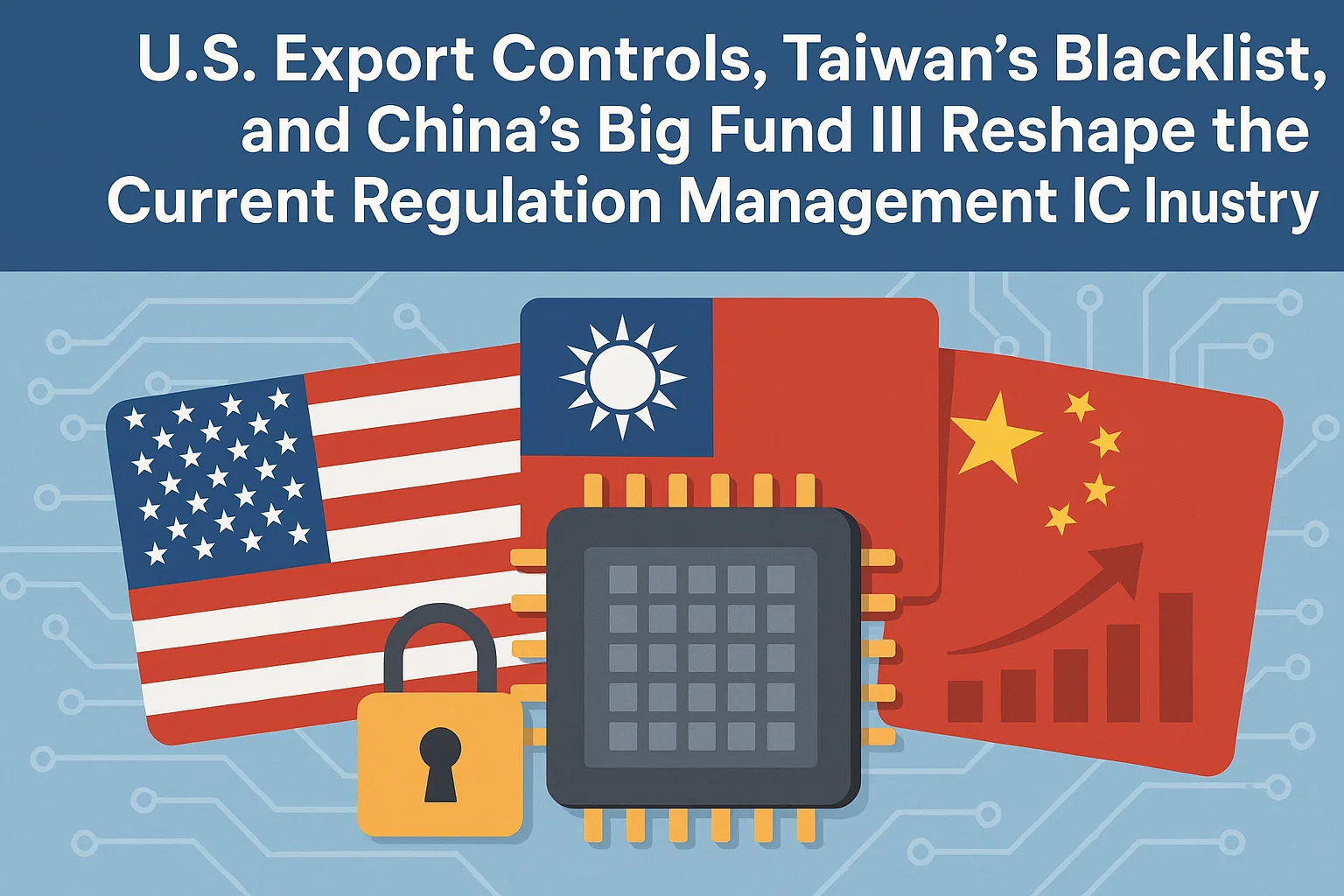
U.S. Export Controls, Taiwan’s Blacklist, and China’s Big Fund III Reshape the Current Regulation Management IC Industry
The global semiconductor landscape is undergoing one of the most dynamic transformations in history. At the heart of this shift lies a vital but often underappreciated component—Current Regulation Management Integrated Circuits (ICs). These ICs play a critical role in power regulation, stability, and efficiency across applications ranging from consumer electronics and automotive systems to industrial automation and advanced computing infrastructure.
The Current Regulation Management IC Market was valued at US$ 1.23 billion in 2024 and is projected to nearly double to US$ 2.34 billion by 2032, registering a compound annual growth rate (CAGR) of 9.6% between 2025 and 2032. This growth trajectory reflects not only technological advancements but also a turbulent regulatory and geopolitical environment that is reshaping global semiconductor supply chains.
Recent developments in the sector—ranging from U.S. export controls on advanced chips and AI model weights, to China’s strategic semiconductor investment funds, to tightening environmental compliance rules in global markets—have redefined both opportunities and challenges for companies operating in the current regulation management IC space.
Access Your Free Sample Report- Current Regulation Management IC Market
What Are Current Regulation Management ICs?
Before exploring the regulatory updates and market dynamics, it is essential to understand what these ICs are and why they are indispensable in modern electronics.
- Functionality: Current regulation management ICs ensure that circuits receive consistent current flow, protecting sensitive components from fluctuations that could lead to inefficiency, overheating, or damage.
- Applications:
- Consumer electronics (smartphones, tablets, wearables)
- Automotive (EV power management, infotainment systems, advanced driver-assistance systems)
- Industrial systems (robotics, automation, energy storage)
- Data centers & AI computing hardware
- Importance: In an age of electrification and AI adoption, where devices demand more power efficiency and stability, current regulation ICs are central to performance and reliability.
This technical significance explains why regulatory frameworks around semiconductor manufacturing and export controls directly influence the current regulation IC industry.
Recent Regulatory Developments Shaping the IC Industry
1. U.S. Expands Export Controls on China (December 2024)
In late 2024, the U.S. Commerce Department imposed new restrictions targeting over 140 Chinese entities, including semiconductor foundries, research labs, and equipment suppliers. These restrictions added them to the Entity List, requiring U.S. companies to obtain licenses before exporting critical equipment, IC designs, or software tools.
- Impact on Current Regulation ICs:
Although the rules primarily target advanced-node ICs and AI processors, current regulation ICs—being integral to electronics manufacturing—face indirect supply chain disruptions. Chinese firms represent a major share of midstream IC assembly and packaging, meaning tighter controls ripple through the entire component ecosystem. - Industry Response:
Many U.S. and allied companies began restructuring supply chains to reduce dependency on Chinese subcontractors. This opens up new opportunities for manufacturers in Taiwan, South Korea, India, and Europe to capture business in current regulation IC production.
2. BIS Export Control Updates (May 2025)
The Bureau of Industry and Security (BIS) issued four critical updates reshaping semiconductor exports:
- Rescission of the “AI Diffusion Rule”: A controversial rule restricting chip distribution was rolled back, easing some compliance burdens.
- New End-Use Controls: Companies must now verify that chips—including power management ICs—are not used in military or WMD-related AI applications.
- “Red Flag” Guidance: Enhanced compliance checklists require firms to scrutinize unusual requests, especially from intermediary distributors.
- Compliance Recommendations: BIS advised manufacturers to update licensing protocols, screening mechanisms, and supply chain audits.
- Industry Implication:
For current regulation IC producers, this means greater scrutiny of export customers. Even seemingly low-end ICs could be restricted if destined for high-risk applications.
3. January 2025: Universal Export Licensing & AI Model Weight Regulation
In early 2025, BIS introduced sweeping changes that redefined global semiconductor trade rules:
- Universal Export Licensing: Certain advanced IC categories now require export licenses worldwide, not just for shipments to China.
- Foreign-Direct Product Rule Expansion: Chips manufactured abroad using U.S. tech are also subject to U.S. controls.
- AI Model Weight Regulation: For the first time, AI model weights themselves became controlled commodities—especially when exceeding massive compute thresholds.
- New Exceptions: Specific allowances were made for allied nations, private-sector R&D, and low-processing-performance chips.
- Relevance to Current Regulation ICs:
While the rules target high-performance compute ICs, secondary components like current regulators also fall under compliance due diligence because they are integral to advanced chip packaging and deployment in AI infrastructure.
Download Sample Report PDF- Current Regulation Management IC Market
4. Environmental and Trade Compliance (March 2025)
Beyond trade controls, environmental regulations are increasingly influencing IC manufacturing:
- REACH (EU) and TSCA (U.S.) regulations impose chemical safety requirements on chip manufacturing processes.
- The EPA is tightening rules on solvents and waste disposal used in semiconductor fabs.
- These compliance mandates increase costs for fabs and packaging houses but also encourage greener innovation in IC design.
- Impact:
Current regulation IC makers are under pressure to redesign packaging with sustainable materials and adopt low-energy manufacturing processes, aligning with global ESG trends.
5. Taiwan Aligns with U.S. in Friend-Shoring Efforts (June 2025)
Taiwan expanded its entity blacklist, adding major Chinese companies like SMIC and Huawei. This move mirrors U.S. efforts to concentrate semiconductor ecosystems within friendly nations.
- Implication for Current Regulation ICs:
- Stronger demand for Taiwanese and South Korean fabs specializing in analog and power management ICs.
- New opportunities for India and Vietnam to step into the supply chain as secondary hubs.
6. China’s Counter-Strategy: Big Fund III and AI Investment (2024–2025)
China responded to U.S. restrictions by massively boosting semiconductor investment:
- Big Fund III (May 2024): ¥3,440 billion (~US$47.5 billion) earmarked for IC manufacturing.
- National AI Fund (early 2025): 60 billion yuan (~US$8.2 billion) dedicated to AI-centric semiconductor development.
- Impact:
These funds aim to reduce dependency on foreign suppliers and strengthen domestic capabilities, which could eventually increase competition in the global current regulation IC market.
Market Outlook (2025–2032)
Despite regulatory turbulence, the Current Regulation Management IC Market is poised for robust growth.
Market Forecast
- 2024 Market Size: US$ 1.23 billion
- 2032 Market Size: US$ 2.34 billion
- CAGR (2025–2032): 9.6%
Growth Drivers
- Electrification of Transport: EVs require highly efficient current regulation ICs for battery management and charging systems.
- Data Centers & AI: The AI computing boom demands stable and energy-efficient power regulation.
- IoT Expansion: Billions of IoT devices require low-power ICs, fueling massive demand.
- Sustainability Push: Green electronics initiatives accelerate innovation in energy-efficient IC design.
Challenges
- Regulatory Overheads: Export licensing and compliance costs remain a burden.
- Supply Chain Fragmentation: Friend-shoring could drive inefficiencies and duplication of infrastructure.
- Rising R&D Costs: Companies must balance innovation with compliance and sustainability.
Opportunities
- Allied-Nation Manufacturing: Growth in India, Vietnam, and Eastern Europe.
- Next-Gen IC Packaging: Advanced packaging for power management ICs integrated into AI systems.
- Eco-Friendly ICs: Demand for sustainable, low-energy regulation ICs is growing rapidly.
Strategic Implications for Industry Players
- For U.S. & European Firms:
Opportunity to expand market share in allied markets as China faces restrictions. - For Asian Tigers (Taiwan, South Korea):
Rising importance as the world’s preferred manufacturing hubs for both digital and analog ICs. - For China:
Heavy investment could eventually narrow the technology gap, but export controls will slow progress in the short to medium term. - For Emerging Economies (India, Vietnam):
A chance to integrate deeper into global semiconductor supply chains, particularly in mid-range IC assembly and testing.
Click Here To Download Full Sample Report- Current Regulation Management IC Market
The Current Regulation Management IC market is not just growing—it is evolving within a new world order of semiconductor geopolitics and environmental accountability. With revenues projected to nearly double by 2032 at a 9.6% CAGR, the industry faces both unprecedented challenges and opportunities.
Regulatory actions by the U.S., Taiwan, and allied nations, combined with China’s counter-investments, are redrawing the global semiconductor map. Meanwhile, sustainability mandates and the explosion of electrification and AI adoption ensure that demand for efficient power regulation ICs will remain strong.
For companies navigating this space, the next decade will require a delicate balance of technological innovation, regulatory compliance, and supply chain agility. Those who succeed will not only secure profitability but also help define the future architecture of the global electronics industry.

Comments (0)