
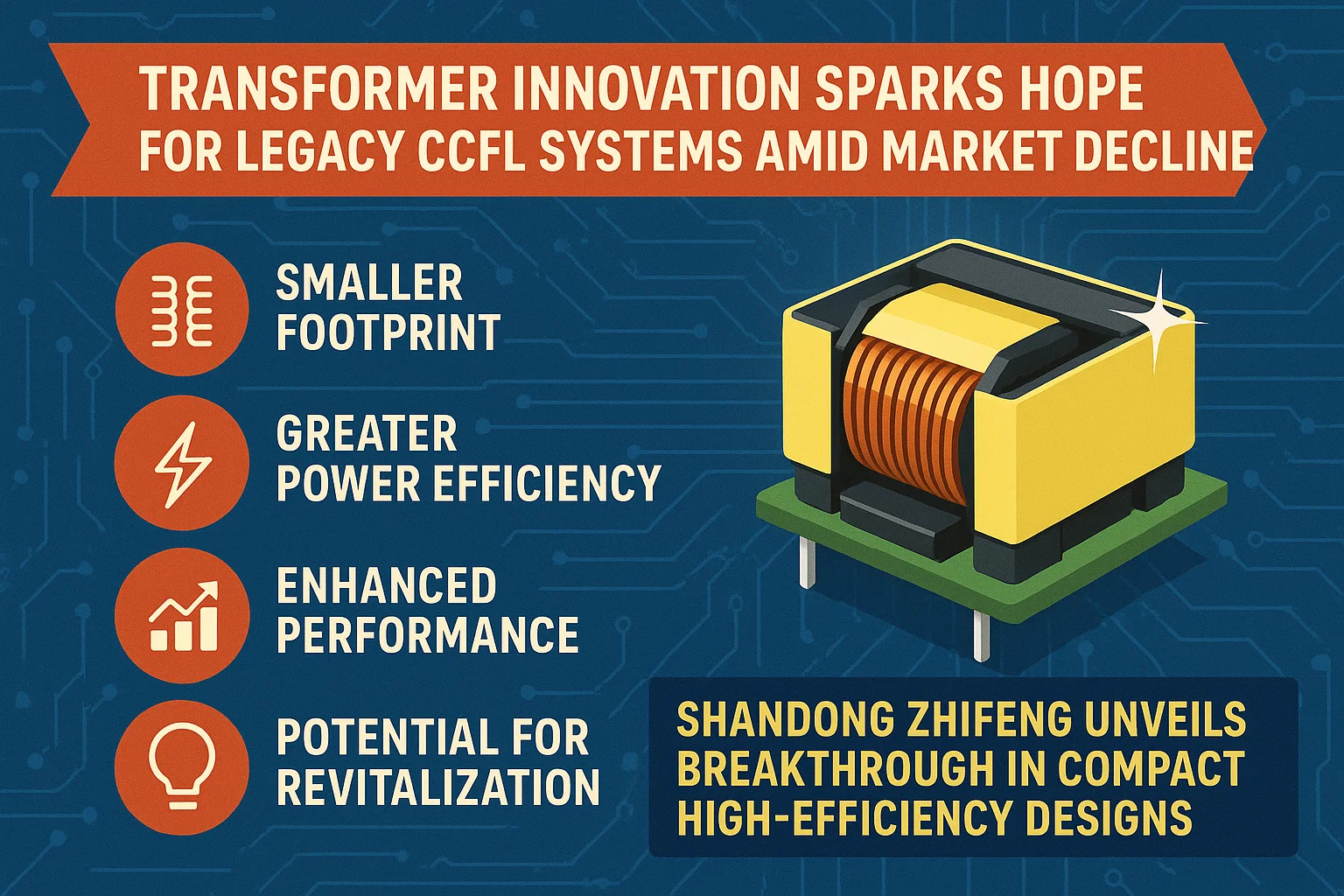
Transformer Innovation Sparks Hope for Legacy CCFL Systems Amid Market Decline: Shandong Zhifeng Unveils Breakthrough in Compact High-Efficiency Designs
Once a staple of the electronics industry, Cold Cathode Fluorescent Lamps (CCFLs) and their associated transformers were crucial in powering LCD backlights, automotive panels, and specialized medical or industrial display systems. However, in the past decade, the rise of light-emitting diodes (LEDs) has overshadowed the CCFL landscape. This has drastically shifted market dynamics, leading to a shrinking global footprint for CCFL transformers.
In 2024, the CCFL transformers market was valued at approximately US$ 234 million, but with declining adoption and reduced manufacturing demand, it is projected to contract to US$ 189 million by 2032, representing a compound annual growth rate (CAGR) of -2.7% over the forecast period (2025–2032). While this reflects a waning era, the story is more nuanced—one of legacy demand, niche applications, and modest innovation in related transformer technologies.
Access Your Free Sample Report- Cold Cathode Fluorescent Lamp (CCFL) Transformers Market
Understanding the CCFL Transformer Market Landscape
What Are CCFL Transformers?
Cold Cathode Fluorescent Lamp transformers are specialized electrical devices that provide the high-voltage, low-current output necessary to start and sustain CCFLs. These lamps have historically been used in LCD monitors, televisions, instrument panels, and some UV sterilization systems.
CCFLs require a unique transformer design because they operate at high voltages—often above 1000V. The transformers need to be compact, efficient, and stable over long operational periods. For decades, they were a preferred lighting solution due to their longevity and consistent brightness.
Shift to LED Technology
The transformation of the display and lighting industry has heavily impacted the CCFL ecosystem. LEDs offer a host of benefits over CCFLs: lower power consumption, longer lifespan, smaller footprint, and compliance with environmental standards like RoHS.
The effect on CCFL transformers has been stark. New product development has slowed, and manufacturers have either pivoted toward LED driver modules or narrowed their focus to supporting legacy systems.
Recent Developments in CCFL Transformer Industry
Despite the contraction, several developments over the last year are worth noting. These reflect broader innovation in the transformer segment and ongoing relevance in limited applications.
1. Breakthroughs in Transformer Materials and Design
In March 2025, Shandong Zhifeng Transformer Co. in China reported notable advancements in transformer technologies, including designs that—while not CCFL-specific—are influencing compact transformer solutions used in high-frequency lighting and legacy applications.
Highlights:
- 110 kV amorphous-alloy oil-immersed transformer: This is a significant step in reducing no-load losses by 60% and improving energy savings. The benefits of such innovations indirectly influence the design of smaller, high-frequency transformers like those used in CCFL systems.
- Use of nanocrystalline and amorphous core materials: These materials are being evaluated for miniaturizing transformers while increasing efficiency and reducing heat dissipation. Smaller form factors can be retrofitted for legacy CCFL applications in aerospace, medical diagnostics, or military display equipment.
While these innovations are geared toward power transformers, material improvements often trickle down to miniature transformer manufacturing, offering new paths to improving residual CCFL transformer designs.
2. Emergence of AI-Enabled Transformer Diagnostics
The industry is embracing smart transformers—those integrated with real-time diagnostic sensors and AI-based monitoring systems. Though CCFL transformers remain analog in nature, the rise of smart power components across the board may influence hybrid retrofit solutions, especially in high-reliability applications like medical imaging.
Smart technology helps ensure:
- Longer transformer life
- Predictive maintenance in sensitive environments
- Optimized performance under fluctuating loads
3. Declining Yet Persistent Niche Demand
While mainstream adoption has ceased, several sectors still utilize CCFLs—and, by extension, their transformers. These include:
- Medical diagnostic devices (legacy displays, surgical lights)
- Automotive dashboards (older models)
- Industrial control systems
- Military-grade equipment
These sectors are slow to adopt new technologies due to the high cost of validation and ruggedization. As a result, CCFL transformers see low but steady demand for replacements and maintenance.
Market Outlook: 2025–2032
The global Cold Cathode Fluorescent Lamp (CCFL) Transformers Market is projected to decline at a CAGR of -2.7% from 2025 to 2032. The key drivers of this negative growth include:
- Widespread replacement of CCFLs with LEDs
- Regulatory pressure to eliminate mercury-containing components
- Lack of R&D funding in CCFL-specific transformer technologies
- Shrinking production lines among major manufacturers
However, the market is not vanishing. It remains supported by legacy infrastructure, replacement demand, and niche application use-cases.
Download Sample Report PDF- Cold Cathode Fluorescent Lamp (CCFL) Transformers Market
Regional Analysis
1. Asia-Pacific
Asia-Pacific remains the dominant region in the CCFL transformer market, especially China, Japan, and South Korea. Key factors include:
- A high installed base of CCFL backlit LCD manufacturing lines
- Continued use in industrial and automotive applications
- OEM support for legacy systems
2. North America
Demand here is low but stable, driven mainly by medical equipment replacement and aerospace applications. Strict regulations and early LED adoption contributed to an early decline in CCFL usage.
3. Europe
Europe mirrors North America, though the push for mercury-free devices under RoHS and WEEE regulations has made CCFLs nearly obsolete in consumer and industrial markets. However, specialized manufacturing in Germany and the UK supports limited supply.
Competitive Landscape
Key players still active in CCFL transformer production—often within broader transformer portfolios—include:
- Sumida Corporation
- TDK Corporation
- Murata Manufacturing Co.
- Delta Electronics
- Jameco Electronics
These companies are largely focused on:
- Supporting legacy contracts
- Manufacturing multi-use transformers
- Transitioning customers to LED driver solutions
There’s a visible shift in their R&D budget from CCFL transformers to LED drivers, solid-state transformers, and power management ICs.
Challenges Facing the Industry
1. Environmental Compliance
CCFLs contain mercury—a known hazardous substance. Transformer manufacturers face stringent regulations on recycling, disposal, and replacement logistics.
2. Limited Scalability
With a shrinking market, economies of scale have become difficult to achieve. This has driven up production costs and reduced profit margins for remaining players.
3. Technological Obsolescence
LED and OLED display technologies are not only more efficient but also compatible with modern electronics ecosystems. CCFL systems are becoming increasingly incompatible with next-gen architectures.
Opportunities in a Declining Market
Despite its downward trend, the CCFL transformer market offers opportunities:
A. Aftermarket and Maintenance
Manufacturers offering OEM-certified replacement transformers for medical, aviation, and industrial equipment can tap into a steady aftermarket demand.
B. Specialty Use-Cases
Some devices require specific brightness and color rendering that CCFLs can provide, such as:
- UV sterilization units
- Phototherapy devices
- Forensic light sources
CCFL transformers tailored to these use-cases may offer a long-tail revenue stream.
C. Retrofitting Solutions
Firms are exploring hybrid transformer modules capable of powering both legacy CCFL and newer LED-based systems. This helps bridge the technology gap without major system overhauls.
Click Here To Download Full Sample Report- Cold Cathode Fluorescent Lamp (CCFL) Transformers Market
Trends to Watch
- Material Efficiency: Amorphous and nanocrystalline core materials may still enhance residual CCFL transformer performance.
- Miniaturization: New demand in compact medical and industrial devices may favor lightweight, space-saving transformer designs.
- AI Integration: Intelligent power control units—even for older systems—could use AI for better predictive maintenance and operation.
The Cold Cathode Fluorescent Lamp (CCFL) Transformers Market is undoubtedly in its twilight years. However, within that decline lies a narrative of adaptation, specialty resilience, and innovation on the fringes. While mainstream display applications have migrated toward LEDs and OLEDs, pockets of demand persist in aerospace, healthcare, and industrial legacy systems.
Looking ahead, transformer manufacturers must navigate a careful balance between supporting legacy infrastructures and investing in future-proof technologies. For investors, engineers, and component suppliers, the CCFL transformer market may not offer explosive growth, but it does present a stable, low-risk avenue for legacy product support, aftermarket service, and transitional technology development.
The sunset may be approaching—but the light hasn’t gone out just yet.

Comments (0)