
SEMICONDUCTOR INSIGHT INDUSTRY PERSPECTIVES
Top 20 Wireless Fast Charging Chip Companies Driving Innovation in Consumer Electronics, Automotive & IoT Applications
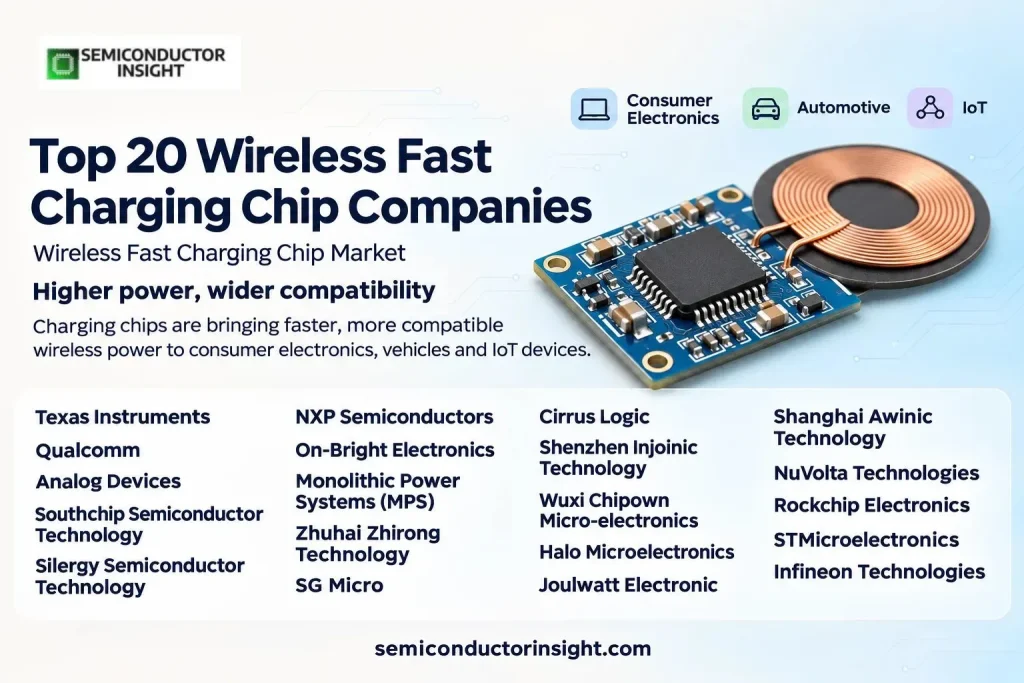
The wireless fast charging chip industry is moving into a new phase as smartphone manufacturers, accessory brands, automotive suppliers and consumer-electronics companies pursue higher power delivery, improved charging efficiency and universal device compatibility.
The introduction of Qi2 25W has created another development opportunity for semiconductor manufacturers, particularly those designing wireless transmitter controllers, receiver ICs, power-management chips and integrated charging platforms.
Texas Instruments – Precision Power Conversion and Receiver-Side Integration
Texas Instruments has an established position in wireless charging through its BQ-series receiver and transmitter controller portfolio. Its BQ51013C is particularly relevant for compact receiver designs, supporting up to 5W wireless power transfer and achieving peak AC-to-DC efficiency of 93% under specified operating conditions. The device integrates synchronous rectification, voltage regulation, communication control and foreign-object-detection functionality, reducing the number of external components required between the receiver coil and the output.
For manufacturers developing wireless charging solutions for smartphones, headphones, medical devices and portable electronics, this integration can simplify PCB architecture and thermal management. The automotive-qualified BQ51013B-Q1 additionally operates across an ambient temperature range of -40°C to 125°C. TI’s engineering strength lies in dependable analog control, power conversion and protection circuitry, although its established 5W receiver products should not be confused with newly developed 25W Qi2 receiver platforms.
Qualcomm – High-Current Charging Architecture and Wireless Ecosystem Integration
Qualcomm’s importance comes from its combination of wireless charging technology, battery-management semiconductors and fast-charging ecosystem development. Its SMB1396 auxiliary converter is designed for high-current wired and wireless charging applications, supporting output currents up to 10A and input voltages up to 21.5V. The architecture supports parallel charging configurations, allowing smartphone manufacturers to distribute power conversion and thermal loads across multiple charging components.
Qualcomm also has a significant historical contribution through WiPower and Quick Charge for Wireless Power. Its collaboration with Injoinic helped introduce a 30W wireless charging pad platform with Quick Charge 3.0 certification. This experience is relevant as the industry transitions towards standardized high-power charging. Qualcomm’s position is therefore particularly important in the intersection of wireless charging controllers, high-current battery charging and smartphone power-delivery ecosystems.
Analog Devices – High-Reliability Wireless Power for Specialized Electronics
Analog Devices approaches wireless power through precision analog circuitry and receiver-side battery charging solutions. Its LTC4120 combines a wireless power receiver with a programmable buck battery charger, supporting charging currents from 50mA to 400mA. The device also uses Dynamic Harmonization Control to adjust resonant operation according to coupling conditions, allowing power transfer across an air gap without requiring extremely precise coil alignment.
The architecture is particularly relevant for portable medical instruments, industrial sensors, sealed electronic equipment and devices operating in environments where physical charging connectors can become unreliable. Its LTC4125 transmitter can deliver more than 5W to a compatible receiver and incorporates automatic power adjustment and foreign-metal detection. ADI’s contribution is strongest in specialized wireless power applications where reliability, controlled energy transfer and analog precision take priority over smartphone-focused charging speeds.
Southchip Semiconductor Technology – High-Power Receiver Chips and Qi2 Integration
Southchip is among the more directly relevant companies in this selection because wireless charging is a dedicated part of its semiconductor portfolio. Its SC96286 wireless power IC supports receiver-side power delivery up to 80W and transmitter-side output up to 20W. The device supports Qi2.0/MPP, integrates bidirectional operating capability and uses a 12-bit ADC for measurement and control functions within a compact 69-ball WLCSP package measuring approximately 3.123 × 4.113 mm.
Its wider portfolio includes transmitter ICs such as SC96019A and SCV96016, with integrated sensing, Q-value detection and protection functions. Southchip has also reported wireless charging solutions entering mass production in Lenovo smartphones and its modules contributing to an early batch of Qi2.2 certifications. These developments give the company a strong position in high-power receiver integration and compact wireless charging platforms.
Silergy Semiconductor Technology – Power Management Integration for Charging Platforms
Silergy’s relevance to wireless fast charging is connected primarily with its broader analog and power-management semiconductor capabilities. Its product portfolio includes buck converters, boost regulators, battery-related power solutions and multi-channel PMICs that can support the power architecture surrounding wireless charging systems.
For a wireless charging product, the receiver IC does not operate independently. Downstream voltage regulation, battery charging, load management and thermal control determine how effectively received energy reaches the battery. Silergy’s high-integration power-management expertise is therefore relevant to manufacturers developing compact charging accessories and consumer-electronics platforms. Its 2026 product announcements include low-voltage regulators supporting continuous load currents up to 3A and switching frequencies of 2.2MHz. These are supporting power-conversion capabilities rather than evidence of a dedicated Qi2 wireless charging controller launch.
NXP Semiconductors – Automotive Wireless Charging and Multi-Coil Controller Development
NXP has a particularly strong technical position in automotive wireless charging, where multiple smartphone charging positions, communication security and environmental reliability are important. Its MWCT2xxxS controller family supports Magnetic Power Profile operation up to 25W and Extended Power Profile operation up to 50W, depending on the configuration. Selected devices incorporate up to 4MB of memory, supporting more sophisticated control and software requirements.
An important January 2026 product update concerns the MWCT2xx3A automotive transmitter family. Its architecture supports two digital demodulation modules and two FSK modulation modules, enabling communication with two phones simultaneously in supported designs. The wider platform includes AUTOSAR software, security functions and automotive-oriented qualification options. NXP’s engineering position is particularly relevant to in-vehicle charging consoles, multi-coil transmitters and integrated automotive electronic systems.
On-Bright Electronics – Supporting the Power Architecture of Wireless Charging Products
On-Bright’s relevance is primarily associated with power-conversion electronics rather than a clearly established standalone Qi2 controller portfolio. Its expertise in AC-DC conversion, switching controllers, power devices and charging-related semiconductor components can support the upstream electrical architecture of wireless charging stations and accessories.
Wireless charging products require more than a transmitter controller. Their complete power path may include an AC-DC converter, USB power-delivery input, DC-DC regulation, and inverter stage and battery-management circuitry. These supporting components determine the stability of the power supplied to the transmitter coil. On-Bright’s experience in integrated power solutions makes it relevant to charger manufacturers seeking compact and cost-conscious designs. Its role should therefore be assessed through the wider charging power chain rather than attributed unverified Qi2 25W or 50W transmitter specifications.
Monolithic Power Systems (MPS) – Compact Power Stages for Automotive Wireless Charging
MPS brings an important system-level approach to wireless charging through integrated power conversion and automotive-oriented reference designs. Its automotive wireless charging reference platform combines the MPQ4262-AEC1 and MPQ4280-AEC1 devices to implement a complete 15W transmitter power architecture.
The design integrates multiple functions, including a transmitter full bridge, auxiliary buck conversion, current-sensing amplification and buck-boost regulation. Using two automotive-grade ICs helps reduce board complexity compared with assembling the same functions from several separate components. This is particularly relevant for vehicle centre consoles and charging pads where PCB space and thermal performance must be managed together. MPS’s competitive strength lies in integrated power stages and efficient automotive power delivery rather than simply offering a standalone wireless charging controller.
Zhuhai Zhirong Technology – Specialized Transmitter and Receiver Chip Development
Zhuhai Zhirong Technology has participated in the development of dedicated wireless charging semiconductors, including transmitter power-stage and receiver-side chip projects. Its publicly documented engineering work includes an 180nm BCD process-based wireless transmitter power-stage project using a flip-chip QFN26 package. The company’s earlier technical disclosures also describe a 5W wireless receiver development project based on 180nm BCD technology.
The significance of this work lies in integrating power switching and control functions into compact semiconductor packages suitable for consumer charging products. BCD manufacturing processes are particularly useful for mixed-signal power ICs because they combine bipolar, CMOS and high-voltage DMOS device technologies. For a competitive assessment, however, its publicly available historical development disclosures should be distinguished from independently confirmed 2026 mass-production shipments.
To Know More about the Report, You Can Freely Browse Our Latest Updated Report: https://semiconductorinsight.com/report/wireless-fast-charging-chip-market/
SG Micro – Analog Power Management and Supporting Charging Components
SG Micro’s relevance is best understood through its analog and mixed-signal semiconductor capabilities. Wireless charging receivers require precise current measurement, voltage regulation, low-noise signal conditioning and protection functions to maintain stable power transfer. These functions create opportunities for supporting analog IC suppliers even when they are not responsible for the main Qi transmitter controller.
SG Micro’s product strengths in power management, amplifiers, voltage references and signal-conditioning components are relevant to charging system designers looking to optimize auxiliary circuitry. Its potential application areas include wireless charging accessories, portable electronics and battery-powered devices. A distinction is necessary here: a publicly verified dedicated high-power Qi2 controller or 25W transmitter product was not established in the reviewed material, so its position is better described as an adjacent analog semiconductor supplier.
Cirrus Logic – Precision Mixed-Signal Engineering for Advanced Consumer Electronics
Cirrus Logic has an established role in mixed-signal semiconductor design, particularly audio and power-related technologies used in premium consumer electronics. Its engineering capabilities are relevant to compact device architectures where multiple power-sensitive subsystems operate within restricted thermal and PCB budgets.
Wireless charging systems require careful coordination between battery charging, power regulation, sensing and device-level thermal management. These are areas where mixed-signal integration and low-power circuit expertise are important. Cirrus Logic’s contribution should nevertheless be differentiated from dedicated Qi transmitter and receiver manufacturers. Its publicly documented portfolio does not establish the same direct wireless charging IC breadth as Southchip, NXP or STMicroelectronics. Its relevance is stronger in the surrounding consumer-device semiconductor ecosystem.
Shenzhen Injoinic Technology – Wireless Charging Controllers and Fast-Charging Ecosystem Development
Injoinic has a direct connection to wireless charging controller development and has previously collaborated with Qualcomm on fast wireless charging platforms. One important example is the IP6808 wireless transmitter family, which includes 5W and 10W configurations and integrates the power driver, USB Type-C functionality and charging control within a compact architecture.
The company also has an established receiver-side presence through the IP6831, which received Wireless Power Consortium Qi certification under Qi version 1.2.4 with a 2W Basic Power Profile. Its importance lies in developing integrated solutions for charging pads, consumer accessories and portable electronics. The combination of transmitter control, USB input management and wireless power conversion is particularly useful for manufacturers seeking to simplify charging-product design and reduce external component counts.
Wuxi Chipown Micro-electronics – Integrated Power Modules for Wireless Charger Designs
Wuxi Chipown’s wireless charging relevance is particularly visible in its power-module portfolio. Rather than concentrating exclusively on Qi communication controllers, the company offers a Wireless Charger Micro IPM category alongside its wider power-management and power-device product lines.
Integrated power modules can simplify the implementation of switching stages by combining several power components into a compact package. For wireless charger manufacturers, this can help reduce external MOSFET requirements, simplify PCB routing and support more compact transmitter designs. Chipown also develops AC-DC converters, synchronous rectifiers, battery-charging ICs and power devices, providing capabilities across several stages of the charging power chain. This makes the company relevant to accessory manufacturers seeking integrated power hardware rather than a complete standalone Qi controller.
Halo Microelectronics – Fast-Charging Circuit Innovation and Wireless Receiver Expertise
Halo Microelectronics has a relevant patent and engineering history in wireless charging receiver circuitry. One notable development is its US invention patent titled Wireless Charging Receiver Circuit and Chip, and Wireless Charging Receiver, granted in 2022. Its wider semiconductor portfolio includes battery-management ICs, high-performance DC-DC converters, protection switches and charging-related integrated circuits.
A current development worth watching is the company’s 2026 expansion in fast-charging power solutions. On November 17, 2026, its wholly owned subsidiary Chengxin Micro announced the CX8901X 65W high-voltage fast-charging complete-board solution. Although this is a wired fast-charging development rather than a Qi transmitter launch, it demonstrates the group’s growing focus on integrated charging electronics. Its wireless charging patent background and broader charging expertise make it relevant to the surrounding power-management ecosystem.
Joulwatt Electronic – Power Conversion Technologies for Charging Infrastructure
Joulwatt’s contribution to wireless charging is associated with its broader analog power and semiconductor portfolio. Its engineering focus includes power-management ICs, DC-DC converters, battery-management components and switching-control technologies that can support charging-related electronic systems.
For wireless fast charging, efficient DC conversion is essential because the energy received by the coil must pass through rectification and voltage-regulation stages before reaching the battery. Power losses in these stages directly influence operating temperature, charging time and overall system efficiency. Joulwatt’s potential relevance is therefore strongest in the supporting conversion architecture. Its position should not be overstated as a leading Qi2 controller supplier without a verified dedicated transmitter or receiver product specification.
Shanghai Awinic Technology – Analog Front-End and Power-Sensitive Device Integration
Awinic is relevant to the wireless charging ecosystem through its analog and mixed-signal semiconductor capabilities. Its product development spans audio ICs, haptic drivers, sensor interfaces and power-related components used in smartphones and other compact electronic devices.
The connection with wireless charging is particularly important in handset-level integration. A modern smartphone combines a wireless receiver, battery charger, thermal monitoring, audio subsystem and multiple power rails within a tightly constrained PCB layout. Components supporting accurate sensing and stable power management can help device designers coordinate these subsystems. Awinic’s role is therefore best evaluated through the wider smartphone semiconductor supply chain, rather than as a confirmed supplier of high-power Qi2 transmitter controllers.
NuVolta Technologies – High-Power Wireless Receiver Chips and Qi2.2 Modules
NuVolta has become one of the more interesting specialized participants in the high-power wireless charging ecosystem. Its NU1668 receiver IC supports wireless power delivery up to 50W, with synchronous rectification, programmable voltage regulation and ASK/FSK communication. The device also supports transmitter operation, enabling bidirectional wireless power functionality.
In June 2026, NuVolta showcased its NU6810 and NU1682 wireless charging ICs at the 12th China International Technology Fair in Shanghai. The company also highlighted products used in Belkin multi-device chargers, TORRAS charging stands and OPPO magnetic wireless power-bank products. Another important development is its reported portfolio of 12 Qi2-certified modules, with additional modules undergoing certification. Its engineering work on thickness, magnetic attachment and thermal management makes it particularly relevant to high-power magnetic charging accessories.
Rockchip Electronics – Processor-Level Integration for Smart Charging Accessories
Rockchip’s role in wireless charging is more closely connected with intelligent electronic platforms than dedicated high-power Qi transmitter and receiver ICs. Its processor and system-on-chip technologies can support charging stations and multifunctional accessories that incorporate displays, communication, power-status monitoring and connected-device management.
This becomes increasingly relevant as charging products evolve from simple single-device pads into multi-device stations combining smartphones, earbuds and wearable accessories. Such platforms may require processor-level coordination alongside dedicated wireless power controllers. Rockchip’s contribution should therefore be viewed as part of the intelligent accessory architecture. It should not be confused with the power-stage or Qi communication semiconductor suppliers responsible for actual wireless energy transfer.
STMicroelectronics – Complete Wireless Charging Ecosystems for Consumer and Industrial Devices
STMicroelectronics has one of the more established dedicated wireless charging portfolios in the industry. Its STWLC receiver and STWBC transmitter families cover applications ranging from wearables and smartphones to medical equipment, industrial tools and point-of-sale terminals.
Its wireless charging portfolio supports conventional 5W and 15W applications, while selected proprietary protocols extend power levels up to 30W. The company integrates power drivers, communication controllers, foreign-object detection and thermal protection to reduce the external component requirement. An important differentiator is its stated minimum seven-year product longevity commitment, which is particularly relevant for industrial and medical applications requiring extended component availability. ST’s combination of transmitter and receiver products, firmware, evaluation boards and reference designs gives customers a more complete development environment.
Infineon Technologies – Qi2.2 25W Controllers and Secure Wireless Power Delivery
Additional major industry participant
Infineon Technologies is an important addition to the original company list because of its dedicated wireless charging IC portfolio and recent Qi2.2 developments. Its WLC1125 transmitter IC supports Qi2.2-compliant 25W charging and incorporates programmable control functions for Magnetic Power Profile, Extended Power Profile and Basic Power Profile operation.
The device also supports Samsung 10W PPDE and Apple 7.5W charging profiles, providing flexibility for manufacturers developing interoperable charging accessories. Infineon’s wider platform combines wireless charging controllers with OptiMOS power devices and OPTIGA Trust Charge authentication technology. Its WLC1115 reference platform previously demonstrated Qi2 15W operation, with a tested end-to-end efficiency of approximately 82% under specified conditions. This combination of power electronics, programmable control and authentication gives Infineon a particularly strong position as the industry transitions towards higher-power standardized charging.
MARKET INTELLIGENCE
Go deeper with our market research
Explore technology forecasts, competitive analysis and customized semiconductor research.
Comments (0)