

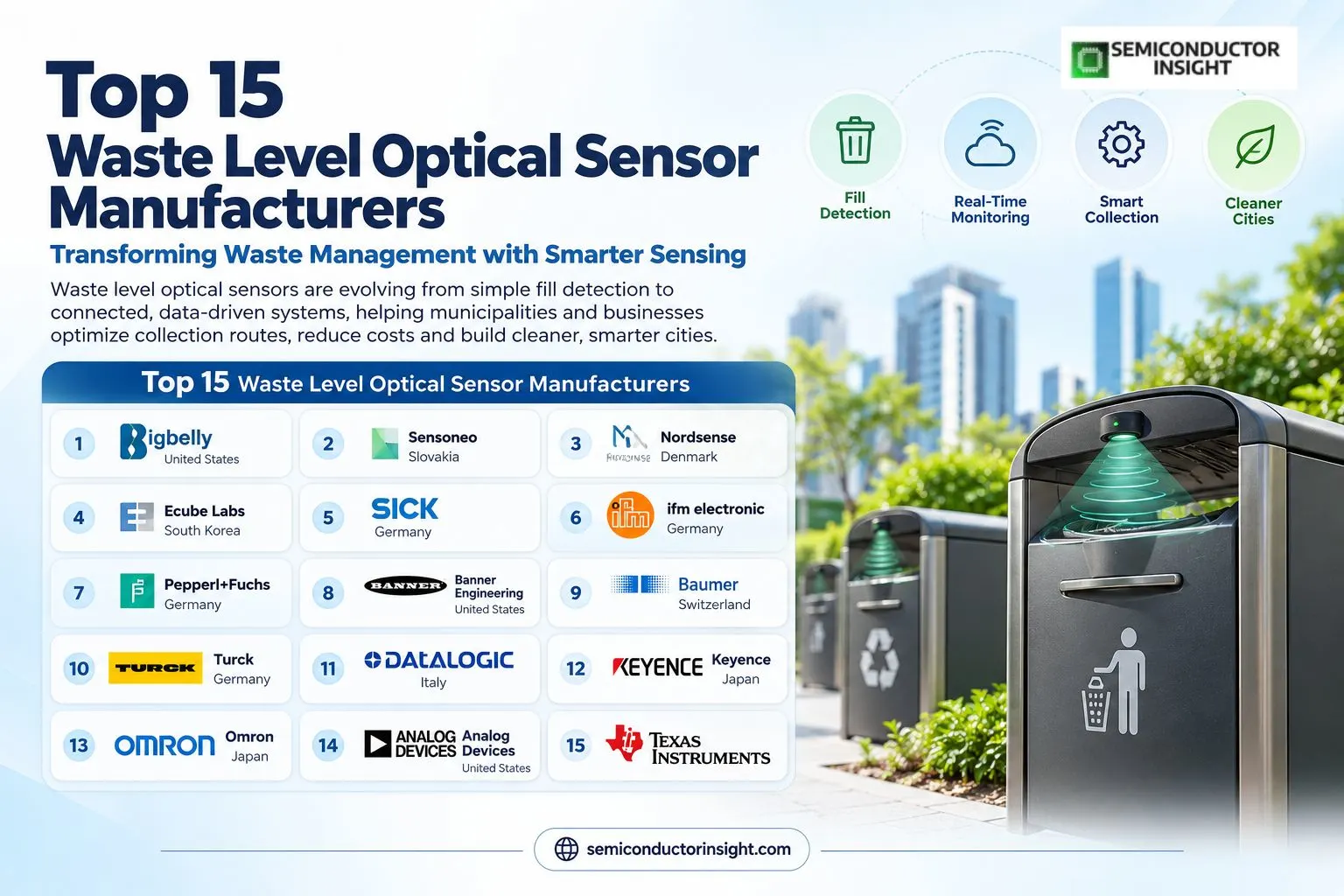
Top 15 Waste Level Optical Sensor Manufacturers Driving Innovation in Smart Waste Management and IoT Solutions
The waste level optical sensor market is evolving from basic container-full detection into a connected monitoring ecosystem where optical distance measurement, ultrasonic sensing, 3D vision, radar and artificial intelligence work together to improve waste collection decisions. These technologies help municipalities, commercial facilities, recycling operators and industrial waste handlers understand how much capacity remains inside a container without relying entirely on manual inspections.
Companies Turning Container-Level Measurements into Operational Intelligence
Bigbelly (United States) – Connecting Sensor-Based Fill Detection with High-Capacity Public Waste Infrastructure
Public-space smart bins | Solar-powered compaction | Connected collection monitoring
Bigbelly has established a distinctive position by combining fill-level monitoring with solar-powered waste compaction. Its CLEAN management platform receives information about fullness, collection activity, bin status and GPS location, allowing municipal operators to understand which public containers require attention.
Its Philadelphia deployment illustrates the operational significance of this model. The city has more than 1,300 Bigbelly smart waste and recycling units, while the original programme began with 500 solar-powered compacting units in high-volume areas. The reported programme outcome includes more than 1.1 million collections saved annually and a reduction in weekly collection frequency from 17 to just 3 visits.
An important differentiator is the combination of sensing and physical capacity management. Its standard Smart unit holds 47 gallons (178 litres), while Smart Max offers 150 gallons (570 litres). This allows operators to address two separate problems: knowing when collection is required and reducing how frequently a container reaches its capacity.
Sensoneo (Slovakia) – Scaling Fill-Level Intelligence across Municipal and Commercial Waste Networks
Ultrasonic and radar sensors | NB-IoT connectivity | Large-scale municipal deployments
Sensoneo stands out through its combination of sensor hardware, waste management software, route optimisation and large-scale municipal implementations. Its portfolio includes ultrasonic and radar-based fill-level monitoring, giving customers options for different container configurations and waste environments.
Its Bay Area Rapid Transit (BART) deployment is an important North American reference. The first batch of sensors was installed in 2025 to monitor dumpsters and roll-on/roll-off containers across a transit network covering 50 stations and 131 miles of track. BART recorded 50.7 million passenger trips during 2024, making reliable waste monitoring particularly relevant to its station and maintenance operations.
The scale of Sensoneo’s broader platform is also notable. Its current company-reported figures include more than 55,000 sensors, 600 projects and deployments across 90-plus countries. The Madrid installation, involving a planned network of 11,100 sensors, demonstrates the importance of connectivity and centralised monitoring when thousands of containers must be managed across a metropolitan area.
Nordsense (Denmark) – Bringing Predictive Collection Decisions to Public Waste Containers
IoT fill-level sensing | Demand-based collection | Municipal route intelligence
Nordsense has built its market relevance around helping municipalities replace fixed collection schedules with demand-based operations. Its sensor-based system monitors container fullness and sends information to a central platform, enabling collection teams to prioritise containers according to actual requirements.
San Francisco provides a particularly useful example. The city’s smart-bin programme addressed a sanitation problem associated with more than 10,000 citizen complaints annually. According to the Nordic IoT Centre’s documented case, the deployment helped reduce overflowing bins by 80%, resident complaints by 66% and illegal dumping by 64%.
Another interesting application is Varde Municipality in Denmark, where 30 large semi-underground containers were equipped with fill-level sensors. The resulting demand-based collection planning saved approximately 1,600 kilometres of collection travel and 1.6 tonnes of CO₂ annually in the documented case. This demonstrates the value of monitoring containers that are geographically dispersed and expensive to inspect manually.
Ecube Labs (South Korea) – Combining Fill-Level Sensors with Data-Driven Collection Optimisation
CleanFLEX | CleanCityNetworks | Smart collection infrastructure
Ecube Labs has developed an integrated approach through its CleanFLEX sensor and CleanCityNetworks platform. The sensor measures container fill levels and transmits information to the cloud, where waste operators can monitor collection activity, container status and changing waste-generation patterns.
Its Dublin Airport implementation is particularly relevant to high-traffic commercial infrastructure. The airport originally collected 840 containers four times daily. Following the deployment of 300 CleanCAP sensors, subsequently represented in the CleanFLEX product portfolio, the operation moved towards 80 larger triple-station units. The reported collection count fell from 3,360 daily collections to 240, representing a reduction of approximately 92.8%.
The technology is also relevant because CleanFLEX supports multiple connectivity approaches, including LoRa, NB-IoT and cellular networks. Its ability to monitor both solid and liquid materials broadens its applicability beyond ordinary municipal rubbish bins. For airports, shopping complexes and transport facilities, this combination of monitoring and route intelligence can help align cleaning resources with actual waste-generation patterns.
Evreka (Türkiye) – Connecting Sensor Readings with Municipal Fleet and Geographic Information Systems
EvrekaCore | Smart collection | GIS-based route optimisation
Evreka differentiates itself through the connection between waste-level sensing, municipal fleet management and geographic information systems. Its approach combines container fullness, location and movement information with operational dashboards, allowing waste managers to determine which assets require collection.
The Tuzla Municipality implementation in Türkiye provides a documented example of this approach. Developed using Esri’s GIS technology, the programme initially operated with 3,000 sensor-equipped containers. Collection vehicles received optimised routes based on container information and geographic analysis. The case study reported 44% shorter collection routes and a 55% reduction in waste collection costs and CO₂ emissions.
Evreka’s relevance lies in making sensor information actionable for municipal operations rather than treating fullness measurements as isolated data points. This is particularly important in cities where underground containers, conventional bins and different collection vehicles must be coordinated through a common operational system.
MaxBotix (United States) – Developing Ultrasonic Measurement Hardware for Difficult Waste-Level Conditions
XL-TrashSonar-WR | Ultrasonic distance measurement | Industrial-grade sensing
MaxBotix occupies an important position as a sensor-component supplier rather than a complete municipal waste management platform provider. Its relevance comes from developing ultrasonic measurement hardware that can be integrated into smart waste monitoring devices, particularly where non-contact distance measurement is required.
The XL-TrashSonar-WR is specifically designed for rubbish-bin monitoring, offering centimetre-level resolution and an industrial-grade configuration. Its product portfolio also includes the HRXL-MaxSonar-WR and SCXL-MaxSonar-WR families, with the latter incorporating self-cleaning technology for environments with high condensation. This is significant because moisture accumulation and dirt can interfere with sensor performance inside waste containers.
MaxBotix reports that its sensors have supported more than 10,000 projects and that it has assisted over 20,000 engineers in selecting sensor solutions. These figures indicate the breadth of its integration ecosystem. Its technology is particularly relevant to IoT developers creating customised monitoring units for municipal bins, commercial dumpsters and industrial containers.
Tekelek (Ireland) – Extending the Operating Life of Wireless Waste-Level Sensors
TEK-839 | LoRaWAN | Long-life battery-powered monitoring
Tekelek has a specific advantage in applications where sensors must operate for extended periods without frequent battery replacement. Its ultrasonic LoRaWAN waste-bin sensor, TEK-839, is designed to monitor solid waste including glass, metal, cardboard and residential rubbish.
The product’s specifications make it relevant to large-scale deployments. It offers a measurement range of approximately 12–300 centimetres, typical accuracy of ±2 centimetres and an IP67-rated enclosure. Its stated battery life reaches up to 14 years under specified operating conditions, including a measurement every 15 minutes and a network transmission every six hours with excellent LoRaWAN coverage. Actual battery performance will depend on operating temperature, signal conditions and configuration.
A further differentiator is the availability of remote configuration, high- and low-level alarms and mounting options. These capabilities matter when operators manage containers across large geographical areas, where visiting individual bins simply to inspect or maintain sensors can create additional operational expenditure.
Explore the full report details in our recently refreshed edition anytime: https://semiconductorinsight.com/report/waste-level-optical-sensor-market/
ifm electronic (Germany) – Bringing Photoelectric 3D Measurement into Bulk-Waste Monitoring
O1D | O3D | Photoelectric time-of-flight technology
ifm electronic is particularly relevant to the optical segment because its portfolio includes photoelectric distance sensors and 3D sensors capable of measuring irregular bulk-material surfaces. Its O1D and O3D families demonstrate how optical measurement can extend beyond conventional single-point distance detection.
The O3D uses photoelectric 3D time-of-flight measurement to identify distances across multiple points. According to ifm’s technical documentation, it can monitor opaque solid materials in tanks, silos and hoppers at distances of up to 10 metres in applicable configurations. Its software can calculate minimum, maximum and average levels while suppressing interfering structures such as internal equipment.
This capability is important because waste surfaces are rarely flat. Plastic packaging, cardboard and mixed refuse can create uneven peaks and valleys, making single-point measurements less representative of actual container capacity. The company’s optical sensing technology therefore offers an interesting route for specialised applications involving large waste bunkers, recycling hoppers and material-handling systems.
SICK (Germany) – Applying Industrial Sensor Reliability to Waste Collection and Recycling Equipment
UC30 | UM18 | LMS111 LiDAR | Industrial detection
SICK brings industrial automation expertise into waste and recycling operations. Its relevance is not limited to determining whether a bin is full; its sensors can also support container positioning, collection equipment automation and material-handling safety.
SICK’s waste and recycling industry documentation describes the UC30 ultrasonic sensor for monitoring critical fill levels in underground containers. The UM18 family supports waste-container position detection on collection vehicles, helping the gripping arm align correctly during emptying. Its LMS111 2D LiDAR technology can additionally assist with three-dimensional gripper positioning and monitoring working areas around automated collection equipment.
This broader technology combination makes SICK relevant to municipalities and industrial operators seeking more automation throughout the collection process. Its contamination-resistant sensing arrangements and IP67-rated LiDAR configurations are particularly useful in environments exposed to dust, moisture and variable outdoor conditions.
RoadRunner Recycling / Compology (United States) – Using Computer Vision to Understand What Is Inside Commercial Dumpsters
Compology smart cameras | Computer vision | Waste metering and reporting
RoadRunner Recycling strengthened its technology portfolio through the 2022 acquisition of Compology. The acquisition brought camera-based waste metering and artificial intelligence into RoadRunner’s broader waste-management services.
The distinction between this approach and conventional distance sensors is important. Instead of relying exclusively on the distance between a sensor and the waste surface, Compology’s camera-based system analyses container images to estimate fullness, identify material composition and provide information about collection activity.
For commercial facilities, this can reveal operational problems that a basic fill-level measurement may miss, including contamination, incorrectly disposed materials and containers being serviced before they are genuinely full. RoadRunner’s March 2026 announcement recognising the company in the CleanAI 60 further highlights its continued positioning at the intersection of artificial intelligence and sustainable waste operations.
Its importance to the market therefore comes from expanding waste monitoring beyond volume measurement towards visual waste intelligence, which can support billing verification, recycling analysis and enterprise sustainability reporting.
Recycle Track Systems (United States) – Turning Real-Time Bin Monitoring into AI-Based Waste Management
Pello | AI-powered bin sensors | GPS and contamination visibility
Recycle Track Systems has strengthened its position through Pello, an AI-powered smart waste platform that combines sensors, GPS, cellular connectivity and real-time operational data.
The company’s September 2025 launch at Citi Field, home of the New York Mets, is a notable example of its expansion into high-traffic entertainment facilities. Pello sensors provide visibility into bin fullness and contamination, while installation takes less than 15 minutes according to the company. AI-generated alerts help facility teams identify overflow risks, address recycling mistakes and organise collections according to actual requirements.
A particularly relevant update arrived in July 2026, when RTS published its 2025 Sustainability Snapshot. The company reported 964 Pello sensors deployed, alongside 5,825 tons diverted annually through TRUE Zero Waste projects and 597 tons avoided through reuse and repurposing initiatives. These figures demonstrate how the company’s sensor business is being connected with measurable waste-diversion activities rather than operating as an isolated monitoring product.
1NCE (Germany) – Providing the Connectivity Infrastructure Behind Distributed Waste Sensors
NB-IoT | Cellular IoT | Device lifecycle management
1NCE plays a different but important role in the waste-level monitoring ecosystem. It is not primarily a waste sensor manufacturer; instead, it provides connectivity that allows independently installed sensors to transmit readings to cloud-based waste management platforms.
Its collaboration with Sensoneo demonstrates this role. In Madrid, 1NCE connectivity supported a deployment monitoring thousands of waste containers through NB-IoT. The project initially involved more than 6,000 connected bins, with an expansion target of 11,100. The reference also describes route reductions of 30–63% and 97% accuracy in actual waste production as reported project outcomes.
Its January 2026 announcement provides a broader indication of connectivity scale. 1NCE reported managing more than 40 million intelligent products across 30,000 customers and 17 industries, with services available in more than 170 countries and regions. The introduction of 1NCE Insights also brings AI-supported network analytics into device management. For waste sensor deployments, connectivity reliability, battery optimisation and remote device management are critical to maintaining thousands of distributed measurement points.
Additional Companies Expanding the Waste-Level Sensing Ecosystem
Enevo (United States / Finland) – Combining Multiple Sensor Inputs with Predictive Waste Collection
WE-009 | Ultrasonic sensing | GPS and motion analytics
Enevo is a relevant additional participant because its sensor architecture combines multiple measurement inputs rather than depending on a single distance reading. Its waste-monitoring devices integrate ultrasonic transducers, GPS, accelerometers, gyroscopes and temperature sensors to capture container fullness, location, movement and operational events.
Its WE-009W and WE-009TW models address different container configurations, including large commercial dumpsters, front-end-loader containers, underground containers and recycling installations. Measurements are generally configurable, with the WE-009 datasheet describing hourly measurement intervals and LTE Cat-M1 communication.
An important differentiator is the SmartPlans platform. Enevo’s system evaluates millions of potential collection plans and routing options hourly, using historical and real-time sensor information to generate demand-based collection schedules over a two-to-four-week planning horizon. This makes the technology particularly relevant to operators managing mixed fleets and multiple waste streams.
WasteHero (Denmark) – Making Fill-Level Data Useful for Dynamic Municipal Collection
Wireless fill-level sensors | LoRaWAN | GPS-enabled container management
WasteHero adds another important dimension to the market through its integration of container sensing, waste analytics and dynamic collection planning. Its fill-level sensor specification covers a detection range of 0–400 centimetres, an IP67 enclosure rating and battery operation of up to five years. Supported communication options include GSM, LTE-M, NB-IoT and LoRaWAN.
The company’s documented Aalborg Council implementation is especially relevant. By combining fill-level information with fleet asset digitalisation and weight tracking, the municipality implemented semi-dynamic collection schedules and reported a 40% reduction in the number of collections. This is a useful example of how sensor information can influence actual municipal service arrangements rather than simply generate fullness notifications.
WasteHero’s technology is particularly applicable to underground containers and mixed municipal waste streams, where manual inspections can be difficult. The combination of container identification, GPS positioning and configurable measurement thresholds also helps operators distinguish between assets requiring immediate collection and those that can remain in service.
GLA-intec (Germany) – Bringing Direct Optical Measurement to Specialised Waste Containers
IceBox Sensor | Optical fill-level measurement | NB-IoT connectivity
GLA-intec is an especially relevant addition because its IceBox Fill Level Sensor uses optical sensing rather than relying exclusively on ultrasonic or radar measurement.
The system is designed for specialised disposal containers, including clothing collection banks and electronic waste containers. Installed in the upper section of a container, the optical sensor scans the waste below and transmits fill-level information to a cloud platform. This provides a direct connection between optical distance measurement and the practical requirements of specialised recycling infrastructure.
An interesting engineering consideration is its battery-powered operation. Because the device must work independently inside a container, communication reliability and power consumption become important design factors. GLA-intec supports GSM, LoRaWAN and NB-IoT connectivity, while its collaboration with 1NCE includes an eSIM soldered directly onto the device’s circuit board to improve resistance to shock and vibration. This is particularly relevant for containers exposed to mechanical handling and cleaning procedures.

Comments (0)