

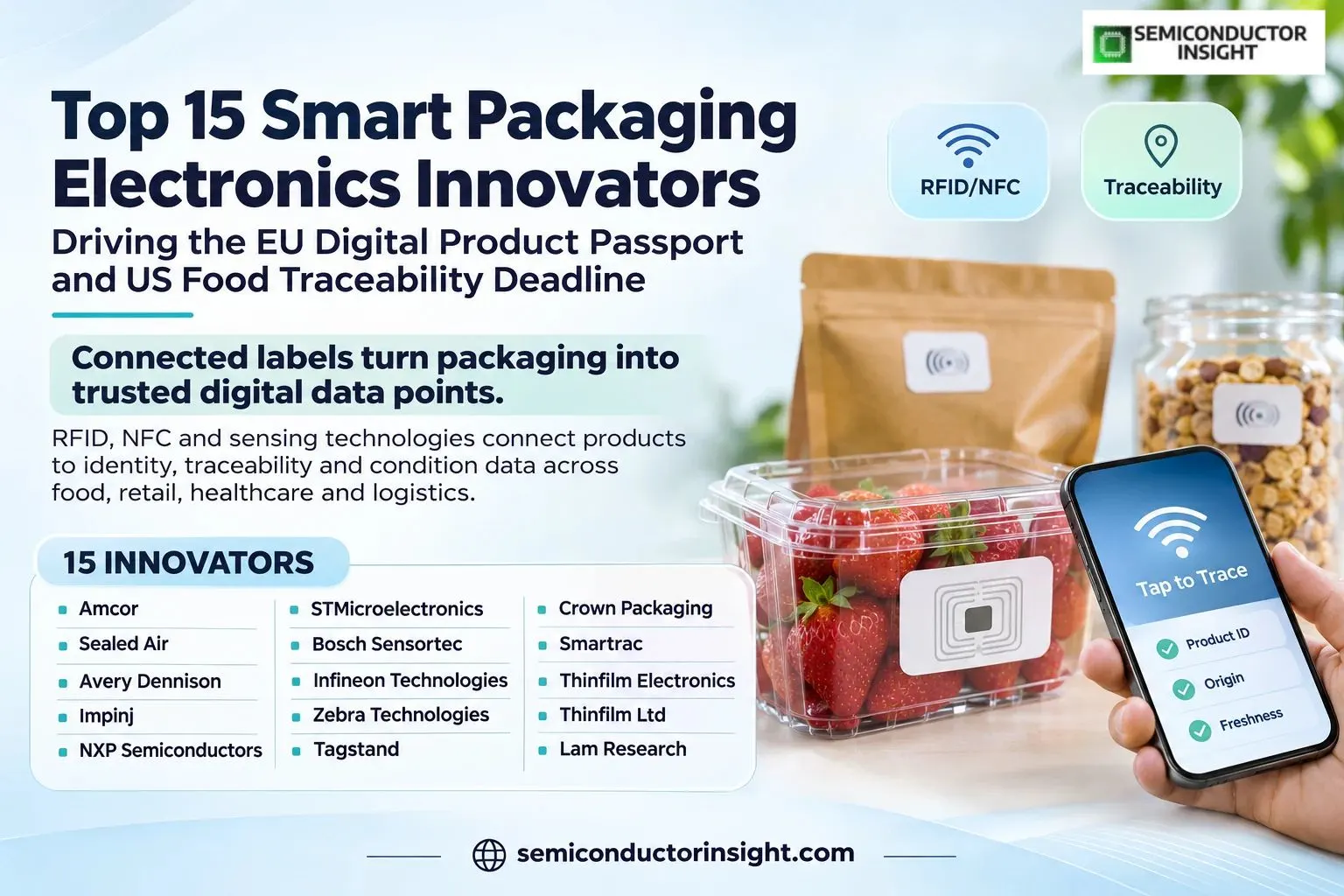
Top 15 Smart Packaging Electronics Innovators Driving the EU Digital Product Passport and US Food Traceability Deadline
Smart Packaging Electronics Market brings together packaging materials and electronic technologies that allow products to communicate, identify themselves, or report information about their condition.
RFID and NFC inlays, printed sensors, temperature indicators, Bluetooth-enabled labels, and embedded identification chips are turning packages into active data points across manufacturing, retail, healthcare, food distribution, and logistics.
Amcor – Connecting Flexible Packaging with Product Traceability
Amcor’s importance lies in its ability to bring intelligent identification into packaging formats manufactured at enormous industrial scale. Its flexible films, labels, and rigid containers provide the physical platform into which RFID, NFC, QR-based identification, and freshness-monitoring features can be incorporated. This is particularly relevant to food, beverages, healthcare, and personal-care products, where packaging must protect the contents while also supporting authentication and supply-chain information.
A useful measure of its manufacturing reach comes from Amcor’s FY2025 sustainability reporting: 597,000 metric tonnes of its flexible packaging production was classified as recycle-ready. The company also reported that recycle-ready solutions were available for 96% of its flexible packaging portfolio by area. These figures do not represent electronic packaging volumes, but they show the scale at which Amcor can potentially introduce connected and traceable packaging formats.
Its 2026 sustainability reporting continues to emphasise packaging circularity and customer collaboration. The strategic opportunity is to combine recyclable material structures with digital identification without making sorting and recovery more difficult. Amcor’s position is strongest as a packaging-platform provider that can work with electronic component suppliers and brand owners to industrialise smart packaging.
Sealed Air – Bringing Product Protection and Digital Monitoring Together
Sealed Air has a particularly relevant position in food and pharmaceutical packaging because its products are designed around protection, freshness, handling, and distribution conditions. Its CRYOVAC food packaging, protective packaging systems, and automated packaging equipment provide opportunities for integrating temperature indicators, traceability labels, and sensor-enabled monitoring into packaging workflows.
The scale of its food-packaging operations is illustrated by the installation of its 4,000th CRYOVAC rotary vacuum packaging system, announced in September 2025. In January 2026, the company marked 85 years of the CRYOVAC brand. These developments demonstrate the industrial reach of its packaging platform, even though they should not be confused with a 4,000-unit smart-sensor installation.
A significant corporate development came in April 2026, when Sealed Air announced completion of its acquisition by CD&R. Its next opportunity in smart packaging lies in combining packaging automation with digital traceability and condition-monitoring systems. For food processors, the potential value is not simply a connected label; it is the ability to link packaging-line information with product handling and distribution records.
Avery Dennison – Making Intelligent Labels Easier to Manufacture at Scale
Avery Dennison has one of the most direct positions in the smart packaging electronics ecosystem through its intelligent labels, RFID inlays, and digital identification materials. Its technology connects the physical product with inventory systems, logistics platforms, and consumer-facing digital information. This gives the company a role in food, pharmaceuticals, retail, apparel, and reusable packaging.
Its 2026 developments are particularly relevant. In August, Avery Dennison introduced AD Fusion, a programme supplying label converters with materials containing pre-inserted RFID inlays. The approach reduces the need for converters to purchase specialised inlay-insertion equipment. In September, the company announced AD Visi, an active Bluetooth Low Energy label range for tracking time-sensitive and high-value shipments.
Another important development arrived in July 2026, when its AD CleanFlake RFID tags received RecyClass Technology Approval for compatibility with European PET bottle recycling streams, building on existing recognition in North America. These initiatives address three commercial requirements: easier RFID production, shipment visibility, and packaging recyclability. Avery Dennison’s advantage is its ability to connect label materials, inlay engineering, and customer converting operations.
Impinj – Providing the Identification Chips Behind Connected Packages
Impinj occupies a central position in RAIN RFID because its endpoint chips allow individual products and packages to be identified through radio-frequency systems. Rather than manufacturing complete packaging structures, it supplies the semiconductor technology that enables item-level identification, inventory visibility, and automated tracking.
The scale of its chip platform is illustrated by the M800 series, which surpassed 5 billion lifetime tag-chip shipments in 2025. This milestone demonstrated the suitability of its RFID technology for large-scale deployments where millions of individual products must be read efficiently. Its Gen2X developments further support the evolution of high-performance RFID systems.
Impinj’s October 2026 third-quarter results recorded revenue of USD 112.1 million, with endpoint IC revenue and unit volumes reaching quarterly records. The company attributed its performance partly to M800 adoption, retail demand, and Gen2X momentum. For smart packaging, this matters because the economics of connected products depend on affordable chips, dependable read performance, and the ability to process large numbers of tagged items quickly.
NXP Semiconductors – Extending Smart Labels into Food, Healthcare, and Logistics
NXP’s role is particularly important in the semiconductor layer of smart packaging. Its UCODE RAIN RFID family supports product identification and tracking across retail, logistics, healthcare, and pharmaceutical supply chains. The technology allows manufacturers to assign electronic identities to packages and products, making them easier to locate, authenticate, and manage throughout distribution.
In January 2026, NXP introduced UCODE X, a new RAIN RFID tag chip designed for high-volume applications. Its published specifications include read sensitivity of −26.2 dBm, write sensitivity of −23 dBm, and a write speed of 32 bits in 1.9 milliseconds. The chip supports smaller inlays, which is relevant to compact food and cosmetics packaging where label space is limited.
NXP’s NTAG X DNA secure NFC technology also supports product authentication, with 16 KB of memory and secure authentication features. These capabilities are relevant to medicines, premium consumer goods, and products requiring digital verification. NXP’s competitive strength comes from providing both long-range RAIN RFID identification and short-range NFC interaction within the wider connected-product ecosystem.
STMicroelectronics – Building Authentication Directly into the Packaging Label
STMicroelectronics brings smart packaging closer to secure product identity through its ST25 NFC and RFID tag portfolio. Its chips can be integrated into labels or packaging structures, allowing a smartphone or compatible reader to access product information, verify authenticity, and retrieve digital records. This is particularly useful for premium beverages, cosmetics, medical products, and products exposed to counterfeiting.
The ST25 family includes several NFC and RFID categories, including Type 2, Type 4, and Type 5 devices. Across the portfolio, memory options extend from 512 bits to 64 Kbits. Selected devices also incorporate digital signatures, counters, tamper detection, and password-based protection.
An important 2026 development is ST’s October launch of MatterConnect, a service that factory-loads authentication credentials into secure chips used in Matter-compatible devices. Although this is not a packaging-specific launch, it demonstrates the company’s capabilities in secure chip provisioning. Its packaging relevance lies in extending trusted digital identity to physical products through embedded NFC technology.
Bosch Sensortec – Enabling Condition-Aware Packaging Systems
Bosch Sensortec contributes a different capability to the smart packaging ecosystem: environmental sensing. RFID identifies a package, but sensors can help establish what happened to its contents during storage or transport. Temperature, humidity, pressure, and gas measurements are especially relevant to food, pharmaceuticals, chemicals, and other sensitive products.
Its environmental sensing portfolio includes integrated devices capable of measuring multiple parameters. The BME690, for example, combines gas sensing with temperature, humidity, and pressure measurement. The BME688 adds AI-enabled gas sensing, with detection capabilities extending to volatile organic compounds and selected gases at parts-per-billion levels.
These capabilities are not equivalent to a finished disposable smart-package sensor. Instead, they provide technology that can support reusable sensor nodes, smart containers, connected transport equipment, and monitoring systems. In 2026, Bosch’s wider sensing portfolio continues to address logistics and asset-tracking applications. Its opportunity is to help packaging systems evolve from simple identification towards condition-based monitoring.
You can freely browse our most recent updated report to learn more about it before scrolling further: https://semiconductorinsight.com/report/smart-packaging-electronics-market/
Infineon Technologies – Securing the Digital Identity of Packaged Products
Infineon has a strong position in the authentication side of smart packaging through its OPTIGA NFC technology. Its secure tags can be embedded in packaging or product labels to help brands verify authenticity, prevent cloning, and provide customers with trusted digital information. This is particularly relevant to cosmetics, luxury products, healthcare goods, and electronic accessories.
Its secured NFC solutions support AES-128 cryptography and NFC Forum Type 4 compatibility. Depending on the product, available memory configurations include 304 bytes, 1 KB, 2 KB, and 4 KB. The OPTIGA Authenticate NBT NFC-I2C bridge extends the functionality to connected devices, providing 8 KB of non-volatile memory and both NFC and I2C interfaces.
The commercial relevance is clear: a simple printed QR code can be copied, whereas a secure NFC tag can support cryptographic authentication. Infineon’s role is therefore more specialised than basic product identification. It helps packaging and brand owners build a trusted digital link between the product, the consumer, and the manufacturer’s authentication system.
Zebra Technologies – Connecting RFID Labels with Warehouse and Retail Operations
Zebra Technologies is important because smart packaging needs more than an embedded tag. It also requires printers, readers, antennas, mobile computers, and software capable of capturing and using the information stored in that tag. Zebra provides much of this operational infrastructure.
Its RFID portfolio covers handheld readers, fixed readers, antennas, RFID-enabled mobile computers, printers, and label supplies. The company offers RFID-enabled printer models across desktop, industrial, and mobile categories, including the ZT421 RFID and ZQ630 RFID Plus. These systems help manufacturers encode labels and enable warehouses to capture package information during receiving, storage, picking, and dispatch.
Zebra’s value is particularly visible in high-throughput operations where manual barcode scanning becomes inefficient. A tagged carton or product can be identified without requiring every label to be individually positioned in front of a scanner. In the 2026 product ecosystem, Zebra’s role remains centred on the infrastructure that makes RFID-enabled packaging operationally useful rather than simply technologically interesting.
Tagstand – Supporting NFC-Based Consumer Interaction
Tagstand represents the consumer-facing side of smart packaging electronics. Its NFC tags and stickers can be attached to products or incorporated into packaging to trigger digital actions when tapped with a compatible smartphone. Applications include product information, digital instructions, promotional content, authentication workflows, and links to online brand experiences.
Its product formats have included NFC stickers, hard tags, tokens, keychains, wristbands, and cards. This variety is useful because smart packaging does not always require a sophisticated electronic sensor. In many cases, a low-cost NFC element can provide a practical connection between a physical package and a digital platform.
For 2026, Tagstand’s relevance is best understood through its NFC customisation and encoding capabilities rather than a newly verified large-scale packaging contract. The opportunity lies in helping smaller brands and packaging converters introduce tap-enabled product experiences without building their own electronic systems. It is a specialist ecosystem participant, not a semiconductor-scale manufacturer.
Crown Packaging – Linking RFID Labels with Packaging-Line Operations
Crown Packaging’s contribution is more operational than electronic-chip manufacturing. Its packaging supply and equipment activities connect labels, printing systems, coding equipment, and packaging machinery with the workflows used by manufacturers and distribution centres. This is relevant because smart packaging needs to be applied, printed, encoded, and verified during production.
Crown Packaging Corp. lists RFID labels among its packaging supplies and offers RFID printers and labelling equipment through its equipment and service network. Its wider North American operations include more than 50 locations and over 200 regional packaging specialists. The company also reports a catalogue of more than 150,000 packaging products.
These figures demonstrate distribution and implementation reach, not electronic-tag production capacity. Its role is to help customers source and deploy the equipment and materials required for traceable packaging. For manufacturers moving from conventional labels to RFID-enabled operations, such integration partners can be important in connecting packaging design with actual production-floor requirements.
Smartrac – The RFID Inlay Technology That Strengthened Intelligent Labels
Smartrac remains an important name in smart packaging because its RFID transponder technology became part of Avery Dennison’s intelligent-label platform. Its inlay expertise supported the development of RFID labels for retail, logistics, industrial applications, and products that are difficult to tag. The acquisition brought additional manufacturing capabilities and product technologies into Avery Dennison’s portfolio.
Avery Dennison completed the acquisition of Smartrac’s RFID transponder business in March 2020 for EUR 225 million. Historical company material described Smartrac’s manufacturing footprint across Germany, Malaysia, China, and the United States, with annual production capacity of approximately 2.5 billion RFID transponders.
Its continuing significance in 2026 should therefore be viewed through the technologies and manufacturing capabilities integrated into Avery Dennison, not as an independent listed competitor. The legacy is important because it demonstrates how RFID inlay expertise can strengthen a packaging materials company’s ability to deliver complete intelligent-label solutions.
Thinfilm Electronics – A Pioneer in Printed NFC and Sensor Labels
Thinfilm Electronics occupies a distinctive place in the development of smart packaging because it pursued printed electronics rather than relying exclusively on conventional silicon-based tag architectures. Its work combined printed memory, sensing elements, and NFC communication to create labels capable of carrying product information and interacting with smartphones.
The company’s earlier technology programme targeted applications such as wine authentication, brand protection, and consumer engagement. Its printed sensor-label concept was particularly notable because it aimed to combine sensing, memory, and wireless communication in a single label. Historical plans included a roll-to-roll production line designed around a potential capacity of approximately 1 billion tags annually.
However, this is a technology-history profile rather than evidence of a leading active 2026 smart-packaging supplier. Thinfilm’s later corporate reporting documented its decision to discontinue NFC and electronic article surveillance product development and sales. Its contribution remains relevant as an early example of how printed electronics could make connected labels thinner and potentially more economical.
Thinfilm Ltd – Understanding the Corporate Transition Behind Its Smart-Label Legacy
Thinfilm Ltd is listed separately in the supplied company names, but it should not be counted as a separate independent smart-packaging competitor from Thin Film Electronics ASA. The names refer to the same corporate technology lineage, and presenting them as two unrelated active suppliers would create an inaccurate competitive picture.
The company’s earlier business focused on printed memory, NFC-enabled labels, and sensor-integrated packaging concepts. Its technology was designed to make digital identification more accessible by placing electronic functionality directly onto flexible label structures. This approach was relevant to beverage authentication, product engagement, and supply-chain visibility.
The important development is the subsequent strategic transition away from NFC and electronic article surveillance activities, documented in its corporate reporting around 2019–2020. For market analysis in 2026, Thinfilm is best treated as a legacy innovator whose printed-electronics work helped shape the smart-label concept, rather than a current large-scale supplier competing with Impinj, NXP, or Avery Dennison.
Lam Research – Supporting the Semiconductor Manufacturing Behind Packaging Electronics
Lam Research is not a direct manufacturer of smart packaging labels, RFID tags, or sensor-enabled containers. Its relevance is further upstream: it supplies semiconductor manufacturing equipment and process technologies that support the production of advanced chips and electronic components. These components ultimately enable the RFID, NFC, sensing, and wireless systems integrated into smart packaging.
In May 2026, Lam announced a Panel-Level Packaging Center of Excellence in Salzburg, Austria. The facility expands research and development into panel-level processing, a manufacturing approach being explored for larger and more complex semiconductor packages. The company’s packaging technology portfolio also supports processes used in through-silicon vias, hybrid bonding, and 3D integration.
This is an indirect but important connection. As smart packaging electronics become smaller, more integrated, and more cost-sensitive, semiconductor manufacturing efficiency influences the economics of the components used in connected labels. Lam should therefore be classified as an upstream manufacturing enabler rather than a direct smart-packaging market leader.

Comments (0)