

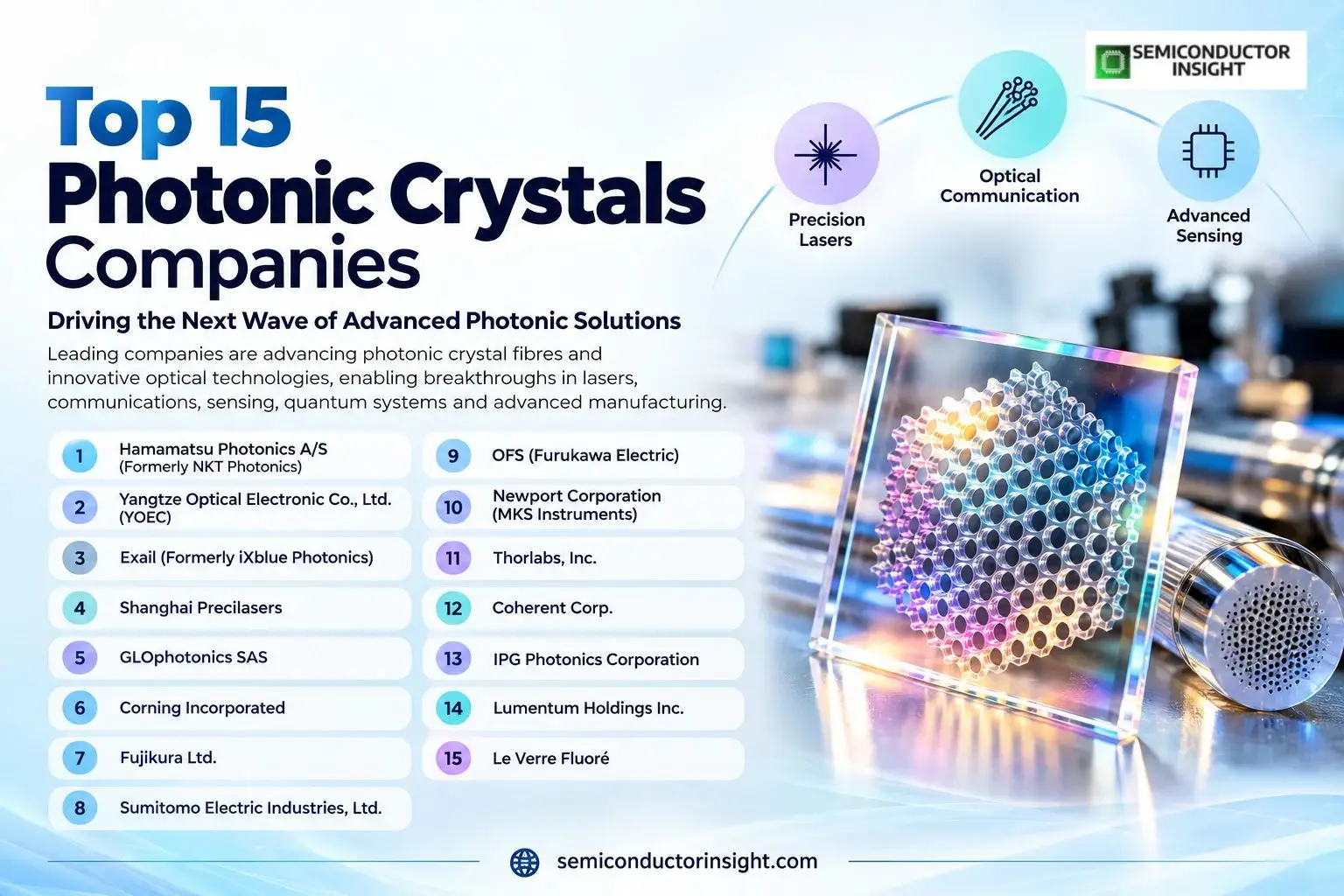
Top 15 Photonic Crystals Companies Driving Innovation in Optical Computing and Next-Generation Photonics (2026-2035)
The photonic crystals market is evolving from specialised optical research into a broader technology ecosystem spanning precision lasers, optical communications, biomedical sensing, quantum technologies and advanced manufacturing. Photonic crystals use periodic variations in a material’s refractive index to control how light propagates. In photonic crystal fibres (PCFs), carefully engineered air-hole patterns or other microstructures enable optical properties that conventional fibres cannot always deliver.
For this company review, the strongest comparisons come from actual product specifications, fibre architectures, application capabilities, research developments and publicly announced corporate changes. The 15 companies below include the seven specified businesses and eight additional suppliers with relevant photonic crystal fibre, specialty fibre or adjacent photonics technologies. They are not presented as a verified global market-share ranking because comparable company-level sales and market-share data are not publicly established.
NKT Photonics, Now Hamamatsu Photonics A/S, Extends Its Specialty Fibre Legacy
The former NKT Photonics remains one of the most directly relevant names in the photonic crystal fibre business because its technology portfolio connects specialised fibre engineering with complete laser systems. Its nonlinear photonic crystal fibres are designed for supercontinuum generation and nonlinear wavelength conversion, using tailored dispersion profiles and high nonlinear coefficients to produce broad optical spectra. These capabilities support spectroscopy, biomedical imaging, semiconductor inspection and scientific instrumentation.
A significant corporate development occurred on 25 June 2026, when NKT Photonics A/S was renamed Hamamatsu Photonics A/S and integrated as the Lasers & Fibers Business Unit within the Hamamatsu Photonics Group. The change followed Hamamatsu’s 2024 acquisition and strengthened the connection between specialty fibres, lasers and optical measurement technologies. The portfolio continues to be relevant for applications requiring carefully controlled wavelengths and stable optical output.
Yangtze Optical Electronic Builds Momentum in Advanced Fibre Architectures
Yangtze Optical Electronic Co., Ltd. (YOEC) is particularly relevant where photonic crystal fibres intersect with specialised sensing, polarisation control and advanced optical systems. Its portfolio includes photonic crystal fibre alongside multicore, polarisation-maintaining and other specialty fibres. This combination matters because photonic crystal structures can be engineered for specific propagation behaviour rather than simply replacing conventional transmission fibre.
In February 2026, YOEC reported presenting developments in multicore fibres, small-diameter polarisation-maintaining fibres and hollow-core fibres at the Asia-Pacific Optical Sensors Conference and the International Workshop on Photonics and Fiber Applications in Sydney. In July 2026, the company also showcased specialty-fibre developments at the International Conference on Sustainable Photonics in China. These activities demonstrate continued engagement with sensing and advanced optical applications, although they do not establish a quantified share of the global photonic crystal fibre market.
iXblue Photonics, Now Part of Exail, Targets Application-Specific Fibre Performance
The former iXblue Photonics business is now associated with Exail, which maintains a commercial portfolio of photonic crystal fibres. Its catalogue includes supercontinuum fibres, endlessly single-mode designs and anti-resonant hollow-core fibres. These are not interchangeable products: supercontinuum fibres are designed for nonlinear spectral broadening, while hollow-core architectures can reduce the fraction of optical power interacting with the glass.
Exail’s published catalogue lists supercontinuum products optimised for wavelengths including 780 nm and 1,060 nm, alongside hollow-core options for wavelengths such as 750 nm, 920 nm and 1,550 nm. The availability of multiple wavelength-specific configurations gives system integrators options for matching fibre characteristics to laser sources and experimental requirements.
Shanghai Precilasers Connects Photonic Crystal Fibre with Practical Laser Systems
Shanghai Precilasers is relevant to customers seeking ready-to-integrate optical assemblies rather than bare fibre alone. Its published photonic crystal fibre product information describes assemblies based on NKT fibre technology, with end caps or collimators fitted to support practical integration. The company identifies applications including mode filtering, short-pulse transmission, multiple-wavelength transmission and polarisation-maintaining delivery.
Its published specifications include a maximum average optical power above 30 W for a listed assembly configuration, alongside a minimum return loss above 50 dB and a polarisation extinction ratio above 18 dB. These figures apply to the specified product configuration, not the company’s entire portfolio. Such engineering details help customers evaluate whether an assembly suits a particular laser or experimental setup.
GLOphotonics SAS Advances Hollow-Core Light Guidance
GLOphotonics occupies a specialised position in hollow-core and gas-filled photonic crystal fibre technology. These fibres can confine light within a hollow region, creating opportunities for controlled interactions between optical pulses and gases. This architecture is particularly interesting for nonlinear optics, pulse compression, spectroscopy and experiments involving plasma formation.
At CLEO 2026, held from 2-6 May in Long Beach, California, research associated with GLOphotonics examined plasma-core photonic crystal fibres for extreme nonlinear and quantum optics. The work explored controlled plasma generation through microwave excitation and ultrafast photoionisation. It illustrates how hollow-core fibres can serve as platforms for research beyond conventional light transmission, although a conference paper should not be interpreted as proof of mass commercial deployment.
Want to learn more about the report? Check out our latest updated version for free: https://semiconductorinsight.com/report/global-photonic-crystals-market/
Kongtum Science & Technology Focuses on Custom Fibre Engineering
Kongtum Science & Technology supplies photonic crystal fibres and offers customised fibre-optic jumpers and processing options. Its polarisation-maintaining photonic crystal fibre is described as using pure silica and shape-induced birefringence to maintain polarisation behaviour. The company highlights sensor, gyroscope and interferometer applications, where environmental stability and controlled optical propagation are important.
Its published specifications for one polarisation-maintaining fibre configuration include a 125 ± 2 μm cladding diameter, attenuation below 2.0 dB/km at 1,550 nm and crosstalk below −28 dB per 100 m. These technical parameters are more useful for procurement comparisons than general claims about optical performance because they give system designers measurable characteristics to assess.
IRFlex Corporation Brings Mid-Infrared Expertise to Hollow-Core Designs
IRFlex Corporation specialises in mid-infrared fibres and optical devices, including chalcogenide glass fibres and a patented hollow-core fibre with anti-resonant arches. Its technology is relevant to applications where conventional silica fibre has limited transmission capability, including chemical sensing, biological-agent detection, medical diagnostics and laser-based infrared countermeasures.
IRFlex identifies an operating wavelength range of approximately 2-11 μm for its broader mid-infrared fibre and device activities. Its anti-resonant hollow-core design is an adjacent technology within the wider microstructured-fibre landscape; it should not automatically be classified as a conventional photonic bandgap fibre. This distinction is important when evaluating the company’s role in the photonic crystals market.
Thorlabs Expands Accessibility for Research and Optical Prototyping
Thorlabs is an important supplier to laboratories and photonics developers because of its broad optical-component ecosystem, fibre-processing equipment and research instrumentation. This distribution and integration capability can help engineers evaluate specialised fibres within experimental systems, where compatibility with light sources, couplers, connectors and measurement equipment is essential.
- Its wider fibre portfolio includes polarisation-maintaining, highly nonlinear and other specialty fibre categories.
- For photonic crystal fibre projects, buyers should verify the exact fibre architecture and current availability rather than assuming that every specialty fibre listed in its catalogue uses a photonic crystal structure.
- Its practical contribution lies in supporting prototyping, optical characterisation and system assembly.
Corning Connects Advanced Fibre Manufacturing with AI Infrastructure
Corning is relevant to the wider photonic crystal fibre ecosystem through its optical-fibre manufacturing expertise and work on hollow-core fibre. In September 2025, Corning announced a manufacturing collaboration with Microsoft to accelerate production of Microsoft’s hollow-core fibre solution for cloud and AI networking. The programme highlighted the need for manufacturing scale and deployment-ready fibre and cable systems as data-centre traffic expands.
Hollow-core fibre is not synonymous with every photonic crystal fibre design, but the technologies share an interest in engineering light propagation through specialised fibre structures. Corning’s manufacturing scale and optical-communications experience make it an important company to monitor as advanced fibre concepts move from laboratory demonstrations towards network deployment.
OFS and Furukawa Electric Bring Specialty Fibre Manufacturing Depth
OFS, part of Furukawa Electric’s wider optical-communications business, is relevant to the photonic crystal fibre ecosystem through its specialty-fibre engineering, optical sensing and communications technologies. Its broader manufacturing and application expertise can support fibre solutions for demanding environments, although specific photonic crystal fibre availability should be confirmed against current product documentation.
A useful distinction for buyers is the difference between a manufacturer of a particular microstructured fibre and a supplier whose portfolio covers adjacent specialty fibres. In applications such as distributed sensing, optical instrumentation and industrial measurement, fibre attenuation, mechanical robustness, bend behaviour and compatibility with the source wavelength can be just as important as the underlying structure.
Fujikura Applies Fibre Engineering to High-Performance Optical Systems
Fujikura is worth monitoring for its optical-fibre manufacturing and fibre-processing capabilities, which serve telecommunications, industrial and advanced optical applications. Its experience with fibre geometry, splicing and manufacturing consistency is relevant to the wider market for specialised light-guiding structures.
For photonic crystal fibre applications, the critical evaluation points are whether a particular product uses the required microstructured architecture and whether it meets the project’s wavelength, attenuation, mode-field and power-handling requirements. Fujikura’s relevance to the broader fibre supply chain should not be mistaken for evidence that every one of its specialty-fibre products is a photonic crystal fibre.
Sumitomo Electric Industries Supports Advanced Optical Material Development
Sumitomo Electric Industries has substantial expertise in optical fibres, optical communications and advanced materials. These capabilities are relevant to the development and manufacturing of fibres that must meet demanding optical and mechanical specifications. In photonic crystal fibre applications, process control matters because small variations in microstructure can change confinement, dispersion and nonlinear behaviour.
For equipment developers, the important comparison is not simply the number of fibre types offered. It is whether the supplier can consistently produce the required geometry, demonstrate performance across the operating wavelength and provide sufficient technical documentation for integration. Current product-level confirmation is necessary before attributing a specific photonic crystal fibre design to Sumitomo Electric.
Photonics Bretagne Specialises in Microstructured and Hollow-Core Fibres
Photonics Bretagne is directly relevant to microstructured fibre development, including hollow-core photonic bandgap designs. Its published technical sheet describes fibre structures in which more than 90% of the relevant photonic bandgap region is air-filled and more than 95% of the optical power can propagate in air for the described design. This reduces interaction between the guided light and glass, which can be beneficial for certain high-power and nonlinear applications.
The published product family includes variants centred around 750 nm, 785 nm, 950 nm and 1,060 nm. That range shows how fibre geometry can be tailored to particular optical sources rather than treated as a universal transmission component. Applications include power delivery, fibre sensing and nonlinear pulse shaping.
IPG Photonics Connects Fibre Technology with High-Power Laser Applications
IPG Photonics is a significant participant in the fibre-laser ecosystem, with products used in industrial processing, materials manufacturing and other high-power laser applications. Its broader fibre-laser expertise is relevant to photonic crystal fibre development because specialised fibre geometries can help manage optical power, dispersion and nonlinear effects.
However, IPG’s prominence in fibre lasers should not be interpreted as evidence that it is a leading supplier of every photonic crystal fibre category. Buyers investigating PCF for high-power applications should verify the actual fibre structure, operating wavelength, pulse duration and damage threshold for the product under consideration. The company’s relevance is strongest at the intersection of advanced fibre technology and laser-system engineering.
Coherent Brings Specialty Fibre Knowledge to Photonic Applications
Coherent is relevant to the broader specialty-fibre landscape through its optical materials, laser and photonics technologies. Its position in the wider industry is useful for applications that require fibre components to work alongside lasers, optical modules and precision manufacturing systems.
For the photonic crystal fibre market, it is important to separate general specialty-fibre capabilities from confirmed PCF product offerings. Procurement teams should seek product-specific information on core geometry, numerical aperture, spectral transmission and nonlinear performance before making supplier comparisons. Coherent is best assessed as an adjacent photonics supplier unless a particular photonic crystal fibre product is verified.
MKS Instruments and Newport Support Fibre Characterisation and Integration
MKS Instruments, through its Newport photonics equipment business, provides optical positioning, laser measurement and fibre-coupling technologies that can support photonic crystal fibre research and system integration. These capabilities matter because the performance of a specialised fibre depends not only on its design but also on launch alignment, coupling efficiency, connectorisation and measurement accuracy.
For developers working with hollow-core or nonlinear fibres, reliable characterisation can help determine whether losses originate in the fibre, the coupling interface or the surrounding optical system. Newport’s contribution is therefore strongest in the enabling equipment and integration layer rather than in assuming that its entire product portfolio consists of photonic crystal fibres.
Photonic Crystal Fibre Market Outlook Through Technology Specialisation
The competitive landscape is shaped by differences in fibre architecture, manufacturing consistency and the applications each supplier can support. Supercontinuum generation, hollow-core transmission, polarisation maintenance, mid-infrared delivery and optical sensing impose different technical requirements, so a single company ranking cannot adequately represent every segment.
Several developments stand out in 2026: Hamamatsu’s integration of the former NKT Photonics business, YOEC’s continued specialty-fibre activity, advances in hollow-core fibre research and India’s launch of silicon-photonics design and test resources. The latter is a broader photonics development rather than a direct photonic crystal fibre market event, but it illustrates growing institutional investment in photonics engineering. India’s Ministry of Electronics and Information Technology reported that the silicon-photonics process design kit launched in April 2026 included more than 50 verified components.
For purchasers, the most useful comparison is between verified product specifications, application suitability, customisation capability, qualification evidence and supply continuity. For suppliers, opportunities lie in converting specialised optical structures into repeatable, integration-ready products that meet the performance requirements of industrial, scientific and communications customers.

Comments (0)