

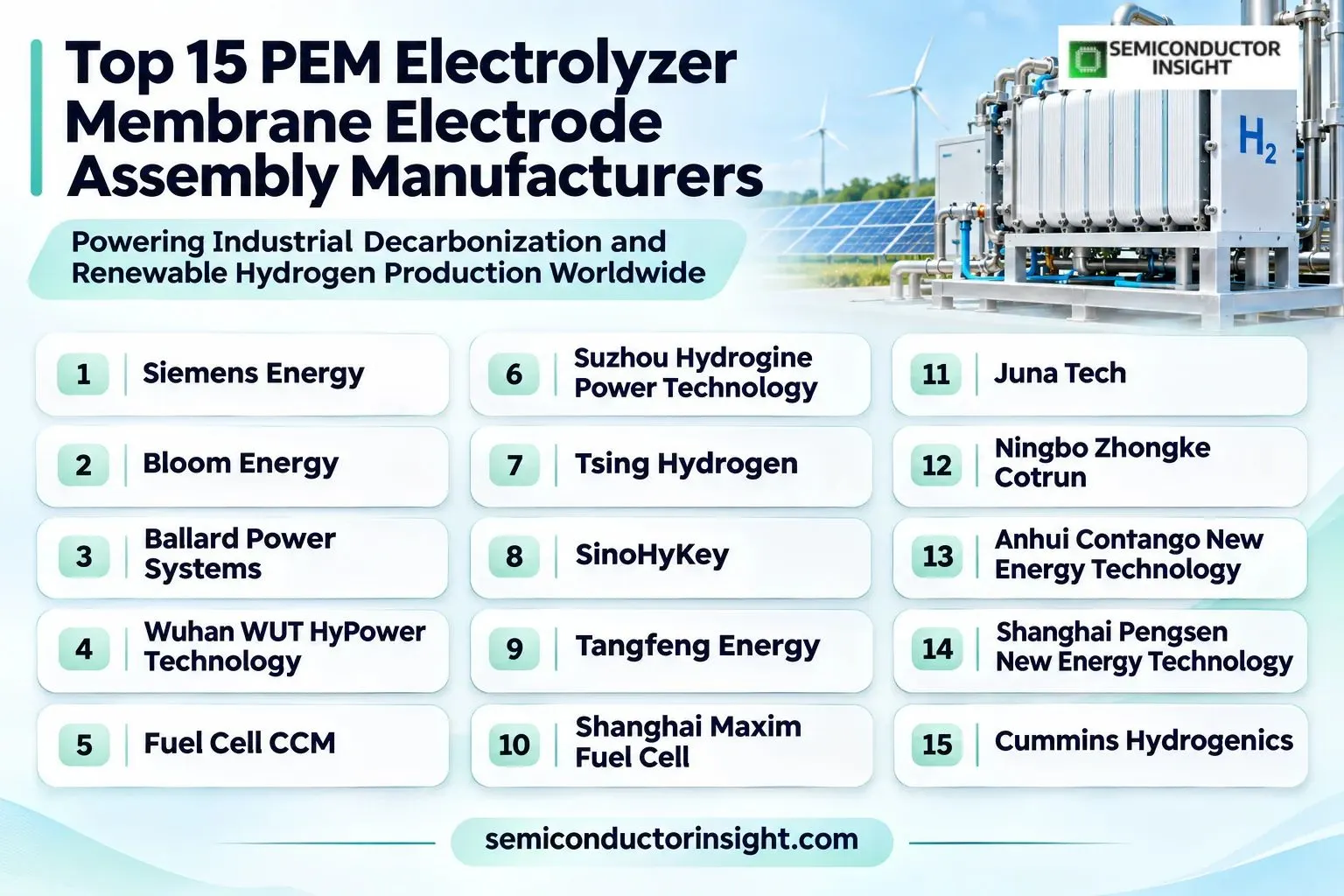
Top 15 PEM Electrolyzer Membrane Electrode Assembly Manufacturers Powering Industrial Decarbonization and Renewable Hydrogen Production Worldwide
PEM electrolysis water membrane electrode market centres on the manufacture of membrane electrode assemblies (MEAs), catalyst-coated membranes (CCMs), electrocatalysts and associated functional layers used in proton exchange membrane water electrolyzers. These components form the electrochemical reaction zone where water is split into hydrogen and oxygen. Their design directly influences hydrogen output, electrical efficiency, operating pressure, durability and stack replacement intervals.
- The market is moving beyond conventional electrode fabrication towards precision coating, lower iridium loading, larger active areas and automated roll-to-roll production.
- In May 2026, the US Department of Energy updated its PEM electrolysis technical targets, including a target of 0.5 mg/cm² total platinum-group-metal content and stack performance of 3.0 A/cm² at 1.8 V per cell.
- These benchmarks are particularly relevant to manufacturers seeking to reduce precious-metal consumption without compromising operating life.
Siemens Energy – Scaling Industrial PEM Stacks Through Automated Membrane Processing
Siemens Energy occupies an important position in the industrial PEM electrolysis value chain through its Elyzer product portfolio and large-scale stack manufacturing operations. Its Berlin gigawatt-scale electrolyzer factory produces stacks for industrial hydrogen projects, with the company reporting experience from more than 500 Elyzer P-300 stacks and over 350,000 operating hours. The P-300 has a power demand of 17.5 MW and can produce approximately 335 kg of hydrogen per hour.
A major 2026 development is the commercial introduction of the Elyzer P-360. Launched in October, this pressurised PEM platform is designed to operate at up to 10 bar and produce as much as 920 kg of hydrogen per hour in a 50 MW configuration. Its manufacturing development also involves direct PFSA membrane coating, automated quality inspection and scalable stack assembly. These capabilities place Siemens Energy in a strong position to influence the industrialisation of membrane-electrode and stack manufacturing.
Bloom Energy – Solid Oxide Expertise Adds a Different Technology Benchmark
Bloom Energy is relevant to the wider electrolyzer landscape, although its hydrogen-production platform is based on solid oxide electrolysis rather than PEM technology. Its inclusion is therefore best understood as an adjacent technology competitor, not as a direct PEM membrane-electrode manufacturer.
The company’s installation at NASA Ames Research Center demonstrates the scale of its alternative approach. The 4 MW Bloom Electrolyzer is designed to produce more than 2.4 tonnes of hydrogen per day, with the company reporting 20-25% higher hydrogen production per megawatt than commercially demonstrated lower-temperature PEM and alkaline systems under its stated comparison. Its high-temperature architecture operates with steam, making it fundamentally different from a polymer membrane electrode assembly. Bloom’s relevance lies in the efficiency benchmark it creates for PEM developers competing for industrial hydrogen projects.
Ballard Power Systems – PEM Fuel-Cell MEA Experience Supports Adjacent Electrochemical Expertise
Ballard Power Systems has extensive experience in proton exchange membrane fuel-cell technology, particularly in membrane electrode assemblies used in heavy-duty transport and stationary power applications. Its FCgen portfolio includes liquid-cooled and air-cooled stack platforms, with MEA technology refined through more than 45 years of product development.
However, fuel-cell MEAs and PEM water-electrolysis CCMs operate under different electrochemical conditions. Ballard’s established strength is in hydrogen-to-electricity conversion, rather than a publicly verified commercial PEM water-electrolysis MEA product line. Its November 16, 2026, Q3 results also highlighted the company’s expansion into a broader hydrogen ecosystem following its GeoPura acquisition. This makes Ballard a relevant adjacent technology participant, particularly for understanding catalyst, membrane and electrode manufacturing expertise, but it should not be ranked as a direct PEM electrolyzer CCM supplier without additional product evidence.
Wuhan WUT HyPower Technology – Building Scale through CCM and MEA Industrialisation
Wuhan WUT HyPower has developed its position around the production of membrane electrode assemblies and catalyst-coated membranes for PEM fuel cells and water electrolyzers. Its technology portfolio includes independently developed CCM membrane electrodes and work on high-efficiency water-electrolysis electrodes.
The company’s publicly reported manufacturing history includes an automated production line that increased total production capacity by more than five times after its industrialisation programme. Its technology disclosures also report membrane-electrode operating life of up to 18,000 hours for a product generation. The company has stated that it has shipped more than 2 million MEA pieces to customers in 16 countries. This combination of manufacturing experience, international shipments and electrolyzer-specific development makes WUT HyPower an important Chinese component supplier to monitor.
Fuel Cell CCM – Custom Electrode Engineering for Different Electrolyzer Configurations
Fuel Cell CCM, associated with Hangzhou Wujang Technology, focuses on customised membrane electrode assemblies and catalyst-coated membranes for fuel-cell and electrolyzer applications. Its product portfolio includes PEM water-electrolysis membrane electrodes, electrolyzer MEAs, hydrogen-oxygen fuel-cell MEAs and direct-methanol fuel-cell components.
Its differentiation is based on configuration flexibility rather than a publicly disclosed gigawatt-scale production figure. Customers can specify electrode dimensions, membrane thickness, catalyst loading and different MEA constructions. The company describes both three-layer CCM structures, where catalysts are coated directly onto the proton-exchange membrane, and five-layer MEAs incorporating additional functional layers. This flexibility is useful for electrolyzer developers that need to evaluate alternative membrane and catalyst combinations during stack design and validation.
Suzhou Hydrogine Power Technology – Roll-to-Roll CCM Production Targets Industrial Consistency
Suzhou Hydrogine Power Technology has developed a substantial component-manufacturing proposition around PEM electrolyzer CCMs and MEAs. Its disclosed production setup includes four R&D and manufacturing locations, approximately 10,000 square metres of facilities, two catalyst production lines and two automated direct-coating and MEA assembly lines.
The company’s published technical specifications report annual catalyst-production capacity of 2,000 kg and MEA manufacturing capacity of up to 2 million pieces. Its roll-to-roll coating process can reach 5 metres per minute, with catalyst-loading distribution standard deviation below 1%. For PEM water electrolysis, it reports an iridium loading of 0.5 mg/cm² for batch production and a stack performance benchmark of 1.74 V at 2 A/cm², alongside an expected service life of 50,000 hours. These are manufacturer-reported specifications, making independent validation and test conditions important when comparing products.
Tsing Hydrogen – SPE Electrode Development and Continuous Catalyst Synthesis
Tsing Hydrogen is developing its position through solid polymer electrolyte (SPE) water-electrolysis catalysts and membrane electrode technologies. Its portfolio includes SPE electrolysis MEAs, electrocatalysts, hydrogen fuel-cell catalysts and a continuous catalyst-synthesis production line.
The company’s approach focuses on integrating active catalytic materials with the polymer electrolyte membrane so that the membrane-electrode structure performs both separation and electrochemical reaction functions. Its continuous production concept is relevant to manufacturers seeking greater catalyst consistency and repeatability between batches. Tsing Hydrogen also promotes ultra-low platinum-loading MEA technology, connecting its fuel-cell materials experience with its water-electrolysis development programme. Its product portfolio demonstrates participation in the core materials segment, although publicly available information does not provide a verified annual PEM-electrolysis MEA production capacity.
SinoHyKey – Precision Patch Coating and Precious-Metal Utilisation
SinoHyKey differentiates itself through selective catalyst coating, particularly its double-sided patch-coating approach. Instead of applying expensive catalyst over the entire membrane surface, the company selectively coats the reaction areas required by the final assembly. This approach is intended to reduce precious-metal wastage when the CCM is fitted into its frame.
Its published manufacturing specifications include roll-to-roll CCM capacity exceeding 300,000 m² annually, coating speeds above 3 linear metres per minute and a maximum coating size of 400 × 280 mm. The company also reports a production yield of up to 99.95%. Its technology platform is primarily associated with fuel-cell CCM and MEA production, while its technical information indicates that oxygen-evolution-reaction technology can be integrated into CCM formulations. This makes its coating expertise relevant to PEM electrolysis development, although specific electrolyzer qualification data should be distinguished from its established fuel-cell product portfolio.
Take a Quick Glance at Our In-Depth Analysis Report: https://semiconductorinsight.com/report/pem-electrolysis-water-membrane-electrode-market/
Tangfeng Energy – Low-Iridium Formulations and Large-Area MEA Development
Tangfeng Energy is developing PEM water-electrolysis MEAs through catalyst formulation, membrane design and manufacturing-process integration. Its product portfolio includes electrolysis MEAs, fuel-cell MEAs and catalysts for PEM water electrolysis. A particularly relevant technical feature is its development of iridium-based catalysts with primary particle sizes of approximately 3-4 nm, intended to improve oxygen-evolution activity and catalyst utilisation.
The company’s PEMWE product information identifies active areas ranging from 25 cm² to 6,000 cm² and an iridium-loading specification of 1.0 mg/cm². It also reports hydrogen content in oxygen of no more than 0.01% under a stated differential-pressure test condition of 3 MPa and 0.5 A/cm². In August 2026, Tangfeng’s exhibition profile highlighted its low-iridium water-electrolysis MEA portfolio and reported more than 120 patents related to catalysts and key materials. Its emphasis on customised active areas and catalyst development is relevant to stack manufacturers seeking application-specific electrode designs.
Maxim Fuel Cell – High-Volume MEA Manufacturing With Electrolysis-Specific Specifications
Shanghai Maxim Fuel Cell has a particularly relevant position in the membrane-electrode segment because it manufactures MEAs for both hydrogen fuel cells and PEM hydrogen electrolyzers. The company reports two automated MEA production lines with combined annual capacity exceeding 1.5 million pieces, supported by dedicated R&D, material-testing and manufacturing facilities.
Its electrolysis MEA specifications include membrane thickness options of 80, 120 and 175 μm, customisable active areas from 1 cm² to 1,800 cm², platinum loading below 0.5 mg/cm² and iridium loading below 1 mg/cm². The company reports operating benchmarks of 1.746 V at 2 A/cm² using a 120 μm membrane and a targeted service life exceeding 40,000 hours. Its 50 Nm³/h PEM water-electrolysis demonstration project in Xinjiang used a 500 cm² active-area MEA and completed 168 hours of high-pressure reliability testing. This provides a more application-specific reference than fuel-cell-only manufacturing capacity.
Juna Tech – JP Series MEAs Push Lower Catalyst Loading for Commercial Stacks
Juna Tech has established a specialised position in PEM electrolysis MEAs through its JP series, which focuses on lower precious-metal loading and industrial-scale manufacturing. Its published product information reports cathode platinum loading of 0.35 mg/cm² and anode iridium loading of 0.86 mg/cm². The company has also described large-format MEAs measuring 500 × 600 mm, addressing the need for larger electrode surfaces in industrial electrolyzer stacks.
Its first-generation JP-30000 product achieved a reported 1.84 V at 2 A/cm², while its improved second-generation design reached 1.75 V at the same current density in laboratory testing. The company also reported more than 1,900 hours of stable laboratory operation, with degradation controlled within 5 μV/h. Its manufacturing development includes a 100 MW MEA production line and a 10-20 Nm³/h electrolyzer testing platform. In August 2026, Juna Tech showcased its JP-PEM CCM alongside AEM and alkaline electrode products, highlighting its expanding focus on industrial hydrogen components.
Ningbo Zhongke Cotrun – Combining Nanocatalysts with PEM Membrane-Electrode Manufacturing
The company name in the supplied list appears to correspond to Ningbo Zhongke Cotrun New Energy Science Technology, which publicly identifies itself as a developer of hydrogen-energy core materials and membrane electrode assemblies. Its activities cover PEM fuel-cell and water-electrolyzer MEAs, together with precious-metal nanocatalysts and electrocatalytic materials.
Its published company information lists annual MEA output of approximately 20,000-60,000 m² and annual precious-metal nanocatalyst output of 0.8-4 tonnes. It also reports nine invention patents relating to its platinum-based and iridium-ruthenium alloy catalyst technologies. Participation in the T/CRES 0030-2025 group standard is another relevant industry development. The combination of catalyst synthesis and membrane-electrode production gives the company opportunities to control more of the material supply chain rather than relying exclusively on externally sourced catalyst formulations.
Anhui Contango New Energy Technology – Advancing Hydrogen Crossover Control through Electrode Design
Anhui Contango has developed a broad hydrogen-component portfolio spanning PEM and AEM water electrolysis, fuel-cell materials, catalysts and membrane electrode assemblies. Its earlier company disclosures described production and R&D operations in Hefei and Shanghai Lingang, together with component supply to more than 30 domestic and international customers.
A notable 2026 development is its patent application published on 28 October, covering a hydrogen-removal layer and a related proton-exchange membrane electrode for water electrolysis. The disclosed formulation uses 10-20 parts metal oxide, 10-20 parts catalyst and 2-10 parts ionomer by weight. The design is intended to reduce hydrogen content in oxygen on the anode side, addressing an important crossover and product-gas safety consideration. Research published on PEMWE MEA durability has also documented testing of Contango-supplied assemblies using 0.5 mg/cm² Pt/C at the cathode and 1.0 mg/cm² iridium black at the anode. These developments demonstrate the company’s involvement in both component supply and electrochemical performance research.
Shanghai Pengsen New Energy Technology – Connecting Catalysts, MEAs and Small-Scale Electrolyzer Systems
The supplied company name appears to differ from the public-facing name Shanghai Pengsen New Energy Technology. Its official website identifies products covering CCMs, MEAs, supported anode catalysts, PEM water-electrolysis electrodes, test fixtures and small-scale PEM electrolyzers.
The company’s approach is notable because it extends beyond selling an individual membrane electrode. Its portfolio connects catalyst development, electrode fabrication, stack engineering and small-scale hydrogen-production test systems. It also describes collaborative PEM electrolysis development with a Fudan University research team. This gives the company a role in component evaluation and application testing, particularly for customers developing or validating new stack designs. Its website indicates that its test platforms can also support AEM electrolysis and carbon-dioxide-reduction research. Publicly available sources do not disclose a verified annual MEA production capacity, so its competitive position is better described through its integrated development and testing capabilities.
Cummins Hydrogenics – Industrial PEM Electrolyzer Experience Meets a Critical 2026 Safety Review
Cummins, through its Accelera and Hydrogenics businesses, has been an established industrial PEM electrolyzer supplier. Its HyLYZER 500 platform is rated at 2.5 MW and can produce approximately 45 kg of hydrogen per hour, equivalent to 500 Nm³/h. The published specifications include 30 barg hydrogen delivery pressure, 99.999% hydrogen purity and a dynamic operating range from 7% to 100%. The World Bank’s electrolyzer supply assessment also identifies manufacturing capacity at Cummins facilities in China, the United States and Spain.
However, a significant 2026 development needs to be included in any current assessment. In September 2026, Hydrogenics issued a stop-use recommendation to customers of HyLYZER electrolyzers following a review of operational data. Cummins confirmed in its November 2026 quarterly reporting that a formal recall had not been initiated and that it was evaluating potential modifications. The issue is commercially important because it places additional emphasis on safety validation, operating data and system-level safeguards. Cummins remains a significant PEM system participant, but its current product status should be monitored before describing its installed fleet as operating normally.

Comments (0)