

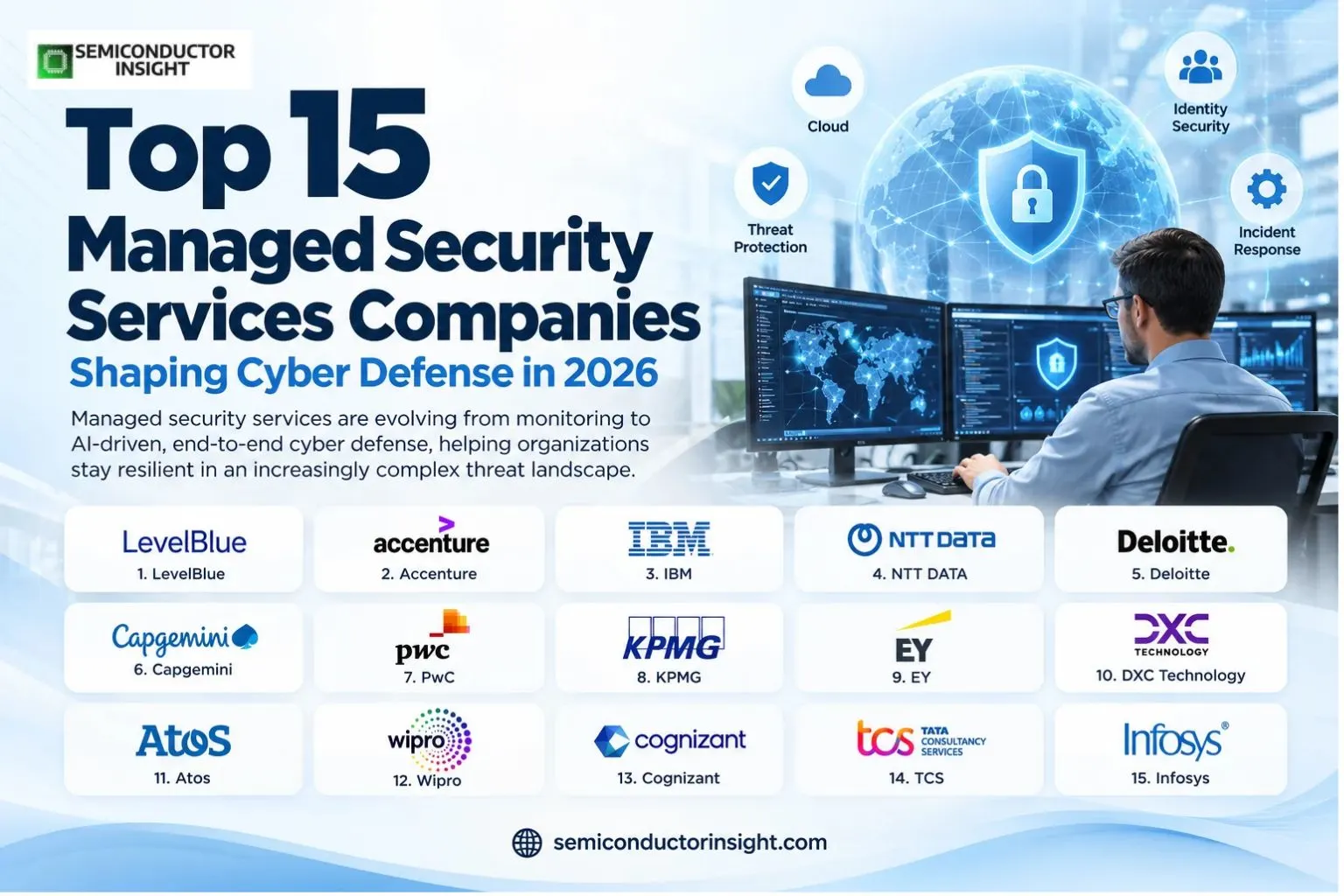
Top 15 Managed Security Services Companies Shaping Cyber Defense in 2026
Managed security services have moved beyond round-the-clock security monitoring. In 2026, organizations increasingly need external security partners that can connect threat intelligence, cloud protection, identity management, incident response, vulnerability remediation and AI-assisted investigations into a coordinated defense system. A managed security services provider (MSSP) can operate a company’s security operations centre (SOC), manage selected security technologies, investigate suspicious activity and help contain incidents without requiring the customer to build every capability internally.
The market is also changing as businesses adopt generative AI, autonomous agents, hybrid cloud infrastructure and connected industrial systems. These environments create new security questions: Can a provider identify an attack moving between cloud applications and employee identities? Can it investigate suspicious AI-agent behaviour? Can it protect operational technology without disrupting production? These capabilities increasingly distinguish major providers from vendors that offer monitoring alone.
LevelBlue – Expanding Pure-Play Managed Security through Integrated Threat Response
Strategic focus: Managed security operations, incident response and enterprise resilience
LevelBlue stands out in the managed security services market because its proposition centres on dedicated cybersecurity operations rather than treating security as a small component of a broader IT outsourcing contract. Its capabilities span managed detection and response (MDR), threat intelligence, digital forensics, incident response and security advisory services. This combination is particularly relevant for enterprises that need both continuous monitoring and access to specialist investigators when an incident escalates.
- A significant development arrived on 21 October 2026, when SentinelOne named LevelBlue its global exclusive delivery partner for Wayfinder services.
- The partnership brings together SentinelOne’s AI-powered security technology and LevelBlue’s managed-service delivery capabilities, including MDR, threat hunting and incident readiness and response.
- LevelBlue also reported in September 2026 that its updated cybersecurity controls drew on more than 9,000 incident response investigations.
- These case-based insights can help translate recurring attack patterns into practical security measures rather than relying solely on alerts generated by software.
Why it matters: LevelBlue’s position is strengthened by the ability to connect prevention, investigation and recovery. For multinational businesses, that integrated model can reduce the difficulty of coordinating separate vendors for threat monitoring, digital forensics and incident management.
Accenture – Turning Managed Security into AI-Assisted Enterprise Defense
Strategic focus: AI-enabled managed security, extended detection and response, and risk operations
Accenture’s strength lies in connecting cybersecurity operations with enterprise technology transformation. Many large organizations operate a mixture of legacy security tools, public-cloud platforms, identity systems and industrial infrastructure. Managing these environments requires more than deploying a monitoring platform; it involves integrating telemetry, standardising incident workflows and ensuring that security controls remain aligned with business operations. Accenture’s managed security capabilities are designed for this complex enterprise environment.
- In March 2026, Accenture introduced Cyber.AI, powered by Anthropic’s Claude models, and described a cybersecurity practice with more than 30,000 cybersecurity professionals. The offering includes Agent Shield, designed to help organisations identify, monitor and govern AI agents.
- In a separate March 2026 development, Accenture and Microsoft expanded capabilities for Adaptive Managed Extended Detection and Response (MxDR), bringing agentic AI and analytics into Microsoft Security environments. Accenture and ServiceNow subsequently launched managed-security and AI-powered risk-migration services on 29 June 2026, addressing the challenge of modernising legacy risk platforms.
Why it matters: Accenture is well positioned where managed security is part of a wider transformation programme. Its opportunity is to help clients consolidate fragmented security operations while adding oversight for AI applications, third-party risk and operational technology.
IBM – Connecting Autonomous Security with Regulated Enterprise Environments
Strategic focus: Managed security, AI-driven remediation, cyber resilience and regulated industries
IBM’s managed security proposition is relevant to organizations that must protect complex applications, sensitive information and critical infrastructure while meeting demanding governance requirements. Its value is not limited to detecting suspicious activity. IBM can combine cybersecurity consulting, technology integration, incident response and managed operations with expertise in hybrid-cloud and legacy enterprise environments.
- On 15 April 2026, IBM announced new cybersecurity measures to address risks associated with frontier AI models, including IBM Autonomous Security, a service using AI agents to help automate vulnerability remediation. This reflects an important change in security operations: providers must increasingly shorten the time between discovering a weakness, establishing its business impact and taking corrective action. On 24 September 2026, IBM UK announced the acquisition of Logiq Consulting, adding specialist capabilities in security assurance, secure systems engineering and secure managed services for defence, critical national infrastructure and public-sector customers.
NTT DATA – Scaling Managed Security Through a Global Cybersecurity Alliance
Strategic focus: Global security operations, AI governance, cloud defense and enterprise integration
NTT DATA’s competitive advantage comes from its ability to connect managed cybersecurity with large-scale IT infrastructure, cloud services and digital transformation. For multinational companies, this matters because security events rarely remain confined to one application or geography. A compromised identity can lead to cloud access, data theft and disruption across multiple business units. A provider must therefore combine platform expertise with operational processes that can work across different environments.
On 20 August 2026, NTT DATA and Palo Alto Networks announced a multiyear strategic alliance focused on secure AI adoption, cyber resilience and cybersecurity modernisation. The companies highlighted a delivery ecosystem backed by more than 2,000 Palo Alto Networks-certified professionals and set a target of US$1 billion in joint business by the end of 2029. That target is a forward-looking commercial ambition, not a completed result. The alliance is important because it combines security technology with NTT DATA’s consulting, engineering and managed-service capabilities.
Our most recent updated related study is available for free at this link: https://semiconductorinsight.com/report/biometric-security-ssd-market/
Arctic Wolf – Bringing Agentic AI into Day-to-Day Security Operations
Strategic focus: Managed detection and response, AI-assisted investigations and exposure management
Arctic Wolf is a significant specialist in security operations, particularly for organizations that need continuous monitoring but lack the budget or expertise to operate a large internal SOC. Its Aurora platform combines managed detection and response, threat investigation, exposure management and incident response. The company’s recent developments focus on increasing the amount of security work that can be handled automatically while retaining human oversight for uncertain or high-impact decisions.
CrowdStrike – Moving Managed Detection and Response Into the Agentic Security Era
Strategic focus: Managed endpoint defense, threat hunting and AI-assisted response
CrowdStrike has established a strong position in managed detection and response through Falcon Complete, which combines endpoint and cross-domain telemetry with expert investigation and remediation. The service is particularly relevant when an organization wants to reduce the burden of managing endpoint alerts, investigating suspicious behaviour and coordinating response across a distributed IT estate.
In March 2026, CrowdStrike introduced Agentic MDR, expanding the role of intelligent agents in security investigations and response workflows. In a separate collaboration announced on 16 March 2026, CrowdStrike and NVIDIA reported internal testing that demonstrated investigations up to 5 times faster and more than 3 times higher triage accuracy for specified benign-event classifications. Those results refer to the companies’ stated testing conditions, rather than guaranteed performance across every customer environment. On 1 September 2026, CrowdStrike also introduced Falcon Guardian to provide visibility and runtime controls for AI agents operating on endpoints.
Orange Cyberdefense – Combining Threat Intelligence With Managed Cloud Detection
Strategic focus: Intelligence-led security, managed detection and response, and hybrid-cloud defense
Orange Cyberdefense differentiates itself through the combination of managed security operations and dedicated threat-intelligence capabilities. This is valuable for enterprises that need to understand not only whether a suspicious event occurred, but also the attack techniques involved, the potential impact and the actions required to contain it. Its position is particularly relevant in Europe and for multinational businesses managing security across different regulatory environments.
Sophos – Extending Managed Detection across Existing Security Environments
Strategic focus: 24/7 MDR, incident response and protection for organisations with limited security staffing
Sophos has a strong role in managed detection and response for organizations that need specialist security coverage without maintaining a fully staffed internal SOC. Its service combines threat hunting, investigation and containment, with different levels of incident-response responsibility depending on the service tier. An important feature is its ability to support some third-party endpoint protection environments, which helps organizations avoid replacing every existing security product before adopting managed detection.
In May 2026, Sophos reported that its MDR service was protecting 40,000 customers worldwide, with customer numbers growing by 39% year over year. The company also reported production results from a full year of agentic operations, describing a model in which AI handles large volumes of routine investigation work and experienced analysts focus on complex threats. Sophos MDR Plus provides a higher level of response support, including direct incident-response assistance and a stated breach-protection warranty of up to US$1 million for qualifying customers, subject to the applicable terms.
Kyndryl – Unifying Network Operations and Security Defense
Strategic focus: Managed security for mission-critical IT, network visibility and cyber resilience
Kyndryl’s position in managed security is closely tied to its experience operating complex, mission-critical enterprise technology. Large organizations cannot always separate security operations from network availability, application performance and infrastructure resilience. A suspicious network event, for example, may require security analysts and infrastructure specialists to work together before a system can be isolated or restored safely.
On 19 February 2026, Kyndryl launched its first Cyber Defense Operations Center in Bengaluru, India. The centre brings network operations and security operations into one operating model, combining real-time visibility, collaborative analysis and AI-enabled assessment services. Its stated scope includes advisory, design, implementation and managed operations. Kyndryl’s October 2026 newsroom also reported the opening of a new Cyber Defense Operations Center in Paris, indicating further development of this integrated delivery model.
Wipro – Delivering Distributed Security Operations at Enterprise Scale
Strategic focus: Cyber defense centres, managed security infrastructure and hybrid IT protection
Wipro’s managed security services are built around operating security controls for organizations with geographically distributed IT environments. Its service scope includes security monitoring, behavioural analysis, unauthorized-access detection, firewall and antivirus operations, identity and access management, data-loss prevention and penetration testing. This breadth is useful for customers that need a provider to manage both daily security operations and the underlying technologies supporting them.
Wipro states that its Cyber Defense Centers span 16 locations, providing a distributed operating base for managed security delivery. The significance is operational: geographically distributed centres can support service coverage, regional delivery needs and security operations across customer environments. Wipro’s model also emphasises management of IT security infrastructure through security operations centres, rather than restricting the engagement to alerts or endpoint protection alone.
HCLTech – Extending Managed Security Into OT, Identity and Exposure Management
Strategic focus: Managed detection, operational technology security and continuous control assurance
HCLTech’s managed security portfolio is notable for covering areas that are often handled separately by enterprise security teams. In addition to threat detection and incident response, its service scope includes hybrid-cloud security operations, operational technology and industrial control system governance, managed identity, privileged-access management, third-party risk management and continuous compliance monitoring. These capabilities are increasingly important as enterprises connect factories, connected devices and cloud-based business systems.
The company’s service portfolio also includes attack-surface management and vulnerability-management capabilities, including its VERITY offering, alongside red-team services, penetration testing and attack-path simulation. This gives customers options to combine continuous monitoring with work that identifies weaknesses before they are exploited. HCLTech also highlights AI trust implementation, including identity and data protection, adversarial testing and governance for AI infrastructure.
Tata Consultancy Services – Integrating MDR With Enterprise Security Workflows
Strategic focus: Managed detection and response, XDR and unified security operations
Tata Consultancy Services (TCS) approaches managed security as part of a broader enterprise technology environment. Its MDR offering includes security monitoring, incident response, recovery, remediation and threat hunting. A notable feature is the integration of extended detection and response (XDR) with security operations and administrative tasks, helping organisations correlate information from different security technologies instead of relying on separate alert queues.
Deloitte – Connecting Managed Security with Cyber Transformation and Threat Response
Strategic focus: Security operations modernisation, managed detection and response, and cyber risk advisory
Deloitte’s role in managed security combines advisory work, technology integration and ongoing operational support. This combination is important for organisations that need to modernise their security operations while also addressing governance, regulatory obligations and internal risk-management processes. Rather than focusing only on alerts, Deloitte can help clients consolidate tools, redesign security workflows and align technology investments with their risk priorities.
On 13 August 2026, Deloitte India announced an expansion of its strategic partnership with CrowdStrike. The arrangement brings CrowdStrike’s Falcon platform together with Deloitte India’s managed security services and cybersecurity transformation capabilities. The companies cited CrowdStrike’s 2026 Global Threat Report, which reported an average eCrime breakout time of 29 minutes, with the fastest observed instance at 27 seconds. These figures highlight why organizations increasingly need rapid investigation and response capabilities. The partnership is designed to help customers consolidate security tools and improve visibility across endpoints and other domains.
Verizon Business – Bringing Network Intelligence into Managed Detection and Response
Strategic focus: Network-centric threat intelligence, managed detection and response, and incident investigation
Verizon Business brings a network-oriented perspective to managed security. Its capabilities include managed detection and response, threat intelligence, incident response and forensic investigation. This is relevant for organizations that need to examine suspicious activity across network traffic as well as endpoint and cloud signals. Network-level visibility can provide additional context when an attack involves command-and-control traffic, lateral movement or unusual data transfers.
Capgemini – Aligning Managed Cybersecurity with Cloud and Digital Operations
Strategic focus: Enterprise security transformation, cloud protection and managed cyber operations
Capgemini’s relevance to managed security comes from its integration of cybersecurity with cloud, data and broader enterprise transformation programmes. For many organizations, the challenge is not simply a shortage of monitoring tools; it is the difficulty of applying consistent security controls as applications migrate to cloud platforms, business processes become automated and technology estates span multiple countries.
This enterprise integration model is important for managed services because monitoring and response need to reflect how applications are built, deployed and operated. Security controls must be aligned with identity systems, cloud configurations, application development practices and compliance requirements. Capgemini’s wider technology and engineering capabilities give it a foundation for addressing those connected needs, although the precise scope of managed security should be assessed against the service package offered for each engagement. The company reported global operations across more than 50 countries in its 2026 corporate information, illustrating the international delivery context in which its services operate.
AT&T Cybersecurity – Supporting Security Operations across Connected Business Networks
Strategic focus: Network security, threat monitoring and managed protection for distributed environments
AT&T Cybersecurity is relevant to the managed security services landscape because business networks remain a critical source of security signals. Enterprises increasingly operate across offices, remote users, cloud applications, connected devices and external partners. These distributed environments make it important to understand how network access, traffic patterns and security controls interact when suspicious activity occurs.
A managed security model built around connected network environments can help organizations coordinate monitoring and response while reducing the operational burden of managing separate tools. This is particularly important for companies with multiple sites, remote workforces and business-critical connectivity requirements. Buyers should assess the specific AT&T service offering available in their region, including whether the contract covers continuous monitoring, incident response, network protection or a combination of these functions.
What Is Changing the Competitive Landscape in 2026?
The developments across these providers point to a clear shift in the way managed security services are being evaluated. Customers increasingly want measurable operational outcomes, not just a promise of continuous monitoring. Three trends are particularly important.
- Agentic security operations: Arctic Wolf reported that its AI resolved 60% of investigations in its agentic SOC, while CrowdStrike and Accenture advanced AI-assisted investigation and response capabilities.
- The emerging question is how providers validate automated decisions, maintain accountability and escalate uncertain cases to human analysts.
- Security consolidation across platforms: NTT DATA’s alliance with Palo Alto Networks, Orange Cyberdefense’s Microsoft Sentinel integration and Deloitte India’s CrowdStrike partnership show how providers are connecting security platforms with managed delivery.
- Consolidation can simplify operations, but buyers should still check integration coverage, data portability and how response responsibilities are divided.
- Greater focus on resilience and recovery: Incident response, vulnerability remediation, exposure management and backup visibility are becoming more connected to routine security operations. LevelBlue’s incident-investigation-based controls and Arctic Wolf’s 2026 integration with Veeam illustrate the importance of linking threat detection with recovery readiness.

Comments (0)